Category Archives: writing
Still trying to slay that dragon
Don’t be a Perfectionist. It will only lead to procrastination. And you know where that gets you quickly: NOWHERE!! Life’s too short–take a chance, make a mistake. You will still be loved, maybe even more than if you insist on being perfect.
I’ve never been a fan of the telephone. Before caller ID flashed on our television screen, before it flashed on just the telephone display, back when you didn’t know who was on the other end of the line, my husband or one of our daughters would have to answer the damn thing.
As for me picking up the phone and initiating a call? Not unless there was absolutely no other means of communication available.
Apparently I haven’t outgrown this. Yesterday waiting with my mother for her appointment with her cardiologist, I looked across the hall and spotted a fellow DAR member (Darlene) who has just moved back to the area and lacks email or internet service. The only means of remote communication with her is via the telephone. Darlene: I’ve been waiting to hear back from you. Me, vaguely gesturing toward my mother: I’ve been busy, sorry. (I couldn’t very well tell her about my issues with the telephone. The mental health department is right down the hall.)
Was I confident that if I waited long enough I would run into Darlene—who lives thirty miles away from me in another state? No, I’m not that bad. I would have called her. Eventually. When I couldn’t put it off another minute. And I mean minute.
Once again, with our random meeting, I was rewarded for my procrastination.

I remember the first time I procrastinated. Not everyone remembers their first time, I bet. Second grade. My “Stuart Little” book report was due. It wasn’t a written book report. We had to dress up as a character for an oral presentation to the entire class. I pretended to be sick and stayed home from school. After a day spent in bed moaning whenever my mother checked on me, the book report went well, mouse tail and all.
Once upon a time I was a teen. I eagerly awaited the ringing of the phone followed by long conversations when I stretched the curly telephone cord to its ironed length to talk to my friends, especially boyfriends, away from the watchful ears of my parents.
Then something happened and the Perfectionist switch was turned on full-time.
I have analyzed my extreme dislike of the telephone. Clearly I am more comfortable with the written word. I can edit my response, I can let it ferment, I can make certain that all information is accurate. I can be a perfectionist when I talk to people in writing. On the phone (or in person), who knows what will—or has—come out of my mouth.
My writing battle with perfectionism and procrastination should be well known to you by now. I still am trying to slay that dragon.
A long way to go before the butterfly emerges
Over the past two days I have written the following: 1) a confession by a murderer; 2) an abduction; 3) a car crash; and 4) a suicide—all of which transpire in the matter of about an hour or less. This is all part of the transformation of my novel, Anne, from women’s fiction to a murder mystery. Though I know it won’t be long until I have to rework the parts of the novel I’ve written in the past, for now I am having fun adding new scenes.
Yikes. Did I just say that I am having fun writing about people committing murder? The “real” me, not the “writer” me, does not like to think about people (or pets) dying. Who does? So how am I able to kill off my characters without shedding a tear? Heartless, I suppose. But only when it comes to fictional characters. I’d be remiss if I didn’t give some credit to my fellow bloggers on Thursday Night Writes who have paved the way with their own heartless stories of murder and mayhem.
There’s still one more death to go but that one was written a few years ago as part of Olivia. Though originally the result of an accident, the death could benefit from a few tweaks to make it more sinister, maybe a full-fledged murder!
I’m excited to be reworking what I now realize was a flat story about family relationships into an exciting murder mystery, albeit not your typical Tana French mystery with a plethora of suspects. At this point in the writing I do not have any suspects, other than the guilty party. Naturally I’m concerned that the “zero suspects” approach will be less than satisfactory to “my” readers. But I remind myself that it’s still early in the process—the chrysalis has a long way to go before the butterfly emerges.
A lack of suspects isn’t my only concern with “Anne.” I’m afraid that I’m front-loading the novel with the stuff that keeps readers of murder mysteries turning the pages.
Did I mention that I don’t have a sleuth? And many miles to go with Anne?
Tickled by Ticks
So that I wouldn’t end up boring our faithful readers with a regurgitation of a prior post, tonight I reread my recent blog posts. (Topics I was considering: genealogy, NO; my in-progress murder mysteries, NO; whining about my inability to finish any of my writing projects, NO. I wasn’t sure what was left to write about.) This followed my second shower of the day, a necessity after the excitement of finding two ticks crawling on my body, with no way to tell if there were any nestling in my hair.
Generally my husband handles all of the spiders and other unsavory creatures in the house. He was off grocery shopping. Lousy timing on his part.
My reaction to the discovery of the first nasty, vile, disgusting creature crawling on my upper arm was to flick it off with the tips of my fingers. He landed on our multi-colored granite counter and by the time I grabbed a paper towel and turned back to the counter, he was scampering away. I was faster and nabbed him with the paper towel (there is no way you can squish those buggers) then flushed him down the toilet.
I texted my daughter so that she would know that one of her ticks had traveled twenty-two miles home with me and she should check her children then settled on the couch to get caught up on the political news I missed today.
Just as I was about to take another bite of my peanut butter and jelly covered English muffin, I felt the telltale tickle on my leg of another tick. (Often those tickles are just phantom ticks–tricks of your mind.) I jumped up and flicked it onto the rug where it was extremely invisible. But I wasn’t. It found my bare foot. Flicked onto the rug again. Back onto my heel. (I may have screamed but since no one was here to hear it, we’ll never know for certain.) Flicked onto the hardwood floor where I could see it. I managed to capture him with a piece of notebook paper.
I flushed him as well. And watched him get sucked down the toilet into the pipes and out to the septic tank. That’s the plan, anyway. You can bet I won’t be using that toilet for a few days.
(Topics I wasn’t considering but wrote about anyway: ticks, YES!)
UPDATE: At exactly 4:52 a.m. I was startled awake by something crawling on my face. TICK!! I bolted out of bed, smashed at my face while frantically pounding the bed. I couldn’t see anything on the bed so I ran into the bathroom thinking it was still on my face. I flapped my bangs but didn’t see anything. I returned to bed and surprisingly fell back asleep. When I woke up a few hours later I found a dead spider on the bathroom sink. Not just dead but almost petrified.

Spider who Fell from the Skylight
Is it possible he fell from the skylight over my bed and landed on my face? If this were a novel I’d say of course it is, anything is possible.
Decline and Fall
I was thinking the other day about the dying institution of marriage. The mystery I’m writing involves an inheritance which, in turn, hangs on the outdated concept of legitimacy.
Mind you, I’m all for dropping any stigma (if any remains) on being born “out of wedlock.” But honestly, older people, if you had been asked in your youth what major changes might occur in your lifetime, would you have predicted indifference to the presence or absence of marriage vows? Of substituting “if it works out” for “till death do us part”?
Anyway, I sat down and tried to come up with other dying institutions that I had thought would live forever. Lo and behold, nearly every one that occurred to me involved reading and writing — one of the core complexes of life for likely readers of this blog.
I had occasion to write something down for one of my grandsons not long ago. He frowned at the note – I thought my handwriting was the problem. I got no farther than, “Oh, sorry, that word’s….,” when he rushed to reassure me. “Oh, it’s okay, Grandma. I can read cursive script.” He can’t write it, though. The schools now teach printing, not writing, because who writes anything longer than a grocery list anymore?
Letters (in the sense of correspondence) no longer exist. Their factual content is now transmitted through email. Their creative, imaginative, playful and literary qualities are just gone. (Worse: their playful qualities are have shrunk and hardened into emoticons created by some wretch chained in an office cubicle.) Email is to letter-writing as tweeting is to thinking.
Now that apps have homogenized all forms of information transfer, “writing down” is no longer a distinct activity with defined functions in society. Do our grandchildren get the point of “The Typewriter,” the famous piece of music that duplicates the rhythm of typewriter keys, the ding of the bell at the end of the carriage and the slam of the carriage return? This tune, without comment, once conveyed “composition” or “news reporting.” (Click the link to hear the Vienna Philharmonic play it, with percussionist Martin Breinschmid on the typewriter.)
Editors are as the dodo. I am still unpublished, but I hear by the grapevine that publishers no longer employ such people. Or if they do, the evidence has vanished from much of what is published. My blogging colleague Eleanor Ingbretson recently read a mystery involving that nasty marine animal, the leech. It was spelled “leach” throughout. WTH. You know what I meant. (That link will take you to the blog of the same name, where you will find fellow mourners of the craft of words.)
(Subcategory of the above: use of the subjunctive. And don’t get me started on “may” and “might.”)
Paper is gone, too, or at least unnecessary. I think text is made of electrons now, but I really haven’t the faintest idea. Vandals burned the monastery libraries of Europe; hackers may yet wipe out War and Peace.
We have lived in the age of the Antonines, and Commodus is upon us. (Don’t bother me with questions when I’m being crotchety. Google it.)
I love my ladies
Spoiler alert…I’m indulging in some writer whining. Again.
Tonight, a remake of a movie that holds a special place in my heart, “Dirty Dancing,” airs on ABC. Among many other negative reviews, TV Guide had this to say: “In an era where actual dirty dancing…has gone so mainstream that Katie Couric knows how to do it, this adaptation does not tango with the present…”
And yet, knowing that it will be a huge disappointment, I will watch it.
I’ve registered for the 2017 New England Crime Bake. Without allowing myself to consider what it would entail, I paid the extra $49 for the Agent and Editor Program, which includes critiques of a pitch and a query as well as the opportunity to pitch to an agent.
Initially I thought that I should pitch my current project, Gabby, at the conference. She’s nowhere near ready but if I focus on her I might be able to whip her into shape by November. What does pitching Gabby do to my plans for a trilogy that takes place in Woodbury, NH?
If I am committed to creating a trilogy, I am pretty certain it doesn’t make sense to pitch the novel that is chronologically the last one (Gabby). I am also pretty certain that it would be incredible if at the Crime Bake I could pitch a cohesive trilogy.
The truth is that in addition to Gabby, my other rough drafts are not ready to be pitched. Anne, Olivia, and Claire. Yes, that is four novels not three but Anne is begging to be joined with her daughter Olivia, and if I acquiesce, I will have a trilogy. But Anne has no murder. Or murderer. My list of characters reveals that I can change a death to a murder and provides a potential murderer. That was easier than I expected. Now for some suspects…
However, that is not the biggest issue with Anne and Olivia. It’s somewhat like Katie Couric and dirty dancing. The premise works for 1993, when it is set, but not so much in 2017. Will it be relevant to readers?
Claire is next. She has some flexibility as to when she takes place but as a senior citizen she is aging the longer she waits. Luckily, she is endowed with a murder, murderer and some suspects. And a man in the attic is timeless.
So now I’ve created a three-headed monster: Anne/Olivia, Claire, Gabby. Do I put Gabby aside and return to Anne/Olivia because she started all of this? Is what I’ve invested hours of time and brain cells into worth resuscitating? Or am I trying to breathe life into a bunch of Word files that I would be better off jettisoning into the Trash folder?
Funny how I can hear a little voice in my head, let’s call him John, giving me some advice—most likely because I have posed this same question to my writing group numerous times. Don’t worry about a trilogy, just focus on getting one novel in good shape so you can pitch it in November. Burn those early writings. They were just practice. And that’s just some of what I assume his advice would be.
But I love my ladies.
I’m (still) a Genealogy Junkie
My road down the path to becoming a genealogy junkie started innocently enough, as I imagine it does for many addicts. (See my blog post of September 13, 2016, A Pilgrim in the Family.) My husband’s family is my drug of choice.
When my research revealed that Bailey Clough, my husband’s fourth great-grandfather, of Lyman, NH, fathered Helen Luella Clough at the age of sixty-nine, I knew I had some digging to do. I located Historical Sketches of Lyman New Hampshire, written by E. B. Hoskins and published by Charles P. Hibbard in Lisbon, NH, in 1903.

Historical Sketches of Lyman New Hampshire
If these sketches are brief and contain little of deep interest, it is because Lyman is a small farming town, and its history has been quiet and peaceful, with no events of a remarkable character.
I smiled when I read this. It is how I envision Woodbury, NH, home to Gabby, Anne, Olivia, Em, Lexi Rae, Claire, Louise. Nothing has happened here of a remarkable nature. Until now.
Finally, on page sixty, I found the Clough family: William Clough served in the French and Indian war three years, was captured by the foe and carried to France, where he was kept a year or more. He entered the Revolution without enlistment, and was at the battle of Bunker Hill. His children were, namely: Zacheus, Enoch, Bailey, Cyrus, Abner, Jeremiah, Elizabeth, and Dorcas.
Turn the page and there’s virile Bailey: Bailey Clough, son of William, married Susannah Smith, sister of Reuben Smith, Nov. 28, 1799. Their children were, namely: James, born in 1801; David, born in 1803; Darius, born in 1809; Benoni, born in 1812; Chester Hutchins, born in 1822; Susan; and Bailey.
Aha. Bailey had a son with the same name. And Helen isn’t listed among the offspring of Bailey Senior. The son must be the father. If the children are listed in order of birth date, which the author generally did, then Bailey would have been born after 1822. As Helen was born in 1838 or 1839 or even 1841 (I think she lied about her age so that she wouldn’t appear to be ten years older than her second husband), it’s hard to believe that her father was the younger Bailey.
I scanned all of the biographies in the history hoping to find something to link Bailey Clough, senior or junior, and the daughter, Helen, and the wife, Lydia. Nothing there, nothing in Ancestry.com, nothing in Find A Grave, nothing in Wikitree. I can’t believe I’ve reached a dead end in the nineteenth century.
I’m mentally exhausted. And ready for a trip to another cemetery!!
PS After writing this post I was itching to resolve the Bailey Senior/Junior mystery. I returned to Ancestry.com and looked at some other family histories (the least reliable source of information) that I had ignored earlier. Some more research and I am closer to saying that Junior was married to Lydia Stevens and was the father of not just Helen Luella but also Martha Ella. (And I get complaints about the names of my characters!) Bailey Junior was born in 1817, making him old enough to be Helen’s father. He died around the time that Martha was born so it is conceivable that Helen went to live with relatives, as the 1850 census shows her living with an eighty-year old Bailey Clough and possibly her aunt and uncle.
Mystery almost solved…now to get to work on my own mystery.
Other Kinds of Craftsmanship
I went down to D.C. two days early for this year’s Malice Domestic conference, because my husband had an event to attend beforehand. I was at loose ends while he expounded energy policy, so I wandered into the annual Smithsonian Craft Show. It’s a juried show that draws applicants from all over the country. More than 1,000 artists competed for 120 spots. Thirty-four states were represented.
You know how you can get really depressed when you read a good mystery, because you can’t imagine how you’ll ever write one that good? Well, here’s news: other crafts than writing can have the same effect. The sheer perfection of these objects left me wincing at my own feeble efforts to make a work of art out of words.
But I’m a brave little soldier. I walked around, took pictures, talked to artists and tried to learn. I’d planned to write you a profound meditation on creativity and craftsmanship. But what do I know? Below are eight of my favorite exhibits, followed by what the makers themselves have to say about the process of bringing them into being. Change a few terms here and there, and they’d apply just as well to the writing trade.
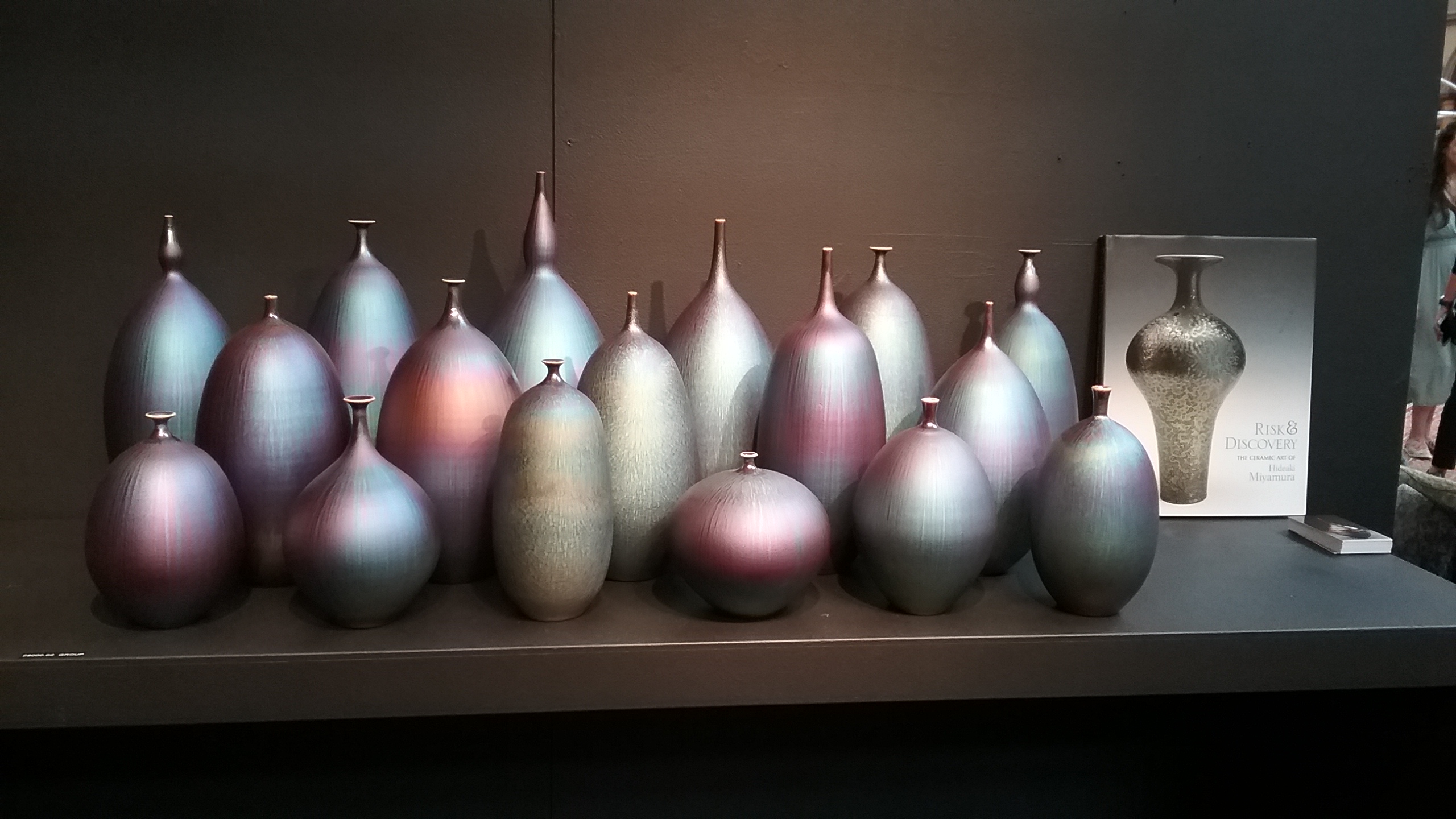
Ceramic vases by Hideaki Miyamura
miyamurastudio.com
My work began as a quest for iridescence…. I studied and apprenticed with a master potter for six years. At first, my studies focused on form. I made thousands of sake cups, then thousands of tea cups, then, eventually, vases and other forms, until my hands and body could create without the intervention of my conscious mind. I performed thousands of experiments….

Poppies on Silk by Deborah Falls
deborahfalls.com
I was drawn to working with silk and dyes because of the vibrant colors of the dyes and the wonderful texture of the silk. Since I am self-taught in this medium, I had no idea of traditional silk painting and developed my own way of applying and managing the unmanageable dyes. I did, however, have a sense of the imagery that I wanted, and was able, after many trials and much patience, to adapt a process that achieves my goals.
It was not until I started planting my own gardens about ten years ago that my imagery changed from abstract to realistic in the form of botanicals. I was so excited every time something emerged or bloomed that I felt compelled to capture this beautiful and amazing natural structure.
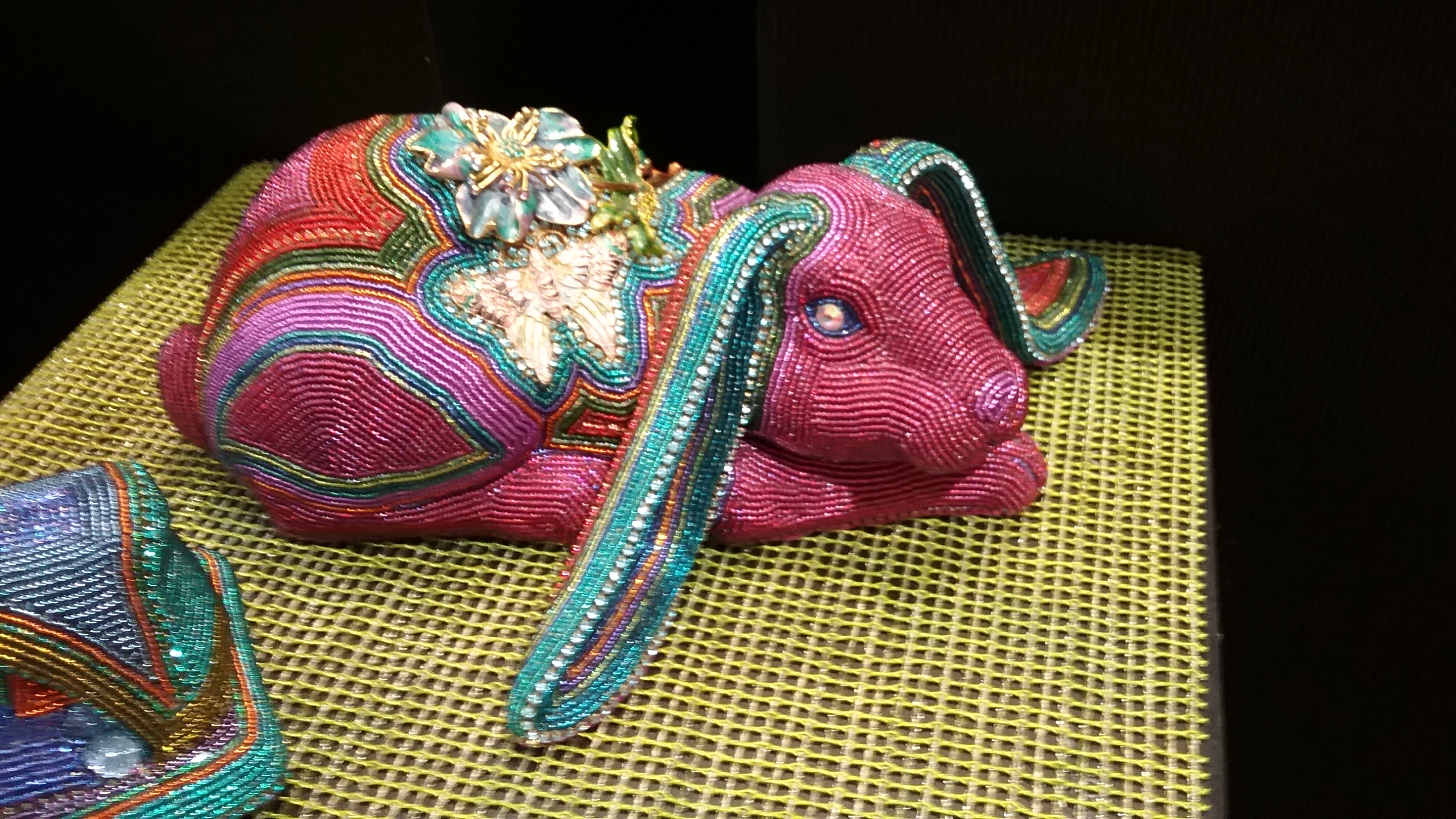
Beaded lop-eared rabbit by Tom and Kathy Wegman
tomandkathywegman.com
Tom and Kathy Wegman’s beaded art lives when they began collecting Native American beaded objects. After a while, they began making their own art, inspired by the beads themselves — bright, shiny things with the power to transform a mundane object into a thing of wonder.
Using over 450 different colors of seed beads to transform everyday objects into works of art. They glue individual strings of beads to other people’s discarded objects — roller skates from the Salvation Army, a lunchbox from the local secondhand store. Their general policy is “the brighter, the better.”

Bird’s-eye maple cabinet by Nojo Design
nojodesign.com
I take my cues from everyday objects, nature, the world around me, something as basic as a leaf – simplicity and elegance on the surface, but with an amazing underlying complexity.
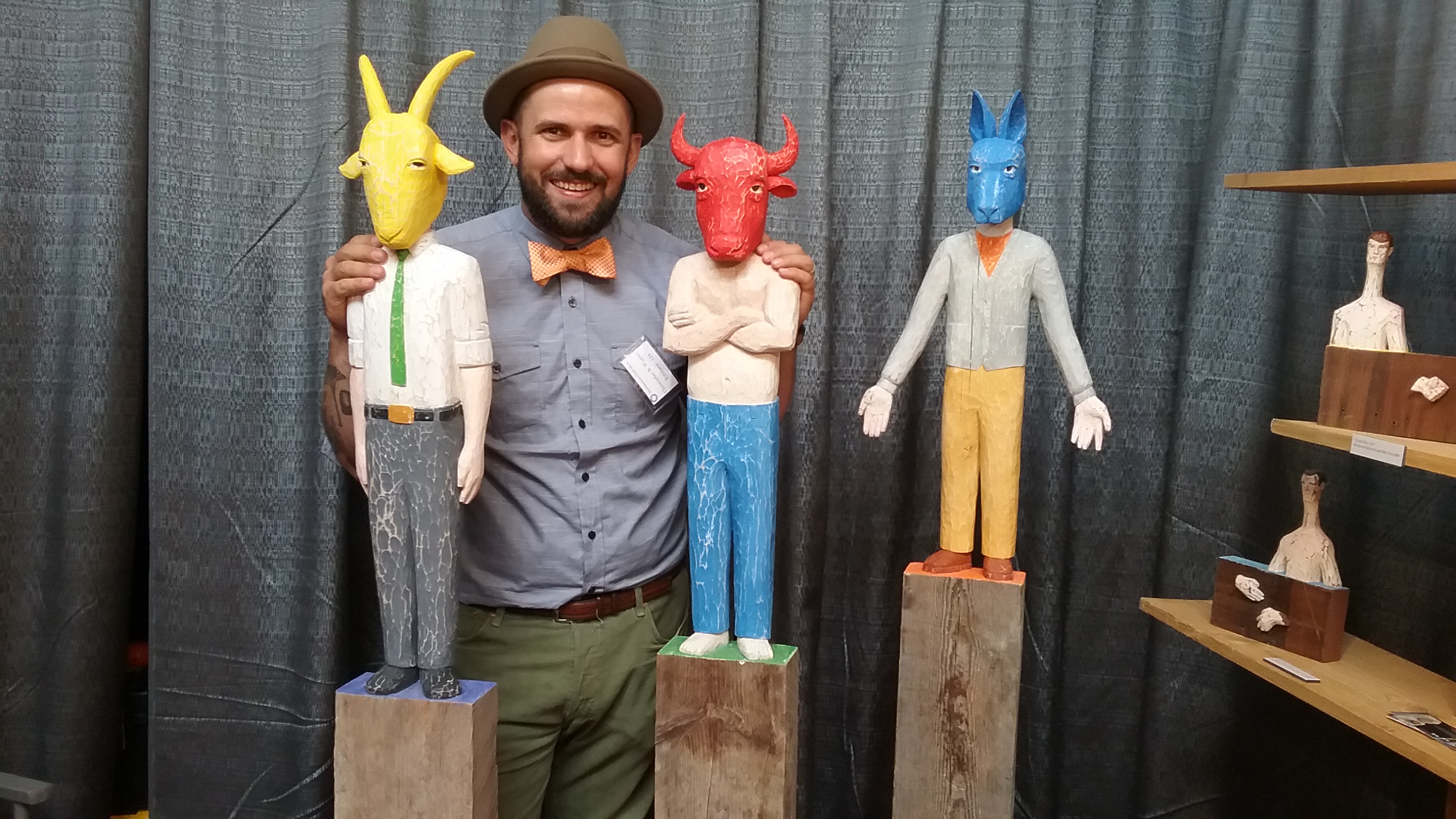
Wood sculptures by Christopher Wagner (and Christopher Wagner)
christopherbwagner.com
The reclaimed lumber he predominantly sculpts in provides a sense of history much greater than anything he could hope to achieve through artificial means. Elements of the wood’s own history, such as, nail holes, checking, and insect burrowing go into forming what he creates.

Retablo of the Garden of Eden by Nicario Jiminez
retablosnicario.com
Retablos are sophisticated folk art in the form of portable boxes filled with brightly colored figurines arranged into intricate narrative scenes. From the 16th to the 19th centuries, Retablos were carried through the mountains by Spanish priests as portable religious shrines for Catholic saints. Later, they were adapted by indigenous people to include their own deities and mythologies.

Glass vases by Fred Kaemmer
fredsglass.com
These pieces arose from a desire to create something interesting with clear glass. I enjoy working in this style because of the balance between control and serendipity each represents. Maintaining the shape of each vessel while allowing the glass canes to create a chaotic and beautiful fused nest within the piece is an exciting balance to execute. As a result, no two are alike.
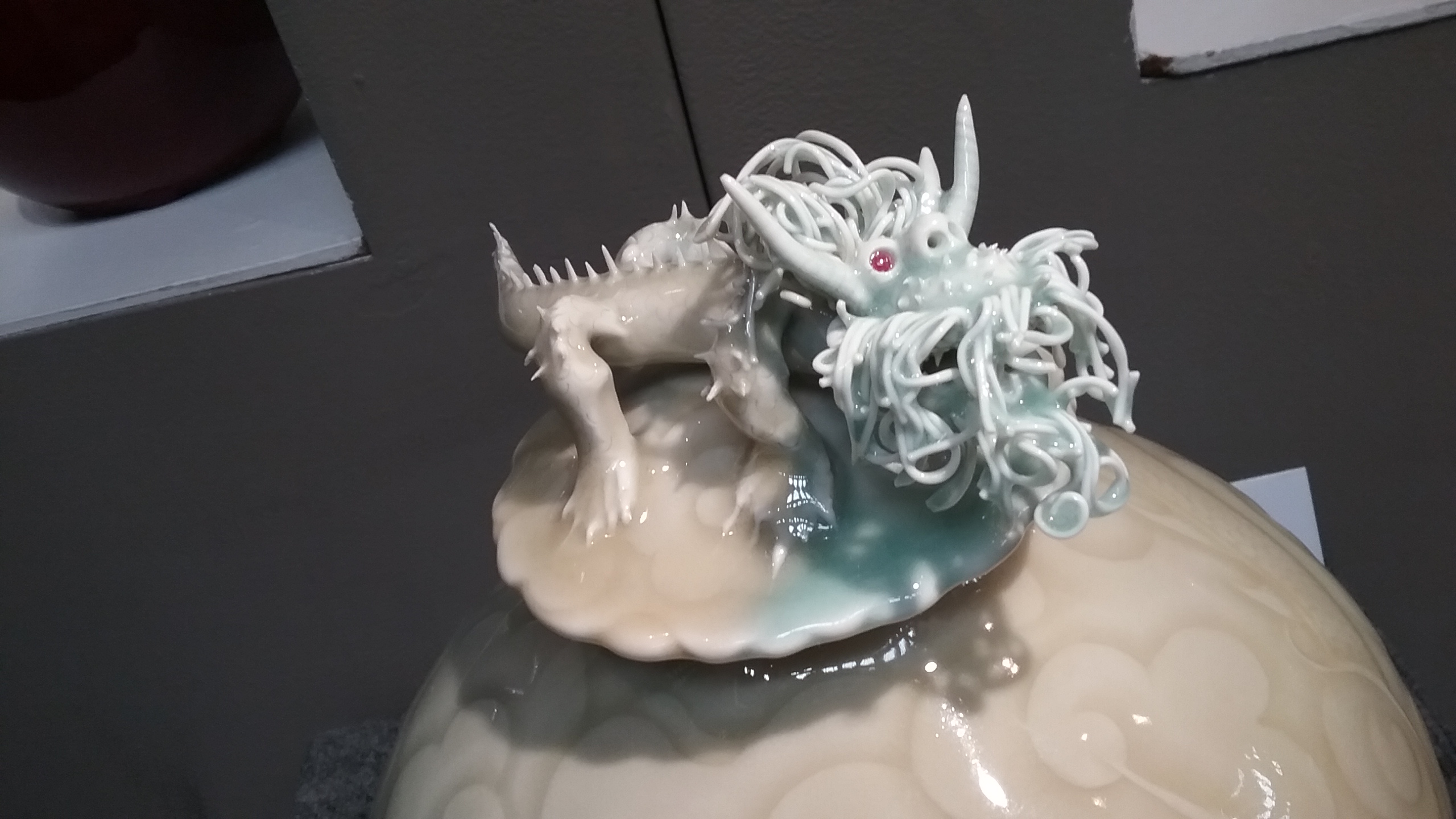
Lid of ceramic vase by ?
I lost my note of the artist’s name and contact information for this one. I’m still searching. For now, I’ll leave the nature of its inspiration to the reader as an exercise. Anybody care to ghost-write the artistic statement of this dragon’s maker?
Happy Mother’s Day to me!
As an early Mother’s Day gift, my daughter, Jennifer, took me to the Sunday matinée of “An American in Paris.” The venue was the Gammage at ASU in Tempe, AZ. The musical, inspired by the Academy Award winning movie from 1951 starring Gene Kelly and Leslie Caron, recently closed at the Palace Theater on Broadway.
Before the curtain went up we didn’t know we were going to see a musical ballet—we thought it was just a musical. We didn’t care–we loved the fact that we were actually at a live Broadway musical set in Paris transported to the desert of Arizona.
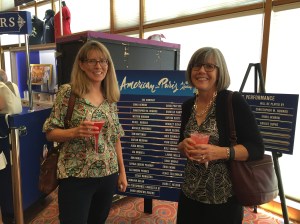
Our drinks: “J t’aime” and “S’ Wonderful.” They were both wonderful!
The main male characters in the musical are two American ex-GI’s: a composer/rehearsal pianist and a painter, and a French singer, with the latter two competing for the affections of a French ballerina/store clerk, Lise. I was quick to notice that there was nary an author to be seen yet I imagine that Paris had its share of American writers in 1951. Possibly a character with the intelligence of an author wasn’t a good fit for a musical ballet.
The choreography was amazing especially the final ballet sequence (seventeen minutes long in the movie—I didn’t time it in the musical performance but it was long). I kept waiting for someone to speak. Without dialogue, I couldn’t figure out what was happening any more than I can decipher a fantasy novel. Were we just being entertained by an elegant ballet? I suppose this was where my imagination was supposed to kick in….
Afterward, I couldn’t resist reading the reviews by New York theater-goers who saw the musical on Broadway. To my surprise, most of them were either totally or partially negative. If I didn’t know better, I would have thought I was reading a review of one of my unfinished novels: main male characters were boring, flat, lacking in emotion (but this is a musical ballet—they could sing and they could dance!); not enough character development; confusing, hard to follow, and flat plot; no conflict until two-thirds of the way through; predictable ending.
Thank you, Jennifer and family, for a fantastic Mother’s Day gift!
Leaving Arizona: With our impending return home to New Hampshire, I am starting to feel the same as when the end of August approaches. That’s why I wiled away the afternoon yesterday in the pool instead of checking things off my To Do List. As the thermometer inches closer to one hundred and above, it’s time to face the gray skies and cool temperatures of New Hampshire. And the budding crab apple and lilac trees, the perennials peeking out of the ground, and the acres of green grass awaiting the awakening of the John Deere mower from hibernation. 
Blame it on Tana French
I read to fall asleep. If you also indulge in that pastime, you may be familiar with the situation when you just can’t put down the book so you read late into the night when you should be sleeping and then when you stop reading you cannot go to sleep. Insomnia is not the outcome I want when I read in bed.
A week ago Friday I started reading The Likeness by Tana French. As with any of her books, right from the first enticing chapter her characters looped their arms through mine and transported me into their world. Realizing I had reached my bedtime reading limit the next night when I almost dropped my iPhone several times after I dozed off, I closed the Kindle app ready for a good sleep. The reading potion had worked it’s intended magic.
Or so I thought. I tossed. Covers off. I turned. Covers back on. The last time I looked at the clock, it was 1:30 a.m. Sunday morning. I blamed my inability to sleep on the nine boys who were having a sleepover at my daughter’s house next door, celebrating my grandson’s thirteenth birthday. There wasn’t much sleeping accomplished that night by anyone in the house as the nine boys roamed outside in the yard and in the park across the street then retired to the room about three feet from our casita. By the sounds of it, a good time was had by all!
Sunday night we were all in bed early. I was close enough to the end of The Likeness that if I could stay awake long enough I’d be able to finish it. My favorite part of reading a mystery is when I hit my “sweet” spot–about 75% of the way through the book-which means all my questions will be answered by the time I fall asleep.
By midnight I had reached the end of the book. Exhausted from Saturday night’s abbreviated sleep, I should have easily snored my way into dreamland at that point.
The last time I looked at the clock was at 2:30 a.m.
I blame it all on Tana French (not on teenage boys or plain old insomnia). Her psychological twists and thriller turns must have made me too worked-up, or anxious, or over-stimulated, to fall asleep. With that in mind, on Monday evening I found an innocuous historical mystery with which to read my way to sleep. Worked like a charm. Guess I don’t need Tylenol PM just yet.
 Eleanor Ingbretson
 Karen Whalen
 llandrigan
 Heidi Wilson
 Mike M
 Thursday Night Writes