Baby’s First Rewrite
I think I passed a milestone this week.
It wasn’t literally my first rewrite of a scene. My writing group would never let me get away with that. All kinds of changes have rippled through my manuscript, usually to remedy total howlers in the plot, but also to remove unlikely remarks by a character or make my subplots more like a braid and less like railroad tracks.
This week is the first time I forced myself to abandon a scene totally and write another to do the same work in the book, better. Be warned: it hurts.

If only my red pencil were as sharp as the Geisha’s blade!
(Geisha’s Blade Philippines Samurai Sword Shop)
Two criticisms forced me to it. Our group’s homicide detective told me that interviews of witnesses would never be conducted with other witnesses present. You isolate them and get each one to tell her own story. Even weightier, there was a sad consensus that ‘it all went on too long.’
Even I could feel the latter problem. While I never used the dread locution, ‘and then,’ I might as well have. On plodded the scene, until slept the mind. I resolved on surgery.
I work in the Scrivener writing program. It’s hugely useful, letting you switch from any scene to any other with a single click, showing links to notes, outlines and subplots on the main page. Unhappily, that makes it so easy to tick back into your original draft, to tinker with it instead of starting fresh, to cheat by leaving your new text to lift just one or two sentences – such clever prose! – from the old.
Somehow, this time, I realized that I had to resist. I stayed with the blank white screen of the new version. When I needed to analyze the old scene for necessary information, I did it in longhand on a yellow pad. I changed the location of the scene, narrowed the point of view, pushed beloved characters into the background.
Lo and behold, it worked. When I checked back with my yellow pad, I found that the new scene did all that the old did, more briskly, with more conflict in the present and more tension about what is to come. The new scene is 25% shorter.
The exercise wasn’t without losses. On my yellow pad, I had drawn two columns: Needed and Good. The latter listed five brief passages in the original scene, a few words or a sentence or two at most, which I liked very much. Four of them showed characters acting characteristically. When I had forced my way through the new scene, these vignettes were gone. The course of action just didn’t allow them to happen.
Were they darlings? I still don’t think so. I’ve stored them in a file called ‘fragments’ for possible reinsertion in a final smoothing. Deep in my heart, though, I don’t expect to see them again.
Looking forward to 12:01 a.m. December 1
This will be short as the deadline for NaNoWriMo is just three days away. I have attained 42,829 out of 50,000 words with three days without commitments remaining so I predict that I will “win” NaNoWriMo. Yippee!! I am ready for 12:01 a.m. on December 1 to arrive so that I can stop writing “Full Circle” what feels like every free minute of every day.
Of course, I exaggerate. I have taken some extended breaks during the month and I’ve enjoyed every moment of them, especially my vacation to the Cancun area. I only wrote one time out of the five days we were gone but that one time was quite satisfying. I even hit my word count on Thanksgiving day–and I hosted the holiday dinner after returning from my trip at eleven the night before.
What I’ve learned from all of this is that I am able to write regardless of the circumstances. I don’t need the perfect chair (I wrote on the airplane) or to be in the mood to write. I can even write while indulging in (gulp) Hallmark holiday movies. Wish I could say that they didn’t have an influence on what I wrote, though love stories and happy endings aren’t all that bad. Maybe my next novel will take place in a castle…
Another lesson has been that it isn’t that hard to whip out a lot of words if I’m prepared to also whip out a lot of revising. In the future. Revising that I’m actually looking forward to doing. Not lying.
Dancing About Architecture

Donald Swann in full voice
Singer and composer Donald Swann once said that writing about music is like dancing about architecture. You can walk around that simile for quite a while. The writing is pointless? Music is bigger, more impressive, more lasting and hence more important? The one can’t substitute for the other?
At the moment, I’m writing about architecture, and Swann’s dictum haunts me. I need to take my readers into a house that is as real to me as my own. I know that each reader will blend my descriptions with her own home, her family’s homes, her feelings about home in general and god knows what else. But I need her to see some parts of the house clearly, and I want her to experience much more than an architectural plan.
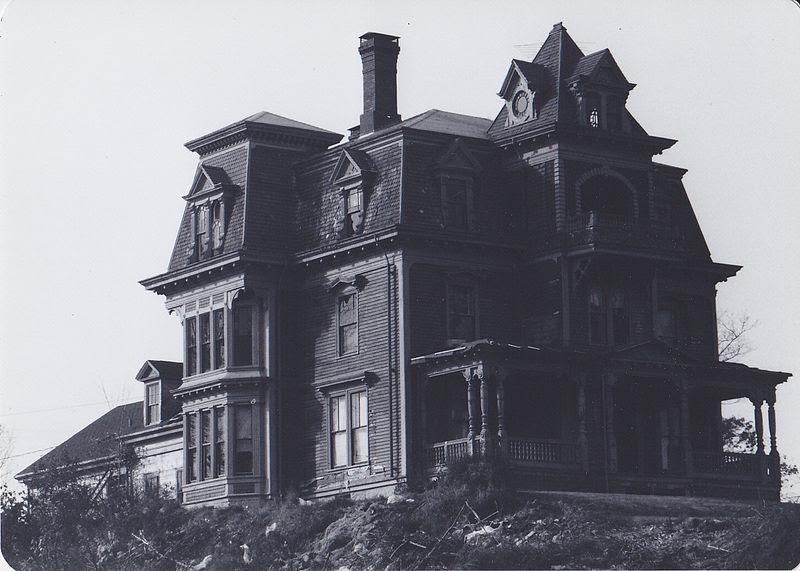
A possible model for Fallowfields
The fictional house in question, recently named Fallowfields by its snobbish owner, was built in the late 1800s in rural New Hampshire. It is an uneasy blend of Victorian-era ostentation and New England tradition. Both aspects are important to my plot and to the personalities of my characters. So both have to come through.
My plot requires that people sneak around the place, in and out, upstairs and down, undetected. So I designed Fallowfields on the model of ‘big house, little house, back house, barn.’ Farm housekeeping in the nineteenth century required more than one structure. The little house was usually built onto the back wall of the big house, which was where the humans lived. It might be a summer kitchen, a dairy, a woodshed or all three. A third structure, the back house, would share the back wall of the little house and shelter a different activity. One way or another, all the space that made up the house was formed around the chores and the home production of goods that supported the family.
The Fallowfields barn now has an apartment built into the old hay loft. My heroine has converted the tack room into a home laboratory for her botany experiments. Readers need to notice that proximity. The little house has, unusally, a second story and an internal flight of stairs. There’s another flight at the front of the big house. Before we can do exciting scenes of rushing up and down and dodging round the house, I must lay the routes out for the reader in the course of their ordinary use. Needless to say, my writing group read the early drafts and scratched their heads. “Wait! She was in the barn. How did she get to the bedroom?” Time to revise.
I want much more from Fallowfields than these mechanics. My heroine is facing forced retirement from work that took her around the globe. Unless I can convey her growing contentment with a life in northern New England, she and the book will come to an unhappy end, which is not my intention. Fallowfields and the rest of her home town must convey the possibility of that contentment.

A view of Peacham
Parts of Fallowfields are based on my grandfather’s house in Peacham, Vermont, purely for the pleasure I take in recalling it. To a five-year-old, its little house was Aladdin’s cave. It held pairs of rubber boots tall and thick enough for Jack-in-the-Beanstalk’s giant, or to survive a universal deluge. There were thin bamboo sticks as tall as my father and balls of bright green twine that would stake vines in the garden next summer. There were little, square wood boxes streaked inside with bright crimson, waiting for yet another year’s raspberry crop. There was a tub of something called paraffin, which I was forbidden to touch. It felt smooth and slick.
Grandpa’s back house was a chicken house. Every egg we ate in that house was less than 24 hours old. At Fallowfields, the old chicken house has been converted into a paradise for a pair of pet ferrets, but hovering sharp and dusty in the air, somewhere between a scent and a memory, is the smell of the feathers, droppings and dirt generated by a flock of healthy chickens. Even today, one breath of that scent takes a half-century off my age. Can I manage to show that? Because telling just won’t do.
A SETBACK
A SETBACK
When I last wrote for Thursday Night Writes I was drawing to the close of the third major revision of my mystery. Now I’m in a major slump of a setback.
What happened? Too many things. Too many hurdles to leap, too many plot changes, too many revisions that could take me all the way back to the beginning of my novel.
Last year about this time I took an on-line course with Paul Harding, the author of the Pulitzer Prize winning Tinkers. He said that when we stop writing on a scene, a dialog, or the whole book, it’s because it’s hard, and it has become work.
My cozy has always been, if nothing else, fun. Now, with everything I need to do to push it forward, it has become work. I’m starting to sound like Maynard G. Krebs from the old Dobie Gillis show. I know that must date me, but if you don’t recognize the name Maynard G. Krebs, you might have heard of Gilligan’s Island. When Maynard grew up, he became Gilligan, but while he was still Maynard he would cringe at the mere mention of the word ‘work’. As Gilligan, however, he always did his share, or more, of the work he and his fellow cast-aways had to do to survive on their deserted island.
The holidays are coming to my rescue, giving me all the excuses I need NOT TO WORK ON THE BOOK RIGHT NOW. And that’s fine, it happens every year. My thoughts turn to turkey dinners and then on to Christmas and knitting for various lucky people.
However this year my hiatus from writing is because I’m cringing at word work, not because it’s time to shift gears to holiday mode. And therein lies my moral dilemma. I don’t like the idea that I’m a lily-livered, weak-kneed, coward when it comes to re-arranging a few words on a page, a few lines of a scene, a few pages in a chapter, a few chapters in the WHOLE BOOK!
If by January I have not succeeded in getting back into the story then I’ll have to seek professional help. But I know I can do it. It’s grow up time for me and Maynard, and when the holidays are over I’ll welcome getting back to work with a renewed vigor. I hope.
Happy Thanksgiving to all.
The places that November will take me
Did bragging that I am ahead of my word count for NaNoWriMo on November 2nd jinx my progress? Seven days later, I am now over a full day’s word count (2,000+ words) behind….and feeling that I am destined to fall even further behind.
The graph on the NaNo website states that at my current writing rate, I will hit my 50,000 word goal on December 5, not November 30. As sophisticated as their website is, it doesn’t take into account hosting Thanksgiving dinner, spending five days at a resort near Cancun, Mexico, with my middle daughter and her family, and celebrating my birthday, just to name a few of the activities that I have given permission to distract me from writing.
I should hit the road writing when I get up in the morning–but I don’t. First it’s the local news (usually a repeat of the prior evening’s news) followed by the national news then trying to convince myself that I need to take my medicine and get ready for the day. All things I would do every day of every other month. Except the fact that it is November allows me to use them as excuses to–wait for it–procrastinate!!
The truth is I will take what I get out of NaNoWriMo. Any quantity of words, even in the form of an extremely rough draft, that I can add to my novel or use as the basis for the final novel in my trilogy is a bonus.
As a reminder, I am a pantser (I write without an outline though in this case I have about ten lines of an “outline” composed on Halloween evening). Today I spent hours with my husband at the hospital having his carpal tunnel syndrome evaluated. When we returned home, I started writing. The scene that developed is a medical emergency that sets up a hospital stay!
It’s possible that I am easily influenced by current events. My current events. Unfortunately, this scene is the second medical emergency/hospital stay of the book. And not part of the outline. But it is chronological. No islands when I’m participating in NaNoWriMo.
Can’t wait to find out where 50,000 words are going to take me…..that’s what I love about being a pantser.
Magna cum Murder
I’m hoping to earn a summa cum murder one of these days, so naturally I’m working my way up. Last weekend, I attended the 21st annual Magna cum Murder conference in Indianapolis. My pocket notebook is bursting with wise tips, potential contacts and off-the-cuff sketches of typical attendees of murder conferences. Face it, people. We’re weird.
We’re also smart and funny and very good company.
On the “smart” front, I call in evidence Cheryl Hollon, formerly an engineer who constructed flight simulators all over the world, now full-time writer of the Webb’s Glass Shop mystery series. Sarah Wisseman was there, too. She’s a former archaeologist, who’s just started her second series of archaeological mysteries, this one starring an art conservator in Siena (Burnt Siena.) My table mates at lunches and dinners included more archaeologists, an anthropologist, a lawyer….
And funny! International guest of honor Simon Brett gave an after-dinner speech that was even better than the chocolatey dessert.
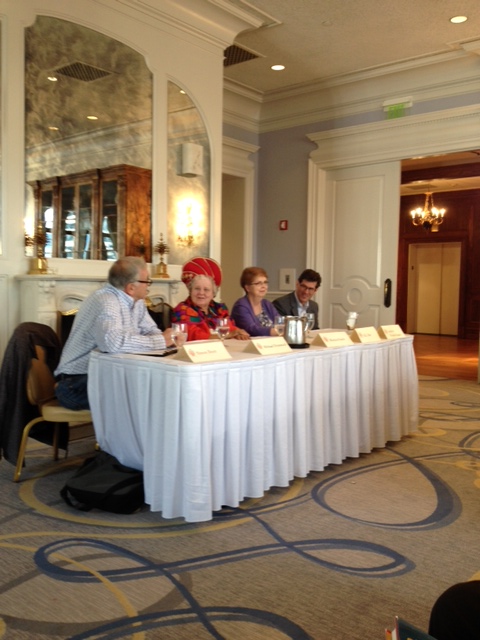
Simon Brett, Michael Dymmoch (hidden by Simon), Monica Ferris, M.E. May and Andrew Welsh-Huggins debate amateur sleuths vs. P.I.s vs. police detectives
I won’t steal too many of his jokes, but here’s a taste:
In a British accent even plummier than his own, he read excerpts from Jane Austen’s only attempt to write a pornographic novel, Sense and Sensuality. (It began, “It is a truth universally acknowledged…” I leave the rest to the reader as an exercise.)
He plundered T. S. Eliot’s business correspondence and came up with a letter to an overdrawn bank customer, beginning, “Dear Mr. Prufrock….”
Dylan Thomas’s Welsh accent sounded from the grave in an excerpt from Under Murder Wood.
We heard some of the latest Scandinavian Noir, The Girl with the Unpronounceable Name, apparently read by the Muppets’ Swedish chef: “The inspector brooded… …. … Then he brooded some more.”
Brett had a few sharp words for the clichés of our genre, too. My favorite: “Writing about serial killers is a lot easier than making up a proper plot.” The hard-as-nails, gorgeous female pathologist came in for heavy criticism, accompanied by Brett-produced sound effects: a liver squishing and a bone saw.
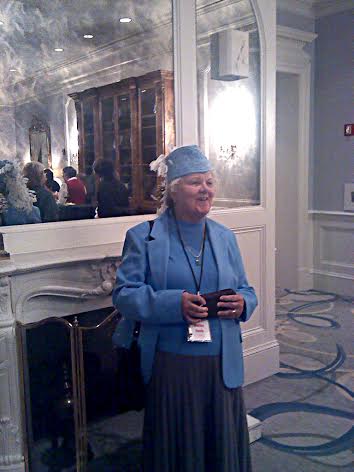
Monica Ferris, hatted by Angie’s Hats of Minneapolis
What is it about mystery writers and hats? I’ve written here before, with pictures, about the hats worn at Malice Domestic’s closing tea party. At Magna cum Murder, Monica Ferris, author of 18 fabric-arts mysteries, stood out for her millinery. Here she is at the cocktail reception, in the blue confection made especially for her by Angie’s Hats of Minneapolis. Check the lower left corner of the mirror behind her to get the full effect of the white feathers. And below, by permission, is one of Angie’s Kentucky Derby hats.

“Ruby” — a Kentucky Derby hat by Angie (already sold, sadly)
And here’s Monica again in the hat (not one of Angie’s) that she wore at the final panel. With her is Michael Dymmoch, author of the John Thinnes/Jack Caleb mystery series, and wearer of dragons.
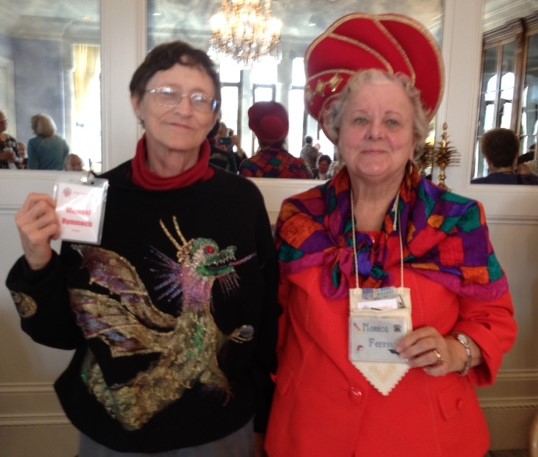
Michael Dymmoch with dragon and Monica Ferris with hat.
All right, I suppose we should do some work here. Some of the writing and publishing tips I collected at Magna included:
Now that publishers do so little and ask so much of writers, a small publisher with a smaller list may put more resources into getting your book known.
Small-town gossip is always a good way to convey information to a reader, but to judge from audience response at one panel, people enjoy reading it for its own sake. Similarly, most of one Q&A was taken up with anecdotes of interesting overheard remarks.
The last impression made by your final scene is what determines whether the reader will buy the next book in your series.
Sally Wright, author of both the Ben Wright and the Jo Grant series, outlines before she writes…and outlines, and outlines…. Sometimes, she goes on for fifty pages before writing the first sentence of the text.
From Sarah Wisseman: have your protagonist miss a clue because of a crisis in her personal life.
And now I suppose, as Willem Lange says, “I gotta get back to work.”
It’s November!
Halloween night I spent multi-tasking: handing out Halloween candy and visiting with the parents (the only trick-or-treaters we get are people we know, all of four families), watching the movie “Water for Elephants,” based on Sara Gruen’s book (that I loved), a NaNoWriMo novel, and working on my outline for my own NaNoWriMo novel, “Full Circle.”
And now it’s November 2nd and as I look around my great room I see orange pumpkins and other Halloween decorations. A good
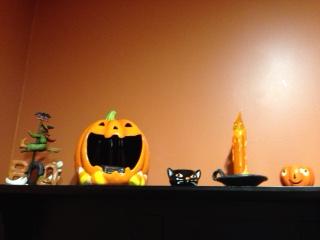
Halloween is over, isn’t it?
sign in some ways. Instead of allowing myself to be distracted by household chores, I’m devoted to the novel I’m writing for NaNoWriMo. And it isn’t about Diana the Huntress after all! (Bad sign: my husband hasn’t put away the decorations either.)
I’ve decided to take the easy way out. I’m writing the fourth and FINAL novel set in Woodbury, NH. (What is a series of four novels called, anyway? A series?) This one is from the POV of Olivia, the daughter of Anne, who is the protagonist of the first novel I ever attempted. The one I started in 1986. Too many years ago to calculate using your fingers and toes so I’ll fess up—that’s one year shy of thirty years.
Using an existing setting and characters for NaNo feels like cheating. OK, to some of you, it is cheating. But it is probably the only way I will win. I’m enjoying myself, knowing that 1) there’s a high likelihood that I’ll win (I’m already ahead of my goal for the first two days of November) and 2) I am going to be done with this series, with these characters, with this setting.
Yup, hard to admit but I am ready to move on to new territory.
I have a feeling that I am going to end up with one novel written from four (or maybe just three) points of view instead of four (or maybe just three) separate novels. As long as I end up with something to show for all of this time spent writing, I’ll be happy. And that means a published novel. Or maybe three. And that’s called a trilogy.…
THE COZY MYSTERY
COZY MYSTERIES are also referred to as ‘cozies’. In England they are called ‘Aga Sagas’ because they are read sitting by the Aga stove on a blustery evening (or afternoon).
I’m drawing to the close of my third complete revision of my cozy. Round of applause, please. It’s been gruesome and exhausting.
One of the members of my writing group had only a vague concept of what a cozy was even after years of critiquing my work. I asked this person to read one that had influenced my choice of fiction, and then he could critique me. After reading twenty-eight pages my fellow writer was completely saccharined-out.
Cozies can have that affect on some people. There are cozies, and there are cozies, just as in any other genre. They run the gamut from Agatha Christie and Dorothy Sayers down to. . . well I won’t say down to whom, but they are out there, complete with misspellings and main character name changes in the middle of the story. One cozy I read misspelled leech throughout the book, and the poor leech was a secondary character.
Usually a cozy takes place in a small community where everyone is known to each other, though not necessarily intimately. It’s a cliquey sort of environment, and emotions can run high for extra tension beyond the tensions the prerequisite murder have caused. If you think of how a movie is rated for S, V, and L, a cozy will come in at a PG. Sex, Violence and Language are virtually absent from the page, only referred to so the reader will know that S and V have occurred in some less savory quarter, or to an unsavory person who uses L.
The protagonists are usually female, as are the readers of cozies. Almost always they are amateurs when it comes to dealing with crime. They continue this charade even if the series runs to ten or a dozen books. It’s an appealing shtick.
The protagonist sometimes has an interesting side-line that can be part of the mystery, or an aside that the followers of that series enjoy reading about. Examples are: innkeeper, caterer, animal breeder, bookbinder, herbalist. The list stretches on.
And the protagonist usually has a friend in the police force who aids her in the search for truth and justice.
I fought against it, but my protagonist has been working with a policeman. He wants to retire, preferably in the arms of the heroine, but that, and anything else un-cozy, will never darken the pages of my story.
Unless there is a sequel.
It’s complicated
With just 13 days—yikes!—until NaNoWriMo starts, I should be well on my way to an outline, character list and setting. At a minimum. And that has been my plan since my failed attempt to win Camp NaNoWriMo in July. It’s a sad story, a common refrain (for me). My July project is floundering and I am unprepared for November.
I thought I had it under control. I knew what my plot was going to be. Sort of. (It’s those “sort of’s” that seem to be my downfall.) All I needed was some additional information from my mother and I’d be ready to outline like a madwoman.
Last night I met with her (my mother, not the madwoman) for what I was certain would be the details that would weave the story together. Alas, all she could tell me was all that she’s already told me.
You may wonder why I need information from my mother to write this story. It’s complicated. But when isn’t it? Back to my resource, my mother. Several years ago, she gave me what I assume is a pewter or silver plated wall frieze of the Roman goddess, Diana the Huntress, and the stag.
She’s 88 (my mother, not Diana), from Germany, and lived there during World War II. The wall frieze was given to her by her mother in 1953 when my mother moved to the US with my father, who was in the US Air Force.
My grandmother found the wall frieze in 1952 in a trunk that her son-in-law (not my father) bought at an auction. Assuming it only contained a bunch of old newspapers, he stored it in the basement. But my grandmother thought otherwise and trudged down to the basement to paw through the newspapers. She was rewarded for her effort with Diana and my uncle let her keep it. She passed it on to my mother, who gave it to me.
I believe that the trunk was property confiscated by the Nazis from a Jewish family. The twist is that a few years ago I found out that the mother of my German grandmother was a Jew who married a Christian. That means I am 1/8 Jewish. Ties with the Jewish part of the family were severed, which may have been what saved my immediate German family from the Holocaust. (I can’t allow myself to think about the fate of the Jewish part of my family.)
Sounds like a lot of potential material for an historical novel. Or would it be creative nonfiction? A memoir? I could incorporate my Jewish and my German ancestry and my American upbringing. And I do want to write that book. But 13 days just isn’t enough time to do the necessary research and develop the plot, outline, setting, characters…..
So I’ll stick to the story of Diana. If I can come up with 50,000 words about a trunk, a Roman goddess, a stag, and a wall frieze.
WINTER IS COMING!
The weather, the leaves, the wood stove are all busy doing their thing. What thing? The pre-winter thing.
Well, is that a good thing, or a bad thing? F. Scott Fitzgerald said, “Life starts all over again when it gets crisp in the fall”. That sounds like a very good thing to me. Summer is just too sultry.
Every season has its ups and downs, but I’d say that the pre-winter season, sometimes called fall, is my favorite. Pre-winter, called so because preparing for winter is what the season is basically all about. My houseplants all have to be back from summer vacation in the yard, and in their spots along the south facing windows by Friday of this week. That’s when the first killing frost happens. Wood has been ordered, and when it arrives it has to be stacked. Screens are already off, and windows need to be washed. I’m looking forward to finishing the current revision of my novel, and putting it to rest for a month or two. I want to get out my yarn and knitting needles and create stuff. I want to learn to do Fair Isle knitting. All I know about Fair Isle knitting is that it is not for the weak. Neither is writing. What, all of a sudden I’ve become Super Woman? I don’t think so. I just keep trying.
I’m looking ahead to those quiet hours spent INDOORS reading, knitting and writing. Those are good things. Of course that means that there will also be more time for things like paper work (not related to writing), cleaning out closets, drawers, and constantly stoking the wood stove instead of only sporadically, as we are now. Those are not my favorite things. Eh, you have to take the good with the bad.
Enjoy your pre-winter now, whether you like it or not, because winter is coming!
 Eleanor Ingbretson
 Karen Whalen
 llandrigan
 Heidi Wilson
 Mike M
 Thursday Night Writes