Category Archives: writing
Icebergs in Arizona
If a writer of prose knows enough about what he is writing about he may omit things that he knows and the reader, if the writer is writing truly enough, will have a feeling of those things as strongly as though the writer had stated them. The dignity of movement of an ice-berg is due to only one-eighth of it being above water. A writer who omits things because he does not know them only makes hollow places in his writing.
—Ernest Hemingway in Death in the Afternoon
Gabby has me diving into the freezing cold water of the North Atlantic, searching for the seven-eighths of my book that is underwater. Although just a meager portion of the seven-eighths, this is what I’ve uncovered:
- Subplot. I’ve fleshed out a murder subplot that wasn’t in the original NaNoWriMo novel. I wasn’t certain I even could use it when it appeared but I’ve grown to like it. I’ve been massaging it, expanding it, and I can see its potential as both a red herring and a means of inserting more of the backstory of some characters.
- Murderer. I’ve changed the murderer. This is big!! And it’s involved reworking not just the murder itself but also relationships among the characters. This change helped me flesh out the relationship between a mother and daughter, going back eighteen years to the daughter’s conception.
- Conflicts. You can never have too many of those, can you? Possibly in your real life but not in a book. My NaNoWriMo conflicts were superficial but now I’ve created some meaningful ones that will help Gabby develop into a well-rounded, mature woman.
- Family history. I’ve delved further into the history of the paternal side of the protagonist’s family, starting with the life of her great-grandfather. One of the perks of being an author is that you are in control of what happened generations ago that affects your living characters. It’s more fun, and easier, than using Ancestry.com.
- Whodunit? Most recently I have visited with each of my characters in order to discover who he or she thinks is the murderer. Through these conversations, I have learned more about my characters’ flaws, as well as gained some insight into where I need to place clues.
At this point, working with the separate parts of the structure of the novels means that I will have to fit all of this information together to form the novel. It is going to be like taking the pieces from numerous jigsaw puzzles and jamming the pieces together to create one much larger puzzle, all the while looking under the sofa and the coffee table for the missing pieces that make up the dreaded hollow places.
During all of this, I haven’t written one word that increases the word count of the novel. And that’s okay. For now.
The Fifth Season

It’s still winter in Orford, New Hampshire — if you don’t look down
I started out with the idea of a novel set in rural New Hampshire. There’s no such thing as a novel set in New Hampshire that excludes the weather. I decided to spread the plot out over a year – up here, you can’t leave out a single month and still cover the territory.
Fate gave me a freebie: the full-year idea fit well with a problem my protagonist faces. She’s stuck at home, probably for good, after years of regular escapes to Kenya.
Today’s weather reminds me of why I changed my plan.
Last fall was lovely. Dampish now and then, but the beeches, oaks and maples all came through with October fireworks in yellow, red and russet. Winter sidled in with a little snow but then appeared to give up. Open ground could be seen in January and February. We had a storm or two, sure, storms that people in D.C. would call blizzards. But nothing you’d mention. Nothing we would, anyway.
Snow gone at the end of February. Temperatures scaling toward 60 every now and then. And then… BWAH-HA-HA-HA-HA!

And from the back door….
Arrives the blizzard that breaks the records. With nine days to go till spring, parts of New Hampshire got more snow in a single day than at any time since Cain discovered writing. (He wrote crime fiction.)
Now we’re back up to March’s ordinary 40-degree highs, on one day out of two anyway. And today is the kind of day I’ll end my novel on. I could stretch it all the way around the calendar, ending on a June day of glorious sun, leaving out the black flies. Or I could end on a July day of glorious sun, leaving out the deer flies and the humidity. But no. My heroine will triumph on the first day of Mud Season.

My fairy footprints
The frost goes deep here. Even calling it “frost” is misleading. It’s a rock-hard layer of frozen earth that can go down five feet. We like it. Foresters can work in the woods all winter with heavy, heavy equipment.
But when the warmth creeps back, the ground unfreezes from the top first. The layers farther down don’t feel a thing. They don’t absorb moisture, either. So for weeks, meltwater mixes with topsoil and sloshes around — and slides and squishes and slops — on that impervious surface. This is Mud Season.
I took the dog out this morning. Winter is still mounded to either side of our forest road. You can’t walk over the plow piles because you’ll go straight down in and never get out again. The road, though, is all spring, from the surface to about two inches down. This new-born world is gluey, gritty, rich and brown. Runnels of melt water dig channels on the slightest slope. A blazing sun picks out sparkly grains of marble in the 3-inch gravel that is trying to hold the our forest roads in place against strong odds.
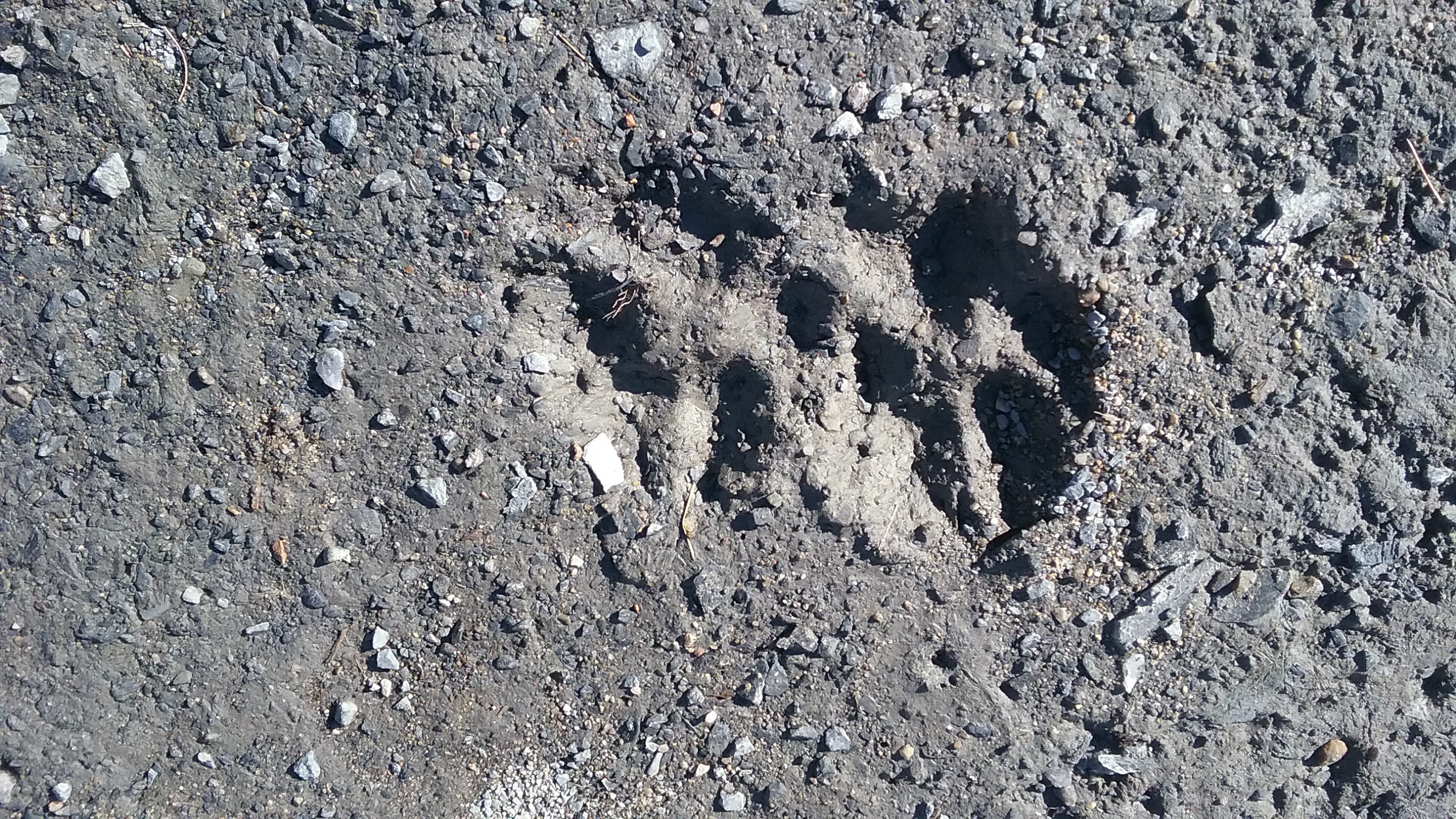
Dog prints, coming soon to a clean floor near me.
Pfeffernuss the dog is a 90-pound black Lab with feet almost as webbed as a duck’s. They sprea-a-ad out under her weight and then snap back into place like little backhoes, storing up hours-worth of pawprints for my floor tiles.
My knee-high muck boots go so deep you’d think “muck” is what they’re made of, not what they cope with. The sound they make on the upstroke is indelicate, nay, carnal.
This is what resurrection looks like in New Hampshire. The delicate blossoms and tender grasses come later, as an afterthought. When Mud Season arrives, you know you have come through the dark night of the New Hampshire soul and back out into the light.
The Ick Factor
The Thursday Night Writers had another set-to this week over my exploding canary. Only four of us were present this time, but the controversy has raged through the whole group since I submitted the first draft of chapter 36 – longer ago than I care to admit.
Here’s the passage:
For my part, I kept the Stark file spread out all over my desk, like one of those impossible variations on solitaire. I inspected every line of every document, straining for some way in which it might imply a deadly secret. I marked Jeremiah’s house purchase with a Post-it memo to trace the sellers. Somehow, the sale wasn’t legitimate? Or Jeremiah’s check bounced? Or maybe way earlier, somebody with the same name had just pretended to be a descendant of Enoch Stark when they bought the house? Pretty thin, Eliza. But it got another yellow sticky note. In the end, the solitaire game looked like an explosion in a canary.
Disregard the plot conundrum. It can’t be quickly explained, and the only problem, as far as the TNWs were concerned, was the canary.
One member is admittedly squeamish. She loves cozies because of their basic rule: no explicit sex or gratuitous violence. Simile or not, she does not want a piecemeal canary obtruded into her consciousness. In a later chapter, a mere reference to “my canary” in the context of the annotated documents was enough to set her off. (Granted, she had been recently lacerated by an episode involving a frog in William Kent Krueger’s Ordinary Grace. It wasn’t a good week to reprise the canary.)
The others, it seemed to me, were going deeper into the image than … I was going to say “a normal person,” but perhaps I should just say “the reader” is likely to. There was speculation as to the appearance of a real exploded canary. A consensus emerged that the resulting color would not be yellow. I believe someone brought up the probable radius of the debris. And there was me, just visualizing little Tweety-colored feathers floating down.
The title of this post comes from a critique I received from Mary Carroll Moore, with whom I’ve taken two live workshops and one online class. She used it when she advised me to abandon the opening sentence of my novel and, indeed, to remove all technical or at least all vivid medical details from the scene, which takes place in a doctor’s office. Here’s the paragraph:
I don’t deny that I was riddled with parasites. I always was when I got back from a field trip. But I saw no reason for Brad to take that tone with a woman twice his age. His father never had a problem with my parasites.
I submitted that paragraph, as part of my first two pages, to a panel at the New Hampshire Writers Day last year. The panel consisted of well-known NH writers – all genres, not just mysteries. Each submission was read aloud by the moderator. The panelists were instructed to raise their hands at the first word, phrase or other issue that “stopped” them.
When my first sentence was read, three out of four of them jumped, but no hand went up. Which means…? You tell me. Please.
(We got well down the second page before I got a hand. Several at once, in fact. But that’s another story.)
So maybe it’s just me. Maybe I’m made of grosser clay than the average cozy fan. Or maybe I just make my friends and seek advice from lovely people who are more-than-average refined. The one thing I’m sure of is that neither the canary idea nor the existence of parasites would boggle the mind of my protagonist. So maybe I’ll keep them both.
***
The Ick Factor may be on my mind at the moment because of the winning response to the challenge I posed in my last blog: to use in mystery plot the following two words:
Ylem: (in big bang theory) the primordial matter of the universe
Feague: To put a live eel up a horse’s bottom. An eighteenth-century horse dealer’s trick to make an old horse seem lively.
And the winner is….
Judy W.! She commented:
Your current words call to mind a Dick Francis-like mystery set in a racing stable. “The feaguing of the poor horse set loose an explosive diarrhea in the stall that splattered the walls like ylem after the Big Bang. Underneath the residue lay the missing gambler.” Ugh. Sorry, but you did issue a challenge.
Congratulations, Judy! After that, an exploding canary is nothing. It wouldn’t even cover up a dead gambler.
A good book makes you think
I know I’m taking a chance when I download “bargain” books from BookBub, Choosy Bookworm, and Amazon, or pick up used books at my favorite Arizona bookstore, Changing Hands. I may end up with a book that doesn’t appeal to me, to put it nicely. Looking on the bright side, it can be motivating to realize that if that book can get published, surely I will have no problem getting my novel into print.
That was not the case with the used book on writing I recently bought, “The Successful Novelist: A Lifetime of Lessons about Writing and Publishing” by David Morrell. I am only 36 pages into the book and I have already gotten my $8.50 worth. (The other used book on writing included in that same purchase, for just $6.50 and to remain unnamed, was barely worth that amount. Even so I read the entire book.)
On page four of “The Successful Novelist,” Morrell states that the correct, and only, answer to his question, “Why do you want to be a writer?” is “Because you need to be.” “Writers write.” A real writer would squeeze writing into any time available, even if it’s just fifteen minutes a day.
The sign of a good book is that it makes you think. (I made that up. I think.) Reflecting back over my younger writing years, this is what I think my writing life should have been. When I was young and energetic, busy with my family, work, and volunteer activities, I should have found a way to say “no” to just one thing. And then locked myself in the closet. (That’s correct. When I wrote in 1987 my very first draft of the book, “Anne,” from which my other books have spawned, I put a desk in my clothes closet. In our open concept house, this was the only place I could escape from the activity and noise. The bathroom was my second choice.) If I’d been smart enough to lock the closet door and write for fifteen minutes each day, by now I actually might have a book completed and, dare I say, published. Thirty years later.
As I ruminated over how quickly those thirty years have passed with so little writing to show for them, the accountant in me picked up my phone, clicked on the calculator app, and started punching in numbers. If I had spent just a half-hour every day writing, 365 days a year, for thirty years, I would have racked up 5,475 hours writing.
I tried to relate that number to something tangible, such as how many books 5,475 hours of writing equates to. Due to the fact that I don’t have any completed, full-length novels to my credit, I can only draw a parallel to my NaNoWriMo experiences. In the month of November I can write 50,000+ words, without writing every day. I estimate that I spend three hours a day on average writing like crazy during the month, which totals ninety hours. For a first draft of 100,000 words, I quadrupled those hours, 360 hours total. In half-hour increments, that equals 720 writing sessions of a half hour each, or pretty darn close to two full years.
Back to the 5,475 hours that I could have spent writing in the past thirty years. If I divide those hours by the 360 hours to produce a rough draft, I could have easily whipped out fifteen rough drafts. Instead of the four unfinished drafts I have, I could have fifteen. Unfinished. Rough. Drafts. Sounds about right.
P.S. Please go back and read Heidi Wilson’s latest blog post. She issued a challenge. Read the comment section for a hilarious response from Judy.
Words You Need to Know
For some reason, when your friends know you are a writer, they become obsessed with sending you words. They may feel you are a connoisseur. They may feel that your vocabulary is inadequate.
Several of my friends have recently been hit with the word-sending bug. While they all said that their lists comprised merely “weird” or “interesting” words, a high percentage of the entries had intriguing connections with the mystery genre. I here offer the best of them to you, conveniently arranged in categories useful to those who murder on paper.
Characters
Apple-knocker: an ignorant or unsophisticated person (I was raised to call such persons oyster-shuckers.)
Badmash: Indian, a hooligan
Shot-clog: An unwelcome companion tolerated because he pays the ‘shot’ (i.e., the bill) for his companions (Note: as this word is attested only in the works of Ben Jonson, perhaps it should appear below, under Historical Fiction.)
Snollygoster: An unprincipled, shrewd person guided by personal advantage, not respectable principles
Suedehead: a youth like a skinhead but with slightly longer hair and smarter clothes
Wittol: a man who knows of and tolerates his wife’s infidelity
Plot elements
Absquatulate: to leave somewhere abruptly
Cacoethes: an urge to do something inadvisable
Eucatastrophe: a happy ending to a story
Exequies: funeral rites
Flews: the thick pendulous lips of a bloodhound or similar dog
Sprunt: To chase girls around a haystack after dark
Murder weapons
Brannock device: the thing they use to measure your feet at the shoe store.
Peen: the side opposite the hammer’s striking side
Probang: a strip of flexible material with a sponge or tuft at the end, used to remove a foreign body from the throat or to apply medication to it
Atmosphere
Bruxism: involuntary and habitual grinding of the teeth
Carphology: convulsive or involuntary movements made by delirious patients, such a plucking at the bed clothes
Uhtceare: Anxiety experienced just before dawn when you cannot get back to sleep for worry about the day ahead
Historical fiction
Resurrection man: a person who, in past times, illicitly exhumed corpses from burial grounds and sold them to anatomists for dissection
Skimmington: a kind of procession once undertaken to make an example of a nagging wife or an unfaithful husband
Technique
Amphibology: a phrase or sentence that is grammatically ambiguous, such as She sees more of her children than her husband.
Interrobang: what it’s called when you combine a question mark with an exclamation point like this: ?!
Finally, I offer a small prize (a shout-out in my next blog) to the reader who can suggest the best way of incorporating the words below in a (single) mystery.
Ylem: (in big bang theory) the primordial matter of the universe
Feague: To put a live eel up a horse’s bottom. An eighteenth-century horse dealer’s trick to make an old horse seem lively.
We all have secrets–don’t we?
I noticed a couple of links to blog posts on Facebook today. Possibly there were more but it was hard to pick out what was a blog post, what was a news (real or fake) article, and what was a personal post. Any post that wasn’t about Elizabeth Warren, Betsy DeVos, or the New England Patriots didn’t have much of a chance of getting noticed today.
One of the links was to a blog about benches. Yup, those uncomfortable wooden couches you sit on in the park. I read the tantalizing first line of the post and continued scrolling. But it did make me think, always a risky proposition.
When Heidi, Eleanor or I write a new blog post, the link gets posted on our personal Facebook pages so that our friends can get to it with just a click. I’m wondering how many of our friends “Like” our blog posts without reading them then quickly proceed to the more appealing posts of puppies, babies, donkeys, and a moose standing on top of a car.
Hey, I’m OK with that. If you aren’t interested in reading about writers, writing, books, and authors, you shouldn’t waste your time reading our blog. BUT if we were to make our blog more personal, a little sexier, might we make loyal readers out of you? Keep in mind, we are three gray-haired ladies in our sixties so you might want to temper your expectations .
While I wait for the green light from Eleanor and Heidi to spice up our content, I have some updates for you.
“NCIS New Orleans” tonight on the leak of sex tapes: we all have secrets. I believe that is true, whether the secrets are current or just partitioned off in our memories. (Feel free to reveal yours in the comment section.) I’m developing secrets for all the potential suspects in my novel, Gabby. I think you’ll like them–my suspects as well as their secrets.
Speaking of Gabby, I’m making progress but I haven’t added a word to my NaNoWriMo novel. How is that progress, you ask? I’m working on what I call the infrastructure of the novel. I’ve summarized the novel into a fourteen page timeframe, which helped me find errors in the timing of plot events. The timeframe summary is also useful for inserting and moving scenes instead of fumbling with 154 pages. At Eleanor’s suggestion, I set up an Excel spreadsheet with the dates and times of day on the left side and my characters across the top. Each cell contains a summary of where each main character is during that time period and what he or she is doing. It makes babysitting all of my characters easier. Still a long ways to go before I am ready to rewrite my first draft.
Arizona is heating up…slowly. We are looking at two days of eighty-plus degree weather then a cool down and some rain. Looking forward to when the temperature stays above seventy-five. I love walking out the door at night or in the morning and not getting hit with a blast of cold air. And when the sun is shining, which it does a lot more than back in New Hampshire, it always feels warmer than the thermometer says. I’ll admit, the cooler weather has kept me in the casita chained to the bed. Writing.
The Plot Acrostic
Aspiring writers, rejoice! There really is a point when the plot tangle breaks.
I was sitting on a logjam the other day when it suddenly broke up beneath me. No, I wasn’t swept downriver to my doom. The logjam was the one that had been afflicting my plot almost since it became complex enough to constitute the skeleton of a book.
Every new idea for a plot development took the story forward, but almost every idea also implied a situation rendered impossible by what had come before. One character, for instance, was intended to instigate a lawsuit against a certain building project. His personality was unpleasant: in fact, he was intended to be the first murder victim. Idea! What if he was, in fact, the murderer? I found him a victim. Two victims.
But wait! To commit the first murder, he had to be in town. Unfortunately, at the intended time of death, he was elsewhere. (In prison, as it happens.) Well, that could be changed.
But wait! If he murdered for the reason I had come up with, he wouldn’t have taken the stand he did on the building project…. You see the problem.
For what seemed like aeons, I shifted and chopped and changed. The longer the manuscript grew, the more changes every new development required. I persevered.
And then, one day, the logjam broke
As it happened, I had been amusing myself with a book of acrostics the night before. When the logjam broke, I recognized what was happening, because it had just begun to happen in my acrostics.
(If you don’t do acrostics, they work this way: as in a crossword, you are given a definition and must come up with the word intended. Each letter in that word is assigned a number, which you then enter in a numbered space in a linear form. When all the correct letters are entered, they make up a quotation.)
I had reached the middle of the puzzle book, where the “medium difficulty” acrostics take on a new character. The definitions become vaguer, more allusive, slangy or punning. The quotations include longer and rarer words, names and complicated clauses.
At this point, the game shifts. Your ability to see the shape of the quotation’s prose, the rhythm of its clauses, its repetitions, lets you fill in words before you have guessed many definitions. The meaning of the quotation leads you to the detail of the words, not the other way around. And the puzzle goes much faster while also being much more fun.
Here is the beginning of the quotation I was working on when the game shifted. Have a go.
_ _L _Y L_V_ _Y P__N M_ P _SS_ _N
Just like that, as I drew near the end of the umpteenth draft of my mystery, the feeling of the changes changed. My solution worked, if only… and I clicked in my Scrivener binder to an earlier scene, altered three words, and all was well. Onward. The solution continued to work, if only…. Back up in the binder, cut a paragraph, and all was well.
I now have only two or three scenes to rewrite (plus a couple of new ones to tie up a subplot), and I will have, not a draft, but a book. Still deeply in need of editing, but a book.
Here’s the whole acrostic:

Even Later Than That
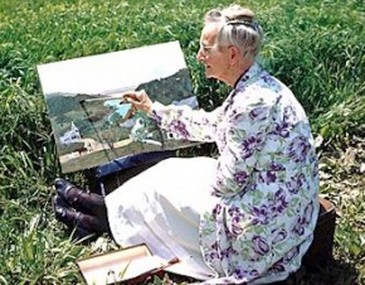
Grandma Moses at Work
I wish that nice people would stop being quite so scrupulous about “age-ism.” Their dire attempts to convince everyone that they hold no stereotypes about people like me have done much to embitter my life.
I only learned about age-ism when it became politically incorrect. As a child (in the 1950s, thank you for asking), I assumed that you just grew up and stayed that way, with nothing significant about you changing except that one day you dropped dead. Wrinkles and rheumatism occurred, of course, but why niggle over the tiny differences between a thirty-year-old grown-up and a seventy-year-old grown-up?
Adolescence and the first gray hair were horrors, naturally, but until the nice people took over, none of it was linked in my mind with personal competence. I didn’t get around to trying to write a book until I was over sixty. Then, still mired in the depths of that project, I encountered the following headline on an arts web site:
14 Brilliant Authors Who Didn’t Succeed Until Way After 30
If you haven’t sold your book yet, the author assured me, not to worry:
After all, dozens of famous writers didn’t “make it” until their 30s, 40s, 50s and, in some cases, even later than that.
One of these dogged late-bloomers was actually 34 before his first novel was published! Probably had dentures. Three of the others were 39. One of them, granted, was 90, but he’d been publishing screenplays for over half a century. If you, Older Unpublished Writer, find this at all encouraging, you can read the article here.
 I tried to find encouragement in the memory of Helen Hooven Santmyer, whose novel And Ladies of the Club was published when she was 88 years old. Its 1176 pages weigh in at 3.1 pounds. The story goes that she had been working on it for 50 years. I hope I can work on my writing for 50 years; that would mean I’ll live to 114. I’d like to be published before then, though.
Unhappily, I pursued my interest in Ms. Santmyer, and discovered that she had already published two novels before Ladies – the first when she was 30 and while she was holding down a full time job.
(I still love Helen. When the college she worked at was purchased by a fundamentalist denomination, she quit, because they demanded that she adhere to biblical literalism and stop drinking and smoking. I’m sure it wasn’t the literalism that made up her mind for her.)
I thought maybe I’d found my tribe when I came across a web site called Persimmon Tree. It bills itself as “a showcase for the creativity and talent of women over sixty.” But then its ‘about’ section goes on:
Too often older women’s artistic work is ignored or disregarded, and only those few who are already established receive the attention they deserve. Yet many women are at the height of their creative abilities in their later decades and have a great deal to contribute. Persimmon Tree is committed to bringing this wealth of fiction, nonfiction, poetry, and art to a broader audience, for the benefit of all.
I’m not cheering, people. You mean somebody gets to say when I’m at the height of my creative powers? Even I don’t know. I’ll bet I won’t know when that is, or was, not even in the minute before I finally do drop dead. Do the twenty-somethings get to cry Ageism! when they read that?
I say we drop the whole issue. Go sit down and write.
Descriptions are for Feeling
I’ve spent this week altering plot points in an important scene in my mystery novel. Since first I wrote it, the characters have evolved, their motivations have changed, and clues have moved, both geographically and logically. But when I surfaced from the job, I found that I had written almost nothing but plot. The reader was getting far too little help visualizing the scene precisely, getting the details that make places and events real and memorable.
Back to my trusty pocket notebook. It contains much plotless writing about things that have seized my eyes and my mind for reasons I wouldn’t even try to explain. None of them are directly relevant to my book. Still, reading these passages fills my mind with the experience of just noticing, of Being There. Maybe they’ll inspire me to find the details that will make my not-too-bad scene really good.
Here are a few of my pocket-notebook inspirations. I’d love to read some of yours.
At a meeting of our local weekly discussion group:
V_____ (a husband) talking, making sense, but pretty platitudinous. J____ (his wife) listening with unchanged expression and posture, but the hand holding her off-V_____ elbow was massaging it, tightening and loosening regularly.
G___ (a husband) discussing photos of galaxies in a book he owned, which he had already discussed with R______ (his wife.) He was addressing the rest of the group with the same arguments he and she had already gone over, but his eyes were usually on her, reliving their own discussion. A committed couple.
At a writing conference:
Up on stage, an author on a panel yaws his orange, desk-style chair rapidly left and right in a short arc. The other authors, in identical chairs, are perfectly still.
A writer teaches a class. As he speaks, in time with an upward lilt at the end of each sentence, his face first rises straight up, then straight out, always maintaining its vertical plane. With the adolescent (he’s not one) intonation, the gesture seems to mean, “You do see, don’t you? Am I being clear? Do you agree?” Sweet, if a bit phony. Yet somehow the gesture also seems mildly aggressive, snakelike.
In the room where I write:
A bird flew into the glass of the door to the balcony behind me. There was a softer thump than usual. I hoped that this would be one of the occasions when the bird just flew off with a headache. But when I went to look, he was lying on the balcony floor. I knelt to look, and saw that his eyes were open and unblinking. (At least I thought they were, but what color are a sparrow’s eyelids?) He wasn’t still. He lay on one wing and his little body was rocking quickly on its longest axis, backforth, backforth, backforth. I saw that he was not convulsing. There was no other movement, no movement of any part. Just his whole body, backforth, backforth, backforth. How could he do that without pushing any part of him against the floor? Then I realized that his heartbeat was moving him. In back and forth, I saw systole and diastole. Bismarck (my cat) came to the door and chittered. When I wouldn’t let him through, he sat and watched. I left, and when I returned, the bird was gone.
Months later: I am working at a card table. My elbows are braced on the table, coffee mug between my hands. My knapsack-purse stands across the table. I am motionless, but one strap of the purse, the looser and closer one, trembles. Why? I am seeing systole and diastole, my own.
A fruit fly remains on a piece of white paper where I put some grapes. A single fruit fly casts a shadow, even on an overcast day.
In the summer Music Tent in Aspen:
A description of Finns. I call them Finns because I think they might be, but more because the first of them I saw made me think at once of a Scandinavian gnome. He was an old man of middle height. We were sitting two rows up from him in the Benedict Music Tent, so I couldn’t see whether white hair sprouted from his ears. But his face was such that I was sure of the ear hair. His skin was a dark brown, but it looked weathered rather than tanned. Or perhaps “tanned” in the sense of leather. Large wrinkles divided his face into subsections. His eyebrows were wild, almost long enough to obscure his vision. His nose was large and long and bulbous, three lumps separated by two none-too-narrow narrower places. His mouth was wide, his lips not especially so. He was smiling, nodding, and talking energetically with the people who accompanied him. They were Aspen Standard, as far as I could see. I can’t remember whether I saw that his teeth were scraggly or assumed it. He was wearing standard old-guy-in-Aspen clothes, a vaguely Western sports shirt and slacks.
The woman was sitting in the row behind them. She came in later with other people, but they all seemed to know one another. My first thought was that she was the ugliest woman I had ever seen. But at the same time, her face was welcoming. I had to work not to stare, and then not to be caught staring. She was the man’s age and about the same height. Her skin was almost as brown as his, very smooth but speckled with large age spots. Aside from the old-lady, nose-to-chin wrinkles, she had almost none. In profile, her face made a perfect convex curve. Her chin was well back, but not receding in a slant; it looked firm, and she didn’t have the feeble, chinless look of a Bertie Wooster. Like the man, she had high cheekbones and a very notable nose. Her nose curved like a raptor’s beak, but not like a witch’s: it didn’t curve back in, but ended at its outermost point, with the septum horizontal to the ground. Not small, but neat. Both man and woman had large ears, his relatively larger than hers, but her hair framed her ears and made them stand out. Her hair was long but not full, clipped back with barrettes behind the ears and straggling down her back. From the roots to her shoulders, it was a slightly grayish white. There, in a visible line, it became a faded, reddish light brown, as if some instantaneous shock had flipped a switch in her scalp. She too was smiling and talking, and her expression made me want to know her.
Now, back to my scene. I’m going for three, very short details with the feel of these passages. I suppose “short” will be the hard part.
October whispers in my ear
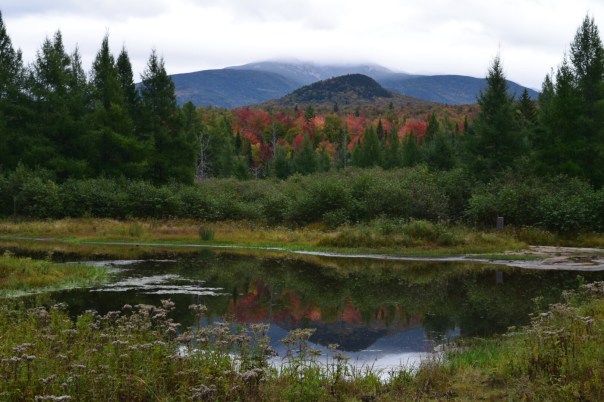 October is here and we in northern New Hampshire know what the forecast is. Changing seasons: shorter, cooler days. Turning leaves: tour buses, leaf peepers. Flipping the family photo calendar: grandchildren clad in Halloween costumes, my mother’s birthday. Swapping out my wardrobe: fleece, socks and sneakers. Fall cleaning: screens down, deck furniture in.
October whispers in my ear: I know you’re busy but don’t forget that NaNoWriMo is on its way. November first is less than thirty days away now. Don’t you always say you are going to start preparing for NaNoWriMo in October? Get your outline and character sketches done so that you can just start typing away on November 1 with your outline for reference? I bet you can exceed 50,000 words if you do that.
This year I have a response. Listen, October, stop bugging me. I am working on an outline for NaNoWriMo. I already have my characters’ names with personalities formed, allowing for more novels to follow. I’ve drawn a rough map of the town where the murder takes place. I’m reading Louise Penny’s “Inspector Gamache” novels to make sure that I don’t end up copying her quaint, idyllic, deadly town.
It’s a real temptation, especially as this area of New Hampshire abounds with similar towns: a town common or green surrounded by old churches, old stately homes, old maples, old, white fence, old pines adorned with Christmas lights. Possibly a gazebo decked with red ribbons and sparkly snow. You get the drift….
My fictional town of Woodbury wears a blue-collar attitude. A diner instead of a bistro. An auto repair shop in place of a bookstore. A run-down motel instead of a B & B. The hub of the town? A Village Store where the locals go to catch up on all the gossip they missed at the diner. And let’s not forget the farms on the dirt roads spiking out of Woodbury. Beyond town lies another world, a lake populated with out-of-state visitors, some who visit for the summer, most just a week or two.
And there’s plenty more. I think I am in better shape than I have ever been for NaNoWriMo.
So take that, October.
 Eleanor Ingbretson
 Karen Whalen
 llandrigan
 Heidi Wilson
 Mike M
 Thursday Night Writes