Category Archives: Heidi Wilson
Shakespeare Encumber(batch)ed

Hamlet (or Mr. Cumberbatch), in the throes of madness
(christmaswarehouse.com)
Last night, I didn’t see Benedict Cumberbatch play Hamlet in HD at Dartmouth’s Hopkins Center. He certainly played Hamlet, the melancholy Dane, only the play wasn’t Hamlet. It was a three-hour performance of pieces of Shakespeare’s play, sliced, diced, and chopped. The meal was tasty. But I went for a dinner of Hamlet and got several interesting “small plates” instead.
I don’t call in the Holy Inquisition whenever anyone alters a word of Shakespeare. New views of old masterpieces occur each time anyone first reads/sees/hears them. Experiments with the text can be fine. And Cumberbatch is a perfect Hamlet for our times: a man trying to do the honorable thing in the face of enormous evil and confusion. Cumberbatch also treads the line between verse and ordinary speech so well you don’t notice he’s doing it. The play would have been comprehensible to an intelligent high-schooler, which is not always true of more conventional productions.
But why open with Hamlet in an attic, listening to a portable record-player spew out Johnny Mathis? Well, all right, if Horatio will then appear and we can get right out on the battlements and see the ghost. But no. Horatio’s first business is to get Hamlet to for Heaven’s sake come downstairs to dinner with the court. When he gets there, everybody else is dressed in Edwardian style. (I suppose Downton Abbey now defines “the olden days.”)
When the ghost finally appears – oh, dear. He speaks his lines very well. He even disappears at one point down a very Shakespearean trap door. But he also rips open his shirt to display a precise plastic imitation of mouldering human flesh. Just like in the movies. The camera closes in, so the HD audience gets a better view than the theatregoers did. And there is a musical (?) sound track, just like in the movies, that conventionally roars its instructions to the audience: Be horrified! Be grossed out! The sound track banged on through most of the play, often drowning out the actors, while the lighting effects mimicked sharp camera cuts.
Hamlet, in case you’ve forgotten, pretends to be mad while actually being driven almost mad by his impossible situation. Poor Cumberbatch, whether willingly or not we may never know, enacts this strategy by trying on a Hallowe’en costume or two, then settling on the uniform of the traditional toy soldier, complete with snare drum. He then marches the length of the banquet table – that’s on the table – drumming. This fools everyone.
Other business is equally incomprehensible. Ophelia has hobbies: she take pictures with a Mathis-era camera and she plays the piano. And your point is? Her final madness causes her speech to soften and accelerate so greatly that she might be listing the deadly side effects of some newly advertised drug. We certainly can’t hear her.
Then, in the final scene, as we try to weigh up the pros and cons of the production, Cumberbatch gives us a performance that absolves him of all offenses. He believes entirely in his reconciliation with Laertes; he behaves and fences like the Elizabethan gentleman, athlete and scholar that he really is, and he dies reconciled to death.
I’m no tekkie, but I hope some computer nerd somewhere will make sure that this performance will be preserved for the ages.
Baby’s First Rewrite
I think I passed a milestone this week.
It wasn’t literally my first rewrite of a scene. My writing group would never let me get away with that. All kinds of changes have rippled through my manuscript, usually to remedy total howlers in the plot, but also to remove unlikely remarks by a character or make my subplots more like a braid and less like railroad tracks.
This week is the first time I forced myself to abandon a scene totally and write another to do the same work in the book, better. Be warned: it hurts.

If only my red pencil were as sharp as the Geisha’s blade!
(Geisha’s Blade Philippines Samurai Sword Shop)
Two criticisms forced me to it. Our group’s homicide detective told me that interviews of witnesses would never be conducted with other witnesses present. You isolate them and get each one to tell her own story. Even weightier, there was a sad consensus that ‘it all went on too long.’
Even I could feel the latter problem. While I never used the dread locution, ‘and then,’ I might as well have. On plodded the scene, until slept the mind. I resolved on surgery.
I work in the Scrivener writing program. It’s hugely useful, letting you switch from any scene to any other with a single click, showing links to notes, outlines and subplots on the main page. Unhappily, that makes it so easy to tick back into your original draft, to tinker with it instead of starting fresh, to cheat by leaving your new text to lift just one or two sentences – such clever prose! – from the old.
Somehow, this time, I realized that I had to resist. I stayed with the blank white screen of the new version. When I needed to analyze the old scene for necessary information, I did it in longhand on a yellow pad. I changed the location of the scene, narrowed the point of view, pushed beloved characters into the background.
Lo and behold, it worked. When I checked back with my yellow pad, I found that the new scene did all that the old did, more briskly, with more conflict in the present and more tension about what is to come. The new scene is 25% shorter.
The exercise wasn’t without losses. On my yellow pad, I had drawn two columns: Needed and Good. The latter listed five brief passages in the original scene, a few words or a sentence or two at most, which I liked very much. Four of them showed characters acting characteristically. When I had forced my way through the new scene, these vignettes were gone. The course of action just didn’t allow them to happen.
Were they darlings? I still don’t think so. I’ve stored them in a file called ‘fragments’ for possible reinsertion in a final smoothing. Deep in my heart, though, I don’t expect to see them again.
Dancing About Architecture

Donald Swann in full voice
Singer and composer Donald Swann once said that writing about music is like dancing about architecture. You can walk around that simile for quite a while. The writing is pointless? Music is bigger, more impressive, more lasting and hence more important? The one can’t substitute for the other?
At the moment, I’m writing about architecture, and Swann’s dictum haunts me. I need to take my readers into a house that is as real to me as my own. I know that each reader will blend my descriptions with her own home, her family’s homes, her feelings about home in general and god knows what else. But I need her to see some parts of the house clearly, and I want her to experience much more than an architectural plan.
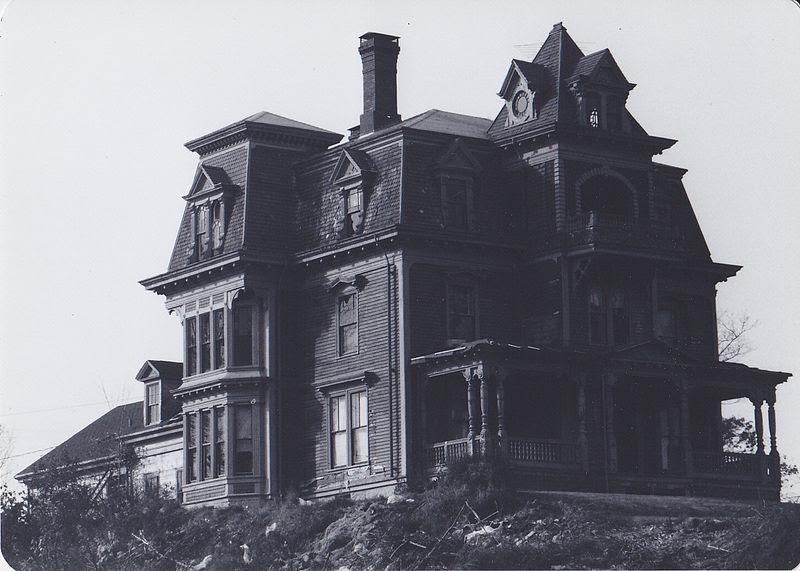
A possible model for Fallowfields
The fictional house in question, recently named Fallowfields by its snobbish owner, was built in the late 1800s in rural New Hampshire. It is an uneasy blend of Victorian-era ostentation and New England tradition. Both aspects are important to my plot and to the personalities of my characters. So both have to come through.
My plot requires that people sneak around the place, in and out, upstairs and down, undetected. So I designed Fallowfields on the model of ‘big house, little house, back house, barn.’ Farm housekeeping in the nineteenth century required more than one structure. The little house was usually built onto the back wall of the big house, which was where the humans lived. It might be a summer kitchen, a dairy, a woodshed or all three. A third structure, the back house, would share the back wall of the little house and shelter a different activity. One way or another, all the space that made up the house was formed around the chores and the home production of goods that supported the family.
The Fallowfields barn now has an apartment built into the old hay loft. My heroine has converted the tack room into a home laboratory for her botany experiments. Readers need to notice that proximity. The little house has, unusally, a second story and an internal flight of stairs. There’s another flight at the front of the big house. Before we can do exciting scenes of rushing up and down and dodging round the house, I must lay the routes out for the reader in the course of their ordinary use. Needless to say, my writing group read the early drafts and scratched their heads. “Wait! She was in the barn. How did she get to the bedroom?” Time to revise.
I want much more from Fallowfields than these mechanics. My heroine is facing forced retirement from work that took her around the globe. Unless I can convey her growing contentment with a life in northern New England, she and the book will come to an unhappy end, which is not my intention. Fallowfields and the rest of her home town must convey the possibility of that contentment.

A view of Peacham
Parts of Fallowfields are based on my grandfather’s house in Peacham, Vermont, purely for the pleasure I take in recalling it. To a five-year-old, its little house was Aladdin’s cave. It held pairs of rubber boots tall and thick enough for Jack-in-the-Beanstalk’s giant, or to survive a universal deluge. There were thin bamboo sticks as tall as my father and balls of bright green twine that would stake vines in the garden next summer. There were little, square wood boxes streaked inside with bright crimson, waiting for yet another year’s raspberry crop. There was a tub of something called paraffin, which I was forbidden to touch. It felt smooth and slick.
Grandpa’s back house was a chicken house. Every egg we ate in that house was less than 24 hours old. At Fallowfields, the old chicken house has been converted into a paradise for a pair of pet ferrets, but hovering sharp and dusty in the air, somewhere between a scent and a memory, is the smell of the feathers, droppings and dirt generated by a flock of healthy chickens. Even today, one breath of that scent takes a half-century off my age. Can I manage to show that? Because telling just won’t do.
Waiting for inspiration
Inspiration…..waiting…..waiting…..when are you going to swoop down and write my blog post for me? That is what usually happens when it’s my turn but this time not so much. Oh, yesterday I wrote enough words to comprise a post. But they weren’t anything I would reread in a few months and wonder if I had actually written them or if my name were mistakenly attached to someone else’s writing.
Yet it’s been hammered into my head that I shouldn’t wait for inspiration. I need to be disciplined, sit down at the same time every day and write. Treat it as though it were a job–unpaid, but a job nevertheless. And some of the members of my writing group do that. They are the ones who produce, who eagerly volunteer to submit their writings for next week’s critiquing by the group.
Where would I be without my writing group? We celebrated our sixth anniversary at last week’s meeting. Six years!! Of the seven attendees, five are charter members and two are “newcomers” We toasted with port, indulged in a multitude of desserts and snacks, and reminisced. I left feeling reinvigorated, ready to tackle (and finish!!) “Claire.” Again.
The next day the four ladies of the group met for our usual Friday lunch. Heidi provided me with an idea for “Claire” that I absolutely will use. It’s a tweak to the story line that started the wheels in my mind turning and whirring.
Three full days later and I haven’t written a word. But I will.
In addition, the three ladies listened patiently as I outlined, off the cuff, my concept for the upcoming NaNoWriMo (National Novel Writing Month) in November. I know what you’re thinking: 1) it’s only September and she’s already started her plot for NaNoWriMo? and 2) she’s going to attempt NaNoWriMo again? She doesn’t need a new writing project, she needs to finish something she’s already started. What is she thinking??
The answer is, for me writing isn’t about thinking. It’s about feeling. That’s what makes me a better pantser than a plotter.
Also, I mentioned in a previous post that without agreeing to submit to my writing group and posting to this blog, I wouldn’t write. I neglected to include committing to NaNoWriMo. It’s potentially 50,000 words that I otherwise would not write.
My proposed story for NaNoWriMo has a personal foundation going back to my grandmother in Germany. Unfortunately, she’s not alive so I will have to rely on the memory of my eighty-seven year old mother to provide the background for my NaNoWriMo novel. In addition, it will involve research about World War II, something I can do in advance of November 1. “Can” doesn’t necessarily translate into “will” I have found.
Linda, Heidi, and Eleanor were supportive of my concept. And of my writing ability. What a wonderful feeling to enjoy a cup of clam chowder with people who have become good friends, talk about writing–and leave with my ego pumped up just a bit.
Vicarious Eviltude
‘Eviltude’ is our family’s term for a certain kind of transgression: those delightful delicts that are entirely voluntary, pleasurable and unregretted. Taking the last piece of chocolate cake without apology or second thought is eviltude, as is buying that adorable, vulgar sequined vest that you will never have the guts to wear in public. Eviltude can be identified by a certain YAHOO! feeling, lamentably scarce in my day-to-day life.
There are days, though, when it just isn’t enough. Respectability weighs heavy, and the odds of becoming a pirate seem vanishingly small. That is one of the times when writing murder mysteries comes to the rescue. (Yes, I know we call it crime fiction now. Mine are murder mysteries.)
Kate Flora blogged the other day, on Maine Crime Writers, that “writing things out of our systems is why we crime writers usually are pretty cheerful.” And this is true. Giving an unpleasant character some of the traits of your venomous neighbor can really ease your mind. It probably counts as eviltude. But it seems to me that Kate left out a lot of the upside. When I am plotting crime, I’m not just relieved of care, I’m gleeful. There is nothing I couldn’t do! And nobody I don’t want to get caught, will get caught!
I just finished reading The Map Thief, a nonfiction account of Edward Forbes Smiley III, who stole hundreds of rare maps from libraries, sold them to collectors and lived the jet set life among the ultra-rich. I learned the details of library security systems, the twist of the wrist used to run a razor blade down a book binding, and the little alterations that can be made to disguise a stolen parchment. It just so happens that my mystery #2 concerns the theft of an ancient manuscript, complete with gorgeous illuminations, glittering and bizarre.

Monkey-lion centaur sawing books (much worse than eviltude)
(Courtesy British Library, Add. 49622, f.146)
As I read about Smiley, I kept thinking, “I could use that! I could use that, too!” It was almost as if I were stealing the books myself. Onward to piracy!
With only two plots (and no completed manuscript) to my credit, I’m amazed at the amount of mayhem I have already enjoyed. Young and old have fallen at my hand, by poison, violence and an intricate plot involving a clown at a children’s party.

Clostridium botulinum bacteria. (Science Photo Library)
As a bonus, every murder needs alternate explanations that the detective must investigate and discard. It’s as much fun as killing your venomous neighbor two or three times. In mystery #1, the first victim is found to be full of botulism toxin. Of course, it is found in the canned tomatoes. But the victim’s house is also full of Botox (as is the victim’s fiance.) How to choose? Shall I have a single murderer kill several people off, one per source of botulism? Or shall I invent more murderers? Now sounds the evil pirate laugh, BWAH-HAH-HA-HA!
I’ve begun to see opportunities for murder in every chance-met object. Here in rural New Hampshire, we have myriad neglected houses dating back a century or two, just crying out for renovation. What if, while the carpenters are rebuilding the sash windows, having found lovely antique sash weights for the purpose, a murderer finds his victim alone in the house?
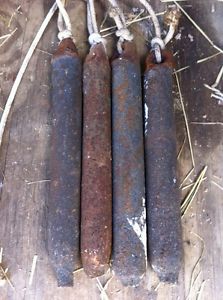
6-lb Antique Sash Weights
(Need a blunt instrument? Get these on Ebay!)
In my saner moments, I fear no good can come of this. Vicarious eviltude could take me to new and dangerous places. I might just wear that vest. To a bar. Where I would get into a fight. With a cop…. Or maybe I should just keep my eviltudes vicarious.
It’s Christmas!
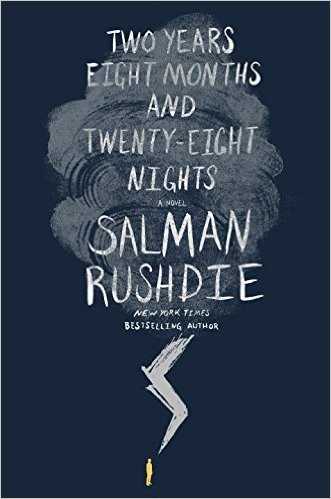
My pre-order has been in for weeks (at my local independent bookstore, of course.) Tomorrow I shall swoop down and scoop up my copy of Two Years Eight Months and Twenty-Eight Nights. It is Salman Rushdie’s first new novel in seven years. Everything else I’m currently reading will start gathering dust.
I encountered Rushdie in the same way many others did: I bought a copy of The Satanic Verses purely to show solidarity against censorship, after Iranian clerics ordered that Rushdie be murdered for the “blasphemy” it contained. It sat on my shelf unread for years. Once I finally read it, I began a reading marathon of everything he ever wrote.
How to explain his magic? Plot summaries wouldn’t do it, even if I could recall every twist and turn of the fantastic events that befall his characters…his myriad characters, his worldsful of characters, the armies of imagined people who march, parasang upon parasang, the length and breadth of the Rushdie universes.
The universes themselves are miracles. These are not alternate worlds like Middle Earth or Westeros. They contain, for example, the India we all know, the England, the United States. They also contain impossible events (two men survive a fall from a bombed plane miles in the air), strange powers (e.g., telepathy and witchcraft), eerie coincidences (an Indian songwriter anticipates all Elvis’s greatest hits.) Real-world politics, popular culture, “high” culture – usually taken down a peg – toss these very-not-ordinary people hither and yon. Some of them survive and even triumph, in a way. Others are ground to bits by the entirely ordinary evil and stupidity that permeate every human institution. But somehow, Rushdie’s Children defeat even defeat itself, simply by being more genuine – realer – than the real-world institutions that destroy them.
If I had to choose one characteristic that will keep me reading Rushdie till they bury me, it would be his perfect pitch for detail. Given his tortuous plots, many in the 500-600 page range, he must select just the right objects to bring the meaning of each scene into focus. Here is a passage that begins by evoking a real-world place in rather general terms, only to explode into the imaginary detail it calls forth from a character’s mind. From Fury:
“In Amsterdam in his middle twenties Malik Solanka – in the city to speak on religion and politics at a left-leaning institute funded by Fabergé money – visited the Rijksmuseum and was entranced by that great treasure-trove’s displays of meticulously period-furnished dollhouses, those unique descriptions of the interior life of Holland down the ages. They were open-fronted, as if bombs had knocked away their façades; or like little theatres, which he completed by being there….
“After a few visits, however, it became clear that mere houses would not be enough for him. His imaginary environments must be peopled. Without people there was no point. The Dutch dollhouses, for all their intricacy and beauty… finally made him think of the end of the world, some strange cataclysm in which property had remained undamaged…. After he had this idea, the place began to revolt him. He started imagining back rooms in the museum filled with giant heaps of the miniature dead: birds, animals, children, servants, actors, ladies, lords.”
And how about that “left-leaning institute funded by Fabergé money”?
So tomorrow I shall vanish from the world for some days, to read Rushdie and do nothing else. I hope my friends will speculate that something very odd may have happened to me. After all, I understand that in Two Years Eight Months and Twenty-Eight Nights, genies rise up from the sea bed in New York Harbor and eat the Staten Island ferry.
Word Death
Eventually, the words get you.
You struggle with plots, with character development, with the godawful job of pulling it all together. And while you are wrestling with that angel, the words he is made of creep through your pores and invade your brain. They become the plaque that stops the neurons firing.
It happened to James Thurber. Much of his last two books, Lanterns and Lances and the posthumously published Credos and Curios,

My 1962 copy of Credos and Curios
were compendia of words that had dug their little claws into his mind and wouldn’t let go, long lists of words that had, perhaps, only sounds in common, or were all place names or first names beginning with O. He packed them up and disguised them as essays and stories, and his most devoted fans slogged their way through, but even they knew it was crazy.
Thurber had shown signs of the word disease much earlier. After “The Night the Bed Fell” and “The Night the Ghost Got In,” he wrote “More Alarms at Night.” In it, you hear the Siren song of verbal miscellany. One of the episodes recounted in “More Alarms” begins when the words won’t let Thurber sleep:
I had been trying all afternoon, in vain, to think of the name Perth Amboy. It seems now like a very simple name to recall and yet on the day in question I thought of every other town in the country, as well as such words and names and phrases as terra cotta, Walla-Walla, bill of lading, vice versa, hoity-toity, Pall Mall, Bodley Head, Schumann-Heink, etc., without even coming close to Perth Amboy…. I began to suspect that one might lose one’s mind over some such trivial mental tic as a futile search for terra firma Piggly Wiggly Gorgonzola Prester John Arc de Triomphe Holy Moses Lares and Penates….
When I read that for the first time, I nearly fell off the end of my mother’s bed, laughing. Mother, propped up at the head and reading herself to sleep, listened with a grin as I read it aloud, choking with laughter. But in Thurber’s later books, the humor had drained out, leaving only the words.
Thurber’s woes came back to me when I read Howard Elman’s Farewell, Ernest Hebert’s wonderful finale to the Darby Chronicles. In the first book of the Chronicles, The Dogs of March, Howard Elman is an illiterate adult, a man with a good eye and a wondering mind but few words with which to order his experience. His rural New Hampshire world is being invaded by the come-heres, wordy, untrustworthy flatlanders who end by taking not only Howard’s land but also his children into their insubstantial world of hot air and incomprehensible notions.
In the Farewell, Howard has learned to read, and death approaches. He is now up against the next generation of strangers, who are obsessed with ones and zeroes and with an ‘ecosystem’ apparently coterminous with, but different from, the New Hampshire forests he loves. They seem to have invaded, not from the flat lands, but from Mars. One of them is his son, who has changed his name.
In this milieu, words have begun to bother Howard. You accumulate them, they name new things that may or may not exist, and then when you put them up against each other, you can see that they don’t make sense. What do they mean, “the prime evil forest”? “Why does ‘purposes’ sound so much like ‘porpoises’?” Howard has begun talking to himself in a final attempt to ‘combobulate’ his world. “How to say it and make it make sense?”
Perhaps it’s a problem of scale. Thurber vanished into minutiae. From Howard Elman’s point of view, his son’s new friends operate in a world of vast, airy nothings. All their words are code words, but the code refers to nothing he can get a grip on. Behind the airy nothings he can see only more airy nothings.
For those of us less talented than James Thurber and Ernest Hebert, a focus on the words themselves just produces ‘darlings’ – abominable cutenesses and dreadfully, dreadfully clever repartée. Once these insinuate themselves into a first draft, the novice writer can find them impossible to dislodge, even knowing that the reader will find them impossible to stomach. When the words begin to preen themselves this way, when you feel the poison creeping into your writerly veins, what to do? Here is one suggestion: imagine this question from an innocent, eager child reader:
“But what happened next?”
Free Names

Listen Up!
For some time, I have been keeping a small notebook in my purse in which to capture fugitive ideas, oddities, vignettes, and joyful or horrid happenings for use in future writing. From this exercise has come, among much else, a long list of weird names encountered in the press and occasionally in life. I long to use them in fiction, but since they belong to real people, the best I can hope for is to mix and match. Today, I want to share some of this raw material with you, my fellow writers, who may well come up with better matches and better mixes than I. Feel free.
Some of the names are simply too appropriate to be believed. There are:
- Sir Jock Stirrup, once head of the British armed forces (and now Baron Stirrup.)
- John Stalker, an ex-Deputy Chief of Police.
- James Naughtie, the BBC Today interviewer of a heterosexual man who, after a stroke, “woke up gay.” Naughtie was described by Britain’s Daily Mail as “the formidable BBC pinko who turned the airwaves blue.”
- UK Member of Parliament, Mark Reckless, who bolted the Conservative Party to join the Independence Party.
(The English outnumber the Americans in my list. Does this Mean Something?)
Here at home, the items in my collection seem to come with brief stories attached. I itch to fill them out:
From my cookbook shelf, Crescent Dragonwagon beckons. According to my sister-in-law, who claims acquaintance with her (and that is not the kind of source one questions), Ms. Dragonwagon married an enlightened man who did not insist that she take his surname. Neither of them wanted a hyphenated name, however, so they made one up. The marriage ended, but Ms. Dragonwagon’s  vegetarian cookbooks were already well known, so, publicly at least, she will be Dragonwagon to the end of her days. The stuff of tragedy.
I found another name near the end of a news tidbit about the theft of a Stradivarius violin. We were several paragraphs down into an account of the Strad before the perpetrator appeared: “The violin, which police said appeared to be in good condition, was stolen late last month from a concert violinist who was shocked with a stun gun…. Police traced the stun gun to Universal Knowledge Allah, a 36-year-old barber….”
A cousin of Michelle Obama made the papers very recently. Rabbi Capers Funnye of Chicago was nominated to become what an international organization is calling the first “black chief rabbi” of the 21st century. A statement from the International Israelite Board of Rabbis declared that Funnye would serve as the “titular head of a worldwide community of Black Jews.” And why not?
Internationally, my best name source so far came from an account of Ted Cruz being booed off the stage at a gathering of Middle Eastern Christian ecclesiastics. It was also my best source of impressive titles. In the audience were:
- Patriarch Mar Bechara Boutros Cardinal Raï, Maronite Patriarch of Antioch and All the East;
- Gregorios III Laham, Melkite Greek Catholic Patriarch of Antioch and All the East, Alexandria, and Jerusalem [pictured at the top of this post];
- Ignatius Youssef III Younan, Syriac Catholic Patriarch of Antioch and All the East;
- Aram I Keshishian, Catholicos of the Great House of Cilicia of the Armenian Apostolic Church;
- Metropolitan Joseph Al-Zehlawi, Archbishop of New York and All North America for the Antiochian Orthodox Christian Archdiocese of North America;
- Bishop Angaelos, General Bishop of the Coptic Orthodox Church of Alexandria;
- Ibrahim Ibrahim, Bishop Emeritus of Chaldean Eparchy of Saint Thomas the Apostle.
I don’t know where to start the character list for my fantasy novel, with the Catholicos of the Great House of Cilicia or the Bishop of the Chaldean Eparchy of Saint Thomas the Apostle. George R. R. Martin, look out! (Alas, the first result of a Google search on the Eparchy was a parish listing — in Southfield, Michigan. The glamor is gone.)
Okay, writers, start your pens. Pick a name and give me a scenario.
An Aspen Phantasmagoria
What brought all this on was a man who passed me on the sidewalk of Main Street in Aspen, Colorado, one fine July morning. He’d be called a “big guy” by the polite; that is, he was well over six feet tall and appeared to be pregnant. His expression was mildly concussed, though most likely, that was just pot. Stretched across his beer belly was a drab gray, hip-length tee shirt sporting in firework colors the legend, BAZINGA!
Not an unusual sight in Aspen. But there are few unusual sights here. Anything and everything shows up, and nobody pays any attention. Incongruities rub shoulders without noticing one another. The motto seems to be “Never connect.”
This fact only started bothering me when I started to write. Writers invent connections, of course. That’s the job. But in most places, in most situations, there’s a pre-existing network of workaday relationships growing through time, a warp and woof. On that, we stitch a story. If you write about Aspen, you write without a net.
Chronology won’t help you. Aspen’s history is a series of jerks and starts. A mining boom created the town in 1879, but by the 1930s, population had dropped again to 700 or so. After WWII, the craze for skiing brought in small numbers of permanent residents and many more seasonal ones. In came the full-time ski bums and the part-time resort patrons. And money. And more money.
Finally, one Walter Paepcke, corporate executive, philanthropist, skier, music lover, founded the Aspen Institute, the Aspen Ski Corp. and the Aspen Music Festival and School on top of everything else. That was the Big Bang, and Aspen has been hurtling away from itself ever since. The ski bums, the potheads, the fat cats, the intellectuals all orbit their own kind and pass through the rest like neutrinos.
So here are a couple of weeks’ observations from the streets, restaurants and concert venues of Aspen. Make of them what you will.
The program announces Beethoven’s Violin Concerto in D Major. The soloist will be Augustin Handelin, unknown to me. The concertmaster appears, wearing black tie. The conductor appears, wearing black tie. Pause. The soloist appears. He is dressed in a Nehru jacket of grubby white with matching trousers whose hems drag behind his heels. He stops, bows, smiles. Can it be? He seems to be wearing lipstick on a mouth (and none of us can help how we’re made) that has side extensions like the Joker in the Batman movies. Surely that powdery white is not his natural complexion? The Concerto has an extended opening before the soloist begins. He stands and waits, grimacing with overwhelming emotion. Or with something. I can’t watch. And then, note by perfect note, he takes the entire audience to Heaven with him.
Aspen is full of terrifying crones with long, jet-black hair (perfectly coiffed), gold jewelry of ball-and-chain weight, blood-red lips and eyebrows disciplined into the perfect accent circonflexe. They do not look like people who listen. Some of them, however, do take mountain hikes. Their presence lingers on the trail in the scent of Diorissimo.
Not all female denizens are slaves of the salon. The New England Puritan is well represented. From my seat at a window table of The Bakery, I watch a woman of a certain age with streaky gray hair, sitting at the bus stop. Her ironed blouse, shorts and vest are as neutral as her hair, spotless and rigorously ordinary. One knows that she bought the turquoise running shoes only because they didn’t come in beige. Beneath the crags of Ajax Mountain she sits, the New York Times folded beside her, atop a copy of The Atlantic.
A new(er)comer to the Aspen Institute complex is the Aspen Center for Physics. Here, people whose brains are of another order than yours or mine come to think about the nature of the universe in peace and quiet. But the Institute does its best to reach out to all sorts and conditions of men. Hence you may, if you like, attend a lecture tonight on “Engineered Magnetism in an Atomic Bose-Einstein Condensate.”
Just down valley in Basalt, Colorado’s newly legal marijuana industry is powering up. The selectboard will wrestle tonight with its own problems of physics: the mountain wind currents and the greenhouse exhaust fans are choking retail and residential districts with the skunky smell of cannabis bloom.
Way, way back in the seventh row of violins (Aspen orchestras run heavy to strings), sits a very small Japanese girl, perhaps 16 years old. She has followed the orchestra dress code: her blouse is white, her skirt and shoes black; she wears no jewelry. But her hair has been cut and dressed to fall in asymmetric wedges and some of it is caught up in a plastic clip shaped like Hello Kitty. She is clearly human, but a human modeled on an anime character crossed with a furry marketing behemoth. One assumes this was voluntary.
Is this just me? Are all these disconnects making me see grotesques where there are none? A scarier question: am I one of them, at least when I’m here?
On Moving the Tuna

You wouldn’t have thought it would be so hard. The moderator of our writing group suggested, with that air of modest assurance that so becomes him, that I should separate Scene A (in which a ferret scatters tuna fish all over a carpet, with disproportionate results) from Scene B (in which the ferret compounds its alimentary offense with the eliminatory consequence and precipitates a crisis.) He was right: together, the scenes were almost repetitious; separated, they helped create a steadily mounting tension. Scene A needed to move back in time.
It turned out to be a game of jackstraws. I re-dated the tuna scene. How to fill the now gaping void between it and Scene B? As luck would have it, I had a brief new scene already planned that was going to simplify the presentation of later events. It went into the breach. Out came a lot of now misplaced material, before and after. That demanded more of the new scene, to patch up the ragged bits. It became half a chapter. That suggested another move, to slim down a later scene, newly overloaded.
We’re talking three months, here, people! Three months of jury-rigging and jerry-building and tearing down and putting up again from scratch. I think the most painful part was having to re-insert huge chunks of the original text, when repeated efforts proved that they really had to go somewhere. And of course, no person of sensibility can partially edit a text. Time spiraled down the plughole as I inserted commas and corrected diction.
By the time the tuna had settled down, I had been forced to outline that whole section of the book. To my amazement, three of the four subplots were now perfectly in order. (The last one looked like a dog’s lunch, but three out of four ain’t bad.) If I’d done that outline in the first place, I wouldn’t have had to move the tuna at all.
Then came enlightenment. I have always been a devout pantser (i.e., I write by the seat of my pants.) The Exuberant Brethren of the Holy Pants believe that inspiration dies at the sight of an outline.  Only by letting the words flow directly from the Muse through the fingers to the keyboard can creation take place. Do not pass brain, do not collect $200. You can clean up any slight problems later. The Severe Order of the Sanctified Plot make up the whole plot in advance. They write it down. They make diagrams. They balance things. Then, scene by scene, they write the first, and practically final, draft. Or so they say. They clean up any slight problems later.
I won’t say I’m ready to join the Sacred Order. Instead, I’m going to copper my theological bets. Four of us Thursday Night Writers have reserved a virtual cabin at Camp NaNoWriMo, an online writing sprint in which we each promise to complete a “writing project” of our choice in the month of July. I’m going to outline a whole second adventure for my amateur sleuth, just to prove I can do it. Who knows? If I ever manage to sell this turkey, I may need a sequel.
 Eleanor Ingbretson
 Karen Whalen
 llandrigan
 Heidi Wilson
 Mike M
 Thursday Night Writes