Category Archives: writing

Perfect wrinkles

I just finished ironing some of the clothes I am about to pack to take on our cruise and land tour of Alaska. One of my daughters was aghast that I would bother to iron before the clothes were stuffed into our suitcases, where they will certainly grow new wrinkles no matter how carefully I roll and fold them.

It goes against my grain to perform anything less than to perfection. Just the thought of packing a pair of unironed pants with wrinkles sends waves of revulsion through me. Well, that may be a slight exaggeration. (But as a writer I am entitled–no, encouraged–to hone my exaggeration skills.)

The need for perfection is a known cause of procrastination for writers. “Perfectionist paralysis” is defined by Urban Dictionary as “the inability to start on…any creative task due to the fear of not getting it perfectly right.” Yup, that’s me. And it’s not limited to starting a project, I’ve found. Revision is also included in that category.

But I’m working on it. I’d love to finish that novel I started in 1986.

Four of us from my writing group have committed to join the July Camp NaNoWriMo, similar to the November NaNoWriMo (a 50,000 word novel in 30 days), except in July we have more flexibility with our projects. We are going to use our weekly “pinky swears” as our projects. For the past week, as I’ve been trying to return to sleep after my early morning jaunt to the bathroom, I’ve been laying in bed pondering my project. I think that’s a good start. After all, I still have two weeks to prepare.

One of my writing group members asked if I would get much writing done on my trip. I plan to keep a journal. But beyond that I know without a doubt that my fiction will flounder. I expect to be too enamored by glaciers and fjords, hopefully even some whales and grizzlies, to focus on Claire, Anne, Olivia, and Emily.

And it’s very likely that I’ll be too busy to notice the wrinkles.

On Moving the Tuna

oceanic_foodweb


You wouldn’t have thought it would be so hard. The moderator of our writing group suggested, with that air of modest assurance that so becomes him, that I should separate Scene A (in which a ferret scatters tuna fish all over a carpet, with disproportionate results) from Scene B (in which the ferret compounds its alimentary offense with the eliminatory consequence and precipitates a crisis.) He was right: together, the scenes were almost repetitious; separated, they helped create a steadily mounting tension.  Scene A needed to move back in time.

It turned out to be a game of jackstraws. I re-dated the tuna scene. How to fill the now gaping void between it and Scene B? As luck would have it, I had a brief new scene already planned that was going to simplify the presentation of later events. It went into the breach. Out came a lot of now misplaced material, before and after. That demanded more of the new scene, to patch up the ragged bits. It became half a chapter. That suggested another move, to slim down a later scene, newly overloaded.

We’re talking three months, here, people! Three months of jury-rigging and jerry-building and tearing down and putting up again from scratch. I think the most painful part was having to re-insert huge chunks of the original text, when repeated efforts proved that they really had to go  somewhere. And of course, no person of sensibility can partially edit a text. Time spiraled down the plughole as I inserted commas and corrected diction.

By the time the tuna had settled down, I had been forced to outline that whole section of the book. To my amazement, three of the four subplots were now perfectly in order. (The last one looked like a dog’s lunch, but three out of four ain’t bad.) If I’d done that outline in the first place, I wouldn’t have had to move the tuna at all.

Then came enlightenment.  I have always been a devout pantser (i.e., I write by the seat of my pants.) The Exuberant Brethren of the Holy Pants believe that inspiration dies at the sight of an outline. Buddha3Only by letting the words flow directly from the Muse through the fingers to the keyboard can creation take place. Do not pass brain, do not collect $200. You can clean up any slight problems later. The Severe Order of the Sanctified Plot make up the whole plot in advance. They write it down. They make diagrams. They balance things. Then, scene by scene, they write the first, and practically final, draft. Or so they say. They clean up any slight problems later.

I won’t say I’m ready to join the Sacred Order. Instead, I’m going to copper my theological bets. Four of us Thursday Night Writers have reserved a virtual cabin at Camp NaNoWriMo, an online writing sprint in which we each promise to complete a “writing project” of our choice in the month of July. I’m going to outline a whole second adventure for my amateur sleuth, just to prove I can do it. Who knows? If I ever manage to sell this turkey, I may need a sequel.

Be ready to duck

We’ve been back in New Hampshire for a little over a week now. Last night was my first writing group meeting since December. And I actually jumped right back into the fray and submitted a revision of my “Jamie” story.

I suppose I could be accused of creating the fray when, following all of the insightful comments from my fellow writers, I took my copy of my story and tossed it into the air. Some might say I flung it across the room but no one can claim that it hit them. So much for saving my ranting and raving for the drive home…..

My husband was appalled when I told him what I had done. He feels that now no one will be honest with their comments in the future, fearful that they will provoke a similar reaction. Not my writing group. Not after five years of sharing the good, the bad, and the ugly. (That’s my writing–everyone else’s is good to outstanding in my mind.)

I am hopeful that they are still happy to have me back after my winter away……I certainly am thankful to be back with my “muses”!

This morning I reviewed the written comments from two of the members of my group. It’s always eye-opening to see my writing through their eyes. Areas that are clear to me they find confusing. Why? It’s clear in my mind what I am trying to convey–but not so much on paper it appears. How would I ever identify those deficiencies without their assistance?  Once I’ve written multiple drafts of a story, it becomes harder and harder to recognize problem areas on my own. Reading it out loud helps–but after correcting any issues that jump out at that point, my writing always sounds pretty darn good. To me.

So thank you, ladies and gentlemen, for your patience and support. And I suppose next time I submit you’ll be ready to duck.

Forty-eight Hours and Still Counting

When I last posted I was in the throes of shopping, and cooking, and thinking I could be the next great screen-play writer. The last never happened.  When the phone call came, we found  that our film team’s genre was to be Cops/Detective. Separately, or together, neither one is a favorite topic of mine.  I don’t read Cop/Detective novels unless I pick up a Robert Parker Spencer, or a Nero Wolfe.

Fantasy, or mystery, or even mockumentary would have been nice. Those are fun. Nevertheless I cast my writing lot in with a husband/wife team who have had lots of experience in writing for films. I learned quite a bit about team writing, brainstorming, and running with Out-Loud ideas rather than keeping them in the quiet recesses of my mind. The pros took off with a story that could feature my daughter. Of course I was hooked. There was even a spot for me. It was a great story.

I did contribute bits and pieces here and there, but the story ran away with itself to become an epic with a cast of . . ., well, it was a large cast. It didn’t get past the judgement of the whole team (crew/cast/editor etc.) who were looking for an idea that could be filmed with an economy of time and effort.

So, I was back to being caterer for a fantastic team of seventeen people. I got to see them build their set (a police interrogation room), and I watched them rehearse and I watched them film. They did these things around the clock for forty-eight hours. I didn’t stay. I’m not that crazy. At ten A.M. Sunday morning they declared a ‘wrap’ which meant they could relax a little. The editors kept working and the actors hung around in case another scene needed to be shot. They ate. They slept. They wandered. They took pictures of each other doing things other than act in the movie.

Somewhere around three a.m., Sunday morning, a crew member wandered into the kitchen. My daughter was working there, either making fake blood or writing dialog. I’m, not sure. (I was home, in bed, and asleep.) The poor sleep deprived college kid looked around blankly and asked my daughter where I was. People were getting hungry. She obligingly made toasted cheese sandwiches for everyone. They had no concept of time at that point.

A seven minute movie was finished, and hand delivered to Boston on time. Eighty-five teams competed with perhaps a dozen different genres. Maybe next year I’ll get to write a fantasy/mystery/ mockumentary, but for now I’m enjoying what the team did, knowing that they were well fed throughout the weekend.

It’s now almost three weeks after the Big Shoot and nary a word from the people in Boston as to how the team fared, or how the caterer fared. A last minute perk: a prize for best caterer. I submitted a WRITTEN narrative and photos documenting my culinary weekend. I did get to write something after all.

Hopefully there will be more news soon.

Just write it

On our way back home to New Hampshire after wintering in Arizona, we are spending a few weeks with our daughter Jennifer and family in Williamsburg, VA. The region, and our daughter’s house itself, is the setting for one of the numerous stories I have started. And never finished. It is only natural that I am motivated to resurrect the story while we are here.

After nearly a year it’s overwhelming on the one hand and like Christmas on the other to open all of my Word files and reread what I wrote (what seems like) so long ago. Six versions, seven installments submitted to my writing group, and one final complete story. And an equal amount of backstory and plot possibilities. Questions without answers. Questions that deserve answers. Meaning that there really never was a final complete story.

The comments from my writing group come flooding back. One person thought the description of the protagonist’s lunch was unnecessary while another thought it showed insight into the character. That’s just one of the comments I recall.

I do remember that the six versions were driven by the diverse comments from my writing group. I appreciate them all and know, deep down, that they can only improve the story. However, I am assured that it is my prerogative as the author to use any, all, or none of them.

My husband, who paints as a hobby during his retirement and knows nothing of the torture we writers endure, instructed me to pick one option, any option, and just write it. But I can’t seem to find my way out of the whirlpool of plot possibilities swirling around me to commit to just one and do as he instructs.

I know. This is a common thread in my blogs, my discussions with my writing group and my friends and family, in my head. Finish it. Answer those questions. Pick one scenario and stick with it. Has her daughter had an affair with the intruder? Or is she currently having one? Is she still married or recently divorced? Did he steal the Honda Odyssey van or the BMW? Did she ask him to steal her car or just jokingly mention it in conversation? Did the mother, my protagonist, go to the methadone clinic or not? Is there even a methadone clinic? See my dilemma??

For research, I am heading to the garage to have my husband tie me to the newel post with string from the lawn edger to see if it will work for my story. One of my writing group participants questioned the ability of the string to restrain my protagonist. We shall see if one of my questions is answered….

Choosing Your Color

410px-Royal_Arms_of_England_(1198-1340).svg

England’s Royal Arms

I’ve been spending a lot of time lately with the second son of an English duke. You’ve guessed, of course: I’m devoted to Lord Peter Wimsey, Dorothy L. Sayers’ renowned aristocratic sleuth. There was something of a vogue for detection among the fictional peerage of the mid-twentieth century.  The fashion waned and probably received its death blow from the dreary antics of late-twentieth-century royalty.

Sayers (imho) made better use of aristocracy, or at least of wealth, than any of her contemporaries. In all too many a mystery, a mink stole or an ancient and expensive brandy drops into the scene for no better reason than to remind the reader that s/he is expected to be enjoying the idea of being rich. Sayers said that she surrounded Lord Peter with just those luxuries she would have loved herself: rare books, one’s own library, top-notch food and drink and presumably Wimsey’s high-powered Daimler, “Mrs. Merdle.” Her genuine delight in Wimsey’s primrose-and-black library, grand piano and excellent wine cellar call forth an equal delight in the reader.

With Sayers, this kind of detail is never just color, in the dreadful sense of the word as used by sportscasters. Our longest visit to Wimsey’s library contrasts its beauty and peace with his agony as he struggles to work out a case against a murderer who has framed the woman Wimsey loves. Dining on snails at an elegant restaurant, Wimsey notices that his guest views that dish askance, and calls for oysters instead. Attentive friend blends with money-no-object host.

CRW_1714

The New York Stock Exchange (Amazing Travel Photos)

The issue of color is on my mind because my fellow Thursday Night Writer Linda Landrigan persuaded me to try the mysteries of Emma Lathen, a queen of Golden Age detective fiction. Lathen was the nom de plume of two women, Mary Jane Latsis, an economist, and Martha Henissart, a lawyer. Their detective is John Putnam Thatcher, senior vice president of the Sloan Guaranty Trust Company. From his Wall Street office, he solves murders that occur in the world of business, especially high finance.

And for me it doesn’t work. I spent twenty years as an economist for investment firms. What is color to most of Lathen’s readers is just another Monday morning to me. My colleagues were not such buffoons as those Thatcher encounters (though I could have given Lathen a useful vignette or three.) But office life as described by an economist and a lawyer reaches me in pure monochrome. For Lathen’s many fans, it apparently works like a charm.

In the end, the characters and plot of Accounting for Murder pulled me in, but I doubt that I’ll read the whole series. And we all know that if you want to sell a mystery these days, and you aren’t an established author, you’d better be able to offer a series that will pull your first readers along with you.

So what about the color in my own mystery? In the literal sense, it starts out red, yellow and orange, the colors of fall in the New Hampshire mountains. It goes white and gray with winter, then a damp tan with mud season, and finally, joyously, green with spring. Figuratively, it’s the atmosphere of an Ivy League college, of a retirement home for some of its eccentric faculty, and of the rural village in transition that surrounds it.

Enough color? Not enough? Been done already? How about if the protagonist is an anthropologist specializing in African witchcraft? Too much yet? No? How about if I add a couple of ferrets? Okay, enough, right? But then I put the octopus in.

Maybe I need to rethink this….

04-21_OctopusNetsuke

I need my writing group

I miss my writing group.I miss the motivation, the camaraderie, it provides. But more importantly for my writing I need my writing group.  I feel accountable to the group to contribute. Away from my Thursday Night Writers for four months now (and another month before I arrive home), my writing has dwindled to a trickle.

I did some quickie research on what writing groups “should” do. It appears we are in noncompliance in a few areas. Yet how to explain our over five years of success as a writing group that meets weekly?

1) Have a mission statement or a written goal. We don’t. Jeez, what’s up with that?

2) Get in on the ground floor. In our group, some have come and gone but four of us have been here since day one.

3) Help each other get published. A few in our group have. We mainly just help each other keep writing. Or provide constructive feedback so that the author won’t be embarrassed when he or she submits something to a contest, literary journal, or agent, or self-publishes.

4) Pick a group that focuses solely on your genre. Living in a rural area we can’t do that (and not everyone writes in just one genre) so occasionally we have issues with other members understanding how something is written. For example, some write cozies and yet others don’t read cozies.

What do I think we do exceptionally well that not all groups do?

  • Our works are submitted in advance, allowing members time to read and absorb the material. Sometimes “in advance” may be a mere hour or two!
  • Meetings are well controlled by John, our group leader/facilitator. He is the sun around which we revolve!
  • We are happy to see each other, we have fun, and we write. We have birthday parties, Christmas parties, celebrations for getting published or winning awards, and anniversary parties for the founding of the group. Some of us meet for lunch on Fridays. Yet we work hard.
  • We willingly share our knowledge with our fellow writers. Having a former police detective in our group comes in mighty handy, especially when we’re writing about guns and crimes.

Six days before my husband and I are due to leave Arizona, I discovered a web page listing twenty-eight writers’ groups and “meetups” in the East Valley. They range from “The Erotic Voice” (13 Eroticians) to “East Valley Writers—Spec Fic (paranormal, sci fi, fantasy)” (12 Evil Dwarves) to “Chandler Romance Writing Meetup” (27 authors).  Some of the meetups have one thousand members.

I am quite certain that I deliberately did not do this research upon our arrival in January. I don’t want a new writing group—I need mine from NH! The one I’m comfortable with. The one whose members I can relate to, understand their comments, and get slightly defensive with.

Though I do try to save my ranting and raving for the drive home.

Maine Crime Wave 2


I finally got up the courage to expose myself. Right: I entered “Two Minutes in the Slammer,” a flash fiction contest that inaugurated the 2nd annual Maine Crime Wave last weekend. The conference MCW posteris held at the University of Southern Maine and sponsored by Maine Writers and Publishers Alliance. It lasted only a day, but not a minute was wasted.

The fun began Friday night. The flash fiction slam was hosted at the Portland Public Library by my favorite mystery blog, mainecrimewriters.com. The winning entries were “slams” indeed, uproariously funny and full of action, all in two minutes. The next time I slam, I’m going for uproar.

I didn’t win that prize, but I got another one: Chris Holm, author of the Collector series of mysteries and most recently of The Killing Kind, told me he liked my story, suggested that I submit it to Thuglit, and then poured forth suggestions for other e-venues that could be appropriate for me! The story went in to Thuglit as soon as I got home, and the next one is being spiffed up for submission.

That’s the best aspect of mystery conferences: there are so many friendly and helpful people. Much-published and admired authors are generous with advice and encouragement. Sort of makes you wonder why literary authors have such a reputation for behaving like twits.

The conference attendees are an equal attraction. At our post-slam dinner, I met Peter Murray, a retired police detective, now a chef. He’s doing research for a book based on the first unsolved murder in Westbrook, Maine, the bludgeoning of Abigail Stack on January 5, 1888. Over dinner, Pete told me about his work on the second unsolved murder – in 1987. Those Westbrook cops are good.  Check out Pete’s blog, especially the post about the pigeons and the lady who tried to poison them with a mixture of whiskey and Alka-Seltzer.

Roaming through the crowd, I met a marine ecologist and the former president of the Farnsworth Museum in Rockland, Maine, both writing their first mysteries. I’m an ex-economist and ex-teacher of Latin and Greek. Is the criminal mind really so widespread throughout the professions? (Anne Jenkins, the museum president, also gave me an update on the meteoric rise of Rockland as a tourist destination. I’ll be checking that out with a mini-vacation soon.)

Barbara Ross, author of the Maine Clambake Mystery Series, gave a blockbuster workshop on how to revise your manuscript. Her handout is now one of my prized possessions. She advocates multiple read-throughs with revisions for one single issue each time. You take the issues in the order that will produce the least wasted effort on things that may disappear in revision anyway. I would have thought of that myself, in time. Sure.

Chris Holm and me

Chris Holm and me

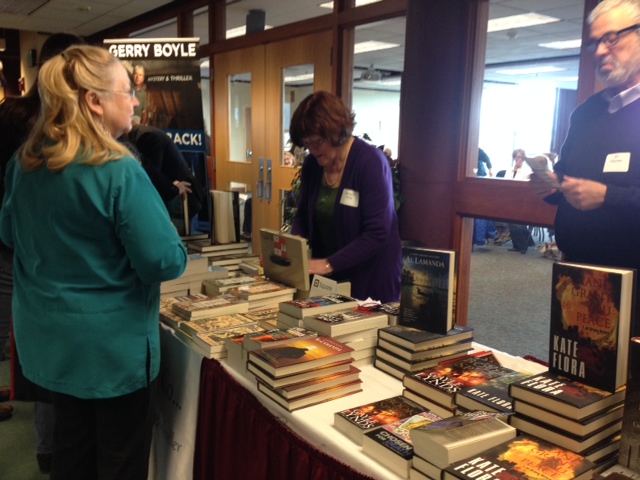
There was a certain amount of genre-blending at the conference. Sarah Graves, who writes the Home Repair is Homicide mysteries, mentioned that #11 in the series, The Book of Old Houses, was inspired in part by H.P. Lovecraft. And then there’s Chris Holm’s Collector mysteries, whose first volume I had just finished. See, there’s this dead guy, who’s been damned for murder and now has to collect the souls of other evildoers when their time comes. But being dead doesn’t mean being dumb. When he gets an assignment that just doesn’t smell right…. I picked up another Collector volume at the Kelly’s Books to Go table in the lobby, where speakers and audience alike were busting their book budgets.

Kelly's Books to Go

Kelly’s Books to Go


Barbara Kelly, the aforementioned bookseller, was on the final panel, the one on the business of getting your book sold to readers once you get it published. It was heartening to hear what enthusiastic fans booksellers can be, if you just take the trouble to make friends at your local bookstores. Barbara will sometimes take books she loves to a conference on a totally unrelated topic, and push them hard to attendees. The panel as a whole agreed on a new (to me) and upbeat concept: the “good rejection.” If your story comes back with comments, you’re onto something. The piece is just “not there yet.” So it’s worthwhile wandering in your personal wilderness yet awhile.


A venerable denizen of the USM campus


Quandaries in Teapots

As you know, we are five writers in search of a reason not to work on the book right now. Reasons, good reasons, are hard to come by which is why you find me actually working on my novel in progress. It’s a cozy mystery, or maybe it’s a cozy thriller. I won’t know until it’s finished. Lately a lot of genres have been morphing into other genres, and that usually makes for just as good a read, but hard to classify. One of my favorite authors, Jasper Fforde, calls these morphings, cross-genre. If you haven’t read Jasper Fforde yet, he’s amazing. He does a great comedy/fantasy/mystery series that follows the adventures of Thursday Next. I won’t tell you anything more, but please send in a comment if you have read or plan to read anything by J. Ff.

Yes, I ran out of reasons NOT to work on my cozy/thriller/mystery set in New Hampshire in the not-so fictional town of Poke. If my heroine, Gracie Smithwick, has her way the spelling of the town’s name will revert back to Poughke at the next town meeting day. She’s up against great odds not only in re-establishing the correct spelling, but in thwarting THE BAD GUY as he attempts to do BAD things. I’m on my third revision and there’s really no good reason not to continue. I plan to drop some dandy carrots in my postings to entice you to entice me to finish.

If you’re reading this blog you are either fellow writers, or fellow readers. If you are cozy writers or readers, maybe you can help me with a small problem. Problems become reasons not to work on the book right now, and I want no more of that. At least not right now.

If, when you are reading cozies, do you find that the heroine falls for the local law enforcement persona way to often? Like in ad nauseum? Like in cliched tropism?  I’m taking a poll and looking for interesting occupations for my heroine’s potential fellow. If I fall head over heels in love with a suggestion not only will I use it, but I’ll give you credit for the idea. How’s that for a bargain. You scratch my back and I’ll wash your hand. Well, that analogy sounds bizarre, but you know what I mean, a nice symbiotic relationship to ward off any reason for me not to work on my book right now.

A Nasty Piece of Work

Today, gentle readers, we are going to talk about those nasty pieces of work who are not what you would call exemplary figures. Nasty but necessary, because if they didn’t abound, dance around, roam the story seeking whom they may devour, from off whom would you bounce your protagonist? You need that nasty as a foil to show the excellent qualities of your hero(ine).

Protagonists today are not cut from the same cloth as the Nancy Drew and Hardy Boy types of yesteryear. They aren’t perfect goody two-shoes. And though they are are still cut from better quality cloth than our antagonists, they can and will lie. Every last character, the good, the bad and the ugly, from the matriarch or patriarch down to the toddler who shakes his head when asked if his diaper is dirty, lies. And it’s not limited to characters on the written page. Fiction is taken from fact and lying is universal. Did you know that on any given day one lies, or is lied to, from ten to over one hundred times?

But we can use that. We can make our good guys lie only about little things, this makes them more believable, and even likeable. We can make our bad guys lie about big things, or, if they are pathological liars, about everything. This makes them more believable, more despicable, more heinous. Whatever you need them to be.

Sometimes the lie is prefaced with one of these old gems: ‘believe me’, ‘honestly’, or, ‘to tell the truth I. . .’, etc.

Sometimes the lie comes with too much baggage in the belief that more exaggeration will belie the lie. Methinks he doth protest too much, someone once said.

Sometimes the lie is delivered with a smile or a warm hearted chuckle. Watch for description of the eyes. Does the sincerity of the spoken word extend to the window of the mind?

Oftentimes the liar, in preparation to putting the big one over on his/her interrogator, will repeat the question, hoping to buy time, ridicule the questioner, or express unbelief.

It’s up to the reader to be as discerning as possible. Look for clues and examine the characters. Go into your next book with open eyes. You can’t expect the author to come right out and say so-and-so is such-and-such. What fun would that be?

All these tricks of the writer’s trade are used to inform the reader who can be trusted and who can’t. Be wary the moment a character darkens the page of the mystery you’ve picked up. This becomes even more enjoyable when the author has penned an unreliable narrator.

Good recent reads about lying: Liane Moriarty’s “Big Little Lies”, and Tana French’s “The Secret Place.”