Category Archives: writing
Vicarious Eviltude
‘Eviltude’ is our family’s term for a certain kind of transgression: those delightful delicts that are entirely voluntary, pleasurable and unregretted. Taking the last piece of chocolate cake without apology or second thought is eviltude, as is buying that adorable, vulgar sequined vest that you will never have the guts to wear in public. Eviltude can be identified by a certain YAHOO! feeling, lamentably scarce in my day-to-day life.
There are days, though, when it just isn’t enough. Respectability weighs heavy, and the odds of becoming a pirate seem vanishingly small. That is one of the times when writing murder mysteries comes to the rescue. (Yes, I know we call it crime fiction now. Mine are murder mysteries.)
Kate Flora blogged the other day, on Maine Crime Writers, that “writing things out of our systems is why we crime writers usually are pretty cheerful.” And this is true. Giving an unpleasant character some of the traits of your venomous neighbor can really ease your mind. It probably counts as eviltude. But it seems to me that Kate left out a lot of the upside. When I am plotting crime, I’m not just relieved of care, I’m gleeful. There is nothing I couldn’t do! And nobody I don’t want to get caught, will get caught!
I just finished reading The Map Thief, a nonfiction account of Edward Forbes Smiley III, who stole hundreds of rare maps from libraries, sold them to collectors and lived the jet set life among the ultra-rich. I learned the details of library security systems, the twist of the wrist used to run a razor blade down a book binding, and the little alterations that can be made to disguise a stolen parchment. It just so happens that my mystery #2 concerns the theft of an ancient manuscript, complete with gorgeous illuminations, glittering and bizarre.

Monkey-lion centaur sawing books (much worse than eviltude)
(Courtesy British Library, Add. 49622, f.146)
As I read about Smiley, I kept thinking, “I could use that! I could use that, too!” It was almost as if I were stealing the books myself. Onward to piracy!
With only two plots (and no completed manuscript) to my credit, I’m amazed at the amount of mayhem I have already enjoyed. Young and old have fallen at my hand, by poison, violence and an intricate plot involving a clown at a children’s party.

Clostridium botulinum bacteria. (Science Photo Library)
As a bonus, every murder needs alternate explanations that the detective must investigate and discard. It’s as much fun as killing your venomous neighbor two or three times. In mystery #1, the first victim is found to be full of botulism toxin. Of course, it is found in the canned tomatoes. But the victim’s house is also full of Botox (as is the victim’s fiance.) How to choose? Shall I have a single murderer kill several people off, one per source of botulism? Or shall I invent more murderers? Now sounds the evil pirate laugh, BWAH-HAH-HA-HA!
I’ve begun to see opportunities for murder in every chance-met object. Here in rural New Hampshire, we have myriad neglected houses dating back a century or two, just crying out for renovation. What if, while the carpenters are rebuilding the sash windows, having found lovely antique sash weights for the purpose, a murderer finds his victim alone in the house?

6-lb Antique Sash Weights
(Need a blunt instrument? Get these on Ebay!)
In my saner moments, I fear no good can come of this. Vicarious eviltude could take me to new and dangerous places. I might just wear that vest. To a bar. Where I would get into a fight. With a cop…. Or maybe I should just keep my eviltudes vicarious.
I am not Salman Rushdie
The September 2015 issue of the “Harvard Business Review” (creativity section) included an Interview with Salman Rushdie by Alison Beard. Thank you to Heidi, who admits to being obsessed with Rushdie, for sharing this inspiring article.
This is how I interpreted some of the interview in relation to how I write (I know, how arrogant to compare myself to a writing giant such as Rushdie):
Rushdie states that he evolved from a plotter to a pantser. He appears to write in a linear fashion, composing only 400 to 500 words a day—mostly complete scenes, requiring minimal, if any, revision. It’s perfect the first time.
I have never succeeded as a plotter. I attempted to outline my current novel, “Claire,” using a storyboard and post-its. Instead of sticking to my outline I ended up writing an island for our most recent writing group and then I determined where it would fit in the plot. (I was told that’s the definition of an island!) I was surprised to find that it closely matched an existing post-it. However, it was neither perfect nor the next unwritten scene.
Rushdie does not share his writing until it is finished. That is hard to pull off in a writing group as the expectation is that you will submit your work on a regular basis. And since I tend not to finish anything—you can see where this is headed!
Undisciplined: me. Disciplined: Salman Rushdie. He treats his writing as though it were a job with a regular schedule—no waiting for inspiration to strike.
I am nowhere near that point in my writing progression. I write when I have committed to submit to my writing group and when it is my turn to post on our blog. That’s not much. Heidi (who else) has suggested that we resurrect our group writing project centered on a bridal shop. Why not? At least I’d have a third reason for writing.
Would Rushdie ever delay publication of one of his works because he had to paint a bedroom to match a quilt? Or even just not write for the same excuse—I mean reason? Certainly not. For one thing, he most likely hires out his painting. Does he realize he’s missing out on the pleasure of a sore back, of putting on the same smelly painting tee shirt every time he paints, of putting Vaseline on his elbow where he scrubbed too hard with a pumice stone to remove stuck-on paint?
Yet I am a day late with this blog post so that I could assist my husband with just such a task. Further proof that I am not Salman Rushdie. As though any further proof were needed….
It’s Christmas!
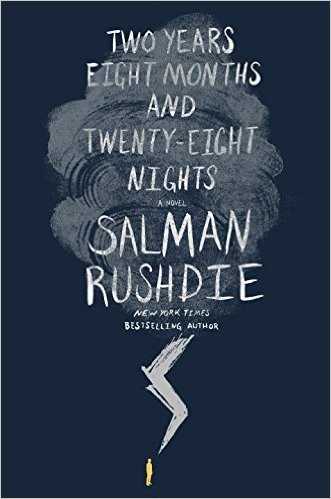
My pre-order has been in for weeks (at my local independent bookstore, of course.) Tomorrow I shall swoop down and scoop up my copy of Two Years Eight Months and Twenty-Eight Nights. It is Salman Rushdie’s first new novel in seven years. Everything else I’m currently reading will start gathering dust.
I encountered Rushdie in the same way many others did: I bought a copy of The Satanic Verses purely to show solidarity against censorship, after Iranian clerics ordered that Rushdie be murdered for the “blasphemy” it contained. It sat on my shelf unread for years. Once I finally read it, I began a reading marathon of everything he ever wrote.
How to explain his magic? Plot summaries wouldn’t do it, even if I could recall every twist and turn of the fantastic events that befall his characters…his myriad characters, his worldsful of characters, the armies of imagined people who march, parasang upon parasang, the length and breadth of the Rushdie universes.
The universes themselves are miracles. These are not alternate worlds like Middle Earth or Westeros. They contain, for example, the India we all know, the England, the United States. They also contain impossible events (two men survive a fall from a bombed plane miles in the air), strange powers (e.g., telepathy and witchcraft), eerie coincidences (an Indian songwriter anticipates all Elvis’s greatest hits.) Real-world politics, popular culture, “high” culture – usually taken down a peg – toss these very-not-ordinary people hither and yon. Some of them survive and even triumph, in a way. Others are ground to bits by the entirely ordinary evil and stupidity that permeate every human institution. But somehow, Rushdie’s Children defeat even defeat itself, simply by being more genuine – realer – than the real-world institutions that destroy them.
If I had to choose one characteristic that will keep me reading Rushdie till they bury me, it would be his perfect pitch for detail. Given his tortuous plots, many in the 500-600 page range, he must select just the right objects to bring the meaning of each scene into focus. Here is a passage that begins by evoking a real-world place in rather general terms, only to explode into the imaginary detail it calls forth from a character’s mind. From Fury:
“In Amsterdam in his middle twenties Malik Solanka – in the city to speak on religion and politics at a left-leaning institute funded by Fabergé money – visited the Rijksmuseum and was entranced by that great treasure-trove’s displays of meticulously period-furnished dollhouses, those unique descriptions of the interior life of Holland down the ages. They were open-fronted, as if bombs had knocked away their façades; or like little theatres, which he completed by being there….
“After a few visits, however, it became clear that mere houses would not be enough for him. His imaginary environments must be peopled. Without people there was no point. The Dutch dollhouses, for all their intricacy and beauty… finally made him think of the end of the world, some strange cataclysm in which property had remained undamaged…. After he had this idea, the place began to revolt him. He started imagining back rooms in the museum filled with giant heaps of the miniature dead: birds, animals, children, servants, actors, ladies, lords.”
And how about that “left-leaning institute funded by Fabergé money”?
So tomorrow I shall vanish from the world for some days, to read Rushdie and do nothing else. I hope my friends will speculate that something very odd may have happened to me. After all, I understand that in Two Years Eight Months and Twenty-Eight Nights, genies rise up from the sea bed in New York Harbor and eat the Staten Island ferry.
A question for Siri
A few nights ago I attended a Willie Nelson and Family and Old Crow Medicine Show concert at Meadowbrook in Gilford, NH. (In case you were wondering why I was there, my friend’s husband backed out and I was asked to go in his place.)
Thousands of people applauded and cheered after each song. Some were inspired by their ingestion of alcohol and other substances but a genuine appreciation of the music permeated the air (along with a sweet odor). There is no disputing the fact that attending a concert is a social activity for many people, in addition to an opportunity to enjoy the music. The majority of the songs performed by Willie Nelson have been sung or played many times over the span of many years yet the attendees reacted as though he had dedicated the last five or more years of his life to creating and perfecting them and that he was performing them for the first time.
What if we authors got that same reception every time someone read a book we had written? Would we be motivated to spend even more time writing?
Different abilities and talents are required for singers and writers (unless the singers also write their own lyrics). Would I as an author be comfortable on stage under bright lights in front of thousands of people reading from my novels about Claire, Anne, or Olivia? Hell, no. I have a hard enough time sharing my writings with my writing group. Yet I couldn’t help being jealous of the accolades the performers received at the concert.
Reading is generally a solitary pastime. Any cheering and clapping is done in the privacy of your home. The author, therefore, receives limited direct feedback. So what drives a writer, especially one who has yet to be published, to keep producing? Maybe that is a question appropriate for Siri, along the lines of “what is the meaning of life?”
Speaking of Claire and her cohorts, I offer my sincerest apologies to them for being out of touch these past weeks. You have to believe me that they’ve been in my thoughts. I know what they’ve been doing and thinking and even planning to do. But I haven’t taken the time to record any of this. Everywhere I have been—the hotel in South Yarmouth, Massachusetts, the Cape Cod Inflatable Park, the swimming pool, the Mayflower Beach—I’m thinking of them, feeling their presence, the same as when I’m reading a book with a main character with whom I identify. I know she isn’t real yet it’s as though she is my companion.
Writing a book is like reading a book. The characters get under your skin, into your head.
Only it’s a million times harder.
Word Death
Eventually, the words get you.
You struggle with plots, with character development, with the godawful job of pulling it all together. And while you are wrestling with that angel, the words he is made of creep through your pores and invade your brain. They become the plaque that stops the neurons firing.
It happened to James Thurber. Much of his last two books, Lanterns and Lances and the posthumously published Credos and Curios,

My 1962 copy of Credos and Curios
were compendia of words that had dug their little claws into his mind and wouldn’t let go, long lists of words that had, perhaps, only sounds in common, or were all place names or first names beginning with O. He packed them up and disguised them as essays and stories, and his most devoted fans slogged their way through, but even they knew it was crazy.
Thurber had shown signs of the word disease much earlier. After “The Night the Bed Fell” and “The Night the Ghost Got In,” he wrote “More Alarms at Night.” In it, you hear the Siren song of verbal miscellany. One of the episodes recounted in “More Alarms” begins when the words won’t let Thurber sleep:
I had been trying all afternoon, in vain, to think of the name Perth Amboy. It seems now like a very simple name to recall and yet on the day in question I thought of every other town in the country, as well as such words and names and phrases as terra cotta, Walla-Walla, bill of lading, vice versa, hoity-toity, Pall Mall, Bodley Head, Schumann-Heink, etc., without even coming close to Perth Amboy…. I began to suspect that one might lose one’s mind over some such trivial mental tic as a futile search for terra firma Piggly Wiggly Gorgonzola Prester John Arc de Triomphe Holy Moses Lares and Penates….
When I read that for the first time, I nearly fell off the end of my mother’s bed, laughing. Mother, propped up at the head and reading herself to sleep, listened with a grin as I read it aloud, choking with laughter. But in Thurber’s later books, the humor had drained out, leaving only the words.
Thurber’s woes came back to me when I read Howard Elman’s Farewell, Ernest Hebert’s wonderful finale to the Darby Chronicles. In the first book of the Chronicles, The Dogs of March, Howard Elman is an illiterate adult, a man with a good eye and a wondering mind but few words with which to order his experience. His rural New Hampshire world is being invaded by the come-heres, wordy, untrustworthy flatlanders who end by taking not only Howard’s land but also his children into their insubstantial world of hot air and incomprehensible notions.
In the Farewell, Howard has learned to read, and death approaches. He is now up against the next generation of strangers, who are obsessed with ones and zeroes and with an ‘ecosystem’ apparently coterminous with, but different from, the New Hampshire forests he loves. They seem to have invaded, not from the flat lands, but from Mars. One of them is his son, who has changed his name.
In this milieu, words have begun to bother Howard. You accumulate them, they name new things that may or may not exist, and then when you put them up against each other, you can see that they don’t make sense. What do they mean, “the prime evil forest”? “Why does ‘purposes’ sound so much like ‘porpoises’?” Howard has begun talking to himself in a final attempt to ‘combobulate’ his world. “How to say it and make it make sense?”
Perhaps it’s a problem of scale. Thurber vanished into minutiae. From Howard Elman’s point of view, his son’s new friends operate in a world of vast, airy nothings. All their words are code words, but the code refers to nothing he can get a grip on. Behind the airy nothings he can see only more airy nothings.
For those of us less talented than James Thurber and Ernest Hebert, a focus on the words themselves just produces ‘darlings’ – abominable cutenesses and dreadfully, dreadfully clever repartée. Once these insinuate themselves into a first draft, the novice writer can find them impossible to dislodge, even knowing that the reader will find them impossible to stomach. When the words begin to preen themselves this way, when you feel the poison creeping into your writerly veins, what to do? Here is one suggestion: imagine this question from an innocent, eager child reader:
“But what happened next?”
Middle of the night jottings
Fantasy–not my thing, I cover my ears in my writing group whenever this genre is discussed. Yet I believe in the fantastical notion that what I think about in the middle of the night when I get up to pee–or to put it more politely to “answer nature’s call”–I will remember word for word in the morning. You know how this fantasy ends.
Except for last night. At 4:30 a.m. (I suppose that makes it this morning and late enough that I could have gotten up for the day) I grabbed the little notebook and pencil on my nightstand and wrote out four pages of diverse thoughts. Some were for my book “Claire” and others for this blog.
Or at least that’s what I wrote. It would be incredibly rewarding if only I could decipher what all those scribbles are. Or, of the ones that I can actually read, what they mean.
For example, my first note is: “This was the time, Claire thought.” Underline.
Hmmm….time for what?? Time to get up and go to the bathroom? Time to get married? Time to iron? (You’ll have to read the book, I suppose, to find out. And I’ll have to finish writing it to figure it out. But I will use that line!)
At our last writing group, I was asked to focus on Claire’s emotional backstory. I’ve been thinking about that during my “free” moments on our recent overnight trip to Ogunquit, Maine, with two of our grandchildren and my eighty-seven year old mother. One germ of an idea managed to surface somewhere between the frigid ocean waves and the heated excitement of Chuck E. Cheese’s.
However, the best one came from one of my middle of the night jottings. It connects the bruises on the bride for whom Claire is making a wedding gown with long sleeves to Claire’s wedding gown with long sleeves that is stored in her attic.
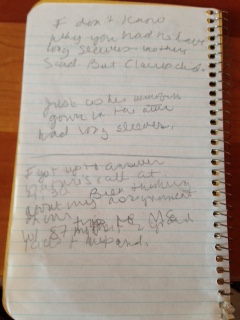
Middle of the night notes
These two ideas have reinforced the fact that I have been writing “Claire” on a superficial level, unwilling or unable to delve into what is happening in Claire’s mind to cause her to act as she does. I finally get it that her actions will not be acceptable to the reader without a better understanding of her motivations, especially her internal ones. As usual, I know what those are, I simply have failed to commit them to paper. Basic “Novel Writing 101” and something John, our facilitator, has encouraged me to focus on. I can’t wait to get to work on that!
Free Names

Listen Up!
For some time, I have been keeping a small notebook in my purse in which to capture fugitive ideas, oddities, vignettes, and joyful or horrid happenings for use in future writing. From this exercise has come, among much else, a long list of weird names encountered in the press and occasionally in life. I long to use them in fiction, but since they belong to real people, the best I can hope for is to mix and match. Today, I want to share some of this raw material with you, my fellow writers, who may well come up with better matches and better mixes than I. Feel free.
Some of the names are simply too appropriate to be believed. There are:
- Sir Jock Stirrup, once head of the British armed forces (and now Baron Stirrup.)
- John Stalker, an ex-Deputy Chief of Police.
- James Naughtie, the BBC Today interviewer of a heterosexual man who, after a stroke, “woke up gay.” Naughtie was described by Britain’s Daily Mail as “the formidable BBC pinko who turned the airwaves blue.”
- UK Member of Parliament, Mark Reckless, who bolted the Conservative Party to join the Independence Party.
(The English outnumber the Americans in my list. Does this Mean Something?)
Here at home, the items in my collection seem to come with brief stories attached. I itch to fill them out:
From my cookbook shelf, Crescent Dragonwagon beckons. According to my sister-in-law, who claims acquaintance with her (and that is not the kind of source one questions), Ms. Dragonwagon married an enlightened man who did not insist that she take his surname. Neither of them wanted a hyphenated name, however, so they made one up. The marriage ended, but Ms. Dragonwagon’s  vegetarian cookbooks were already well known, so, publicly at least, she will be Dragonwagon to the end of her days. The stuff of tragedy.
I found another name near the end of a news tidbit about the theft of a Stradivarius violin. We were several paragraphs down into an account of the Strad before the perpetrator appeared: “The violin, which police said appeared to be in good condition, was stolen late last month from a concert violinist who was shocked with a stun gun…. Police traced the stun gun to Universal Knowledge Allah, a 36-year-old barber….”
A cousin of Michelle Obama made the papers very recently. Rabbi Capers Funnye of Chicago was nominated to become what an international organization is calling the first “black chief rabbi” of the 21st century. A statement from the International Israelite Board of Rabbis declared that Funnye would serve as the “titular head of a worldwide community of Black Jews.” And why not?
Internationally, my best name source so far came from an account of Ted Cruz being booed off the stage at a gathering of Middle Eastern Christian ecclesiastics. It was also my best source of impressive titles. In the audience were:
- Patriarch Mar Bechara Boutros Cardinal Raï, Maronite Patriarch of Antioch and All the East;
- Gregorios III Laham, Melkite Greek Catholic Patriarch of Antioch and All the East, Alexandria, and Jerusalem [pictured at the top of this post];
- Ignatius Youssef III Younan, Syriac Catholic Patriarch of Antioch and All the East;
- Aram I Keshishian, Catholicos of the Great House of Cilicia of the Armenian Apostolic Church;
- Metropolitan Joseph Al-Zehlawi, Archbishop of New York and All North America for the Antiochian Orthodox Christian Archdiocese of North America;
- Bishop Angaelos, General Bishop of the Coptic Orthodox Church of Alexandria;
- Ibrahim Ibrahim, Bishop Emeritus of Chaldean Eparchy of Saint Thomas the Apostle.
I don’t know where to start the character list for my fantasy novel, with the Catholicos of the Great House of Cilicia or the Bishop of the Chaldean Eparchy of Saint Thomas the Apostle. George R. R. Martin, look out! (Alas, the first result of a Google search on the Eparchy was a parish listing — in Southfield, Michigan. The glamor is gone.)
Okay, writers, start your pens. Pick a name and give me a scenario.
Confession: I am a pantser
I’ve hit the wall, thrown in the towel, given up on my Camp NaNoWriMo project. Oh, I still plan on completing my novel “Claire”—just not in July. If I believed in writer’s block, I’d have to say this is what I am experiencing. But I know deep down I’m just being plain lazy. And that I set too ambitious a goal.
After all, it is summer and we did just buy a Jeep. A toy that we have gotten maximum pleasure out of in the few weeks that we have owned it, tooling around the scenic roads of Vermont and New Hampshire every available evening, anxious to stumble upon some wildlife, or, absent that, feel the freedom of the wind blow through our (my) hair, removed from the necessities of mowing the lawn and painting the trim on the house. And working on “Claire.”
John, our group’s facilitator, has requested (“suggested”—too passive) that I bring in an outline of the book to the next writing group meeting in two weeks. I readily agreed. Deadlines are my allies. And the outline is half-written anyway. Which may be my source of writer’s block. Assuming I believed in it.
I am a “pantser.” I start writing with a germ of an idea for my work of fiction and then I write. I usually don’t have an outline when I start—that would make me a “plotter.” I prefer for my plot to evolve organically. (I just learned that there are also “plantsers.”)
I’m not alone in this approach. But the plotters will tell you that this only makes more work for us pantsers in the long run, that I’ll need to write a few rough drafts to be where they are after their first rough draft.
Hang in there—I’m getting to my point….
Which is that for Camp NaNoWriMo I decided to write more like a plotter than a pantser, outlining before adding to the 10,000 plus words I had already written for “Claire.” Seemed like more than a good idea. More like a necessity. After all, this is the first book in a trilogy and a thriller. That worked. For a while.
Now that I have a half-finished outline, I’m unable to get back to the story and write. Or even finish the outline. So I’m stuck. Writer’s block. Lesson learned: I am definitely a pantser. What I really want to do is just write the damn book.
I’m relying on my writing group to jump-start my writing. Bring it on!!
Meanwhile, I’m waiting for July 31 so that I officially can announce that I did not win Camp NaNoWriMo 2015.
An Aspen Phantasmagoria
What brought all this on was a man who passed me on the sidewalk of Main Street in Aspen, Colorado, one fine July morning. He’d be called a “big guy” by the polite; that is, he was well over six feet tall and appeared to be pregnant. His expression was mildly concussed, though most likely, that was just pot. Stretched across his beer belly was a drab gray, hip-length tee shirt sporting in firework colors the legend, BAZINGA!
Not an unusual sight in Aspen. But there are few unusual sights here. Anything and everything shows up, and nobody pays any attention. Incongruities rub shoulders without noticing one another. The motto seems to be “Never connect.”
This fact only started bothering me when I started to write. Writers invent connections, of course. That’s the job. But in most places, in most situations, there’s a pre-existing network of workaday relationships growing through time, a warp and woof. On that, we stitch a story. If you write about Aspen, you write without a net.
Chronology won’t help you. Aspen’s history is a series of jerks and starts. A mining boom created the town in 1879, but by the 1930s, population had dropped again to 700 or so. After WWII, the craze for skiing brought in small numbers of permanent residents and many more seasonal ones. In came the full-time ski bums and the part-time resort patrons. And money. And more money.
Finally, one Walter Paepcke, corporate executive, philanthropist, skier, music lover, founded the Aspen Institute, the Aspen Ski Corp. and the Aspen Music Festival and School on top of everything else. That was the Big Bang, and Aspen has been hurtling away from itself ever since. The ski bums, the potheads, the fat cats, the intellectuals all orbit their own kind and pass through the rest like neutrinos.
So here are a couple of weeks’ observations from the streets, restaurants and concert venues of Aspen. Make of them what you will.
The program announces Beethoven’s Violin Concerto in D Major. The soloist will be Augustin Handelin, unknown to me. The concertmaster appears, wearing black tie. The conductor appears, wearing black tie. Pause. The soloist appears. He is dressed in a Nehru jacket of grubby white with matching trousers whose hems drag behind his heels. He stops, bows, smiles. Can it be? He seems to be wearing lipstick on a mouth (and none of us can help how we’re made) that has side extensions like the Joker in the Batman movies. Surely that powdery white is not his natural complexion? The Concerto has an extended opening before the soloist begins. He stands and waits, grimacing with overwhelming emotion. Or with something. I can’t watch. And then, note by perfect note, he takes the entire audience to Heaven with him.
Aspen is full of terrifying crones with long, jet-black hair (perfectly coiffed), gold jewelry of ball-and-chain weight, blood-red lips and eyebrows disciplined into the perfect accent circonflexe. They do not look like people who listen. Some of them, however, do take mountain hikes. Their presence lingers on the trail in the scent of Diorissimo.
Not all female denizens are slaves of the salon. The New England Puritan is well represented. From my seat at a window table of The Bakery, I watch a woman of a certain age with streaky gray hair, sitting at the bus stop. Her ironed blouse, shorts and vest are as neutral as her hair, spotless and rigorously ordinary. One knows that she bought the turquoise running shoes only because they didn’t come in beige. Beneath the crags of Ajax Mountain she sits, the New York Times folded beside her, atop a copy of The Atlantic.
A new(er)comer to the Aspen Institute complex is the Aspen Center for Physics. Here, people whose brains are of another order than yours or mine come to think about the nature of the universe in peace and quiet. But the Institute does its best to reach out to all sorts and conditions of men. Hence you may, if you like, attend a lecture tonight on “Engineered Magnetism in an Atomic Bose-Einstein Condensate.”
Just down valley in Basalt, Colorado’s newly legal marijuana industry is powering up. The selectboard will wrestle tonight with its own problems of physics: the mountain wind currents and the greenhouse exhaust fans are choking retail and residential districts with the skunky smell of cannabis bloom.
Way, way back in the seventh row of violins (Aspen orchestras run heavy to strings), sits a very small Japanese girl, perhaps 16 years old. She has followed the orchestra dress code: her blouse is white, her skirt and shoes black; she wears no jewelry. But her hair has been cut and dressed to fall in asymmetric wedges and some of it is caught up in a plastic clip shaped like Hello Kitty. She is clearly human, but a human modeled on an anime character crossed with a furry marketing behemoth. One assumes this was voluntary.
Is this just me? Are all these disconnects making me see grotesques where there are none? A scarier question: am I one of them, at least when I’m here?
Camp NaNoWriMo
It’s the Fourth of July weekend, I’ve just returned from a cruise and land tour to Alaska, my endocrinologist has started me on a new medication with adverse side effects, Camp NaNoWriMo has just begun, and—naturally—it’s my turn for a blog post.

Mendenhall Glacier, Juneau, Alaska
No, I don’t expect any sympathy. I don’t work so I should have plenty of time to write. Right?
Rrriiiggghhhttt. Time isn’t the problem. What do I have to say that is worth reading???
Since this isn’t a cooking or entertaining blog, I won’t bore anyone with my plans for celebrating Independence Day.
Since this isn’t a travel blog, I doubt if anyone wants to hear about my trip to Alaska. (I did have good intentions of keeping a journal. That lasted a day.)
Since this isn’t a medical blog, I’ll save you from a description of how the .05 mg of fludrocortisone is affecting me.
Guess that leaves Camp NaNoWriMo, the July session of the traditional NaNoWriMo held in November, which you may or may not know that I have “won” two times. (Winning entails submitting an original novel of at least 50,000 words written during the month.)
For July, I’ve committed to writing an additional 50,000 words of my already started “Claire” novel. Submitting a work in progress is legal during Camp NaNoWriMo but not in November. My brilliant idea for “Camp” was first to outline how I am going to connect the three novels that I have based in the town of Woodbury: “Anne,” “Claire,” and “It Takes a Village Store,” (all evidently working titles) and then write “Claire,” the first book in my trilogy.It made sense a few months ago….
Now that I am attempting to commit to paper how to connect the three books as well as write the first book all during July, I’m starting to rethink my plan. If the idea is to write 50,000 words in 31 days (note that November only has 30!) and it’s already the 3rd, maybe I’ll forgo working on the links among the three books and instead devote my efforts to “Claire.”
I already have 11,000 words written for this book, as well as a ton of backstory, and I even know the ending—at least the ending as of today—so it makes sense to just whip out the rest of the book. I might even be done before the end of the month….
Happy Fourth of July to all of our followers!!
 Eleanor Ingbretson
 Karen Whalen
 llandrigan
 Heidi Wilson
 Mike M
