
Category Archives: Uncategorized

On Moving the Tuna

oceanic_foodweb


You wouldn’t have thought it would be so hard. The moderator of our writing group suggested, with that air of modest assurance that so becomes him, that I should separate Scene A (in which a ferret scatters tuna fish all over a carpet, with disproportionate results) from Scene B (in which the ferret compounds its alimentary offense with the eliminatory consequence and precipitates a crisis.) He was right: together, the scenes were almost repetitious; separated, they helped create a steadily mounting tension.  Scene A needed to move back in time.

It turned out to be a game of jackstraws. I re-dated the tuna scene. How to fill the now gaping void between it and Scene B? As luck would have it, I had a brief new scene already planned that was going to simplify the presentation of later events. It went into the breach. Out came a lot of now misplaced material, before and after. That demanded more of the new scene, to patch up the ragged bits. It became half a chapter. That suggested another move, to slim down a later scene, newly overloaded.

We’re talking three months, here, people! Three months of jury-rigging and jerry-building and tearing down and putting up again from scratch. I think the most painful part was having to re-insert huge chunks of the original text, when repeated efforts proved that they really had to go  somewhere. And of course, no person of sensibility can partially edit a text. Time spiraled down the plughole as I inserted commas and corrected diction.

By the time the tuna had settled down, I had been forced to outline that whole section of the book. To my amazement, three of the four subplots were now perfectly in order. (The last one looked like a dog’s lunch, but three out of four ain’t bad.) If I’d done that outline in the first place, I wouldn’t have had to move the tuna at all.

Then came enlightenment.  I have always been a devout pantser (i.e., I write by the seat of my pants.) The Exuberant Brethren of the Holy Pants believe that inspiration dies at the sight of an outline. Buddha3Only by letting the words flow directly from the Muse through the fingers to the keyboard can creation take place. Do not pass brain, do not collect $200. You can clean up any slight problems later. The Severe Order of the Sanctified Plot make up the whole plot in advance. They write it down. They make diagrams. They balance things. Then, scene by scene, they write the first, and practically final, draft. Or so they say. They clean up any slight problems later.

I won’t say I’m ready to join the Sacred Order. Instead, I’m going to copper my theological bets. Four of us Thursday Night Writers have reserved a virtual cabin at Camp NaNoWriMo, an online writing sprint in which we each promise to complete a “writing project” of our choice in the month of July. I’m going to outline a whole second adventure for my amateur sleuth, just to prove I can do it. Who knows? If I ever manage to sell this turkey, I may need a sequel.

REPOSE WITH THE RIGHT BOOK

REPOSE WITH THE RIGHT BOOK

Usually the only exercise and adventure I want, or desire (notice I did not say need), are definitely to be found in one book or another. You have to read a lot of books to get just what you’re looking for in terms of exercise for the little ‘grey cells’, and when you find an author you like you stick to him like glue. Of course different areas of the brain will cry out at different times to be stimulated. That calls for a variety of genres and authors in order to satisfy the restlessness that ensues when ennui hits. Ennui of the brain is a terrible thing.

For sheer laugh-out-loud humor I enjoyed Tamar Myers for years and years. Then she got ennui and moved on. Writers need to exercise their brain cells too. When the author gets tired of her character, the reader knows it. Tamar’s books were definitely good for exercising the lungs.

For humor mixed with more fantasy than you’d ever hope to find in one lifetime read Jasper Fforde. Heaven forfend that he should ever get bored with Thursday Next! I know I never will. Jasper Fforde lives in Wales and seldom crosses the pond to speak in this hemisphere but, in September, he will be speaking in Vancouver. As my daughter points out, Vancouver is just as far as Wales and if I want to hear him, meet, him, learn from him, wouldn’t it be more fun to do all that over there? Yes, of course it would, but the couch potato thing will kick in and I’ll never go. To either place. But thinking about JFf., on the same side of the ocean, does get the blood flowing. Makes me want to get up and do something. Book a flight?

Faye Kellerman, a new discovery, and Tana French write psychological thrillers, one in L.A. and the other in Britain. I’m not whole-heartedly into that genre but have a great deal of respect for both authors who write exceptionally well and touch, but do not dwell, on the evil imbedded in their stories. That much I can deal with. Other, more heavy-handed thrillers I stay away from. Too much of a thrill, while being in repose, can be more than the heart and mind can take. Makes one get up and pace, or even take a walk. In the winter the quickened heart rate has made me reach for the snow shovel and get out in the (really) fresh air to clear not only the brain but the snow as well. No chance of ennui while reading a thriller.

So many good mystery writers, so little time to read them all. A really good mystery will incorporate a lot of the above specifics, keeping the reader on the tips of her toes from beginning to end. I like Aaron Elkins a lot. He, and his wife and sometimes co-author, Charlotte, travel the globe to seek out new destinations for his trusty sleuths, saving me the time and effort of doing so. Though, I admit, occasionally he prompts wander-lust in my lazy soul. One of his last stories took place in Iceland, a place where I actually have been (note my avatar), and made me want to re-visit.

Being a bookish couch potato is a lot more involved than a casual observer might think. A lot goes on in that prone body while, seemingly, only the eyes are darting back and forth. There’s a lot of potential in repose with the right book.

Putting the Demons Down–on Paper

Are family demons a gift to fiction writers? In the first draft of my post today, I wrote about my mother. In so many ways she was a wonderful woman, but—but I’m pulling back. Though she is still an enigma to me, it is my grandmother, from whom I have more distance, who is the greater mystery.

My grandmother was crazy. She was an alcoholic, physically and verbally abusive to her daughters, and suffocatingly jealous. Yet to all outside appearances, she was perfect. Her Depression-era house, with its perimeter of roses, was modest and clean; her daughters’ clothes were hand-sewn with excruciating attention to detail; their grades were excellent.

Unnamed while she lived was that trifecta of shame: mental illness, alcoholism, violence in the home. If my grandmother had wanted help—and I don’t believe she ever acknowledged she had a problem—she could not have gotten it. The devil on her back was unmentionable. And besides, no one—no one outside the home—ever saw that demon.

My mother told some of the stories of her childhood, and my grandmother’s sister a few more that predated my grandparents’ marriage. But with the death now of my grandmother’s siblings, how she because who she was is a lost story—and besides no one wanted to talk about it. When I recall her now, I see a tall, strong woman with medusa-like hair, crazy-intense eyes, and skin discolored from cigarettes and liquor. The fiery anger of her younger years had quelled by the time my mother had moved back home, though I witnessed a few incoherent drunken rages.

I can talk about my grandmother more easily than my mother (the part I’ve cut from the earlier draft) because I didn’t have that much of a role in my grandmother’s drama. Unlike my mother, I don’t have to examine the things I did to survive in such a soul-crushing environment.

I admire those writers who can peel back their respectable outer shells and expose the demons inside. It takes courage, even when those demons are expressed through fiction. I once wrote a novella about an unlikely friendship between two girls who shared a horrific experience—except that I dialed back on the evilness. I couldn’t bring myself to name it. Instead, the girls shared a bad experience, but not one so bad that they couldn’t talk about it. I justified my cowardliness with the excuse that a truly terrible experience would be the story, rather than the story I wanted to tell about evolving relationships and attitudes.

The manuscript is shelved. I still have affection for the characters and I would never want to hurt them. It was a nice story, if boring. You wouldn’t want to read it.

Noir in a Familiar Place

Well, I didn’t make a movie or hobnob with other writers since I last wrote in this space, but I did go to Montreal.  Montreal is one of my most favorite places in the world, starting over forty years ago when my brother and I went there and we felt like daring men about town because we drove down notorious Ste. Catherine Street.  Really, we made one run and stopped once, at a depanneur, where I bought a pack of Player’s cigarettes.  The kicker is that I didn’t even smoke, but they seemed exotic in a pack so different that what was available in the states.  That pack and several coins and bills served as my souvenirs.

The city’s place in my heart and psyche was cemented though, when it was part of the itinerary on my honeymoon with Barb.  That situation has solidified as we have returned yearly on our anniversary ever since and our children have come along on every trip from the time they were born.  I’d be a poseur to pretend I was a ‘habitant’, although I do wear a Canadiens ball cap while there.  I figure it’s a lot safer than a B’s hat.  We usually park our car while there and travel about on foot or by bicycle or subway.  Ste. Catherine Street still figures prominently for its shopping and dining, with very little remaining of the “adult” entertainment for which it was once known.

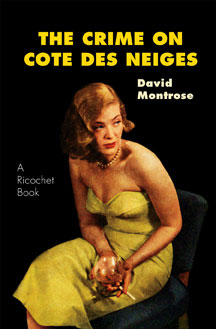
The Crime on the Cote des NeigesLast year, llandrigan gave me a copy of The Crime on Cote des Neiges by David Montrose, a 1951 story set in Montreal.  This and several other old Montreal books have been reissued by Montreal’s Véhicule Press as one of their Ricochet series of vintage noir mysteries.  Looks hardboiled, doesn’t it?  The story line is standard cynical-private-dick-with-a-heart-of-gold clears an innocent girl of murder.  It is well written and highly enjoyable, but fascinates me even more with all its references to streets I have walked and place names I know.

During this last trip to Montreal, I made a point to go to La librairie Paragraphe, 2220, avenue McGill College (okay, for you Anglophiles, that’s Paragraphe Bookstore and I highly recommend a visit there) and look for other Ricochet issues.  I bought three and am Sugar-Puss on Dorchester Streetcurrently reading 1949’s Sugar-Puss on Dorchester Street by Al Palmer, a Montreal journalist who covered the police beat and wrote a column on city nightlife.  It has me thinking back to that trip in the early 70’s and the realization that Dorchester Street, which runs parallel two blocks over from Ste. Catherine, still existed then, although it depended on what part of it you were situated as it was called both a street and a boulevard even then.  That changed in 1977, when the city renamed the majority of it Boulevard René Lévesque.  And since that time it has undergone extreme urban renewal with huge residential swaths razed and replaced with high-rise corporate headquarters edifices. But still, I was there only slightly twenty years after Palmer wrote about a young farm girl who came to the city to escape the boredom of rural Quebec.  Who knows what I might have seen then if I had been more observant in my early twenties.  As it is, I have to satisfy myself with blurry memories of what the city looked like and the knowledge that at least I was there.

What to write about

These blogs have a wonderful way of forcing focus and at the same time make that focus harder to achieve.  I’m sure that all writers come up with visions that seem so real and then watch them evaporate in the presence of a notebook or computer.  It can get worse; the fuzzy mirage of a story becomes even more blurry when the heat of waiting to the last minute to finish it is applied.  Let’s see what I can come up with in the next hour before my deadline.

You, the reader, have no way of knowing that this is not the next paragraph I wrote.  I actually wrote and discarded two paragraphs using a metaphor of a chef using experience and imagination to put together a fine dinner and made the comparison of writing ideas to food ingredients and editing to cleaning, chopping and parboiling.  It was lame.

But, I’m still thinking along the lines of places where a writer can get ideas.  At the supermarket actually might be a good idea.  Any place other where people congregate can be fertile ground for observing the human condition.  Take Wal-Mart for example, it is probably one of the best people watching places there is.  I remember once, a long time ago, seeing this hairy old guy standing in the check-out line with just a giant bag of cosmetic puffs in his basket.  Although it piqued my naturally suspicious mind that odd things usually have a definite explanation, I didn’t confirm until later that drug users use cotton balls for purifying heroin before shooting up.  What at first seemed to be just an odd and almost funny scenario could almost certainly be made part of a story that juxtaposes the tragedy of drug abuse with the banality of its everyday trappings.  Or maybe there was no more to it than he was getting them at the request of his makeup laden wife.

You don’t have to leave home gather the ingredients of stories.  Just listen to the news and voila, there is the whole spectrum of the human condition laid out for the taking.  Think about a fictional character conjured from tidbits of observations made of the president, Tom Brady and George Stephanopoulos.  Bet that puts a picture in your head.  Maybe you could see a spectator make a face at a golf match and read whatever you want into it to make the next great story of the golf fiction genre.  By the way don’t even stop to wonder if there is such a thing as a golf fiction genre; if you write a great story, there will be one.

Hearing the Story

Last weekend I had the opportunity to listen to Leslie Budewitz do a terrific reading of one of her stories—“The End of the Line” from the December 2006 issue of Alfred Hitchcock’s Mystery Magazine.

Her dramatic reading highlighted for me how well the narrative voice served the needs of the story. The narrative was confident, active, and melodic without drawing attention to itself. I was never pulled out of the story by an awkward turn of phrase or unduly repeated word. The narrative voice of the story was not the character’s voice, but it reflected the inner workings of the character’s mind.

Hearing the story reminded me that one of the pleasures of reading is the performative aspect. Even while reading alone, I still hear the story as I read, and that audible dimension is a large part of what I find so satisfying in a beautiful passage of writing—and frustrating when the language is flat or clumsy or when the writer has tried too hard to affect an unnatural style.

Every writer should read his or her work aloud—perhaps first alone, but also to someone else when the work is more polished. And every writer should listen to his/her own writing. When you listen to your own writing, what do you hear?

We talk often about how important it is for writers to read widely. I would say that listening is just as crucial a part of the writing process. Listen to other writers as you read, listen to the world—and listen to yourself.

Forty-eight Hours

There are forty-eight hour writing contests and forty-eight hour film-slams, and on Friday, May first, through Sunday, May third, I will be writing and slamming. And catering.

And which activity do you suppose wakes me at night to give me the heebie-jeebies? The food part. Someone could faint from lack of food because I didn’t prepare enough. Will I find the cast and crew to bring them meals on wheels? I’ll have no idea where they’ll be filming when I think they should be eating a nutritious lunch. And the lasagna. It could stay warming in the oven till two in the morning while they finish a scene. What will it taste like then?

I need to get over this. I catered for this team, my son’s, a few years ago. The only complaint then was that there were not enough snacks. The team has grown from ten to seventeen, and I’m tripling the provisions.

My first acting role was in last year’s film slam. I played a crabby Eastern European ticket taker who sprays down undesirable patrons with bug spray before they can enter the ‘pristine’ theater. I was told I did a good job, but having meals on hand when hungry will mean more to the cast than having a crabby Eastern European character actor waiting in the wings. Still, I wouldn’t say no if asked to fill in.

This year, for the first time, I’ll get to write a log line. It’s like an elevator pitch. Anyone in cast and crew who is so inclined will have a chance to write and pitch their very abbreviated scripts to the others, to try to sell their idea. I wish I knew how to prepare for that. It’s not like cooking ahead, because before a forty-eight hour film slam or project begins no one knows what they will be filming. Think sitting around nibbling on the caterer’s offerings, biting nails, guessing, while waiting for the phone call. This call will tell the team in what genre their film must be, and what line of dialog, character, and prop must appear in the film.

Because this particular film project is headquartered in Boston, my daughter (who has also acted, written and cooked), will be there to receive the instructions. She’ll call in all the info needed to get cast and crew started, and then she and another team-mate will make the long trek up north to join the crew.

The call will come at seven-thirty P.M. Talk about pressure. Talk about being at your best at the end of the day. I was heebie-jeebied about meals? We won’t get forty-eight hours to write this script; we’ll get maybe two. When I’ve written a story for a forty-eight hour writing contest I’ve roamed the house with pad and pencil for at least two hours waiting for the muse to strike. That option is out for a film slam. I’ll be feeling like the octopus from Heidi’s posting on 4/27.

Then, when a script or concept is decided upon, everyone will jump into furious activity even though it’s closing in on the end of the day. Props must be begged, borrowed or built. Sets constructed. Outdoor scenes decided upon. Costumes found and made to fit. There’ll be more writing, certainly a rudimentary screenplay is needed, one that will allow the actors a little creative wiggle room. It will be typed up, printed, and handed out. Lines need to be learned. A seven minute film needs to be completed and in Boston by 7:30 Sunday evening.

I’ll do the dishes and go home. They’ll stay up all night.

Tomorrow everyone will be twice as hungry, and breakfast is at six. Maybe I’d better get some more food. There’s no reason to think my story will be picked, or I’ll get to play another crabby role, but sure as shootin’, these folks will need to be fed.

Choosing Your Color

410px-Royal_Arms_of_England_(1198-1340).svg

England’s Royal Arms

I’ve been spending a lot of time lately with the second son of an English duke. You’ve guessed, of course: I’m devoted to Lord Peter Wimsey, Dorothy L. Sayers’ renowned aristocratic sleuth. There was something of a vogue for detection among the fictional peerage of the mid-twentieth century.  The fashion waned and probably received its death blow from the dreary antics of late-twentieth-century royalty.

Sayers (imho) made better use of aristocracy, or at least of wealth, than any of her contemporaries. In all too many a mystery, a mink stole or an ancient and expensive brandy drops into the scene for no better reason than to remind the reader that s/he is expected to be enjoying the idea of being rich. Sayers said that she surrounded Lord Peter with just those luxuries she would have loved herself: rare books, one’s own library, top-notch food and drink and presumably Wimsey’s high-powered Daimler, “Mrs. Merdle.” Her genuine delight in Wimsey’s primrose-and-black library, grand piano and excellent wine cellar call forth an equal delight in the reader.

With Sayers, this kind of detail is never just color, in the dreadful sense of the word as used by sportscasters. Our longest visit to Wimsey’s library contrasts its beauty and peace with his agony as he struggles to work out a case against a murderer who has framed the woman Wimsey loves. Dining on snails at an elegant restaurant, Wimsey notices that his guest views that dish askance, and calls for oysters instead. Attentive friend blends with money-no-object host.

CRW_1714

The New York Stock Exchange (Amazing Travel Photos)

The issue of color is on my mind because my fellow Thursday Night Writer Linda Landrigan persuaded me to try the mysteries of Emma Lathen, a queen of Golden Age detective fiction. Lathen was the nom de plume of two women, Mary Jane Latsis, an economist, and Martha Henissart, a lawyer. Their detective is John Putnam Thatcher, senior vice president of the Sloan Guaranty Trust Company. From his Wall Street office, he solves murders that occur in the world of business, especially high finance.

And for me it doesn’t work. I spent twenty years as an economist for investment firms. What is color to most of Lathen’s readers is just another Monday morning to me. My colleagues were not such buffoons as those Thatcher encounters (though I could have given Lathen a useful vignette or three.) But office life as described by an economist and a lawyer reaches me in pure monochrome. For Lathen’s many fans, it apparently works like a charm.

In the end, the characters and plot of Accounting for Murder pulled me in, but I doubt that I’ll read the whole series. And we all know that if you want to sell a mystery these days, and you aren’t an established author, you’d better be able to offer a series that will pull your first readers along with you.

So what about the color in my own mystery? In the literal sense, it starts out red, yellow and orange, the colors of fall in the New Hampshire mountains. It goes white and gray with winter, then a damp tan with mud season, and finally, joyously, green with spring. Figuratively, it’s the atmosphere of an Ivy League college, of a retirement home for some of its eccentric faculty, and of the rural village in transition that surrounds it.

Enough color? Not enough? Been done already? How about if the protagonist is an anthropologist specializing in African witchcraft? Too much yet? No? How about if I add a couple of ferrets? Okay, enough, right? But then I put the octopus in.

Maybe I need to rethink this….

04-21_OctopusNetsuke

Writing From Experience

Like first time parents, new writers worry about things they never realized existed before.  For me, this became a reality when we started our writing group and the others chimed in about how I should write stories based on my twenty-eight years as a State Trooper, ten of which were as a homicide detective.  For the five years since retirement, my persistent objection to my Thursday Night cohorts has been that it would be improper or unseemly for me to write about some of my experiences.  It is a high honor and huge responsibility to be entrusted to investigate a murder and I felt somehow that to write about what I had witnessed would take unfair advantage of my position.  I have discussed this with my old detective partner and he pointed out that if people did not write about these things, then how would anyone find out about them?  Maybe I’ll soften and reevaluate my stand as I progress as a writer.  No guarantees, but I’ll work on it.

Joseph Wambaugh wrote “…what a sorrowful thing it is to be murdered” in his novel The Glitter Dome.  I read that long before I became a cop, but it stayed in my subconscious and reemerged when I saw my first dead body.  It is sorrowful.  It’s not dramatic and certainly not glamorous.  It’s not at all like Hollywood’s CSI with mood music and fuzzy, psychic flash-back visions of the crime.  It is coldly sobering to stand or kneel over the most personal physical legacy of a human, their body, a human being who only hours earlier would never in their wildest dreams imagine that before the day was over, they would be cold, gray objects of observation to be described in notebooks, photographed and measured for diagrams.  I doubt that many people stop to consider when they lace up their shoes or button their shirts in the morning that they won’t be the ones to undo them at the end of the day.

Sometimes bodies lay in some degree of repose like on TV, but often they are in the grotesque sprawl of their last attempt to retain life or in the ineffective comfort of a fetal position.  Injury levels range from a few bruises or a little hole that is hard to find to extensive, mangled trauma with copious spilled blood.  There is a stillness to death greater than sleep or unconsciousness.  Oh, there actually is real, every-day music sometimes; if a body is discovered with a radio playing in the room, that’s documented as part of the scene and left on until everything is processed and turned off with the lights only when the search warrant return is left on the premises and the doors closed and locked.  You can only guess at the weird and lousy associations I have with some popular songs from years past.  The whole thing was and is sorrowful.

Any writing inspired by actual cases will have to be done with a high regard for ethics and respect for those involved.  No person’s death should be grist for the mill of popular culture where everything is presented merely for entertainment and titillation.  Before writing about such things, I’m going to grapple with the concept of “socially redeeming value”.  I’m no Pollyanna, in fact I’m quite cynical, but I do believe in karma.

It’s About Time . . .

Except when it’s about something else.

I’m late with my blog post. I had thought that at the last minute Devine Inspiration would give me a good shove in the back and I would start moving forward on saying something. Apparently, D.I. has moved on herself—perhaps she’s read her share of self-help books on deadbeat relationships.

I’m particularly embarrassed about being late with my post because my day job is all about deadlines: getting edited copy to the typesetter, moving proofs through various editing stages so that we get the magazine to the printer on time, and eventually it gets mailed out to subscribers—on time.

Creative writers, too, have obligations and deadlines. The writer scribbling in blissful isolation—picture a cabin on the lake—is not the reality for most of us. If I were dumped in such a place, I might spend more time climbing the walls then actually writing. Writing is a social event; the activities of our lives, the complexities of our relationships swirl and meld in a febrile, creative mind. And as writers, we don’t just draw from our relationships and interactions with others, we are also responsible to our audiences. We need to contribute pieces to our writers groups and blogging partners, and some even have contractual deadlines to deliver a manuscript to an editor at a publishing house. It’s these social aspects of being a writer that provide that much need shove in the back.

Thanks, Heidi, Eleanor, Karen, Mike, Michael, and John. (D.I., I’m doing just fine, not that you asked . . . Do you even still think of me?)