Category Archives: books
The score is 0 to 3
Returning to Arizona after eight months away–our fifth season of snowbirding–still feels as though we are embarking on a long vacation. You’d think we would have visited all of the tourist attractions by now. Yet we’ve hardly made a dent in everything this extraordinary state has to offer.
A few weeks ago, we spent a leisurely Sunday at Kartchner Caverns and Biosphere 2, both relatively close to Tucson though not anywhere near to each other. This thirteen-hour day was immediately followed by three (out of ten) of us sick with the flu. While my writing friends in NH struggled with severe colds over the holidays, I remained healthy, only to succumb to the foreign Arizona germs.
While in Arizona my plan is to hide out in the theater room with my laptop and work on my current project, “Anne.” (If you are confused as to which project is my current one, you are not alone. It reminds even me of a tennis match.) The score is 0 writing sessions to 3 movies (Dunkirk, Atomic Blonde, and The Zookeeper’s Wife). Writers take note: of the three movies, Dunkirk was the only one not based upon a novel.
Due to our trek to the Tucson area, we missed watching the 75th Golden Globe Awards live. The extensive news (more political than entertainment—who knows where the line is anymore) coverage has brought me up to date on what transpired. The highlights of the evening for me would have been when Big Little Lies and The Handmaids Tale won their awards. Both television shows are based on books of the same name by Liane Moriarty and Margaret Atwood, respectively. As a writer I want to believe that the success of these shows is due to the novels they are based upon. Looking for inspiration, I reread “Liars” as I recuperated from the flu.
To have someone—many someones—love your book so much that they would want to make a movie or television series based upon it would be unbelievable. (Though according to the panel of authors at the New England Crime Bake 2017 who had movies made from their books, it’s not guaranteed to be a positive experience for the author.)
Would the prospect of a movie or television series adapted from one of my (currently unfinished) novels motivate me to write? If my pinkie swear with Eleanor (to finish “Anne” over the winter) doesn’t motivate me, I doubt if anything will.
You’ve Got Letters.

John Adams to Abigail Smith
A few blogs ago, I was whining and complaining about the decline of all things literate: cursive script gone from the schools, editing that goes no further than spellcheck, and above all, letter writing that has dwindled to email.
But why mope? We’re all writers here; hence, we’re all readers; hence, we have access to the written treasures of the centuries. I went to my bookshelves and within minutes pulled down an armload of books likely to contain the kind of letters no one writes any more. Here is a sample to brighten your day.
In the parlance of his own day (the reign of Charles II of England) John Wilmot, Earl of Rochester was a rakehell. Not the man you would expect to write this letter to his new bride:
I know not well who has the worst on’t, you, who love but a little, or I, who doat to an extravagance; sure, to be half kind is as bad as to be half witted; and madness, both in love and reason, bears a better character than a moderate state of either.
Full disclosure #1: Rochester was an earl, but an impoverished one. His bride, with whom he eloped, was very, very rich.
Full disclosure #2: After a lifetime of drinking, whoring and brawling, Rochester repented on his deathbed and died in the odor of sanctity. On the other hand, we have only his friends’ word for this.
In Sense and Sensibility, Lady Middleton is wary of the Dashwood sisters, fearing that they may be “satirical” of mind. Wonder who Jane Austen was thinking of? Jane to her sister Cassandra:
Another stupid party last night…. I cannot anyhow continue to find people agreeable; I respect Mrs. Chamberlayne for doing her hair well, but cannot feel a more tender sentiment. Miss Langley is like any other short girl with a broad nose & wide mouth, fashionable dress & exposed bosom. Adm: Stanhope is a gentlemanlike Man, but then his legs are too short, & his tail too long.
E.B. White and his wife hobnobbed with the literati of The New Yorker. It didn’t go to their heads. White to his brother:
The summer reached a sort of peak the day we went to the Blue Hill Fair and K [White’s wife] tried to take a leak in the bushes just as the trap-shoot started. She came out with only a minor flesh wound, but she might as well have been through Anzio. We all thought it was very comical, and one shooter (I heard later) got 25 pigeons out of a possible 25.
Helene Hanff, author of 84 Charing Cross Road, in New York, to her supplier of out-of-print classics, Marks & Co. of 84, Charing Cross Rd., London:
De Tocqueville’s compliments and he begs to announce his safe arrival in America. He sits around looking smug because everything he said was true, especially about lawyers running the country….
Did I tell you I finally found the perfect page cutter? It’s a pearl-handled fruit knife. My mother left me a dozen of them…. Maybe I go with the wrong kind of people but I’m just not likely to have twelve guests all sitting around simultaneously eating fruit.
While we’re on politics, you needn’t depend on cable news for furious denunciations of partisanship. John Adams to Thomas Jefferson, explaining why the excellent law codes of antiquity have been lost:
Why are those Laws lost? I say the Spirit of Party has destroyed them, civil, political and ecclesiastical Bigotry. Despotical, monarchical Aristocratical and democratical Fury, have all been employed in this Work of destruction of every Thing that could give us true light and a clear insight of Antiquity. For every One of these Parties, when possessed of Power, or when they have been Undermost and Struggling to get Uppermost, has been equally prone to every Species of fraud and Violence, and Usurpation.
And while we’re on the Adamses, a final love letter from one of the great love stories of history. Abigail Adams, in Braintree, Massachusetts, to John Adams, in France representing the newly independent United States, 1778:
How insupportable the Idea that 3000 leagues, and the vast ocean now divide us – but divide only our persons for the Heart of my Friend is in the Bosom of his partner. More than half a score years has so riveted it there, that the Fabrick which contains it must crumble into Dust, e’er the particles can be separated.
Now please sit down, think of your brightest, funniest, most verbal friend, and write him or her a letter. On paper, with a pen, in script. Just to keep Tinkerbelle alive.
On Not Being Neil Gaiman

I’ve been berating myself all week for not being Neil Gaiman.
I’m not bothered that I haven’t written multiple blockbuster fantasies – that’s past praying for. I’m just fed up with my inability to spot all the glorious weirdness I know is out there, just beyond my peripheral vision.
When Gaiman was writing American Gods, he traveled the U.S. by the back roads, stopping in the small towns, eating in the diners, and above all, visiting the “roadside attractions.” Genius that he is, Gaiman realized that in America, the loci of magical forces would not be intersecting ley lines, ruined temples or mysterious Templar manuscripts. They would be found in places like the House on the Rock in Spring Green, Wisconsin.
Now, I had a house in Ithaca, Wisconsin, for 9 years. I was less than 20 miles from Spring Green. For counties around, the sides of barns and old factories were plastered with ads for the House on the Rock. And I never went there.
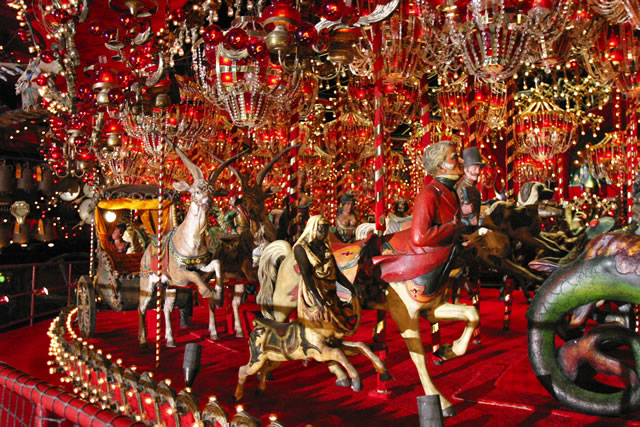
Carousel, The House on the Rock, Spring Green, Wisconsin
I never rode the centaur on the “world’s largest indoor carousel.” (None of the mounts on the House on the Rock’s carousel is a horse.)
I never saw the doll collection, thousands of them, arranged on tiered platforms like a wedding cake (if you had a wedding where the guests ate the bride. Brides.) I never walked into the infinity room, suspended without support over the sheer drop below the Rock itself, a 60-foot column of stone atop which no sane person would ever, ever build a House.
Thoughtful people have reflected negatively on the House on the Rock. It contains a dusty collection without rhyme or reason, accumulated, it would seem, for the same reason that Hillary climbed Mt. Everest: it could be done. There was stuff in the world, so one Alex Jordan, Jr. built the House, bought the stuff, hauled it there and… that’s it. That was the point. If there was a point.
Gaiman is not a thoughtful, reflective person, he is a lunatic genius, so he knew what to do with the House on the Rock. In American Gods, the old gods of America’s immigrant peoples gather at the House on the Rock to debate the means of making a comeback. They ride the carousel. They quarrel. They split into factions. And then they are overwhelmed by other gods, who… but I won’t spoil your fun. Buy the book.
It happens that I spent the past week driving across America. Dope that I am, I did it the sensible way. I took the interstates. I ate at the same McDonald’s every day – it followed me around like a jackal. I read the same billboards over and over. The same jerk in the same Minicooper cut across the same three lanes of traffic every seven exits. Every mile of the northeast and the Midwest had exactly the same things on offer.
I tried, I really did. But when I reached my goal in the Rocky Mountains and toted up my score of weird-and-wonderful, it was pitiful. Three. That was my score: three.
Number One: Somewhere in Nebraska, above what looked like a warehouse, a billboard modestly touted its owner and his wares:
MAX I. (SOME-NAME-OR-OTHER).
CAREER APPAREL. FLOOR MATS. TOWELS.
Question: which careers?
Number Two: A woman sitting at a bar, her back to my table. Her heels – the real ones, not the ones on her sandals – are hooked around the legs of her bar stool. They are huge, perfectly spherical and smooth as cue balls. Her Achilles tendons could play a major part in a suspension bridge. If Achilles had built his up to the same proportions, he would have lived to sack Troy.
Number Three: A headline in the local paper. (This shouldn’t count, because when I read it I had already reached my destination. But I’m desperate here, people.)
Locals Become Leading Trout Semen Freezers
“John Riger and Barry Stout said that as far as they knew, they were the only ones preserving fish semen on their scale anywhere in the world.”
This was apparently good news for the Tasmanian rainbow trout.
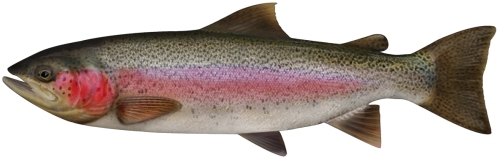
Tasmanian Rainbow Trout (bottle baby?)
On the other hand, Riger’s and Stout’s teenage daughters ran away to join a convent the day after the story was printed. And I really shouldn’t claim a point for this find: the accomplishment recorded took place in 1987. The Aspen Times has a regular archival feature. Around here, history is measured in decades, not centuries.
So, readers, help me out here. You aren’t Neil Gaiman, either. What weird-and-wonderful thing has crossed your path lately? And above all, where did you find it?
Decline and Fall
I was thinking the other day about the dying institution of marriage. The mystery I’m writing involves an inheritance which, in turn, hangs on the outdated concept of legitimacy.
Mind you, I’m all for dropping any stigma (if any remains) on being born “out of wedlock.” But honestly, older people, if you had been asked in your youth what major changes might occur in your lifetime, would you have predicted indifference to the presence or absence of marriage vows? Of substituting “if it works out” for “till death do us part”?
Anyway, I sat down and tried to come up with other dying institutions that I had thought would live forever. Lo and behold, nearly every one that occurred to me involved reading and writing — one of the core complexes of life for likely readers of this blog.
I had occasion to write something down for one of my grandsons not long ago. He frowned at the note – I thought my handwriting was the problem. I got no farther than, “Oh, sorry, that word’s….,” when he rushed to reassure me. “Oh, it’s okay, Grandma. I can read cursive script.” He can’t write it, though. The schools now teach printing, not writing, because who writes anything longer than a grocery list anymore?
Letters (in the sense of correspondence) no longer exist. Their factual content is now transmitted through email. Their creative, imaginative, playful and literary qualities are just gone. (Worse: their playful qualities are have shrunk and hardened into emoticons created by some wretch chained in an office cubicle.) Email is to letter-writing as tweeting is to thinking.
Now that apps have homogenized all forms of information transfer, “writing down” is no longer a distinct activity with defined functions in society. Do our grandchildren get the point of “The Typewriter,” the famous piece of music that duplicates the rhythm of typewriter keys, the ding of the bell at the end of the carriage and the slam of the carriage return? This tune, without comment, once conveyed “composition” or “news reporting.” (Click the link to hear the Vienna Philharmonic play it, with percussionist Martin Breinschmid on the typewriter.)
Editors are as the dodo. I am still unpublished, but I hear by the grapevine that publishers no longer employ such people. Or if they do, the evidence has vanished from much of what is published. My blogging colleague Eleanor Ingbretson recently read a mystery involving that nasty marine animal, the leech. It was spelled “leach” throughout. WTH. You know what I meant. (That link will take you to the blog of the same name, where you will find fellow mourners of the craft of words.)
(Subcategory of the above: use of the subjunctive. And don’t get me started on “may” and “might.”)
Paper is gone, too, or at least unnecessary. I think text is made of electrons now, but I really haven’t the faintest idea. Vandals burned the monastery libraries of Europe; hackers may yet wipe out War and Peace.
We have lived in the age of the Antonines, and Commodus is upon us. (Don’t bother me with questions when I’m being crotchety. Google it.)
Show Your Shelf!

Miniature of Cornificia (Corinse) in her study, from a Flemish translation of Christine de Pizan’s Cité des dames (‘De Lof der Vrouwen’), Bruges, 1475. British Library Add MS 20698, f.70r
Nowadays, even the Pope takes selfies. If you’re a committed writer and/or reader, though, you can get a better likeness than that. Share your shelfies, picture of your books. Give yourself a little leeway, and you can include your desk, your writing space and your reading corner. Why post a picture of your ugly mug? Show us your frontal cortex!
Here’s the most public of my shelfies, the bookcase beside my fireplace.  It displays the books most worth looking at as objects. Almost all of those on the top two shelves were my mother’s or my grandmother’s. They’re bound in leather, tooled in gold. (The books, not my progenitors, though they were pretty hidebound, too.) The stretch of identical bindings is a set of officially worthy books, some of which are indispensable, like Pride and Prejudice and Wuthering Heights, though I’d already read those in paperback before it occurred to me to look through the family holdings. On the other hand, Lord Charnwood’s biography of Abraham Lincoln will probably be up there, unmoved and undusted, when I die.
The tall books on the bottom shelves are mostly art and coffee table books. I have no memory at all of their provenance. I think people break in at night and drop them off to free up their own shelf space.
Below, in extreme contrast, is The Holy of Holies. Books have to be canonized to get here, and for this purpose, I am the Pope.  Most are fiction; a few belong on the history or science shelves. Atwood and Byatt are there, as are Pogo, the best of Diana Wynne Jones, and Perfection Salad, a study on the sociology of home cooking around 1900 that transports me to my grandmother’s kitchen. The woman in the picture is my best friend. A librarian, naturally.
Next, my Purgatory. These, combined, constitute the To Be Read pile. I’ll spare you images of the Lowest Circle (books that have been sitting around so long I can’t remember what they’re about, let alone why I bought them) and the Middle Circle (books I still firmly intend to get to, only not just now, because the purchasing impulse did not convert quickly enough into the buckling down impulse. There’s a lot of nonfiction here.)
Finally, the TBR Upper Circle. These are probably going to make it into my brain within a year or so. I hardly had to rearrange the piles at all to display all my major interests (widdershins from top left): writing, the Israel/Palestine conflict, mysteries and Buddhism.  The mix stays the same all the way down. There are also a few specialized books picked up for research, for instance, a detailed description of a classic Yankee-clipper-era mansion and an endless account of everything known about the Abenaki people of New England. But I guess those come in under “writing.”
How about you, readers? What do your bookshelves look like? Are your shelfies a better likeness of the real you than what you see in the mirror?
Later addendum: Actually, it’s not your frontal cortex (which should have been “frontal lobe” anyway.) You read with your posterior parietal lobe. But somehow, “show us your posterior!” even with “parietal lobe” added, seems to change the tone.
 Eleanor Ingbretson
 Karen Whalen
 llandrigan
 Heidi Wilson
 Mike M
 Thursday Night Writes