Quandaries in Teapots
As you know, we are five writers in search of a reason not to work on the book right now. Reasons, good reasons, are hard to come by which is why you find me actually working on my novel in progress. It’s a cozy mystery, or maybe it’s a cozy thriller. I won’t know until it’s finished. Lately a lot of genres have been morphing into other genres, and that usually makes for just as good a read, but hard to classify. One of my favorite authors, Jasper Fforde, calls these morphings, cross-genre. If you haven’t read Jasper Fforde yet, he’s amazing. He does a great comedy/fantasy/mystery series that follows the adventures of Thursday Next. I won’t tell you anything more, but please send in a comment if you have read or plan to read anything by J. Ff.
Yes, I ran out of reasons NOT to work on my cozy/thriller/mystery set in New Hampshire in the not-so fictional town of Poke. If my heroine, Gracie Smithwick, has her way the spelling of the town’s name will revert back to Poughke at the next town meeting day. She’s up against great odds not only in re-establishing the correct spelling, but in thwarting THE BAD GUY as he attempts to do BAD things. I’m on my third revision and there’s really no good reason not to continue. I plan to drop some dandy carrots in my postings to entice you to entice me to finish.
If you’re reading this blog you are either fellow writers, or fellow readers. If you are cozy writers or readers, maybe you can help me with a small problem. Problems become reasons not to work on the book right now, and I want no more of that. At least not right now.
If, when you are reading cozies, do you find that the heroine falls for the local law enforcement persona way to often? Like in ad nauseum? Like in cliched tropism? I’m taking a poll and looking for interesting occupations for my heroine’s potential fellow. If I fall head over heels in love with a suggestion not only will I use it, but I’ll give you credit for the idea. How’s that for a bargain. You scratch my back and I’ll wash your hand. Well, that analogy sounds bizarre, but you know what I mean, a nice symbiotic relationship to ward off any reason for me not to work on my book right now.
It’s About Time . . .
Except when it’s about something else.
I’m late with my blog post. I had thought that at the last minute Devine Inspiration would give me a good shove in the back and I would start moving forward on saying something. Apparently, D.I. has moved on herself—perhaps she’s read her share of self-help books on deadbeat relationships.
I’m particularly embarrassed about being late with my post because my day job is all about deadlines: getting edited copy to the typesetter, moving proofs through various editing stages so that we get the magazine to the printer on time, and eventually it gets mailed out to subscribers—on time.
Creative writers, too, have obligations and deadlines. The writer scribbling in blissful isolation—picture a cabin on the lake—is not the reality for most of us. If I were dumped in such a place, I might spend more time climbing the walls then actually writing. Writing is a social event; the activities of our lives, the complexities of our relationships swirl and meld in a febrile, creative mind. And as writers, we don’t just draw from our relationships and interactions with others, we are also responsible to our audiences. We need to contribute pieces to our writers groups and blogging partners, and some even have contractual deadlines to deliver a manuscript to an editor at a publishing house. It’s these social aspects of being a writer that provide that much need shove in the back.
Thanks, Heidi, Eleanor, Karen, Mike, Michael, and John. (D.I., I’m doing just fine, not that you asked . . . Do you even still think of me?)
The Non-Existent Page, the Blank Page and the #$%^&*@! Page
Countless good stories are lost forever because of the non-existent page; they never get written. If not reduced to words right away, budding tales often blow away like swirled flights of dried leaves in a November wind, never to form the same pattern again. Without immediate attention, fleeting visions and vague concepts can recede beyond the reach of memory. Once released from consciousness, they float back up to the heavens like a reverse rainfall and dissipate into the ether, where they may or may not coalesce and fall back into someone else’s imagination. My “gravatar” is a blank notebook page because a recurring theme in my writing life is to lose great ideas if I don’t write them down while they are fresh in my mind. That little notebook could have saved those stories and given them a firm toehold from which to advance.
Whether ideas are fresh or captured in a notebook, a writer celebrates a story by facing the blank page with the intention of turning it into the written page. If a writer is the little engine that could, the result is a successful flow of words as stories grow into a rich creation. There are no guarantees, though. Even with notes, ideas that seemed so clever when jotted down can morph into nonsense during a second reading. What originally appeared to be inspiration turns out to be a chimera which evaporates from the heat applied to transform it into an understandable whole. Still, the writer sits down to face the blank page.
Sometimes words stall and headaches develop. A blank page that is not blooming becomes an enervation to the writer who confronts the #$%^&*@! page. Whether or not the writer merely feels stuck or is actually thinking blasphemy and crudeness, the reality is that the creative process has stopped. Thursday Night Write’s llandrigan characterized this phenomenon as “…fear or inertia or mental disorganization…” and Karen Whalen commented that the writer “…would rather have a root canal than write…” That’s where I am now, so I’m going to put this away for awhile. When I get back, hopefully I’ll bring the muses with me.
Write About What You Are Afraid Of
Advice for writers: write about what you are afraid of. I’ve never been very good at that. In fact, when things have happened to me that nightmares are made of (hitting a pedestrian with my company car, getting adrenal cancer, to name a few) I can’t write. I won’t write. I avoid recording my thoughts and emotions, even just the facts. Maybe that’s why I took two memoir writing classes, to find a way to break through that wall. Yet I still have no desire to write about what I fear. Possibly that will develop as I grow as a writer.
This week I read Laura Moriarty’s book, “The Rest of Her Life,” about a teenage girl who hits and kills a pedestrian in a crosswalk. I was interested in how another author would approach this topic, especially from the driver’s perspective. Moriarty focused more on the relationships among the family members and how they all dealt differently with the accident. I didn’t get what I wanted from the novel. But that’s what happens when you read a book, especially fiction. You get what the author wants to give you.
Cancer. If I wanted to write about my experience with adrenal cancer I’d be competing with a multitude of other cancer books. I doubt if I have anything new to contribute. Even if I did, I still have no desire to write about it.
I want to write about people who don’t exist. Whose lives I have made up and control. Whose lives do not resemble mine. In other words, books and stories I would want to read, characters I could engage with, who entertain me but don’t mimic me. I can’t engage with myself. Do other writers?

Woman in Gold
Yet there is one story that I play a minor role in that both piques my interest and frightens me, the story of my German heritage through my mother. We have both Nazis and Jews for relatives; anyone who knew about the Jews is long gone. My mother, though Christian, lost two brothers during World War II. They got on a train and my mother’s family never saw them again. Watching the movie “Woman in Gold” this morning not only brought me to tears, it also resurrected my need to know more about the German history of my family. I must hurry—my mother is 87. This is a story I want to write although it has been written before. But this one would be for me.
The Joys of Research

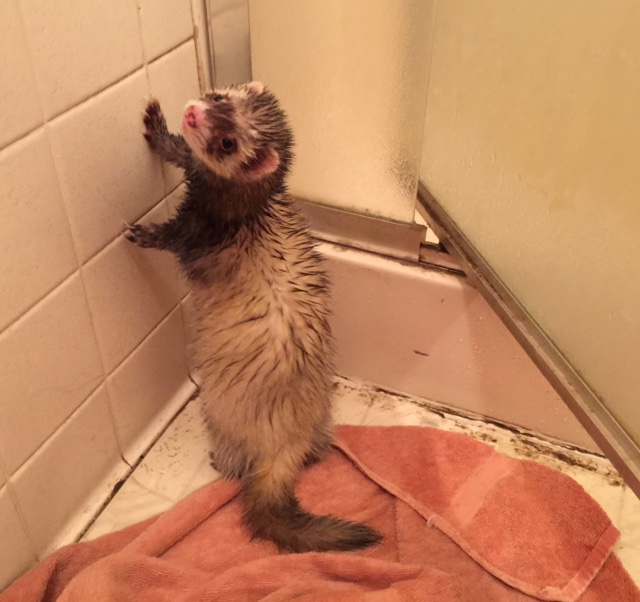
Martha, a ferret with attitude
I mean, of course, the early research for your writing, when you don’t know what you need except bright new ideas, and everything is fair game. We’re not talking last-minute research, when you suddenly find out that every ambulance now carries a perfect antidote for the poison that killed your murder victim.
For some reason known only to my unconscious, the protagonist of my mystery novel emerged carrying two ferrets, George and Martha. (If you can think of any reason why this would happen, please do not tell me.) That’s Martha, above. My ferrets cannot talk; readers are not privy to their thoughts, if any; they do not solve the mystery. They just make messes, reveal human character and generally provide uproar when uproar is needed by the author.
My first source of ferret information was a friend. She owns seven ferrets. They live on the upper level of her house, separated from the kitchen and her other pets downstairs. I held her ferrets: furry and squirmy. I smelled them. Not close up, there’s no need for that. Ferrets broadcast an aroma that ferret lovers do not find offensive. I played with them: irresistible. They bounce, pounce and slither nonstop. They run with their hind half elevated in a kind of Spy-vs.-Spy hunch. The ferret philosophy of life is WHEE-EE-EE-EEEEEE!
Narnia
Like mink, ferrets are water creatures. This is Narnia, who runs for the shower whenever she hears it running. Another of my friend’s fuzzies would park herself under the nozzle and stare at it until someone turned it on for her.
After the cute-ferret session, my friend sat me down for a serious talk about potty habits. Theirs, not mine. If you are squeamish, ferrets are not for you. If you want to know more, you’ll have to find out for yourself.
Next stop: books, books, books. If nothing else, research is a license to buy books. Ask Amazon about ferrets, and it first produces what you’d expect: The Ferret Handbook, Ferrets for Dummies and the alarming How to Stop Ferret Biting in 3 Days. But wait! There’s more! Richard Bach, author of Jonathan Livingston Seagull has written a series of fables about two ferrets, both of whom are writers. I sampled one volume, but my insulin level rose so alarmingly that I had to stop. There is also a 30-page mystery for children, featuring Fiona and Farley Ferret. Here we see one of the reverse benefits of research. Warning: you are entering the Sentimentality Zone. Watch your feet or you will step in something squishy.

Red Ferret Hoodie
From Amazon, you can buy tiny red ferret hoodies, a high-sided plastic litter pan in a delicate shade of mauve, “The Ultimate Crunchy Advanced Nutrition Diet for Ferrets,” and a ferret decal for your car window. You can also give your ferret a “leopard-design” hammock. Surely this is like offering a shark-design hammock to a herring? Another repressed-hostility product: a wholly edible image of a ferret for the top of a sheet cake. It’s Kosher! Gluten Free! Soy Free! Trans-Fat Free! Buy yours now from Amazon!
Next, the wonderful web. You could spend the rest of your life watching cute ferret videos. Fun fact: ferrets are one of very few pets that have a smooth reverse gear. Just try to get your dog to back up. A ferret will do it so easily that he looks as if someone pressed the ‘rewind’ button. Check out the YouTube video, around minute 4:00.
Ferret owners are not necessarily mad. But they are very … specific. They are very focused on ferrets. Case in point: a YouTube performance by a proud ferret mommy of the song she composed, “Ferret, Oh, Ferret.” The tune’s her own invention, but it’s kind of like “O, Canada,” sung at a cricket match by a real non-professional.
Once you’ve done your research, you come to the hard part. You have to decide what belongs in the book. Ferrets are a lot messier than I want to deal with, in life or in fiction. I can leave the messy parts out of the story. But even when ferrets are misbehaving, they are every bit as adorable as ferret fanciers think they are. I don’t want readers rushing out to buy pets they’re going to get rid of at best and neglect at worst. So I’m planning a disclaimer, with web links, at the end of the book. I will not buy my own ferrets. I won’t. Really.
Pens and Nylons
This weekend I cleaned out my closet and finally emptied that old drawer of pantyhose. Each pair was brutally twisted into a knot and stuffed in a drawer that was so full that they sprang out at me whenever I opened it like a jack in the box. They were a reminder of an earlier life, much like the old photo you keep of the jerk who dumped you in college.
I wore a lot of stockings in my twenties and thirties. I dressed up in a power suit everyday for work, slogged from Hoboken to the city, to a tiny office with a view of the office building across the street at Third and Forty-third, and told myself that my job writing for a trade magazine was leading up to something grand, something with a paycheck that would pay the rent at least.
These stockings I’d hung onto for so long no longer fit and were mostly out of style, but like that long-dead relationship, I could point to specific hurts from individual pairs. That pair bagged at the knees, this pair gave up their elastic and rolled down during a presentation, those elegant ones turned to wire at midnight and scored my thighs raw.
Apparently, at one point in my life I wore teal tights—but I have blocked that memory. Mostly I wore off-black sheers. I wore a lot of off-black in my twenties, which I chalk up to a fundamental lack of confidence and a desire to blend into the grimy sidewalks of the city.
Some were so old that the fibers had stiffened. They were awful things and awful reminders of an awkward young adulthood. So why had I kept them, in their own little drawer where they would jump out at me like a suppressed memory?
On Sunday, into the trash went the old pantyhose. Liberté!
What do pantyhose have to do with writing? Tossing them was such a release, that I actually spent some considerable time thinking about the things we hoard, and it brought me around to writing. I identify with being a writer, and yet I can’t say I have accomplished much. I lack confidence—I’m that writer who wears off-black sheers in hopes that I don’t draw attention to myself.
My desk is cluttered with Post-it Notes and fools cap sheets of character developments and first paragraphs. I’ve hung onto a lot of old premises for stories that can’t seem to find a plot, shining lines that lack a poem to nestle into, stale ideas of myself as a writer, and rigid notions of what writing must look like. Those first five pages of a mystery that I think I must finish before trying something new. I spin my wheels on this stuff without much progress.
Tossing my writing tidbits might not be as easy as tossing the pantyhose, but thinking about what gets in the way of writing—fear or inertia or mental disorganization—perhaps is one step of moving beyond what holds us back.
It’s barely Spring, a new year is ahead. It’s time to toss the old ideas about writing and start afresh, this time with a blog, and a new commitment to writing.
And it is a fresh start. Blogging is something new and still uncomfortable for me. It’s its own genre: quick, short, immediate—and intimate. So much so that blogging can seem a bit like talking into the mirror. On the same token, blogging can lead to an empathetic community of people who by sharing their fears and struggles work together to overcome them—and ultimately to celebrate with each other our successes.
Cross My Heart and Hope to Blog
Peer pressure isn’t a bad thing if you pick your peers wisely. For the past five years, I’ve belonged to a writing group and if not for their encouragement, you wouldn’t be reading these words right now. In fact, this piece was presented to the group just last night and they made some great suggestions for improvement.
Five of us shifted into high gear to form the Thursday Night Writes blog as a vehicle for our writing. Like the teenager who listened to his friends’ pleas to prove how fast his father’s car would go, I succumbed and put the pedal to the metal. Like all who venture out on the open road, we hope to end up somewhere good, and with this blog we invite you, our readers, to come along. Let us know if we’re firing on all eight cylinders or we’re off in a ditch somewhere. Don’t worry, with all the experience we have critiquing each other, we’re finely tuned to bang out dings and dents from crashes.
We regularly face the question of why we write. Just because some unknown person out there can read it doesn’t mean that they will and if they do, it doesn’t mean they will like, understand, or profit by it.
Before anything can happen, we have to get over our fears and blocks of putting words to paper. There are bumps, if not solid jersey barriers, at every turn in the road, made up of embarrassment, shyness, and self-consciousness (thank God for spell check on that last one), and some straight sections where ambition, hubris and maybe even arrogance, accelerate unchecked with no regard to speed limits.
If we were driving real cars on this trip, we could follow some cut and dried rules of the road like the ones found in the National Highway Traffic Safety Administration’s guidance documents. There are plenty of rules for writers too, but good luck making them work. For example, books and magazines for writers, as well as certain leaders of writing groups, do advocate a rule of “Set aside a time every day and sit down and write.” Yeah, well, sounds great unless you don’t have anything in mind to write. “The ideas will flow once you try.” Someone tell the Muses; they don’t always notice when a keyboard is under hand. Sitting down to write without a writing goal is to ignore that huge orange diamond “Road Closed” sign and take the turn down that dirt road anyway. A short time spinning wheels in soft sand and hot sun will leave the unprepared parched with a shriveled up creative-juice gland.
If there should be an idea knocking around in the garage between your ears …
Enough of the motorist metaphor. Next time, I will address the concept of The Blank Page. I’ve had a lot of great ideas on profound things to say about it, let’s see what happens.
Desire Isn’t Enough

Arizona hummingbird-my muse?
I’ve moved from the bed of the dim, cozy casita to the patio adorned with blue sky and sunshine. Little birds chatter in the palo verde trees. The water fountain bubbling in the background competes with the wind chimes in the tree. Helicopters and Canada geese fly overhead while the thrum of a hummingbird draws my attention to the feeder. A ruby glitter signals this is a male. My muse, perhaps?
I have decided to read outside rather than write inside—the comfort of the bed was about to lure me to sleep at eleven in the morning. Or was it the pressure to write that caused my eyes to glaze over, my lids to droop? Yet here I am, outside, surprised to find pen and paper, rather than my Kindle, in hand. How is it that the distractions of a glorious winter morning in Arizona are allowing me to focus on my writing when I was convinced that I needed quiet and seclusion, and especially darkness, to get words, action, characters, plot, onto paper?
Excuses. I have plenty of them. The environment isn’t conducive to writing (see above), I have too many other things to do (aren’t I retired?), I don’t have the energy (it’s the medicine), my Words with Friends and Trivia Crack opponents are waiting for my next move (life or death situation to some).….you get the drift.
I can’t write on demand–the forces of the universe must be perfectly aligned before I can put pen to paper, fingers to keyboard,

I’m a winner!
with words leading to paragraphs to chapters to a book. A completed book. Yet I have won NaNoWriMo two times—a “complete” novel, 50,000 words written in the month of November! How do I reconcile this?
NaNoWriMo frees me. No inner critic sits on my shoulder or on the page. No time for self-doubt, perfection, or the fear of failure that normally trigger my procrastination. No concern over what my writing group will think. And then there’s that deadline. All I need for the other eleven months of the year is to find a way to replicate NaNoWriMo, to accept that my first draft will be a shitty first draft, and my creative juices will flow. Miraculously, I will become a published author. Though I have heard that it also takes hard work, writing every day, perseverance. Oh, and I can’t forget a dash of talent. Desire isn’t enough. And desire is all that I seem to be able to muster.
A few nights ago I was up until one in the morning reading a novel, anxious, as usual, to find out how it would end. Although it was my own 2014 NaNoWriMo submission, I had already forgotten. Now I remember how as midnight on November 30 approached those last few sentences seemingly leapt from the keyboard onto the page, surprising even me. Funny how that happens.
Of the Making of Many Blogs There Is No End
WordPress has my number. No sooner had I obeyed its command to “Create Your Web Site,” than it was tempting me to explore everybody else’s blog instead of writing my own. It waved a dozen links to blogs on writing under my nose, even more to book lovers’ blogs, and one called (truth in advertising) Longreads that can mess you up for days.
Then there’s Freshly Pressed, WordPress’s links to individual posts that “you might like.” How does it know? Yeah, Google tells it. The trouble is, Google is so often right. I told myself I was looking for good writing, for ideas on using WordPress well, for designing the page, blah, blah. And I did find ideas I could use.
But if I read all this stuff, when do I write?
All the wonderful How to Write books pose this same problem. Ideas about writing exist in a different universe from writing itself. Books show you nice clear roads to success: if you are writing X kind of book, and arrange your chapter in Y way, the result for your book will be Z. Those are the basic books. The tone of the more advanced comes closer to celebrity cooking shows: “you’ll be amazed how just a touch of coriander (humor/specifics/pornography) will transform your recipe!”
The actual experience of writing is more like forcing yourself to jump off a cliff, having been told by, say, an angel that you will not in fact be smashed to jam, because you can fly – as long as you think you can. Some days, just the icon for your writing program is enough to send you to Longreads.
When you do make the jump, you can fly or you can’t. You start where you left off or somewhere else in the text where you need to be. Your characters need to limber up over a few (dozen) pages. Then they stop making the kind of remark you make at dinner parties to people you don’t know why you’re talking to. And then, from somewhere behind your left ear, an earlier prop or an embedded quarrel or a potential love affair hooks around and snatches your plot. Suddenly, the conversation is making sense, but only if we assume that… and the story is writing itself. If you can keep the scene pulled up around you, and refrain from insisting that it “work out right,” you’re golden. For the time being.
And some days, you’re smashed to jam.
There is no way to avoid either the jump or the jam. I read a bit, here and there, in my pile of how-to books, and like the blogs, they add to my little store of technique. I may even recall their tips to my great profit, if I ever get to the third draft. As soon as your nose emerges from the book, you are going to have to walk back to that cliff face. So get over it, close the book, close the writing blog and jump.
That’s all for today. I gotta go write my post.
 Eleanor Ingbretson
 Karen Whalen
 llandrigan
 Heidi Wilson
 Mike M
 Thursday Night Writes