
Forty-eight Hours and Still Counting

When I last posted I was in the throes of shopping, and cooking, and thinking I could be the next great screen-play writer. The last never happened.  When the phone call came, we found  that our film team’s genre was to be Cops/Detective. Separately, or together, neither one is a favorite topic of mine.  I don’t read Cop/Detective novels unless I pick up a Robert Parker Spencer, or a Nero Wolfe.

Fantasy, or mystery, or even mockumentary would have been nice. Those are fun. Nevertheless I cast my writing lot in with a husband/wife team who have had lots of experience in writing for films. I learned quite a bit about team writing, brainstorming, and running with Out-Loud ideas rather than keeping them in the quiet recesses of my mind. The pros took off with a story that could feature my daughter. Of course I was hooked. There was even a spot for me. It was a great story.

I did contribute bits and pieces here and there, but the story ran away with itself to become an epic with a cast of . . ., well, it was a large cast. It didn’t get past the judgement of the whole team (crew/cast/editor etc.) who were looking for an idea that could be filmed with an economy of time and effort.

So, I was back to being caterer for a fantastic team of seventeen people. I got to see them build their set (a police interrogation room), and I watched them rehearse and I watched them film. They did these things around the clock for forty-eight hours. I didn’t stay. I’m not that crazy. At ten A.M. Sunday morning they declared a ‘wrap’ which meant they could relax a little. The editors kept working and the actors hung around in case another scene needed to be shot. They ate. They slept. They wandered. They took pictures of each other doing things other than act in the movie.

Somewhere around three a.m., Sunday morning, a crew member wandered into the kitchen. My daughter was working there, either making fake blood or writing dialog. I’m, not sure. (I was home, in bed, and asleep.) The poor sleep deprived college kid looked around blankly and asked my daughter where I was. People were getting hungry. She obligingly made toasted cheese sandwiches for everyone. They had no concept of time at that point.

A seven minute movie was finished, and hand delivered to Boston on time. Eighty-five teams competed with perhaps a dozen different genres. Maybe next year I’ll get to write a fantasy/mystery/ mockumentary, but for now I’m enjoying what the team did, knowing that they were well fed throughout the weekend.

It’s now almost three weeks after the Big Shoot and nary a word from the people in Boston as to how the team fared, or how the caterer fared. A last minute perk: a prize for best caterer. I submitted a WRITTEN narrative and photos documenting my culinary weekend. I did get to write something after all.

Hopefully there will be more news soon.

Malice Domestic

Thanks to my spot in the TNW blogging schedule, my report on Malice Domestic 2015 can’t be news, it’s already olds. (For those who don’t know, MD is an annual convention of those who love ‘traditional mysteries.’ Think Dorothy L. Sayers.) So I’ll skip the usual list of superlatives – just google the program — and instead I’ll tell you about the people, things and events that really got me where I live or made me wonder.

Item: Why does a vendor of nesukes and other Asian carvings in glass or stone take a booth every year in the Malice dealers’ room? The booth next door sells jewelry, which makes sense since perhaps 95% of the attendees are female. All the others booths sell books old and new or hand out information on other conventions. Why netsukes?

My Baby

My Baby

Naturally, I opened my wallet. This is what I bought:

I recognized it instantly. Here is my first book, breaking out of its egg. I had been expecting an angel.

I don’t know what its Chinese maker thought it was. The vendor told me that she instructs her supplier on what to carve, but the objects that travel back over the Silk Road may or may not comply. The carvings of birds are wonderful. The cats too are very much like cats. The horses begin to morph into strange, wavy beasts, especially about the nose. And the vendor says that, describe as she will, her carvers cannot produce a coyote. Her coyote standards are high; she raised litters of them in her kitchen for years.

My theory on the demand for netsukes at MD is that they embody convolution. Everything is folded back on itself, twisted out of shape, more complicated than it should be, but in the end, you can hold it all in one hand. Just like a good mystery.

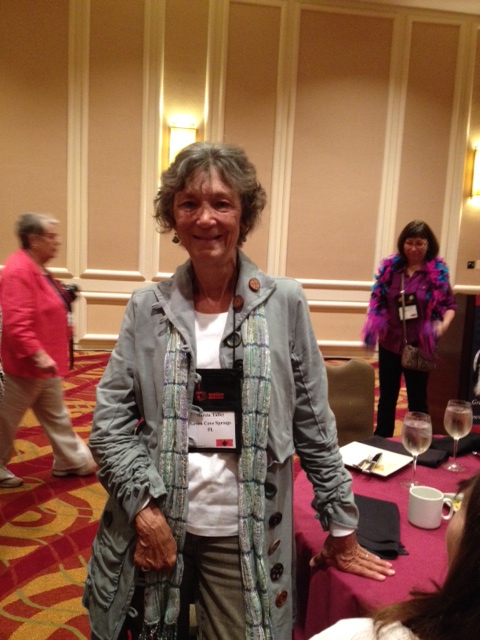
Item: How could it come about that Marcia Talley, author of several excellent mysteries, an Agatha Award winner and a 2015 MD panelist, looks precisely like Eliza Harris, protagonist-to-be of my first mystery? She was kind enough to let me take a photo. Here is Marcia/Eliza:

Marcia Talley

Marcia Talley

The physical resemblance is amazing, but the core of the coincidence is a matter of style. Marcia comes across as warm and open, but there is an enlivening tang of acid in her take on things. The opening sentence of her first mystery, Sing It to Her Bones, could almost have been said by Eliza, mutatis mutandis: “When I got cancer, I decided I wasn’t going to put up with crap from anybody anymore.”

Item: Where does the booze fit in? As far as I could see, MD attendees are fairly abstemious. At least I was invited to no wild parties and heard no reports of trashed hotel rooms. (I may just be unpopular.) But the Hyatt Hotel bar was Malice Central; every chair was occupied from an early hour, and those weren’t tea cups on the tables. How much of the three-day, non-stop effervescence was powered by sheer creativity, and how much by the traditional writers’ fuel?

Writers' Fuel

Writers’ Fuel

The tipple of choice seemed to be wine, but here and there the drinks of the Golden Age appeared. On the first afternoon, two of the rare male attendees were bracing themselves to face the female maelstrom:

And a final item, the hats. The Hyatt bar notwithstanding, Malice Domestic ends with a tea party, a formal tea party with glittery place settings, scones, clotted cream and strawberry jam. It is the custom for the Guppies to wear feather boas, whatever else their costume. (Guppies = “The Great Unpublished,” a subgroup of Sisters in Crime, the association of — mostly — female traditional mystery writers. ) Regardless of publication status, ladies of verve appear at the tea in hats. No, in HATS. The year 2016 will see me shopping for something to rival these:

HATS

HATS

What to write about

These blogs have a wonderful way of forcing focus and at the same time make that focus harder to achieve.  I’m sure that all writers come up with visions that seem so real and then watch them evaporate in the presence of a notebook or computer.  It can get worse; the fuzzy mirage of a story becomes even more blurry when the heat of waiting to the last minute to finish it is applied.  Let’s see what I can come up with in the next hour before my deadline.

You, the reader, have no way of knowing that this is not the next paragraph I wrote.  I actually wrote and discarded two paragraphs using a metaphor of a chef using experience and imagination to put together a fine dinner and made the comparison of writing ideas to food ingredients and editing to cleaning, chopping and parboiling.  It was lame.

But, I’m still thinking along the lines of places where a writer can get ideas.  At the supermarket actually might be a good idea.  Any place other where people congregate can be fertile ground for observing the human condition.  Take Wal-Mart for example, it is probably one of the best people watching places there is.  I remember once, a long time ago, seeing this hairy old guy standing in the check-out line with just a giant bag of cosmetic puffs in his basket.  Although it piqued my naturally suspicious mind that odd things usually have a definite explanation, I didn’t confirm until later that drug users use cotton balls for purifying heroin before shooting up.  What at first seemed to be just an odd and almost funny scenario could almost certainly be made part of a story that juxtaposes the tragedy of drug abuse with the banality of its everyday trappings.  Or maybe there was no more to it than he was getting them at the request of his makeup laden wife.

You don’t have to leave home gather the ingredients of stories.  Just listen to the news and voila, there is the whole spectrum of the human condition laid out for the taking.  Think about a fictional character conjured from tidbits of observations made of the president, Tom Brady and George Stephanopoulos.  Bet that puts a picture in your head.  Maybe you could see a spectator make a face at a golf match and read whatever you want into it to make the next great story of the golf fiction genre.  By the way don’t even stop to wonder if there is such a thing as a golf fiction genre; if you write a great story, there will be one.

Just write it

On our way back home to New Hampshire after wintering in Arizona, we are spending a few weeks with our daughter Jennifer and family in Williamsburg, VA. The region, and our daughter’s house itself, is the setting for one of the numerous stories I have started. And never finished. It is only natural that I am motivated to resurrect the story while we are here.

After nearly a year it’s overwhelming on the one hand and like Christmas on the other to open all of my Word files and reread what I wrote (what seems like) so long ago. Six versions, seven installments submitted to my writing group, and one final complete story. And an equal amount of backstory and plot possibilities. Questions without answers. Questions that deserve answers. Meaning that there really never was a final complete story.

The comments from my writing group come flooding back. One person thought the description of the protagonist’s lunch was unnecessary while another thought it showed insight into the character. That’s just one of the comments I recall.

I do remember that the six versions were driven by the diverse comments from my writing group. I appreciate them all and know, deep down, that they can only improve the story. However, I am assured that it is my prerogative as the author to use any, all, or none of them.

My husband, who paints as a hobby during his retirement and knows nothing of the torture we writers endure, instructed me to pick one option, any option, and just write it. But I can’t seem to find my way out of the whirlpool of plot possibilities swirling around me to commit to just one and do as he instructs.

I know. This is a common thread in my blogs, my discussions with my writing group and my friends and family, in my head. Finish it. Answer those questions. Pick one scenario and stick with it. Has her daughter had an affair with the intruder? Or is she currently having one? Is she still married or recently divorced? Did he steal the Honda Odyssey van or the BMW? Did she ask him to steal her car or just jokingly mention it in conversation? Did the mother, my protagonist, go to the methadone clinic or not? Is there even a methadone clinic? See my dilemma??

For research, I am heading to the garage to have my husband tie me to the newel post with string from the lawn edger to see if it will work for my story. One of my writing group participants questioned the ability of the string to restrain my protagonist. We shall see if one of my questions is answered….

Hearing the Story

Last weekend I had the opportunity to listen to Leslie Budewitz do a terrific reading of one of her stories—“The End of the Line” from the December 2006 issue of Alfred Hitchcock’s Mystery Magazine.

Her dramatic reading highlighted for me how well the narrative voice served the needs of the story. The narrative was confident, active, and melodic without drawing attention to itself. I was never pulled out of the story by an awkward turn of phrase or unduly repeated word. The narrative voice of the story was not the character’s voice, but it reflected the inner workings of the character’s mind.

Hearing the story reminded me that one of the pleasures of reading is the performative aspect. Even while reading alone, I still hear the story as I read, and that audible dimension is a large part of what I find so satisfying in a beautiful passage of writing—and frustrating when the language is flat or clumsy or when the writer has tried too hard to affect an unnatural style.

Every writer should read his or her work aloud—perhaps first alone, but also to someone else when the work is more polished. And every writer should listen to his/her own writing. When you listen to your own writing, what do you hear?

We talk often about how important it is for writers to read widely. I would say that listening is just as crucial a part of the writing process. Listen to other writers as you read, listen to the world—and listen to yourself.

Forty-eight Hours

There are forty-eight hour writing contests and forty-eight hour film-slams, and on Friday, May first, through Sunday, May third, I will be writing and slamming. And catering.

And which activity do you suppose wakes me at night to give me the heebie-jeebies? The food part. Someone could faint from lack of food because I didn’t prepare enough. Will I find the cast and crew to bring them meals on wheels? I’ll have no idea where they’ll be filming when I think they should be eating a nutritious lunch. And the lasagna. It could stay warming in the oven till two in the morning while they finish a scene. What will it taste like then?

I need to get over this. I catered for this team, my son’s, a few years ago. The only complaint then was that there were not enough snacks. The team has grown from ten to seventeen, and I’m tripling the provisions.

My first acting role was in last year’s film slam. I played a crabby Eastern European ticket taker who sprays down undesirable patrons with bug spray before they can enter the ‘pristine’ theater. I was told I did a good job, but having meals on hand when hungry will mean more to the cast than having a crabby Eastern European character actor waiting in the wings. Still, I wouldn’t say no if asked to fill in.

This year, for the first time, I’ll get to write a log line. It’s like an elevator pitch. Anyone in cast and crew who is so inclined will have a chance to write and pitch their very abbreviated scripts to the others, to try to sell their idea. I wish I knew how to prepare for that. It’s not like cooking ahead, because before a forty-eight hour film slam or project begins no one knows what they will be filming. Think sitting around nibbling on the caterer’s offerings, biting nails, guessing, while waiting for the phone call. This call will tell the team in what genre their film must be, and what line of dialog, character, and prop must appear in the film.

Because this particular film project is headquartered in Boston, my daughter (who has also acted, written and cooked), will be there to receive the instructions. She’ll call in all the info needed to get cast and crew started, and then she and another team-mate will make the long trek up north to join the crew.

The call will come at seven-thirty P.M. Talk about pressure. Talk about being at your best at the end of the day. I was heebie-jeebied about meals? We won’t get forty-eight hours to write this script; we’ll get maybe two. When I’ve written a story for a forty-eight hour writing contest I’ve roamed the house with pad and pencil for at least two hours waiting for the muse to strike. That option is out for a film slam. I’ll be feeling like the octopus from Heidi’s posting on 4/27.

Then, when a script or concept is decided upon, everyone will jump into furious activity even though it’s closing in on the end of the day. Props must be begged, borrowed or built. Sets constructed. Outdoor scenes decided upon. Costumes found and made to fit. There’ll be more writing, certainly a rudimentary screenplay is needed, one that will allow the actors a little creative wiggle room. It will be typed up, printed, and handed out. Lines need to be learned. A seven minute film needs to be completed and in Boston by 7:30 Sunday evening.

I’ll do the dishes and go home. They’ll stay up all night.

Tomorrow everyone will be twice as hungry, and breakfast is at six. Maybe I’d better get some more food. There’s no reason to think my story will be picked, or I’ll get to play another crabby role, but sure as shootin’, these folks will need to be fed.

Choosing Your Color

410px-Royal_Arms_of_England_(1198-1340).svg

England’s Royal Arms

I’ve been spending a lot of time lately with the second son of an English duke. You’ve guessed, of course: I’m devoted to Lord Peter Wimsey, Dorothy L. Sayers’ renowned aristocratic sleuth. There was something of a vogue for detection among the fictional peerage of the mid-twentieth century.  The fashion waned and probably received its death blow from the dreary antics of late-twentieth-century royalty.

Sayers (imho) made better use of aristocracy, or at least of wealth, than any of her contemporaries. In all too many a mystery, a mink stole or an ancient and expensive brandy drops into the scene for no better reason than to remind the reader that s/he is expected to be enjoying the idea of being rich. Sayers said that she surrounded Lord Peter with just those luxuries she would have loved herself: rare books, one’s own library, top-notch food and drink and presumably Wimsey’s high-powered Daimler, “Mrs. Merdle.” Her genuine delight in Wimsey’s primrose-and-black library, grand piano and excellent wine cellar call forth an equal delight in the reader.

With Sayers, this kind of detail is never just color, in the dreadful sense of the word as used by sportscasters. Our longest visit to Wimsey’s library contrasts its beauty and peace with his agony as he struggles to work out a case against a murderer who has framed the woman Wimsey loves. Dining on snails at an elegant restaurant, Wimsey notices that his guest views that dish askance, and calls for oysters instead. Attentive friend blends with money-no-object host.

CRW_1714

The New York Stock Exchange (Amazing Travel Photos)

The issue of color is on my mind because my fellow Thursday Night Writer Linda Landrigan persuaded me to try the mysteries of Emma Lathen, a queen of Golden Age detective fiction. Lathen was the nom de plume of two women, Mary Jane Latsis, an economist, and Martha Henissart, a lawyer. Their detective is John Putnam Thatcher, senior vice president of the Sloan Guaranty Trust Company. From his Wall Street office, he solves murders that occur in the world of business, especially high finance.

And for me it doesn’t work. I spent twenty years as an economist for investment firms. What is color to most of Lathen’s readers is just another Monday morning to me. My colleagues were not such buffoons as those Thatcher encounters (though I could have given Lathen a useful vignette or three.) But office life as described by an economist and a lawyer reaches me in pure monochrome. For Lathen’s many fans, it apparently works like a charm.

In the end, the characters and plot of Accounting for Murder pulled me in, but I doubt that I’ll read the whole series. And we all know that if you want to sell a mystery these days, and you aren’t an established author, you’d better be able to offer a series that will pull your first readers along with you.

So what about the color in my own mystery? In the literal sense, it starts out red, yellow and orange, the colors of fall in the New Hampshire mountains. It goes white and gray with winter, then a damp tan with mud season, and finally, joyously, green with spring. Figuratively, it’s the atmosphere of an Ivy League college, of a retirement home for some of its eccentric faculty, and of the rural village in transition that surrounds it.

Enough color? Not enough? Been done already? How about if the protagonist is an anthropologist specializing in African witchcraft? Too much yet? No? How about if I add a couple of ferrets? Okay, enough, right? But then I put the octopus in.

Maybe I need to rethink this….

04-21_OctopusNetsuke

Writing From Experience

Like first time parents, new writers worry about things they never realized existed before.  For me, this became a reality when we started our writing group and the others chimed in about how I should write stories based on my twenty-eight years as a State Trooper, ten of which were as a homicide detective.  For the five years since retirement, my persistent objection to my Thursday Night cohorts has been that it would be improper or unseemly for me to write about some of my experiences.  It is a high honor and huge responsibility to be entrusted to investigate a murder and I felt somehow that to write about what I had witnessed would take unfair advantage of my position.  I have discussed this with my old detective partner and he pointed out that if people did not write about these things, then how would anyone find out about them?  Maybe I’ll soften and reevaluate my stand as I progress as a writer.  No guarantees, but I’ll work on it.

Joseph Wambaugh wrote “…what a sorrowful thing it is to be murdered” in his novel The Glitter Dome.  I read that long before I became a cop, but it stayed in my subconscious and reemerged when I saw my first dead body.  It is sorrowful.  It’s not dramatic and certainly not glamorous.  It’s not at all like Hollywood’s CSI with mood music and fuzzy, psychic flash-back visions of the crime.  It is coldly sobering to stand or kneel over the most personal physical legacy of a human, their body, a human being who only hours earlier would never in their wildest dreams imagine that before the day was over, they would be cold, gray objects of observation to be described in notebooks, photographed and measured for diagrams.  I doubt that many people stop to consider when they lace up their shoes or button their shirts in the morning that they won’t be the ones to undo them at the end of the day.

Sometimes bodies lay in some degree of repose like on TV, but often they are in the grotesque sprawl of their last attempt to retain life or in the ineffective comfort of a fetal position.  Injury levels range from a few bruises or a little hole that is hard to find to extensive, mangled trauma with copious spilled blood.  There is a stillness to death greater than sleep or unconsciousness.  Oh, there actually is real, every-day music sometimes; if a body is discovered with a radio playing in the room, that’s documented as part of the scene and left on until everything is processed and turned off with the lights only when the search warrant return is left on the premises and the doors closed and locked.  You can only guess at the weird and lousy associations I have with some popular songs from years past.  The whole thing was and is sorrowful.

Any writing inspired by actual cases will have to be done with a high regard for ethics and respect for those involved.  No person’s death should be grist for the mill of popular culture where everything is presented merely for entertainment and titillation.  Before writing about such things, I’m going to grapple with the concept of “socially redeeming value”.  I’m no Pollyanna, in fact I’m quite cynical, but I do believe in karma.

I need my writing group

I miss my writing group.I miss the motivation, the camaraderie, it provides. But more importantly for my writing I need my writing group.  I feel accountable to the group to contribute. Away from my Thursday Night Writers for four months now (and another month before I arrive home), my writing has dwindled to a trickle.

I did some quickie research on what writing groups “should” do. It appears we are in noncompliance in a few areas. Yet how to explain our over five years of success as a writing group that meets weekly?

1) Have a mission statement or a written goal. We don’t. Jeez, what’s up with that?

2) Get in on the ground floor. In our group, some have come and gone but four of us have been here since day one.

3) Help each other get published. A few in our group have. We mainly just help each other keep writing. Or provide constructive feedback so that the author won’t be embarrassed when he or she submits something to a contest, literary journal, or agent, or self-publishes.

4) Pick a group that focuses solely on your genre. Living in a rural area we can’t do that (and not everyone writes in just one genre) so occasionally we have issues with other members understanding how something is written. For example, some write cozies and yet others don’t read cozies.

What do I think we do exceptionally well that not all groups do?

  • Our works are submitted in advance, allowing members time to read and absorb the material. Sometimes “in advance” may be a mere hour or two!
  • Meetings are well controlled by John, our group leader/facilitator. He is the sun around which we revolve!
  • We are happy to see each other, we have fun, and we write. We have birthday parties, Christmas parties, celebrations for getting published or winning awards, and anniversary parties for the founding of the group. Some of us meet for lunch on Fridays. Yet we work hard.
  • We willingly share our knowledge with our fellow writers. Having a former police detective in our group comes in mighty handy, especially when we’re writing about guns and crimes.

Six days before my husband and I are due to leave Arizona, I discovered a web page listing twenty-eight writers’ groups and “meetups” in the East Valley. They range from “The Erotic Voice” (13 Eroticians) to “East Valley Writers—Spec Fic (paranormal, sci fi, fantasy)” (12 Evil Dwarves) to “Chandler Romance Writing Meetup” (27 authors).  Some of the meetups have one thousand members.

I am quite certain that I deliberately did not do this research upon our arrival in January. I don’t want a new writing group—I need mine from NH! The one I’m comfortable with. The one whose members I can relate to, understand their comments, and get slightly defensive with.

Though I do try to save my ranting and raving for the drive home.

Maine Crime Wave 2


I finally got up the courage to expose myself. Right: I entered “Two Minutes in the Slammer,” a flash fiction contest that inaugurated the 2nd annual Maine Crime Wave last weekend. The conference MCW posteris held at the University of Southern Maine and sponsored by Maine Writers and Publishers Alliance. It lasted only a day, but not a minute was wasted.

The fun began Friday night. The flash fiction slam was hosted at the Portland Public Library by my favorite mystery blog, mainecrimewriters.com. The winning entries were “slams” indeed, uproariously funny and full of action, all in two minutes. The next time I slam, I’m going for uproar.

I didn’t win that prize, but I got another one: Chris Holm, author of the Collector series of mysteries and most recently of The Killing Kind, told me he liked my story, suggested that I submit it to Thuglit, and then poured forth suggestions for other e-venues that could be appropriate for me! The story went in to Thuglit as soon as I got home, and the next one is being spiffed up for submission.

That’s the best aspect of mystery conferences: there are so many friendly and helpful people. Much-published and admired authors are generous with advice and encouragement. Sort of makes you wonder why literary authors have such a reputation for behaving like twits.

The conference attendees are an equal attraction. At our post-slam dinner, I met Peter Murray, a retired police detective, now a chef. He’s doing research for a book based on the first unsolved murder in Westbrook, Maine, the bludgeoning of Abigail Stack on January 5, 1888. Over dinner, Pete told me about his work on the second unsolved murder – in 1987. Those Westbrook cops are good.  Check out Pete’s blog, especially the post about the pigeons and the lady who tried to poison them with a mixture of whiskey and Alka-Seltzer.

Roaming through the crowd, I met a marine ecologist and the former president of the Farnsworth Museum in Rockland, Maine, both writing their first mysteries. I’m an ex-economist and ex-teacher of Latin and Greek. Is the criminal mind really so widespread throughout the professions? (Anne Jenkins, the museum president, also gave me an update on the meteoric rise of Rockland as a tourist destination. I’ll be checking that out with a mini-vacation soon.)

Barbara Ross, author of the Maine Clambake Mystery Series, gave a blockbuster workshop on how to revise your manuscript. Her handout is now one of my prized possessions. She advocates multiple read-throughs with revisions for one single issue each time. You take the issues in the order that will produce the least wasted effort on things that may disappear in revision anyway. I would have thought of that myself, in time. Sure.

Chris Holm and me

Chris Holm and me

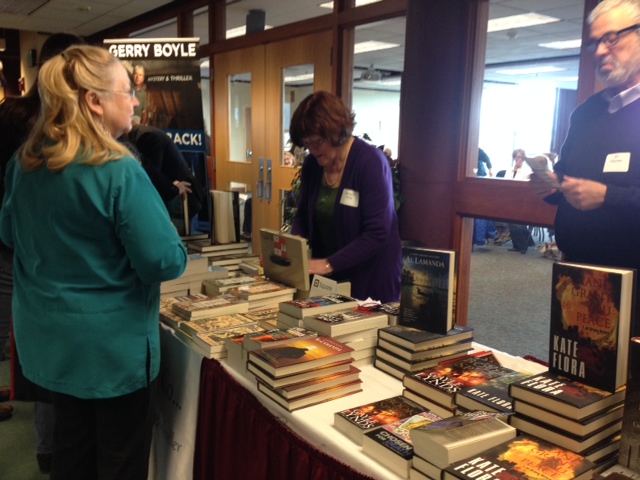
There was a certain amount of genre-blending at the conference. Sarah Graves, who writes the Home Repair is Homicide mysteries, mentioned that #11 in the series, The Book of Old Houses, was inspired in part by H.P. Lovecraft. And then there’s Chris Holm’s Collector mysteries, whose first volume I had just finished. See, there’s this dead guy, who’s been damned for murder and now has to collect the souls of other evildoers when their time comes. But being dead doesn’t mean being dumb. When he gets an assignment that just doesn’t smell right…. I picked up another Collector volume at the Kelly’s Books to Go table in the lobby, where speakers and audience alike were busting their book budgets.

Kelly's Books to Go

Kelly’s Books to Go


Barbara Kelly, the aforementioned bookseller, was on the final panel, the one on the business of getting your book sold to readers once you get it published. It was heartening to hear what enthusiastic fans booksellers can be, if you just take the trouble to make friends at your local bookstores. Barbara will sometimes take books she loves to a conference on a totally unrelated topic, and push them hard to attendees. The panel as a whole agreed on a new (to me) and upbeat concept: the “good rejection.” If your story comes back with comments, you’re onto something. The piece is just “not there yet.” So it’s worthwhile wandering in your personal wilderness yet awhile.


A venerable denizen of the USM campus