Building the Plot Machine
When last heard from, I was moaning and complaining about my inability to focus in on the important things, in particular, my mystery novel’s plot problems. Since then, I have followed my own advice: “Apply rear end to chair. Write.” Danged if it isn’t working.
What is going down on paper – into electrons, I should say – is not fluent prose but brief sentences in an Excel worksheet. It’s my fourth attempt to organize this monster in Excel. Fourth time’s the charm.
My earlier worksheets were chimaeras. Along the horizontal axis were the four murders I had concocted. Each column was meant to state, in chronological order, “what happened.” The difficulty was that everybody’s “what happened” was different from everybody else’s.
I don’t mean just the characters, though each of them had his or her own body of knowledge about who was where, when and why, and above all, who hated whom. I also had to keep track of what happened as far as the reader knew. And of things that had happened all right, but that were supposed to make no sense until the big reveal at the end. And of the little event-clouds that shroud those baffling happenings in ordinariness for the time being.
Since my mystery is a cozy, my detective is an amateur. Her personal life impinges deeply on her need to solve the mystery. Her biggest personal problem (illness) needs to be consistent with the action. Even more, it needs to cast light on her actions, and outside events have to feed back into her situation. I added another column.
Her biggest challenge in outward life (a lawsuit) demanded a similar treatment. Add another column.
Then there were the police. They had to be hunting in all the wrong places. Their errors needed to ratchet up the dangers for the detective. Another column.
On top of that, mere order of events wasn’t enough. I needed specific dates for every event. Can’t have people building snowmen in May (actually, you can do that sometimes here in New Hampshire) or going on a shopping binge on Christmas Day.
You can imagine what a ragbag my worksheet became. Columns could be plot threads, themes, or characters. I found myself copying and pasting the contents of one box into three more, where they were just as relevant. Excel can be an excellent disordering technique.
Now I think I’ve got it. In the new worksheet, each column represents a single character and its contents are single-minded: what does this person want right now, and how does s/he go about getting it? No date column yet, but I think I’ll be able to stagger each character’s moves with the others – and possibly get them into a tighter, tenser order. That’s to say nothing of the way the author’s errors light up. I wasn’t half-way through entering my data before I found the murderer acting directly against his own interests. Duh.
I’ve been whining about all this in my writing group for so long that our moderator came up with an exercise for all of us to work on. He went to http://writingexercises.co.uk and used their “random plot generator.” Out popped the following:
Main Character: An optimistic 23-year-old woman
Secondary Character: A rebellious 60-year-old woman
Setting: The story begins on a cliff
Situation: A robbery goes badly wrong
Theme: It’s a story about risk-taking
Character action: Your character sets out on a rescue mission
Our assignment is not to write the story, but to come up with the outline of a coherent plot using these elements. I hope to make this a dry run in miniature of my big Excel project.
(By the way, writingexercises.co.uk also provides other sorts of prompts and helps you work on other tasks, e.g., “generate a fictitious ‘English-sounding’ town name.” Check it out.)
So what about it, campers? How do you keep your plot threads untangled? All tips welcome. Or try your hand at the exercise, and let us know how you did.
It Has to be Good, Not Perfect
The sun pours down on my life today. Actually, a thunderstorm is approaching, but to me, all is light and life. I gave a talk yesterday to a foreign affairs discussion group I belong to. Today, therefore, I no longer have to give a talk to the foreign affairs discussion group!
Speaking in public is not a problem for me. It’s the fear of making a mistake that wrecks my life. The search for correctness on every last tiny point ate up last week like the Tazmanian Devil pouncing on its prey. I had a good grasp on my material. But what if that date (2005) should actually be 2004? Google it. It was 2005. What if…? Google it. I spent more time in Google than in Word.
Because I spent the week obsessing, I printed my handouts at the last minute. My printer broke down. I switched to my husband’s printer, got one file completed, and the printer suddenly began taking its orders from Mars. Half a ream of paper was wasted before I finished the task. My office looked as if Dirty Harry had ransacked it.
No time for a shower before leaving. I plastered my hair down with a comb so severely that no one could doubt I intended it to look that way, for some unfathomable reason. Since I know where all the local speed traps are, I walked into the meeting room right on time, wearing an easy expression of ‘no sweat!’ Which made me think of the missed shower again.
And it all went fine. It almost always does. And so what if I had made a mistake or two? The world would not have ended. I would not have been damned for all eternity.
You wouldn’t think that writing fiction would be as susceptible to the search for perfect truth as reportage. You’re supposed to make fiction up. The writer is responsible for all the truth in the fiction. Unhappily, s/he gets none of the feedback offered by the real world when truths collide. In life, a brook simply will not run uphill. In your book, it can run one way in Chapter 3 and the other in Chapter 11. Until some kind or not-so-kind reader points that out.
The perfection trap doesn’t confine itself to fictional facts. When every flaw catches your eye equally, whether it’s a poor word choice or a gaping plot hole, progress can be agonizingly slow. I’ve managed to bring forth a first draft. I’ve rewritten, rewritten the rewrites and … you finish the sentence, assuming it ever ends. A draft that really needs only a clean-up is still miles over the horizon.
Perhaps it’s a trick of focal distance. The present plan is to focus on plot, plot, plot and never mind the rest. And we all know how to find out whether that’s a good idea. 1) Apply rear end to chair. 2) Write.
WRITING WILL TAKE OVER YOUR LIFE
WRITING WILL TAKE OVER YOUR LIFE!!!
It’s true.
It’s not bad, but it is true.
Before I began writing with my group, the Thursday Night Writes, I was happy and carefree. I’m still happy, but the cares, oy vey.
I had hit the floor running with a full length cozy. Now, six years later, I find myself staggering along with the same cozy. Sure it’s improved, I can see that, but I want it done. I want to stop thinking about it and I can’t. It preys on my mind constantly.
What should I do about it? Finish it, you say? I don’t have time to finish it.
This lack of time is problematic to say the least. What I need is an unlimited amount of time. Away from home and distractions. With meals brought on a tray. Well, maybe I’ll need to get the food myself, but there will be a tray, I’m sure.
The perfect solution appeared to me in a stressed out moment. I needed good quality jail time. Not prison, not anything longer than six months, just a half year stint in a upscale jail.
When I presented my idea to the group they thought I was surely jesting. Our resident ex-cop was aghast. I wanted to know what crime I could commit that would land me in swanksville for half a year. I knew how jails operated. Three square meals a day, semi-private room, exercise time, and privileges for good behavior.
A class B misdemeanor was what I wanted. It’s less than a felony, and quite possibly after my book was done I could get a good lawyer to have my misdemeanor expunged. Maybe I could pay off said lawyer with my royalties. Hmmm.
A class B could be shoplifting, or possibly drunk driving, among other things. These two are the most popular. Jean Valjean got a heck of a lot longer sentence for nicking some bread for his starving sister and her child, but we live in a more enlightened age. Six months, tops.
Or, if I were to say the F word in court, especially if I directed it at the judge, I could get six months. I’d have to be in court for something already, and this plus that would make my time add up to possibly longer than I’d intended.
The closest I ever got to jail was long before I began writing. More recently I rolled through two stop signs and was pulled over by a distinguished gent with a badge. I tried to bribe him with some freshly baked baklava. He could smell it as soon as I’d rolled down the window, but he was having none of it. He let me off with a warning. A verbal warning, not even one in writing that I could contest in court and perhaps have the opportunity of using the F word.
Possibly a simpler solution to my problem is simply to let writing take over my life. Imprison myself at home, handcuff myself to the desk, hypnotize myself into foregoing snack and meal breaks until the cozy is done.
Ah, then revision. There’s the rub.
When you know you’ve made it as a writer
You know you’ve made it as a writer when your career is the subject of one of the questions on the Buzztime Trivia game at Buffalo Wild Wings. We were “dining out” with our oldest grandson at B-Wild at Chandler Fashion Center when I glanced up at the huge screen on the wall connected to the tablet at our table and read a question I could actually answer. In other words, it wasn’t sports related.
The question was, per my recollection, “who writes about the nightmarish side of society?” I’m unsure who the other choices were but I knew immediately that Joyce Carol Oates was the answer. She may not be everyone’s cup of tea but I happen to love her books, as depressing as they tend to be. Wonder what that says about my psychological makeup?
I was fortunate to hear Oates read from her novel “The Accursed” at the Canaan, NH, Meetinghouse Readings on July 11, 2013. (Was it really almost three years ago?)
Anyone living within an hour’s drive, or more, of Canaan, NH, please plan to attend the readings at least once. The Meetinghouse, built in 1793, is worth the trip alone. I don’t know how the moderator convinces such acclaimed authors to make the trek to Canaan but you are certain to find at least one each summer that has you sitting on the edge of your bench, pinching yourself to check that you haven’t ventured into an alternate universe.
If I had to choose between being a question on the Buzztime Trivia game and reading from one of my novels at The Meetinghouse, without a doubt I would choose the latter. On second thought, I’d prefer to follow in Oates’ footsteps and do both.
So, I Signed Up for Duotrope
SO, I SIGNED UP FOR DUOTROPE
I went for the free introductory week.
It will take me a full week, and probably more, to navigate everything they offer the writer who wants someone else to do her research. There’s nothing wrong with that. I feel totally inadequate to the task of finding someone, anyone out there, who might be interested in something I wrote. That’s what Duotrope does, and they say they do it best.
Does that include miracles?
Yeah, right.
When I cleaned off my desk several weeks ago I found bits and pieces of stories never finished, short, short stories, and other amazing things I’d forgotten I’d written. Some were, to me, good. Some I remembered as better than they appeared now in the light of many day’s (year’s) passage. Some were ‘gag’ me material. Gah.
Will Duotrope find homes for these treasures and for the ones I’ve been steadily working on for lo these many years?
Meaning a miracle?
Duotrope will not only do the search for an agent or publisher for my unique story, they will keep track of what I’ve sent out, when I’ve sent it, and how long it should be before I hear back from the recipient. They will refine the search for the perfect spot for my story to the smallest number possible, almost guaranteeing success.
But do they do miracles?
Is a miracle the same as pulling a rabbit out of a hat? Definitely not. The rabbit was hidden in the hat already. A miracle is when there’s no rabbit, but something manages to get pulled off anyway.
I have to write something way better than a ‘gag’ me story. I have to pull all the bits and pieces of a story into one homogenous whole. And I have to take a good story and make it the best I can.
Is that the miracle?
No, unfortunately. It’s called pulling a rabbit out of a hat.
Why don’t I write?
Today’s post on the Maine Crime Writers blog by Bruce Robert Coffin about why he writes resonated with me, as do many of their posts. Beyond the writing connection, it may be because I spent my “formative” years (ages 4 to 14) living in Bangor.
Funny how my reasons for not writing when I should be writing mirror Coffin’s reasons for writing…
He writes to quiet those voices he hears in the middle of the night. When I can’t sleep, I think about my characters and what they are up to and–just as when I was hypnotized on a stage in front of hundreds of people–before I know it I’m sound asleep. No need to keep pen and paper on my nightstand. (I do but, as you may recall, I can’t read what I’ve written so I use it for grocery lists.)
Coffin apparently has some demanding, strong-willed characters in his stories who have no qualms about disagreeing with his plans for them. My characters, on the other hand, hang around as they lean against the walls, hands in their pockets, and wait for direction from me. Don’t they realize how much work they make for me with their lack of gumption and rebelliousness? Give me a protagonist who has a mind of her own and flaunts (my) authority and I’ll step back and let her take charge.
I don’t know where he gets some of his characters, either. Apparently his Sergeant Byron takes Coffin for rides in his car on his way to catch the bad guy. Instead of the other way around. As none of my characters have drivers’ licenses they expect me to drive them wherever they need to go. I just don’t have time for that. Maybe carpooling is the answer?
One thing we do have in common is that he doesn’t appear to prepare in-depth outlines. (And why should he? His characters run the show.) I’m a proud pantser and I surmise that Coffin is as well, based upon his comment that the enjoyment he derives from writing is not knowing what is going to happen in his stories.
Unfortunately for me, a newbie cozy/murder mystery writer, demands are being made of me that I may not be able to meet. After submitting my rough plot summary and character description for a new cozy to my writing group last night I’ve been asked to write the murder scene. Before I write anything else. The audacity! That I should know “who done it” before, well, before I know anything else. Apparently the writer, unlike the reader, should know this prior to investing time and energy into writing the actual book. Sigh. Big sigh. How do I reconcile this with my badge of honor as a pantser? I suppose it could be to ensure that the reader will want to invest time and energy into reading my book…
Giveaway Books. Or Not.

Awaiting you at the Five Colleges Book Sale
The annual Five Colleges Book Sale is a big deal here in the Upper Valley. Organized to fund scholarships for New Hampshire and Vermont students at Mt. Holyoke, Simmons, Smith, Vassar, and Wellesley colleges, it is the largest second-hand book sale in northern New England. For this book addict, it is a blessed way to reduce my library, at least for the two weeks between when I drop off my contributions and when I attend the sale.
Today, I went down to the basement to pack up the pile of books that I have winnowed over the last year. Here are a few of the items you’ll be able to buy at a really good price, while benefitting worthy young scholars:
The German Cookbook, by Mimi Sheraton. I bought this book hoping to please my Germanophile husband with the dishes of his ancestors.

After rolling the strudel dough
http://www.wikihow.com/Make-Apple-Strudel
I should have checked the apple strudel recipe before I forked over the cash. It involves rolling out dough, which you have already slapped down on the pastry board 115 times, over a whole kitchen table until it is as thin as tissue paper. Guess I’ll have to think of some other way to please my husband.
Two biographies of Samuel Johnson. I tried hard to like Johnson. I read Boswell’s Life of Johnson and was sure he had to be right about his idol. So I read these books. Doubtless they are great works of scholarship. But what kind of idiot tries to write a life of Johnson after Boswell?
Six paperback murder mysteries, published between 1993 and 2014. I read them all within the last two or three years. I cannot remember the plot of a single one. This confirms me in my dreary notion that my own mystery manuscript will have to be re-re-re-revised till Judgment Day.
 Angels and Demons, by Dan Brown. Brown’s The Da Vinci Code was a page turner, I admit. No matter that it read like its own outline. Like everyone else, I couldn’t put it down. So I went and paid the hardback price for his earlier book. It was like The Da Vinci Code if The Da Vinci Code had never been outlined at all. It had angels and demons. I guess. Further, deponent remembereth not.
The Strange Ride of Rudyard Kipling. His Life and Works, by Angus Wilson. I haven’t read this one. It belonged to my late husband. I’d like to read it…but there just isn’t TIME. I flipped through it… it looks fascinating…with photos, yet…a Spy cartoon…but something’s got to go. I can’t keep retrieving things from the pile.
Which brings me to the more interesting part of this list. Below are several books from the pile that the Five-Colleges sale will not be seeing. How long have they languished in this limbo? And more important, what was I thinking when I put them there?
Something of Myself, by Rudyard Kipling. I compromised. I’ll give up the biography and keep the autobiography. I flipped through this, too. I cannot discard a book that includes the sentence, “For the great J.M. [Cook] himself – the man with the iron mouth and domed brow – had been one of my father’s guests at Lahore when he was trying to induce the Indian Government to let him take over the annual pilgrimage to Mecca as a business proposition.”
The Letters of Madame, Vol. II. Princess Elisabeth Charlotte of the Palatinate, known as “Madame,” married Louis XIV’s brother in 1671. She was a woman

Madame, in her later years
who did not pussyfoot. She slapped her son’s face before the whole court when she learned that he had agreed to marry one of his royal uncle’s bastards. She never had the slightest desire to participate in court intrigue, love affairs, government or fashion. She liked hunting all day, she liked her meals large and regular, and she loved to write letters. The accounts she sent to her German family and friends about the court at Versailles were so frank that the government used them to blackmail her in later life. Their demand? That she shut up about her opinion of Mme. de Maintenon, the king’s mistress. I found this second volume, without its first, in a second-hand bookstore, and I have been looking for Volume I ever since.
Howe & Hummel: Their True and Scandalous History, by Richard H. Rovere. William F. Howe and Abraham H. Hummel were New York lawyers in the second half of the nineteenth century. They got murderers off scot free. They got Lilian Russell divorced – frequently. They bought off witnesses. Hummel eventually went to jail himself. If you liked the movie Chicago, you’d love Howe & Hummel.
A Moveable Feast, by Ernest Hemingway. Good grief! This is a first edition, bought by my mother when it came out in 1964. Just last year, I bought the new edition that includes the parts that Hemingway’s publishers cut, and I hunted for this book to compare it with. And there it was, down in the giveaway pile. I must have been mad.
These notes are based on the contents of the first two grocery bags of books that made up the pile. There are two more. I don’t dare look into them.
A Miserable Week
A Miserable Week
It was a misery specific to me alone, and I could have suffered that way except for good friends and good books. The books had more endurance, friends would cluck, cluck and duck out after finding me, the drama queen, unendurable.
I had a toothache. There’s probably no one who is a stranger to toothache, and if there is, then harken unto my words and stop eating desserts. Or go back and be born with exceptionally strong teeth. There’s nothing like a toothache to reform a dessert-aholic or to to make him wish for a better genetic profile. Even if the reformation and all the wishing in the world are only temporary.
So, at the apex of the pain, I had an extraction. I’m not even going to talk about that, it’s too fresh. It was yesterday.
Good books were what pulled me through this ordeal. They will sit with you for however long it takes for the pain medication to kick in, even longer if you like. They uncomplainingly drop from your hands and onto the floor when, in a weakened condition or during a brief snooze, your fevered fingers lose their grip. Name one acquaintance who would stand for that.
I’ll tell you who stood me in good stead during this prolonged, painful ordeal. It was Jasper Fforde.
Oh, good grief. Is she going to babble on about him again? Every other blog post it’s Jasper Fforde this, or Jasper Fforde that. The man doesn’t even know how to spell his own name!
Yes, I am going to babble on about J.Ff., and here, from two erudite researchers, are comments on the double Ff (ff):
I’d heard the “ff” was from an old calligraphic way of writing a capital “F” — it only looked like a doubled lower case letter. But folks (or is it “ffolkes”?) misinterpreted it, and over time it became “ff”. (scratch1300)
I think scratch1300 is on the right track. From Brewer’s Dictionary of Phrase and Fable] [quote] Double F (Ff, or ff) as an initial in a few personal names, as Ffoulkes, ffench, etc., is a mistaken use in print of the medieval or Old English capital F as it appears written in engrossed leases, etc. In script the old capital F looked very much like two small f’s entwined. (bibliophage)
That’s all I’m going to say on that subject, except maybe I’ll use that spelling on occasion when I’ve got a character who needs an uplift.
How fast we mortals forget our resolves. My husband just came home and was about to eat the last piece of rum cake, but I beat him to it.
Getting cozy
Remember my last blog post where I announced that I was combining my three partial novels into one novel with three main characters, three points of view? I’ve scrapped that idea and moved on to a new one that is certain to be my final one.
Maybe.
You’re probably wondering what possible iteration is left. Drum roll, please. Two novels! “It Takes A Village Store” has transmogrified back into a standalone novel. A cozy, no less. (You may sense the influence of a few of my writing group members.)
I was surprised at how easy it was to transform “It Takes A Village Store” into a cozy. Deciding who to kill was easy–he was an existing, dislikable character. Adding more characters, potential murderers and their motives, was easy as well. Amazing how far you can get without a plot. I’ve volunteered to submit a plot outline to my writing group at our next meeting. Always a challenge for me, a pantser, to quantify my story. Especially before writing it. The other challenge is that my daughter and her family from Virginia (her house is the setting for “The Intruder”/”He’s All She Has”) arrive tomorrow and leave Sunday. And Sunday is Easter.
Excuses, excuses. Don’t worry, dear writing group members, I’ll submit an outline and you’ll help me revise it. And revise it.
That leaves the other two novels fitting together perfectly into one–mother, Anne, and daughter, Olivia. In love with the same man. I’ll definitely have to develop a different take on this overdone concept. Anyway, that’s way off into the future at the rate that I write…

Sunset in Arizona
W? Or Not?

Would-be writers can always be lured into taking just one more how-to-write course, buying just one more book, attending just one more conference. Flailing and weeping in the chaos of our own material, we’re sure that someone out there has a system. No, has The System that, with one hard shake, will order our characters, themes and events into a page-turning plot.
I lost a lot of time trying to cram my plot into the shape recommended by  Mary Carroll Moore’s Your Book Starts Here. Her system is to shape your plot like the letter W. Your protagonist encounters loss or danger, plunges to the depths, pulls herself together and addresses her problem with some success – we’re now at the peak of the first upstroke of the W – then gets really whacked by some failure or complication, descends to the uttermost depths, and finally wrestles her way back to whatever fate you have in store for her.
The W method is good for making a start, and also for combatting saggy-middle syndrome. In the end, though, you have to compound your own prescription. So today, I offer a few alternative plot shapes, as discussed by Kurt Vonnegut on the Washington Post’s “Wonkblog.” In a hilarious (truly!) video Vonnegut explains how simple it all is, really.
Plot 1 is “Man in Hole.” The hero starts in a reasonably comfortable condition, encounters a problem, solves it and ends up better off. Vonnegut graphs this  from beginning to end as a nice even sine wave on a happy-unhappy vertical axis. Events head down into negative territory, reverse course at the bottom, and end up even higher on the happy scale than they started. Wonkblog’s example: Arsenic and Old Lace. Note that Mary Carroll Moore’s W could be titled “Man in Two Holes.”
Plot 2 is “Boy Meets Girl,” in which the initial events head upward on the graph, i.e., boy falls in love. From there on, Plot 2 replicates Plot 1, as the lovers are separated, then reunited. Traditionally, “Boy Meets Girl” ends higher on the vertical scale than “Man in Hole,”since (as we all know) they lived happily ever after.
Now we get into the kind of plot I like best: Cinderella. No, not for the happy ending. By me, that prince is a Ken doll. According to Vonnegut (and strangely
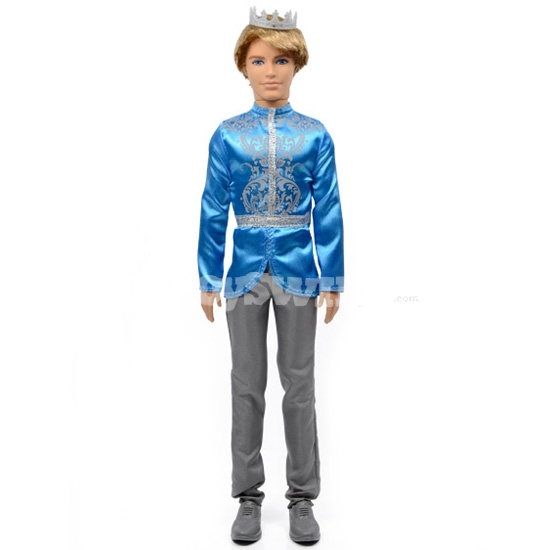
The Ken Prince from, I kid you not, “toyswill.com”
mis-graphed in the Post article), “Cinderella” is distinguished by its beginning – among the cinders, way, way below the middle of the happy-unhappy axis. Then (and this is what I love), progress toward the Prince’s ball takes place not in a smooth curve, but in a series of stair-steps. The gown. The glass slippers. The pumpkin coach. The mouse-horses. These lovely items are provided by Cinderella’s fairy godmother, but in more interesting stories, each has its own provenance, sometimes but not always obtained by the heroine’s own efforts.

Broccoli’s fractal form, an instance of the Fibonacci sequence
It’s the detail that grabs me. The plot takes on the shape of a Fibonacci sequence. Every step can replicate into a handful of details or issues, which in turn can replicate. This is why I like Proust. (Trouble is, I haven’t yet been able to work out what the heck his stair-steps are leading to.)
The stair-steps also occur in the folkloric creation story, in which a deity or deities generate successive gifts which, combined, produce the world. My favorite literary example is Elizabeth von Arnim’s Elizabeth and Her German Garden, but of course Genesis I is better known. According to Vonnegut, the Old Testament is simply the creation story with an unhappy ending tacked on: God makes the world, we live in it, we die. With the addition of the New Testament, we are back to Cinderella.
Vonnegut does not ignore modern literature. There’s “From Bad to Worse,” in which some poor schlemiel simply gets hammered, and that’s it. Wonkblog’s example: The Metamorphosis. And then there’s “Which Way is Up?”, exemplified by that most modern of stories, “Hamlet.”
You can noodle around with these curves forever, and come up with a story to match anything you can draw . At present, I have no idea what shape my own story (fictional, that is) will take. I got troubles, I got worries, I got stair steps, nobody gets a girl … who could ask for anything more?
 Eleanor Ingbretson
 Karen Whalen
 llandrigan
 Heidi Wilson
 Mike M
 Thursday Night Writes