Category Archives: Heidi Wilson
The Plot Acrostic
Aspiring writers, rejoice! There really is a point when the plot tangle breaks.
I was sitting on a logjam the other day when it suddenly broke up beneath me. No, I wasn’t swept downriver to my doom. The logjam was the one that had been afflicting my plot almost since it became complex enough to constitute the skeleton of a book.
Every new idea for a plot development took the story forward, but almost every idea also implied a situation rendered impossible by what had come before. One character, for instance, was intended to instigate a lawsuit against a certain building project. His personality was unpleasant: in fact, he was intended to be the first murder victim. Idea! What if he was, in fact, the murderer? I found him a victim. Two victims.
But wait! To commit the first murder, he had to be in town. Unfortunately, at the intended time of death, he was elsewhere. (In prison, as it happens.) Well, that could be changed.
But wait! If he murdered for the reason I had come up with, he wouldn’t have taken the stand he did on the building project…. You see the problem.
For what seemed like aeons, I shifted and chopped and changed. The longer the manuscript grew, the more changes every new development required. I persevered.
And then, one day, the logjam broke
As it happened, I had been amusing myself with a book of acrostics the night before. When the logjam broke, I recognized what was happening, because it had just begun to happen in my acrostics.
(If you don’t do acrostics, they work this way: as in a crossword, you are given a definition and must come up with the word intended. Each letter in that word is assigned a number, which you then enter in a numbered space in a linear form. When all the correct letters are entered, they make up a quotation.)
I had reached the middle of the puzzle book, where the “medium difficulty” acrostics take on a new character. The definitions become vaguer, more allusive, slangy or punning. The quotations include longer and rarer words, names and complicated clauses.
At this point, the game shifts. Your ability to see the shape of the quotation’s prose, the rhythm of its clauses, its repetitions, lets you fill in words before you have guessed many definitions. The meaning of the quotation leads you to the detail of the words, not the other way around. And the puzzle goes much faster while also being much more fun.
Here is the beginning of the quotation I was working on when the game shifted. Have a go.
_ _L _Y L_V_ _Y P__N M_ P _SS_ _N
Just like that, as I drew near the end of the umpteenth draft of my mystery, the feeling of the changes changed. My solution worked, if only… and I clicked in my Scrivener binder to an earlier scene, altered three words, and all was well. Onward. The solution continued to work, if only…. Back up in the binder, cut a paragraph, and all was well.
I now have only two or three scenes to rewrite (plus a couple of new ones to tie up a subplot), and I will have, not a draft, but a book. Still deeply in need of editing, but a book.
Here’s the whole acrostic:

Even Later Than That
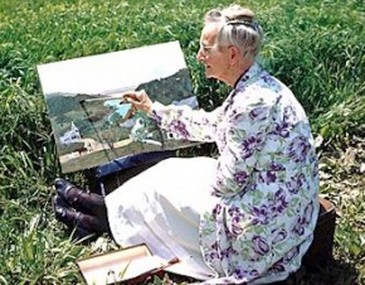
Grandma Moses at Work
I wish that nice people would stop being quite so scrupulous about “age-ism.” Their dire attempts to convince everyone that they hold no stereotypes about people like me have done much to embitter my life.
I only learned about age-ism when it became politically incorrect. As a child (in the 1950s, thank you for asking), I assumed that you just grew up and stayed that way, with nothing significant about you changing except that one day you dropped dead. Wrinkles and rheumatism occurred, of course, but why niggle over the tiny differences between a thirty-year-old grown-up and a seventy-year-old grown-up?
Adolescence and the first gray hair were horrors, naturally, but until the nice people took over, none of it was linked in my mind with personal competence. I didn’t get around to trying to write a book until I was over sixty. Then, still mired in the depths of that project, I encountered the following headline on an arts web site:
14 Brilliant Authors Who Didn’t Succeed Until Way After 30
If you haven’t sold your book yet, the author assured me, not to worry:
After all, dozens of famous writers didn’t “make it” until their 30s, 40s, 50s and, in some cases, even later than that.
One of these dogged late-bloomers was actually 34 before his first novel was published! Probably had dentures. Three of the others were 39. One of them, granted, was 90, but he’d been publishing screenplays for over half a century. If you, Older Unpublished Writer, find this at all encouraging, you can read the article here.
 I tried to find encouragement in the memory of Helen Hooven Santmyer, whose novel And Ladies of the Club was published when she was 88 years old. Its 1176 pages weigh in at 3.1 pounds. The story goes that she had been working on it for 50 years. I hope I can work on my writing for 50 years; that would mean I’ll live to 114. I’d like to be published before then, though.
Unhappily, I pursued my interest in Ms. Santmyer, and discovered that she had already published two novels before Ladies – the first when she was 30 and while she was holding down a full time job.
(I still love Helen. When the college she worked at was purchased by a fundamentalist denomination, she quit, because they demanded that she adhere to biblical literalism and stop drinking and smoking. I’m sure it wasn’t the literalism that made up her mind for her.)
I thought maybe I’d found my tribe when I came across a web site called Persimmon Tree. It bills itself as “a showcase for the creativity and talent of women over sixty.” But then its ‘about’ section goes on:
Too often older women’s artistic work is ignored or disregarded, and only those few who are already established receive the attention they deserve. Yet many women are at the height of their creative abilities in their later decades and have a great deal to contribute. Persimmon Tree is committed to bringing this wealth of fiction, nonfiction, poetry, and art to a broader audience, for the benefit of all.
I’m not cheering, people. You mean somebody gets to say when I’m at the height of my creative powers? Even I don’t know. I’ll bet I won’t know when that is, or was, not even in the minute before I finally do drop dead. Do the twenty-somethings get to cry Ageism! when they read that?
I say we drop the whole issue. Go sit down and write.
You Belong in the Upper Valley If…
…your first thought when you need to buy something is, ‘I’ll just run down to Dan & Whit’s.’

Dan & Whit’s General Store
If you live in the Upper Valley of the Connecticut River, you don’t think twice about Dan & Whit’s Country Store of Norwich, Vermont. You just go in and get stuff as thoughtlessly as you open your fridge for a Coke. Or you explain where somebody lives as ‘about ten minutes from Dan & Whit’s.’ Maybe that’s why we locals sometimes forget how quintessentially Vermont D&W’s is.

The principle
In fact, you can’t get absolutely everything there, as the front window is careful to point out. But you can get all the important things:
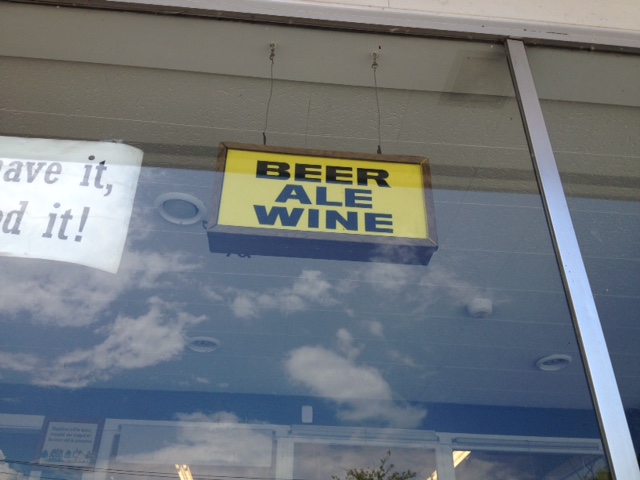
The application
Once you’re in, you encounter what looks like a small grocery store. You can get Spaghetti Os and Tide, sure. But you’ll also notice a high percentage of Vermont-made food items. Not all of them are kale:
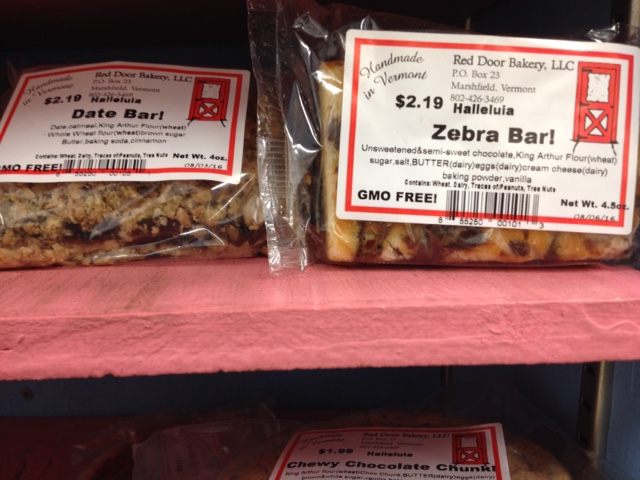
Adds 3/4″ of pure Vermont to your hips
The Red Door Bakery of Marshfield Vermont does not make mimsy, everything-free baked goods. These are cookies that intend to be cookies. And succeed.
Across the aisle, you’ll find a product so packed with Vermonticity, you’ll be glad you moved here. The Cabot Creamery Cooperative is owned by the farmers whose milk it processes — a very Bernie Sanders set-up.
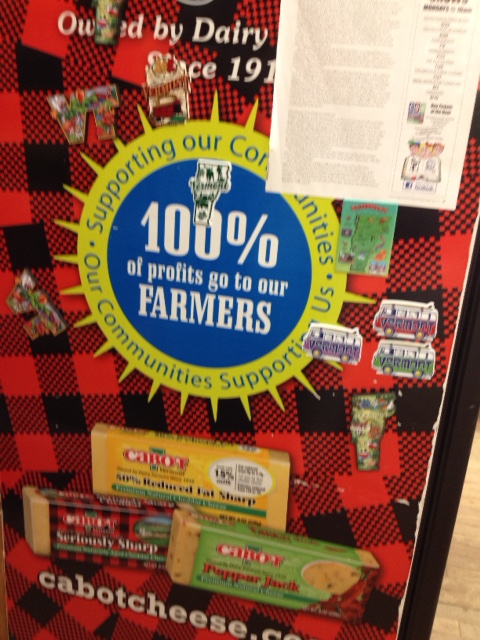
Cabot co-op cheese for your apple pie
Cabot does make more than one product. It’s just that cheddar cheese drives all thought of yogurt from a Vermonter’s mind. Remember, come-heres, that cheddar is not an ingredient for dainty pastry puffs. It is meant to go with apple pie, eaten with a knife.
Now the grocery aisles are fading out. As you wander, the goods morph toward pans. And salt shakers. Thread. Glue. Cartoon stickers for the kids. Cork screws. Exactly what you imagine was spread from a Yankee peddler’s pack around 1850 (ex the stickers), enticingly open on the back porch.
The gizmo department fades away in turn. Clothing appears. Yes, you can get a Dan & Whit’s sweatshirt, if you insist. You can also get a big, touristy mug that proclaims all the traits that identify Vermonters.
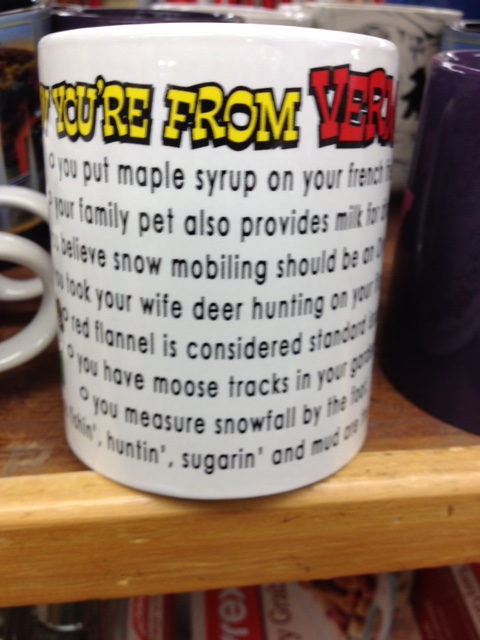
Inevitable tourist kitsch.
(Many of these statements are true. Especially the one about taking your wife hunting for your wedding anniversary.) On the other hand, real Vermonters come in looking for these:

Only real Yankees can wear these out.
This is where Dan & Whit’s becomes eerie. As you circle back around the little office, a door appears on your right. Another on your left. You pick one. You wander through a corridor that seems to have left the building. You turn right, left, right again. Stairwells gape in unexpected places. Physicists at nearby Dartmouth College have demonstrated that Dan & Whit’s back premises exist in hyperspace, and the store’s inside is larger than its outside.
After your first right turn comes proof that Dan & Whit’s does indeed carry all the things you actually need:

The first of the back rooms. These fall in the same category as beer: you need it, Dan & Whit’s has it.
Just remember that real Vermonters install these things themselves.
Press on, past topsoil, bird seed, dog food and above all Halite for winter sidewalks, 50 pound bags of it stacked almost to the ceiling. You will need this. Buy several.
Another doorway. The floor has been roughly — very roughly — horizontal all the way, but you know you are now in an underground environment, the bowels of Mother Earth. Here you find just what She believes you need.

In the suburbs you had grass in the back yard. Here, you have vegetables.
Please do not disgrace yourself by asking for “green bean” seeds. There are seven varieties available. Also, please read the instructions on your new pressure cooker carefully before canning. Newbies may experience poisoning or explosions. It ain’t easy becoming a Vermonter.

What you do with all those vegetables
You’ll find your way out eventually. (If you turn right one door too early, you will find yourself, embarrassingly, standing behind the meat counter.) Plunk your pressure cooker down on the counter, pay for it, and remember to take your new socks out before you use it.
Welcome to Vermont. Welcome home.
The Morning After
“I met those of our society who had votes in the ensuing election, and advised them, 1. To vote, without fee or reward, for the person they judged most worthy: 2. To speak no evil of the person they voted against: And, 3. To take care their spirits were not sharpened against those that voted on the other side.”
— John Wesley, October 6, 1774
I found this quotation the day before the election, too late to learn from it for the period of the campaign. It was on the Facebook page of Professor Charles Manekin of Princeton, a philosophy professor, a dual Israeli/American citizen and an activist for Palestinian rights. All I can do now is to try to apply it during the Trump administration.
Some help with this task came from an African-American writer (didn’t catch her name) who was interviewed on NPR’s Morning Edition today. Her first comment was that she “had not listened enough” to Trump’s supporters, had not understood the depth of their fear and their anger.
Why wasn’t I listening more carefully? Our town foodbank is always short of food. I have neighbors who can’t afford proper medical care. Their parents, not wealthy, were nonetheless in a much more secure position. Though they work as hard as their parents did, they can’t give that security to their own children. They know, as we all do, of the dizzying heights of wealth accrued by a few in the course of globalization and of the political corruption that weaves through that process and battens on it.
Not that I know what to do about it all. Over the last decade, as I followed the trade wars, the drug wars, the war wars, it has seemed to me that every apparently reasonable policy step, every best try or least-worst idea, has backfired to create more misery. The far left wants us to become Sweden. The far right wants us to vanish the government, except for the ones with guns, and let it all hang out. The middle muddles, producing slight variations on what already hasn’t worked.
The best I can come up with on policy questions is to think my way through, give my considered opinion and reasons to my neighbors and, if I have the opportunity, to someone who might be able to put them into practice, and then apply myself to healing the wounds that will be inflicted on human beings, as they always have been.
In the course of that effort, I hope I will be able to apply John Wesley’s advice, to speak no evil and let not my spirit be sharpened.
Columbus Day: It’s All in the Point of View

Columbus in his glory
Another Columbus Day, another round of arguments at the intellectual level of 1066 and All That. Was Christopher Columbus a Good Thing or a Bad Thing?
It all depends on your POV. The meaning of the Columbus story, like any story, can be whatever you like. It’s more interesting if you let it tell itself to you from all possible points of view, and then thread your way through them. The greater the number of threads, the subtler the story.
A single POV might yield a genre pot-boiler. Conquering hero braves disaster, nearly dies, wins new continent, bestows Civilization on benighted heathen.

Conquistadors in action
Alternatively, noble savages (variant: sophisticated though low-tech culture) welcome strangers; strangers turn out to be pox-ridden thugs; lovely hemisphere and its people ravaged; reparations now due.
Suppose we mix in a little more back story. Christopher knows the world is round. Educated Europeans did know that. Facing east, you go overland to India. Facing west, you cross the sea to India. Then it turns out that there is a whole New World in the way.
“New World” wasn’t a metaphor. It wasn’t a new planet, but it was so huge, so different, so strange and hence so dangerous that it might as well have been. Monsters and marvels that had floated in medieval minds for centuries instantly crystallized into stories about the New World.

Christopher’s new American neighbors
There be blemmyes, headless men with their faces in their chests! There be monopods, single-legged men who lie on the ground in the shade of their enormous, single feet!
A writer could do better than sci-fi with that. Imagine exploring a place full of actual dangers – venomous snakes and fanged beasts whose habits you don’t know, a population rapidly learning that they might be better off without you – while behind every bush you know that an unhuman human might lurk. Imagine a stream of consciousness that holds both kinds of knowledge with absolutely equal certainty.
Or take the sci-fi angle from the other side. The Spanish chroniclers thought the welcome they received meant that the native population thought the conquistadors were gods. Maybe, maybe not. But what if they, or some of them, did think Quetzalcoatl had returned?

Quetzalcoatl, Codex Telleriano
Seriously. If you are or have been religious, what would you do if you met your god, embodied, right here and now? How would you imagine the likely future? How would you imagine it if your god were Quetzalcoatl?
Two points of view. You could have a collision of disillusionments. You could have a folie á deux. You could have one disillusionment confronting a persistent monomania. (No, please, do not make one side a languorous beauty and the other Bruce Willis. I don’t care how big the royalties would be.)
And why confine yourself to the humans? What stirred in the mind of the Spanish horse who first saw the Argentine pampas? Europeans introduced the domestic cat to the New World. What delicious new prey for the jaguar! What an Armageddon for the voles!
It must have been like two galaxies colliding. Slowly, over the centuries, they interpenetrate. Columbus Day focuses on the explosions. A better story might explore all the gravitational pulls. Then – if you tell it all carefully enough and honestly enough – like any story, its meaning can be whatever you have learned.
A Modest Enlightenment
“Stories about women’s enlightenment often feature damage to domestic equipment.”
I found this parenthetic remark by a modern Buddhist teacher in his commentary on the koan called A True Person of No Rank. The domestic equipment in question was a doughnut pan, whatever that is. Its newly enlightened owner rushed off to her Zen teacher to present her enlightenment, and later became a “famous teacher” herself.
I don’t know if writing is equivalent to enlightenment, but it seems to have the same effect on household efficiency. Most of the women writers I know, or whose blogs I read, complain about the pile-up of housework that occurs when they take large chunks of time to write. I notice that the more successful ones usually report ignoring the pile to do the writing. We amateurs use it as an excuse for why we didn’t write.
Both ways of dealing with dirty dishes exist, of course, but I think they miss the deeper relationship between scutwork of all kinds and writing. Scutwork is, by definition, menial and repetitive. Dish after dish into the dishwasher. Or in the office, memo after memo into the files. Sweep the floor again, just before they track more mud in.
In other words, it’s the maintenance of order. A lot of us are willing to admit doing trivial tasks to avoid facing the blank page in the typewriter. (Remember typewriters?) But why are those tasks preferable? Because doing them, we accomplish what, at the moment, we can’t accomplish with our writing. Mostly it isn’t the blank page that scares us off. It’s the roily-boily mess on the dozens or hundreds of already-filled pages that were supposed to be a book but look like a dog’s lunch. Rather than plunge into that abyss and be lost forever, we put a load of wash through.
So, the washing machine is churning. What now? Like the psychiatrist dealing with a phobia, we may inch just a little closer to the neurotic fear. The desk is in a state of chaos. Chapter outlines have fluttered to the floor, and sticky notes encroach on the keyboard. The character list has become a bookmark on which coffee-mug rings make the Olympic symbol. We straighten up the desk. In doing so, we will have to read at least some of each slip of paper, to find out which pile it belongs in. The names of characters and places fill our minds with detailed images and inch us toward our fictional world.
The next step may be the most dangerous. A lot of that paper should not have been put in the piles or the files; it should have gone into the wastebasket. The abortive outlines and mad, scribbled notes on every possible plot twist or additional detail that might conceivably, someday, end up in the final draft need to be out of your sight, if not burned to ashes. You are where you are. By all means, reread a little of the last chapter to get a good run-up to the current one. Just don’t start over. Planning and outlining were all very well in their time. Re-planning and re-re-planning are avoidance.
Your washing (or your doughnut pan) have done the trick, no smashing required. At this point, you scroll down to the blank space below your last word – and write. Feel free to make some doughnuts later.
A Different Kind of Character

View through a ruined abbey
On the advice of Umberto Eco (in Reflections on The Name of the Rose), I’ve just decided to give more weight in my novel to its setting. Thinking it over, I realized that one way to do this is to include a new, non-human character: the plucky little newspaper that serves my fictional town of Oxbow, New Hampshire. I dredged from my files the clippings I’ve accumulated from our real local paper, the illustrious Valley News of Lebanon, NH, mainstay of the Upper Valley of the Connecticut River. The News is living proof that rural life provides all the opportunity you need to spread yourself out in life, to let anything happen. Up here, it eventually will.
Exhibit A, from the Valley News “Local Briefs” section:
NAKED PEDESTRIAN STROLLS THROUGH BURLINGTON [VERMONT]
A naked pedestrian strolling through Burlington this week has caused quite a stir.
The man was first spotted Tuesday walking through the city’s Church Street Marketplace completely nude, with exception of sneakers and a bandana on his head.
Bystanders say they were amazed to see him walk around the busy shopping and dining district.
Burlington Police Lt. Paul Glynn said that while the man’s nakedness is “inappropriate,” it’s not necessarily illegal as long as he left home naked and isn’t disrobing the public [sic] or harassing people.
The man turned down a request by WCAX-TV for an interview.

I love the first sentence. It could only have been written by an experienced small-town reporter. You can’t imagine it appearing in the New York Times. I like to picture the interviews of the bystanders: “How did you feel when you saw the man?” “Well, amazed, I guess. I was just amazed.” Reporter writes down, “Witness amazed.”
The typo is nice, too. And the sun protection of the bandana directs one’s thoughts to all the possibilities of sunburn.
Best of all are the scrupulous liberties of the People’s Republic of Vermont. (We Granite-staters don’t always see eye-to-eye with the Vermonters just across the river.) Vermont law says that you may not take your clothes off in public. But that’s all the law says. So…. What would constitute harassment in this case? Touching is out, obviously, but what about, “Look at this”? If you only said it once? Only once to each person? Panhandling in a non-harassing manner is allowed. If you didn’t even ask for cash, just for one moment of human attention before you moved on, who could object to that? He didn’t want to appear on TV, so it’s clear he isn’t an exhibitionist. Not in Vermont, anyway.
Local TV covered the story, too, if you’re feeling voyeur-ish.
Last February 5, “Local Briefs” reported a near-tragedy. Here are the essentials. (Unhappily, the Valley News website doesn’t include the paper’s archives, so I can’t send you to the original articles.)
Fire officials say a heat lamp used for chickens caused a fire that gutted a small barn. All of the chickens escaped unharmed.
These would not be generic chickens. Here in the Upper Valley, we like to buy our eggs from our neighbors, and we know the chickens almost as well as we do the neighbors’ dogs. Miss Bossy, for instance, is a Rhode Island Red who lives out in Orfordville. I heard about her from

Miss Bossy?
the lady at the feed store, who is her owner (though Miss B. might not agree about that.) Miss Bossy is the smallest of her tiny flock, which she rules with an iron claw. Her fellow Rhode Island Red is named Thelma. The two Buff Orpingtons don’t have names – I guess compared to Miss Bossy and Thelma, they’re such wimps they’re hardly there at all. You can see why, when fire threatens a barn up here, the Valley News knows what’s important. All the chickens got out.
The paper does a good job of selecting and condensing national and world news stories for its “World and Nation” page (two pages, max.) We get several serious items a day from the top news bureaus plus a small feature summing up lesser stories in a few sentences. Sometimes, on a slow news day, the editor favors us with oddities that just struck his fancy. E.g.:
Meerkat Expert Cleared of Assault in Zoo Love Triangle
London, AP. A former meerkat expert at London Zoo was cleared Tuesday of assaulting a monkey handler in a love spat over a llama-keeper….
Meerkat, marveling

Or, if your favorite sin is anger rather than lust:
West Palm Beach, FL. Joshua James, 24, is charged with aggravated assault with a deadly weapon …after throwing an alligator through a Wendy’s drive-thru window.
The point to notice about these stories is their datelines. London, West Palm Beach, what can you expect? If they weren’t already crazy, they’d live here. The news(wo)man’s inverse-square law states, “The farther from home, the weirder.” James got off with nothing worse than probation.
Local papers set the tone, but all our media report scrupulously on what matters to, or reliably annoys, people like us. War and pestilence were raging around the globe, as always, when the public radio station gave us this bulletin:
A tractor-trailer full of cheese caught fire on the interstate. The driver escaped, and was able to detach the truck from the trailer, but the trailer and its contents were destroyed.
Use all the senses, the writing mavens tell us. Think how grounded, how riveted, your reader would be if you could convey to her the sight and smell of 17 tons of smashed and smoking cheese! Consider the plight of the cars immediately following. The report didn’t say, but if it was Velveeta, it would qualify for HazMat treatment. And if, like me, you write mysteries, who set that fire?
Nobody Reading Your Blog? What You Need Is a Monkey-centaur.
It’s hard enough to claw back time from the demands of life and fiction writing to write a blog post. Why, then, double the time with a search through Google images to illustrate my points? Because that’s where so much of the fun lies. Visual puns, quirky interpretations or just the weirdities that pop up on the web can add a zing that keeps the casual reader going. So today, in fraternal and sororal solidarity, I offer up one of my best sources of free images.
The British Library’s Medieval and Earlier Manuscripts blog reproduces illuminations from the manuscripts in their collection. When I contacted them, they said I might reproduce the images in my blog as long as I credited the Library and gave their citation to the manuscript. Hence this monkey-centaur, with which I illustrated the concept of an evil deed.

Monkey sawing books
(Courtesy British Library, Add. 49622, f.146)
What could be worse than sawing a book in half? Who but a monster would do it?
The blog itself is a welcome break from the slog through my inbox. Every few days one of the BL’s experts discourses on a gorgeously illustrated manuscript, on several manuscripts on a single theme, on a type of illustration (the marginalia are the

Detail of a marginal scene of a fox seizing a duck, with ‘sound effects’ added in a later hand, reading ‘queck’. (Courtesy British Library, Add MS 49622, f. 190v)
most fun) or on whatever else strikes their fancy. The Library is digitizing its collections as fast as ever it can, and newly digitized manuscripts are frequent subjects of the blog. An international cadre of enthusiasts seem to spend their time crawling through the collection online, and sometimes they find delights that the staff haven’t had time to appreciate. This hapless duck was tweeted out by one Erik Kwakkel of Leiden, who got credit in the BL’s caption. He must have been researching his genealogy.
Medieval monks laboring in the scriptorium frequently found their minds directed to the world, the flesh and the devil. Sometimes these showed up in decorous and improving forms. Sometimes not.
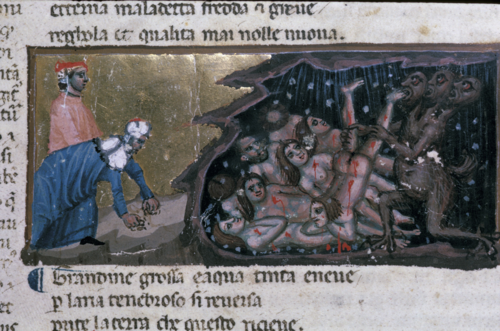
Cerberus (strangely human) feasts on the gluttons condemned to Hell (Courtesy British Library MS Egerton 943, f. 12r)
Here we have the punishment of gluttony from a manuscript of Dante’s Inferno. In classical mythology Cerberus was a three-headed dog who guarded the gates of Hades; here he is a three-headed devil who eats those who eat too much. Be warned.

Nun rebuking a lecherous grotesque. (Courtesy British Library Add. ms 49672 f098v)
Progress has made prudes of us. Here we have a nun wagging a monitory finger at a grotesque who is clearly attacking her. According to the BL manuscripts blog, later owners of such manuscripts often defaced scandalous images in the margins as disrespectful to the pious subject matter.
And here is the editorial comment of some envious monastic on the lovers in the main image:
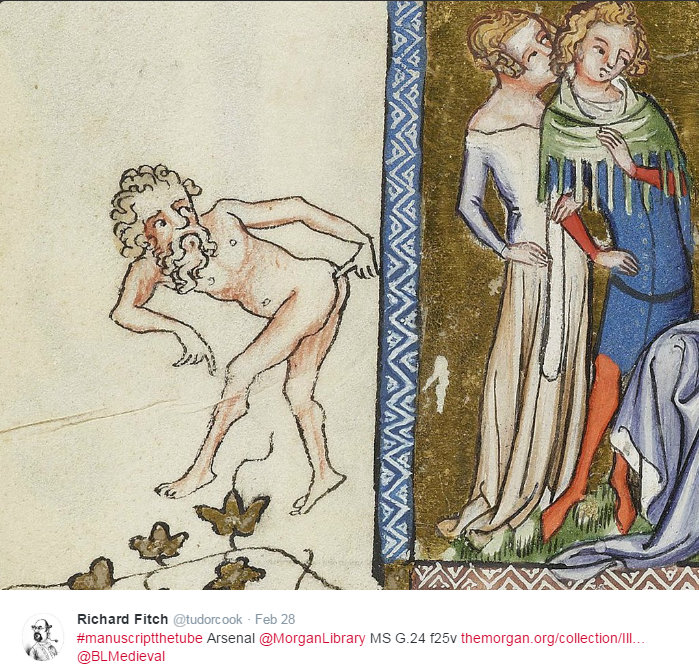
A monk’s envy expresses itself. The BL bloggers passed this on from the Morgan Library’s collection, MS G 24, f. 25v.
Readers of the blog get to play with the toys, too. Contests are held for the best caption for various images. The one just above was submitted in a contest to find images illustrating the names of London subway stops. That one was for “Arsenal.”
If you’d like some sympathy in your writing woes, check out The Burden of Writing: Scribes in Medieval Manuscripts.
Every April 1, a spoof post appears. In one, the digital whizzes at the British Library had introduced flying saucers into the illuminations. Another announced the discovery of an ancient cookbook with recipes for unicorn.
I know you get too much email already, but I really recommend following this blog. You’ll find images you can use, and you’ll enjoy yourself, too.
Catch Me If You Can, Google!
My fellow oldsters talk a lot these days about how scary Google is. Sometimes the scary thing is called “The Cloud” or just “They”. What’s worrying my buddies is the idea that somebody out there, Mr. Google for choice, is amassing information on them from their computers, secret stuff, that will be used to sell them things, and soon after that, to mess directly with their minds. These conversations usually end with firm resolutions, if not oaths, that they never have and never will purchase anything except on the most rational principles of usefulness.
I got a little antsy about Mr. Google myself, before my grandson put an ad blocker on my computer. I’d been looking online for a dress to wear to a family graduation. Didn’t find one. But for weeks afterward, every dress I’d clicked on kept popping up on every site I went to.

Featured! Sale! Today Only! It wasn’t that I minded having Them know that I’d considered that dress. I minded having Them think I’d buy anything if they waved it under my nose enough times.
The ad blocker solved that problem. Lately, though, I’ve been taking note of what my digital friends try to make me buy on their own sites. I thought Mr. Amazon liked me, because I buy so many books from him. So many, in fact, that I never even glanced at his recommendations – I didn’t have space on my shelves for what I was buying anyway. Then one day I just happened to look down….

Reading Level: Ages 5-102
Do I sound to you like a person for whom the ideal book would be Horton Hears A Who?
That was Mr. Amazon’s #1 pick for me. Besides, I’ve already read it. Many times. Out loud. To myself.
All right, all right, that doesn’t make my case, does it? Then consider the #2 choice: the Bible. Could be a compliment, could be an insult. I opted for the second interpretation when I noticed that the #5 recommendation was also the Bible.
I do buy cozy mysteries. I like Miss Marple a lot, anything by Ngaio Marsh even better and Dorothy L. Sayers best. Amazon entered my purchases into its complex algorithms, turned the crank and out popped John Grisham’s A Time to Kill.
My favorite Tana French
That was the only mystery suggested, except for The Likeness by Tana French, which I had already bought from Amazon.
After that came The Scarlet Letter. So I was right about why they put in the Bible.
YouTube must be using the same algorithms. Long ago, I worked for investment management firms as an economist, and I still keep up on the subject. Mr. Google knows that I have a bookmark to a site that gives stock market quotations. He must have told Mr. YouTube. I’ve been known to buy books on the subject online, too. Mr. Amazon is in the loop. So what is my first recommended video on YouTube?
BREXIT 2016: ILLLUMINATI-FREEMASON Struggles
At this point, I began to form algorithms of my own. Take two or three books on the economy, add two or three or four dozen on fantasy worlds, elves and so forth, divide by The Companion to The Name of the Rose, and you get irrefutable proof that the Illuminati were behind one side of the Brexit vote and the Freemasons behind the other. I didn’t watch the video just because I wouldn’t give them the satisfaction. But it does worry me. Not that YouTube has my number, but that there’s somebody out there who made that video.
In fact, I have occasionally searched for clips on YouTube, so Mr. YouTube was able to take his own notes. For instance, I’m working on a book that has pet ferrets in it. I clicked on videos of ferret owners showing off their weasly little companions. I admit that I even clicked on one that had “cute” in the title. Naturally, YouTube now always recommends ferret videos. In the last lot, they saw fit to include:
See How Easily a Rat Can Wriggle Up Your Toilet

You don’t have to believe this.
You can see the connection to ferrets, can’t you?
“Cute” earned me a flood of links to animals claiming that distinction. It also got me:
EXCLUSIVE: Male Polar Bear Chases and Eats Cub
I didn’t watch that one, either.
So you tell me: have the Illuminati of the Internet got my number yet? I figure I’ll be long dead before the Exalted Grand Masters can sell me so much as a peanut.
Readers: what are the computer geniuses flogging to you these days?
 Eleanor Ingbretson
 Karen Whalen
 llandrigan
 Heidi Wilson
 Mike M
 Thursday Night Writes