
Author Archives: Heidi Wilson

Free Names

Listen Up! says his Beatitude Gregorius III

Listen Up!

For some time, I have been keeping a small notebook in my purse in which to capture fugitive ideas, oddities, vignettes, and joyful or horrid happenings for use in future writing. From this exercise has come, among much else, a long list of weird names encountered in the press and occasionally in life. I long to use them in fiction, but since they belong to real people, the best I can hope for is to mix and match. Today, I want to share some of this raw material with you, my fellow writers, who may well come up with better matches and better mixes than I. Feel free.

Some of the names are simply too appropriate to be believed. There are:

  • Sir Jock Stirrup, once head of the British armed forces (and now Baron Stirrup.)
  • John Stalker, an ex-Deputy Chief of Police.
  • James Naughtie, the BBC Today interviewer of a heterosexual man who, after a stroke, “woke up gay.” Naughtie was described by Britain’s Daily Mail as “the formidable BBC pinko who turned the airwaves blue.”
  • UK Member of Parliament, Mark Reckless, who bolted the Conservative Party to join the Independence Party.

(The English outnumber the Americans in my list. Does this Mean Something?)

Here at home, the items in my collection seem to come with brief stories attached. I itch to fill them out:

From my cookbook shelf, Crescent Dragonwagon beckons. According to my sister-in-law, who claims acquaintance with her (and that is not the kind of source one questions), Ms. Dragonwagon married an enlightened man who did not insist that she take his surname. Neither of them wanted a hyphenated name, however, so they made one up. The marriage ended, but Ms. Dragonwagon’s 61I1YmyYe5L._SX432_BO1,204,203,200_vegetarian cookbooks were already well known, so, publicly at least, she will be Dragonwagon to the end of her days. The stuff of tragedy.

I found another name near the end of a news tidbit about the theft of a Stradivarius violin. We were several paragraphs down into an account of the Strad before the perpetrator appeared: “The violin, which police said appeared to be in good condition, was stolen late last month from a concert violinist who was shocked with a stun gun…. Police traced the stun gun to Universal Knowledge Allah, a 36-year-old barber….”

A cousin of Michelle Obama made the papers very recently. Rabbi Capers Funnye of Chicago was nominated to become what an international organization is calling the first “black chief rabbi” of the 21st century. A statement from the International Israelite Board of Rabbis declared that Funnye would serve as the “titular head of a worldwide community of Black Jews.” And why not?

Internationally, my best name source so far came from an account of Ted Cruz being booed off the stage at a gathering of Middle Eastern Christian ecclesiastics. It was also my best source of impressive titles. In the audience were:

  • Patriarch Mar Bechara Boutros Cardinal Raï, Maronite Patriarch of Antioch and All the East;
  • Gregorios III Laham, Melkite Greek Catholic Patriarch of Antioch and All the East, Alexandria, and Jerusalem [pictured at the top of this post];
  • Ignatius Youssef III Younan, Syriac Catholic Patriarch of Antioch and All the East;
  • Aram I Keshishian, Catholicos of the Great House of Cilicia of the Armenian Apostolic Church;
  • Metropolitan Joseph Al-Zehlawi, Archbishop of New York and All North America for the Antiochian Orthodox Christian Archdiocese of North America;
  • Bishop Angaelos, General Bishop of the Coptic Orthodox Church of Alexandria;
  • Ibrahim Ibrahim, Bishop Emeritus of Chaldean Eparchy of Saint Thomas the Apostle.

I don’t know where to start the character list for my fantasy novel, with the Catholicos of the Great House of Cilicia or the Bishop of the Chaldean Eparchy of Saint Thomas the Apostle. George R. R. Martin, look out! (Alas, the first result of a Google search on the Eparchy was a parish listing — in Southfield, Michigan. The glamor is gone.)

Okay, writers, start your pens. Pick a name and give me a scenario.

An Aspen Phantasmagoria

What brought all this on was a man who passed me on the sidewalk of Main Street in Aspen, Colorado, one fine July morning. He’d be called a “big guy” by the polite; that is, he was well over six feet tall and appeared to be pregnant. His expression was mildly concussed, though most likely, that was just pot. Stretched across his beer belly was a drab gray, hip-length tee shirt sporting in firework colors the legend, BAZINGA!

Not an unusual sight in Aspen. But there are few unusual sights here. Anything and everything shows up, and nobody pays any attention. Incongruities rub shoulders without noticing one another. The motto seems to be “Never connect.”

This fact only started bothering me when I started to write. Writers invent connections, of course. That’s the job. But in most places, in most situations, there’s a pre-existing network of workaday relationships growing through time, a warp and woof. On that, we stitch a story. If you write about Aspen, you write without a net.

Chronology won’t help you. Aspen’s history is a series of jerks and starts. A mining boom created the town in 1879, but by the 1930s, population had dropped again to 700 or so. After WWII, the craze for skiing brought in small numbers of permanent residents and many more seasonal ones. In came the full-time ski bums and the part-time resort patrons. And money. And more money.

Finally, one Walter Paepcke, corporate executive, philanthropist, skier, music lover, founded the Aspen Institute, the Aspen Ski Corp. and the Aspen Music Festival and School on top of everything else. That was the Big Bang, and Aspen has been hurtling away from itself ever since. The ski bums, the potheads, the fat cats, the intellectuals all orbit their own kind and pass through the rest like neutrinos.

So here are a couple of weeks’ observations from the streets, restaurants and concert venues of Aspen. Make of them what you will.


The program announces Beethoven’s Violin Concerto in D Major. The soloist will be Augustin Handelin, unknown to me. The concertmaster appears, wearing black tie. The conductor appears, wearing black tie. Pause. The soloist appears. He is dressed in a Nehru jacket of grubby white with matching trousers whose hems drag behind his heels. He stops, bows, smiles. Can it be? He seems to be wearing lipstick on a mouth (and none of us can help how we’re made) that has side extensions like the Joker in the Batman movies. Surely that powdery white is not his natural complexion? The Concerto has an extended opening before the soloist begins. He stands and waits, grimacing with overwhelming emotion. Or with something. I can’t watch. And then, note by perfect note, he takes the entire audience to Heaven with him.


Aspen is full of terrifying crones with long, jet-black hair (perfectly coiffed), gold jewelry of ball-and-chain weight, blood-red lips and eyebrows disciplined into the perfect accent circonflexe. They do not look like people who listen. Some of them, however, do take mountain hikes. Their presence lingers on the trail in the scent of Diorissimo.


Not all female denizens are slaves of the salon. The New England Puritan is well represented. From my seat at a window table of The Bakery, I watch a woman of a certain age with streaky gray hair, sitting at the bus stop. Her ironed blouse, shorts and vest are as neutral as her hair, spotless and rigorously ordinary. One knows that she bought the turquoise running shoes only because they didn’t come in beige. Beneath the crags of Ajax Mountain she sits, the New York Times folded beside her, atop a copy of The Atlantic.


A new(er)comer to the Aspen Institute complex is the Aspen Center for Physics. Here, people whose brains are of another order than yours or mine come to think about the nature of the universe in peace and quiet. But the Institute does its best to reach out to all sorts and conditions of men. Hence you may, if you like, attend a lecture tonight on “Engineered Magnetism in an Atomic Bose-Einstein Condensate.”


Just down valley in Basalt, Colorado’s newly legal marijuana industry is powering up. The selectboard will wrestle tonight with its own problems of physics: the mountain wind currents and the greenhouse exhaust fans are choking retail and residential districts with the skunky smell of cannabis bloom.


Way, way back in the seventh row of violins (Aspen orchestras run heavy to strings), sits a very small Japanese girl, perhaps 16 years old. She has followed the orchestra dress code: her blouse is white, her skirt and shoes black; she wears no jewelry. But her hair has been cut and dressed to fall in asymmetric wedges and some of it is caught up in a plastic clip shaped like Hello Kitty. She is clearly human, but a human modeled on an anime character crossed with a furry marketing behemoth. One assumes this was voluntary.


Is this just me? Are all these disconnects making me see grotesques where there are none? A scarier question: am I one of them, at least when I’m here?

To Live or To Write? Decisions, Decisions!

I’ve hardly set pen to paper for ten days. It’s a weird feeling. For over five years, I’ve been writing regularly (not daily—I can’t claim that.) Just now, though, I’ve got a five-week trip to pack for, two home improvement projects under way, an elderly friend who’s ill and considering assisted living, and a sick cat. And poison ivy.

So much for the endless stream of whining complaint. Thank you for listening.

I have to find out how real (sc. published) writers get it all done. I know they have lives. At conferences, I’ve distinctly heard them mention spouses and children. Unlike me, they have to make the rounds of book fairs and do public appearances. They must eat: quite a number of them are plump.

I warn you, the first person to suggest ‘discipline’ as the solution, dies. The house, the spouse, the garden, the shopping, the cooking… getting all those seen to, over and over, feels like boot camp forever.

A schedule? I have one. My brain only writes in the morning. In the afternoon, it stares out from behind my eyes and refuses any but simple, repetitive tasks. So I should carve out several undisturbed morning hours. But the 86-pound black Lab, Nussi, needs at least two, spaced half-hour hikes up and down Cottonstone Mountain, where we live, to keep from ballooning to 100 pounds. I confess to having the same problem myself, marked up by a certain percentage. Did I mention plumpness? The spouse, when at home, requires computer assistance at startlingly irregular intervals. The man to fix the dishwasher will be here at 10. Or so.

It’s more complicated than that, really. Here’s an example. Somehow, back in the mists of time, a custom arose that the spouse has a medium-boiled egg for a mid-morning snack. The spouse literally cannot boil an egg. The writer boils it. And empties the dishwasher while the water heats. And flips the wash while waiting for the dirty dish.

I can hear Gloria Steinem screaming. Tough beans, Gloria. That isn’t just a boiled egg. That’s communion, read the word how you will. That’s ritual. That’s a very happy marriage. Sure, I could say, “Go make yourself some toast.” But would that be a good trade?

Here’s a thought: that five-week trip is about to take me to a little town in the Rockies, Redstone, Colorado, population 92. where we have very few friends. There is no garden. There is a Whole Foods – some distance away, granted – that sells pre-made food. We have a microwave. I need to go on a diet anyway. The spouse, bereft of his New Hampshire wood lot, will need exercise. Dog walking is very healthy.

So, maybe that’s a research project for July. Try out ways to free up time. Decide what is worth less than writing and can be lived without. Practice ways of condensing the simple, repetitive tasks.

So, whaddaya think? Will that work? Even if it doesn’t, I’m going to get some writing done.

On Moving the Tuna

oceanic_foodweb


You wouldn’t have thought it would be so hard. The moderator of our writing group suggested, with that air of modest assurance that so becomes him, that I should separate Scene A (in which a ferret scatters tuna fish all over a carpet, with disproportionate results) from Scene B (in which the ferret compounds its alimentary offense with the eliminatory consequence and precipitates a crisis.) He was right: together, the scenes were almost repetitious; separated, they helped create a steadily mounting tension.  Scene A needed to move back in time.

It turned out to be a game of jackstraws. I re-dated the tuna scene. How to fill the now gaping void between it and Scene B? As luck would have it, I had a brief new scene already planned that was going to simplify the presentation of later events. It went into the breach. Out came a lot of now misplaced material, before and after. That demanded more of the new scene, to patch up the ragged bits. It became half a chapter. That suggested another move, to slim down a later scene, newly overloaded.

We’re talking three months, here, people! Three months of jury-rigging and jerry-building and tearing down and putting up again from scratch. I think the most painful part was having to re-insert huge chunks of the original text, when repeated efforts proved that they really had to go  somewhere. And of course, no person of sensibility can partially edit a text. Time spiraled down the plughole as I inserted commas and corrected diction.

By the time the tuna had settled down, I had been forced to outline that whole section of the book. To my amazement, three of the four subplots were now perfectly in order. (The last one looked like a dog’s lunch, but three out of four ain’t bad.) If I’d done that outline in the first place, I wouldn’t have had to move the tuna at all.

Then came enlightenment.  I have always been a devout pantser (i.e., I write by the seat of my pants.) The Exuberant Brethren of the Holy Pants believe that inspiration dies at the sight of an outline. Buddha3Only by letting the words flow directly from the Muse through the fingers to the keyboard can creation take place. Do not pass brain, do not collect $200. You can clean up any slight problems later. The Severe Order of the Sanctified Plot make up the whole plot in advance. They write it down. They make diagrams. They balance things. Then, scene by scene, they write the first, and practically final, draft. Or so they say. They clean up any slight problems later.

I won’t say I’m ready to join the Sacred Order. Instead, I’m going to copper my theological bets. Four of us Thursday Night Writers have reserved a virtual cabin at Camp NaNoWriMo, an online writing sprint in which we each promise to complete a “writing project” of our choice in the month of July. I’m going to outline a whole second adventure for my amateur sleuth, just to prove I can do it. Who knows? If I ever manage to sell this turkey, I may need a sequel.

Malice Domestic

Thanks to my spot in the TNW blogging schedule, my report on Malice Domestic 2015 can’t be news, it’s already olds. (For those who don’t know, MD is an annual convention of those who love ‘traditional mysteries.’ Think Dorothy L. Sayers.) So I’ll skip the usual list of superlatives – just google the program — and instead I’ll tell you about the people, things and events that really got me where I live or made me wonder.

Item: Why does a vendor of nesukes and other Asian carvings in glass or stone take a booth every year in the Malice dealers’ room? The booth next door sells jewelry, which makes sense since perhaps 95% of the attendees are female. All the others booths sell books old and new or hand out information on other conventions. Why netsukes?

My Baby

My Baby

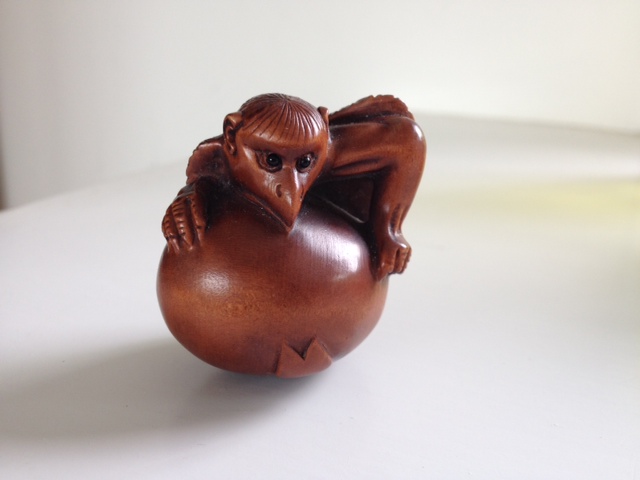
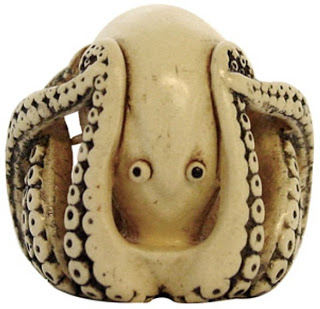
Naturally, I opened my wallet. This is what I bought:

I recognized it instantly. Here is my first book, breaking out of its egg. I had been expecting an angel.

I don’t know what its Chinese maker thought it was. The vendor told me that she instructs her supplier on what to carve, but the objects that travel back over the Silk Road may or may not comply. The carvings of birds are wonderful. The cats too are very much like cats. The horses begin to morph into strange, wavy beasts, especially about the nose. And the vendor says that, describe as she will, her carvers cannot produce a coyote. Her coyote standards are high; she raised litters of them in her kitchen for years.

My theory on the demand for netsukes at MD is that they embody convolution. Everything is folded back on itself, twisted out of shape, more complicated than it should be, but in the end, you can hold it all in one hand. Just like a good mystery.

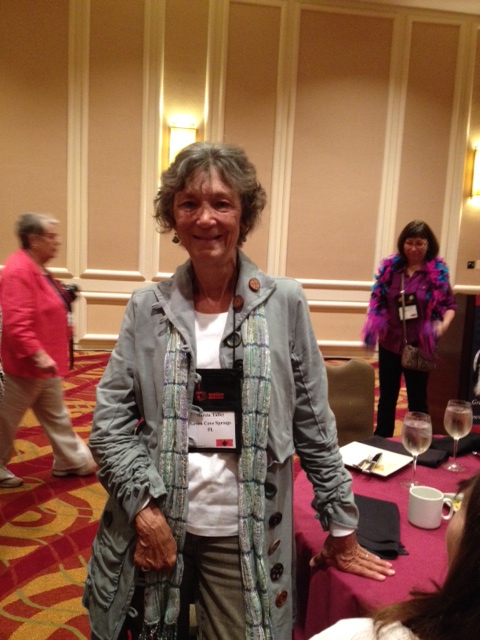
Item: How could it come about that Marcia Talley, author of several excellent mysteries, an Agatha Award winner and a 2015 MD panelist, looks precisely like Eliza Harris, protagonist-to-be of my first mystery? She was kind enough to let me take a photo. Here is Marcia/Eliza:

Marcia Talley

Marcia Talley

The physical resemblance is amazing, but the core of the coincidence is a matter of style. Marcia comes across as warm and open, but there is an enlivening tang of acid in her take on things. The opening sentence of her first mystery, Sing It to Her Bones, could almost have been said by Eliza, mutatis mutandis: “When I got cancer, I decided I wasn’t going to put up with crap from anybody anymore.”

Item: Where does the booze fit in? As far as I could see, MD attendees are fairly abstemious. At least I was invited to no wild parties and heard no reports of trashed hotel rooms. (I may just be unpopular.) But the Hyatt Hotel bar was Malice Central; every chair was occupied from an early hour, and those weren’t tea cups on the tables. How much of the three-day, non-stop effervescence was powered by sheer creativity, and how much by the traditional writers’ fuel?

Writers' Fuel

Writers’ Fuel

The tipple of choice seemed to be wine, but here and there the drinks of the Golden Age appeared. On the first afternoon, two of the rare male attendees were bracing themselves to face the female maelstrom:

And a final item, the hats. The Hyatt bar notwithstanding, Malice Domestic ends with a tea party, a formal tea party with glittery place settings, scones, clotted cream and strawberry jam. It is the custom for the Guppies to wear feather boas, whatever else their costume. (Guppies = “The Great Unpublished,” a subgroup of Sisters in Crime, the association of — mostly — female traditional mystery writers. ) Regardless of publication status, ladies of verve appear at the tea in hats. No, in HATS. The year 2016 will see me shopping for something to rival these:

HATS

HATS

Choosing Your Color

410px-Royal_Arms_of_England_(1198-1340).svg

England’s Royal Arms

I’ve been spending a lot of time lately with the second son of an English duke. You’ve guessed, of course: I’m devoted to Lord Peter Wimsey, Dorothy L. Sayers’ renowned aristocratic sleuth. There was something of a vogue for detection among the fictional peerage of the mid-twentieth century.  The fashion waned and probably received its death blow from the dreary antics of late-twentieth-century royalty.

Sayers (imho) made better use of aristocracy, or at least of wealth, than any of her contemporaries. In all too many a mystery, a mink stole or an ancient and expensive brandy drops into the scene for no better reason than to remind the reader that s/he is expected to be enjoying the idea of being rich. Sayers said that she surrounded Lord Peter with just those luxuries she would have loved herself: rare books, one’s own library, top-notch food and drink and presumably Wimsey’s high-powered Daimler, “Mrs. Merdle.” Her genuine delight in Wimsey’s primrose-and-black library, grand piano and excellent wine cellar call forth an equal delight in the reader.

With Sayers, this kind of detail is never just color, in the dreadful sense of the word as used by sportscasters. Our longest visit to Wimsey’s library contrasts its beauty and peace with his agony as he struggles to work out a case against a murderer who has framed the woman Wimsey loves. Dining on snails at an elegant restaurant, Wimsey notices that his guest views that dish askance, and calls for oysters instead. Attentive friend blends with money-no-object host.

CRW_1714

The New York Stock Exchange (Amazing Travel Photos)

The issue of color is on my mind because my fellow Thursday Night Writer Linda Landrigan persuaded me to try the mysteries of Emma Lathen, a queen of Golden Age detective fiction. Lathen was the nom de plume of two women, Mary Jane Latsis, an economist, and Martha Henissart, a lawyer. Their detective is John Putnam Thatcher, senior vice president of the Sloan Guaranty Trust Company. From his Wall Street office, he solves murders that occur in the world of business, especially high finance.

And for me it doesn’t work. I spent twenty years as an economist for investment firms. What is color to most of Lathen’s readers is just another Monday morning to me. My colleagues were not such buffoons as those Thatcher encounters (though I could have given Lathen a useful vignette or three.) But office life as described by an economist and a lawyer reaches me in pure monochrome. For Lathen’s many fans, it apparently works like a charm.

In the end, the characters and plot of Accounting for Murder pulled me in, but I doubt that I’ll read the whole series. And we all know that if you want to sell a mystery these days, and you aren’t an established author, you’d better be able to offer a series that will pull your first readers along with you.

So what about the color in my own mystery? In the literal sense, it starts out red, yellow and orange, the colors of fall in the New Hampshire mountains. It goes white and gray with winter, then a damp tan with mud season, and finally, joyously, green with spring. Figuratively, it’s the atmosphere of an Ivy League college, of a retirement home for some of its eccentric faculty, and of the rural village in transition that surrounds it.

Enough color? Not enough? Been done already? How about if the protagonist is an anthropologist specializing in African witchcraft? Too much yet? No? How about if I add a couple of ferrets? Okay, enough, right? But then I put the octopus in.

Maybe I need to rethink this….
04-21_OctopusNetsuke

Maine Crime Wave 2


I finally got up the courage to expose myself. Right: I entered “Two Minutes in the Slammer,” a flash fiction contest that inaugurated the 2nd annual Maine Crime Wave last weekend. The conference MCW posteris held at the University of Southern Maine and sponsored by Maine Writers and Publishers Alliance. It lasted only a day, but not a minute was wasted.

The fun began Friday night. The flash fiction slam was hosted at the Portland Public Library by my favorite mystery blog, mainecrimewriters.com. The winning entries were “slams” indeed, uproariously funny and full of action, all in two minutes. The next time I slam, I’m going for uproar.

I didn’t win that prize, but I got another one: Chris Holm, author of the Collector series of mysteries and most recently of The Killing Kind, told me he liked my story, suggested that I submit it to Thuglit, and then poured forth suggestions for other e-venues that could be appropriate for me! The story went in to Thuglit as soon as I got home, and the next one is being spiffed up for submission.

That’s the best aspect of mystery conferences: there are so many friendly and helpful people. Much-published and admired authors are generous with advice and encouragement. Sort of makes you wonder why literary authors have such a reputation for behaving like twits.

The conference attendees are an equal attraction. At our post-slam dinner, I met Peter Murray, a retired police detective, now a chef. He’s doing research for a book based on the first unsolved murder in Westbrook, Maine, the bludgeoning of Abigail Stack on January 5, 1888. Over dinner, Pete told me about his work on the second unsolved murder – in 1987. Those Westbrook cops are good.  Check out Pete’s blog, especially the post about the pigeons and the lady who tried to poison them with a mixture of whiskey and Alka-Seltzer.

Roaming through the crowd, I met a marine ecologist and the former president of the Farnsworth Museum in Rockland, Maine, both writing their first mysteries. I’m an ex-economist and ex-teacher of Latin and Greek. Is the criminal mind really so widespread throughout the professions? (Anne Jenkins, the museum president, also gave me an update on the meteoric rise of Rockland as a tourist destination. I’ll be checking that out with a mini-vacation soon.)

Barbara Ross, author of the Maine Clambake Mystery Series, gave a blockbuster workshop on how to revise your manuscript. Her handout is now one of my prized possessions. She advocates multiple read-throughs with revisions for one single issue each time. You take the issues in the order that will produce the least wasted effort on things that may disappear in revision anyway. I would have thought of that myself, in time. Sure.

Chris Holm and me

Chris Holm and me

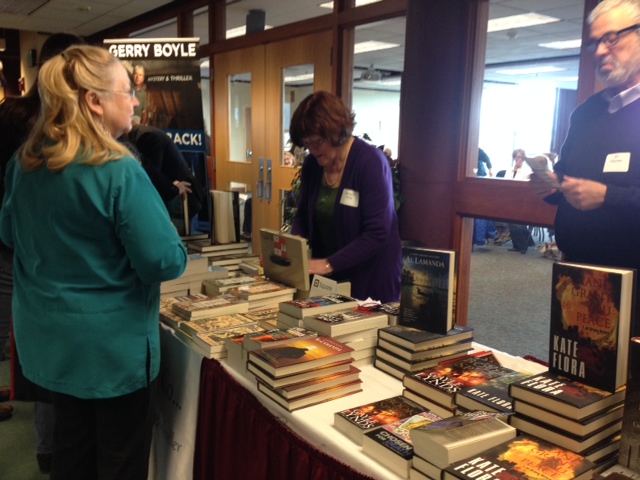
There was a certain amount of genre-blending at the conference. Sarah Graves, who writes the Home Repair is Homicide mysteries, mentioned that #11 in the series, The Book of Old Houses, was inspired in part by H.P. Lovecraft. And then there’s Chris Holm’s Collector mysteries, whose first volume I had just finished. See, there’s this dead guy, who’s been damned for murder and now has to collect the souls of other evildoers when their time comes. But being dead doesn’t mean being dumb. When he gets an assignment that just doesn’t smell right…. I picked up another Collector volume at the Kelly’s Books to Go table in the lobby, where speakers and audience alike were busting their book budgets.

Kelly's Books to Go

Kelly’s Books to Go


Barbara Kelly, the aforementioned bookseller, was on the final panel, the one on the business of getting your book sold to readers once you get it published. It was heartening to hear what enthusiastic fans booksellers can be, if you just take the trouble to make friends at your local bookstores. Barbara will sometimes take books she loves to a conference on a totally unrelated topic, and push them hard to attendees. The panel as a whole agreed on a new (to me) and upbeat concept: the “good rejection.” If your story comes back with comments, you’re onto something. The piece is just “not there yet.” So it’s worthwhile wandering in your personal wilderness yet awhile.


A venerable denizen of the USM campus


The Joys of Research

Martha, a ferret with attitude

Martha, a ferret with attitude

I mean, of course, the early research for your writing, when you don’t know what you need except bright new ideas, and everything is fair game. We’re not talking last-minute research, when you suddenly find out that every ambulance now carries a perfect antidote for the poison that killed your murder victim.

For some reason known only to my unconscious, the protagonist of my mystery novel emerged carrying two ferrets, George and Martha. (If you can think of any reason why this would happen, please do not tell me.) That’s Martha, above. My ferrets cannot talk; readers are not privy to their thoughts, if any; they do not solve the mystery. They just make messes, reveal human character and generally provide uproar when uproar is needed by the author.

My first source of ferret information was a friend. She owns seven ferrets. They live on the upper level of her house, separated from the kitchen and her other pets downstairs. I held her ferrets: furry and squirmy. I smelled them. Not close up, there’s no need for that. Ferrets broadcast an aroma that ferret lovers do not find offensive. I played with them: irresistible. They bounce, pounce and slither nonstop. They run with their hind half elevated in a kind of Spy-vs.-Spy hunch. The ferret philosophy of life is WHEE-EE-EE-EEEEEE!

FullSizeRender (1)

Narnia

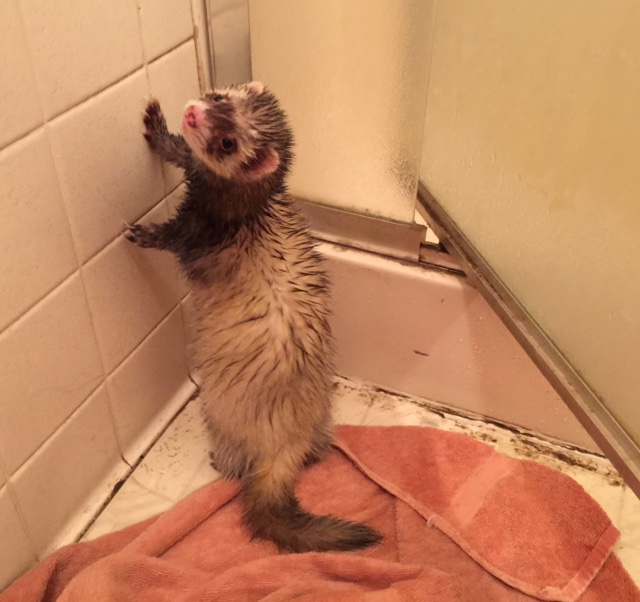
Like mink, ferrets are water creatures. This is Narnia, who runs for the shower whenever she hears it running. Another of my friend’s fuzzies would park herself under the nozzle and stare at it until someone turned it on for her.

After the cute-ferret session, my friend sat me down for a serious talk about potty habits. Theirs, not mine. If you are squeamish, ferrets are not for you. If you want to know more, you’ll have to find out for yourself.

Next stop: books, books, books. If nothing else, research is a license to buy books. Ask Amazon about ferrets, and it first produces what you’d expect: The Ferret Handbook, Ferrets for Dummies and the alarming How to Stop Ferret Biting in 3 Days. But wait! There’s more! Richard Bach, author of Jonathan Livingston Seagull has written a series of fables about two ferrets, both of whom are writers. I sampled one volume, but my insulin level rose so alarmingly that I had to stop. There is also a 30-page mystery for children, featuring Fiona and Farley Ferret. Here we see one of the reverse benefits of research. Warning: you are entering the Sentimentality Zone. Watch your feet or you will step in something squishy.

41FxHHhDjdL._AA160_

Red Ferret Hoodie

From Amazon, you can buy tiny red ferret hoodies, a high-sided plastic litter pan in a delicate shade of mauve, “The Ultimate Crunchy Advanced Nutrition Diet for Ferrets,” and a ferret decal for your car window. You can also give your ferret a “leopard-design” hammock. Surely this is like offering a shark-design hammock to a herring? Another repressed-hostility product: a wholly edible image of a ferret for the top of a sheet cake. It’s Kosher! Gluten Free! Soy Free! Trans-Fat Free! Buy yours now from Amazon!

Next, the wonderful web. You could spend the rest of your life watching cute ferret videos. Fun fact: ferrets are one of very few pets that have a smooth reverse gear. Just try to get your dog to back up. A ferret will do it so easily that he looks as if someone pressed the ‘rewind’ button. Check out the YouTube video, around minute 4:00.

Ferret owners are not necessarily mad. But they are very … specific. They are very focused on ferrets. Case in point: a YouTube performance by a proud ferret mommy of the song she composed, “Ferret, Oh, Ferret.” The tune’s her own invention, but it’s kind of like “O, Canada,” sung at a cricket match by a real non-professional.

Once you’ve done your research, you come to the hard part. You have to decide what belongs in the book. Ferrets are a lot messier than I want to deal with, in life or in fiction. I can leave the messy parts out of the story. But even when ferrets are misbehaving, they are every bit as adorable as ferret fanciers think they are. I don’t want readers rushing out to buy pets they’re going to get rid of at best and neglect at worst. So I’m planning a disclaimer, with web links, at the end of the book. I will not buy my own ferrets. I won’t. Really.

Of the Making of Many Blogs There Is No End

WordPress has my number. No sooner had I obeyed its command to “Create Your Web Site,” than it was tempting me to explore everybody else’s blog instead of writing my own. It waved a dozen links to blogs on writing under my nose, even more to book lovers’ blogs, and one called (truth in advertising) Longreads that can mess you up for days.

Then there’s Freshly Pressed, WordPress’s links to individual posts that “you might like.” How does it know? Yeah, Google tells it. The trouble is, Google is so often right. I told myself I was looking for good writing, for ideas on using WordPress well, for designing the page, blah, blah. And I did find ideas I could use.

But if I read all this stuff, when do I write?

All the wonderful How to Write books pose this same problem. Ideas about writing exist in a different universe from writing itself. Books show you nice clear roads to success: if you are writing X kind of book, and arrange your chapter in Y way, the result for your book will be Z. Those are the basic books. The tone of the more advanced comes closer to celebrity cooking shows: “you’ll be amazed how just a touch of coriander (humor/specifics/pornography) will transform your recipe!”

The actual experience of writing is more like forcing yourself to jump off a cliff, having been told by, say, an angel that you will not in fact be smashed to jam, because you can fly – as long as you think you can. Some days, just the icon for your writing program is enough to send you to Longreads.

When you do make the jump, you can fly or you can’t. You start where you left off or somewhere else in the text where you need to be. Your characters need to limber up over a few (dozen) pages. Then they stop making the kind of remark you make at dinner parties to people you don’t know why you’re talking to. And then, from somewhere behind your left ear, an earlier prop or an embedded quarrel or a potential love affair hooks around and snatches your plot. Suddenly, the conversation is making sense, but only if we assume that… and the story is writing itself. If you can keep the scene pulled up around you, and refrain from insisting that it “work out right,” you’re golden. For the time being.

And some days, you’re smashed to jam.

There is no way to avoid either the jump or the jam. I read a bit, here and there, in my pile of how-to books, and like the blogs, they add to my little store of technique. I may even recall their tips to my great profit, if I ever get to the third draft. As soon as your nose emerges from the book, you are going to have to walk back to that cliff face. So get over it, close the book, close the writing blog and jump.

That’s all for today. I gotta go write my post.