Monthly Archives: April 2018
Packing Day
Packing day—to return home—is never long enough. (Packing to go to AZ should be a piece of cake. It starts as soon as I stop wearing my summer clothes. That can be any day from October 1 until the second. Of October. I am not kidding you. That’s when summer ends in New Hampshire, which gives me almost three months to fill two suitcases. Does that mean I start packing on October second? You already know the answer to that if you have been following this blog. Just search “procrastination” and you’ll have a good idea of what day I start packing.)
My largest suitcase (my LARGEST suitcase lost a wheel in Australia and is unfortunately sitting in a landfill) was packed three days ago, though I did struggle. Whittling my wardrobe down to three days worth of clothing was difficult, especially when you consider everything we packed into these last three days.
Saturday we watched a grandson play two games of a basketball tournament; they won both! (The most fun was when the grandmother from the other side of the family and I agreed to collaborate on a book together!) By seven p.m. we were at Rawhide Western Town and Event Center for a granddaughter competing in the Regional Level 7 Gymnastics competition. The other regions represented were Utah, Nevada, Southern California and Northern California. She did extremely well and brought home three medals.

Garden at the plaza in Care Free, AZ
Yesterday the ladies of the Arizona family (two daughters, three granddaughters, and me) dressed up for lunch at the English Rose Tea Room in Carefree. So much fun!! The Tea Room is in a plaza of cute shops with a gorgeous Southwestern garden area. Elephant Bluff and Skull Mesa were visible to the north.
Last night some of the men (my husband and two grandsons) joined the ladies at San Tan Flat for a farewell dinner. Margaritas, outdoor tables, rancher tips and steak, two vicious games of Uno (my granddaughters are sharks), s’mores cooked over our own fire pit, and dancing to live music. We couldn’t have asked for a better sendoff (unless our sons-in-law were not tied up with work obligations and could have joined us)!!
See you in New Hampshire!!
PULL UP OUR SOCKS?
PULL UP OUR SOCKS?
That’s what Heidi urged us to do when our blogging was going down the tubes. I looked up the expression and found this:
Socks didn’t always have an elastic band around the top. Our great-grandparents used to wear garters to keep them up. In days gone by, schoolboys in shorts could regularly be seen with socks drooping around their ankles and were told to smarten themselves by pulling their socks up.
Poor kids. Try rolling a hoop down the street with lengths of knitted tubing fluttering around your feet. A definite dog attractor. There are other sock expressions found and explained on the internet, but I won’t go into them here. Some are fun and suitable for a writer to utilize.
So, here we are, pulling up our socks.
Heidi went at it with a vengeance (see two posts ago), with her medieval manuscripts post, and Karen followed with her short story woes. I feel for her; I’m in the same boat, struggling with word counts that don’t allow for character expansion or descriptions out the wazoo. Wazoo is a fascinating word. Thank goodness that it has gone beyond its original meaning and is now acceptable in family settings and good clean writing. At least I think it has. If I use it, if I’ve even heard its new meaning, it generally indicates it’s been in usage for ages. Like, pull up your socks.
My short story woes are slightly different than Karen’s. I enjoy ripping the clothes off my overdressed stories till they are clad only in the basics. Just a tad more than a birthday suit, the suit in which your story was dressed when it first occurred to you. No one wants to see that. Still, I need to have a complete story within the confines of competition requirements, one that sounds right for the word count, neither sparse or wordy, There’s a great word in Yiddish; ungapatchka. It means too much. I love it. Don’t bother looking it up; it’s not there. It’s a word that just is. I don’t think there’s an opposite, an antonym, or maybe I haven’t heard it yet.
I added a program to my computer (drum roll here), that’s been helping me with my writing. It’s called Grammarly. There is no part of my brain that can deal with grammar and punctuation. This program spots all my errors and, with my permission, will correct them for me. I can’t tell you how many times I’ve tried to memorize Strunk and White’s Elements of Style to no avail. This program is the cat’s pajamas. Probably Dr. Denton’s with the socks attached.
So now I’m whizzing through my short stories like mad, not because I have this program but because all the competitions I want to enter are due at the end of this month. Grammarly is a real blessing to those who have a phobia to usage.
I’ve gotten four stories out already (these were pre-written stories; nobody is that good), whereas I (my critique mates, actually) would still be struggling with the grammar in the first one or two. I’ve spared them unnecessary anguish when their own troubles already besiege them.
You see how well I’ve pulled my socks up, Heidi?
Try doing any of those things with a novel
I’ve never considered myself a short story writer. I read them—and enjoy them–but I never feel as satisfied when I’m done with them as when I read a novel.
Yet here I am, reviving a short story that I’ve been working on for a few years. I have twenty-six saved versions of this story (with four different working titles) on my laptop. When I originally wrote it—back in 2014—the total word count was eleven thousand words. I’ve condensed it to five thousand words. As you can imagine, it doesn’t read like the original story. (And that’s a good thing–I’ve reread the original story.)
Why revive this project if I couldn’t finish it in 2014—or 2016—or 2017?
The need to complete a piece of writing is driving me, not exactly insane…more like to write. Something that I can submit for publication. Or rejection. Going back and forth working on the novels of my Woodbury trilogy without making any discernible progress has left me frustrated, unsure of my ability to write and revise, over and over, until I can say it is as good as it gets.
Just possibly, I’m finding that writing a short story is good practice for writing a novel. (Or just for learning how to write.)
With my short story, I can revise the entire piece in a day less than a week, submit it to my group for critique, and, within six days, I can produce another revision. Of the entire story. I can keep track of the changes I’m making from the beginning to the end of the story. I can reread the entire story each time I work on it. Try doing any of those things with a novel.
A major problem I am facing with my short story is fitting in all the scenes and dialogue that I need with a limited word count. I believe the story can be told in five thousand words. But I am beginning to suspect that I need more words than that to write it. It’s easier to take words out than to have to add them in. Or so I’ve been told. Maybe I’ll just ignore that nagging word count on the bottom left of my screen and write.
Does this mean I will abandon my trilogy for the pleasure of writing short stories? Doesn’t strike me as likely right at the moment. Though I can envision always having a short story in progress to turn to whenever I need the instant gratification I can’t get from writing a novel.
Remarkable Manuscripts
You know how the writing mavens warn you against letting yourself get carried away by your research? Against noodling around in depth upon depth of interesting stuff instead of turning out text? Today we consider how much fun you can have if you ignore them.
At present, I’m plotting a mystery that will involve a rare books library and its collection of illuminated manuscripts. My first and most valuable co-conspirator is that deeply respectable institution, the British Library. Their daily Medieval Manuscripts blog greets my every morning with some new twist on their very old theme. The BL is digitizing its collection, so you can burrow down to find what interests you or browse just for fun.
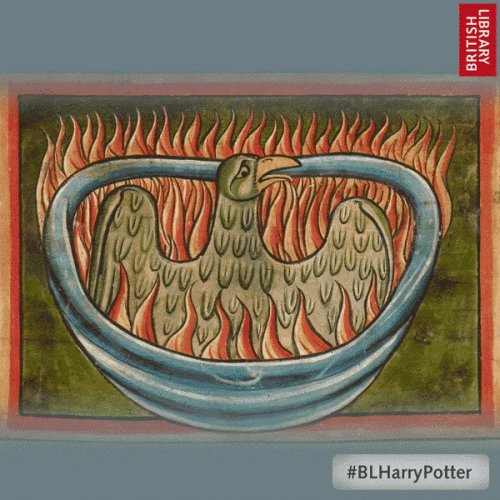
A phoenix immolating itself, from a medieval bestiary
British Library, Harley MS 4751, f. 45r
This phoenix was on display at the BL’s recent exhibition “Harry Potter: A History of Magic,” which brought together texts and museum objects that Harry himself might have used to pursue a wizardly education. It comes from a bestiary that might have been the text for Hagrid’s Care of Magical Creatures class. (The exhibition sold out long in advance for every single day, a first for the Library.)
For facts and figures, and above all to avoid howlers, I’m studying Christopher de Hamel’s 2017 blockbuster, Meetings with Remarkable Manuscripts. (Okay, it may not have been on the bestseller lists. But it’s 632 pages long and weighs three pounds.) De Hamel is the former librarian of the Parker Library of Corpus Christi College at Cambridge, a treasure house of manuscripts.
De Hamel travelled the world to research this book, visiting twelve of the most important and most beautiful manuscripts in existence. The earliest dates to the late 500s, the latest to about 1515. Each essay combines his travels, accounts of each rare book library and its denizens, his musings on the manuscripts – including some new observations and deductions on the making and history of each – with multiple images of the illuminations, of their present homes and of the men and women who bought, sold and preserved them.
Chapter One concerns the Gospels of St. Augustine, owned by Corpus Christi itself. It is the oldest surviving Latin gospel book anywhere in the world. The saint in question is not the fourth-century Bishop of Hippo but the missionary who brought Roman Catholicism to England. The book’s readings of the text and its imagery served as exemplars for later and more elaborate gospel books down the centuries.
Its predecessors may be even more interesting: scholars suggest links between the style of its art and Ethiopia, a home of early Christian monasticism. That style of Ethiopian religious painting persists today.
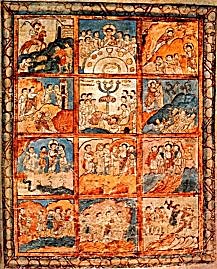
Scenes from the Passion of Christ
Gospels of St. Augustine

Modern Ethiopian religious woodcut
fineartamerica.com
De Hamel’s anecdotes are even more enticing than his scholarship. Here we see him in his librarian persona, dressed in full academic regalia, presenting the Gospels of St. Augustine for Pope Benedict’s veneration when he visited England. That’s Rowan Williams, the late Archbishop of Canterbury, on the left.

Christopher de Hamel, the Gospels of St. Augustine, and others
The Gospels of St. Augustine are also used during the enthronements of Archbishops of Canterbury, and at the last two such ceremonies, de Hamel again presented the book. He reports that in 2003, at the enthronement of Rowan Williams, at the first vibrating notes of the opening hymn, the parchment pages of the book rose and fluttered. He adds that the same did not occur for the current incumbent.
In the succeeding chapters, we meet, among others, the Book of Kells, the Copenhagen Psalter and the Visconti Semideus. Here are a few tidbits that may find their way, suitably transmuted, into my mystery:
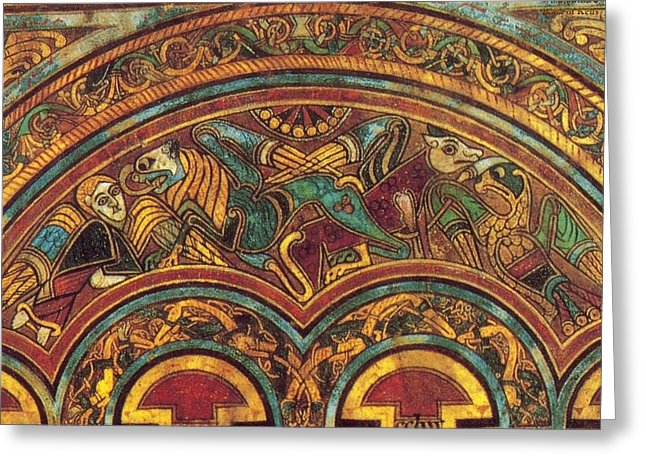
Decorative emblems of St. Mark and St. Luke
The Book of Kells
De Hamel says he is often asked if the Book of Kells is like a Book of Hours. And if so, his questioners want to know, what is a kell? Such innocent ignorance pales beside the vandalism of one George Mullen, who “restored” the Book of Kells in the 1820s and saw fit to touch up the decorations with white paint, to “improve the definition.”
The Copenhagen Psalter, we learn, was probably created as a first reading book for a young prince. This purpose is demonstrated by a large, carefully drawn alphabet and a table of punctuation and abbreviations. Its illuminations are certainly royal. If manuscripts, de Hamel says, were accompanied by music, the Copenhagen Psalter would require trumpets and a church organ.

Cat playing a rebec
British Library Harley 6563 f 40
More endearing, though, are the marginalia, calculated to appeal to a child. One of them shows a cat playing a rebec, a sort of early fiddle. This image occurs in many illuminated manuscripts and harks back, de Hamel believes, to whatever tale or folk belief gave us “Hey diddle, diddle, the cat and the fiddle.” He adds that when a dinner guest of his own, a master of medieval music, arrived with a rebec, an experiment became possible. The musician played, and de Hamel’s cat “rushed in as if drawn by a magnet, rolling on the floor in ecstasy, as punch drunk as a dervish.”
The Semideus is a manual on warfare, presented to Filippo Maria Visconti, duke of Milan, in 1438. The violent subject matter was appropriate to the recipient, a warlord whose emblem was a blue viper devouring a child. Yet the pictures of tactical devastation are charming, washed with soft pastel colors and full of tiny, perfect detail. This battle scene is viewed from the opposing page by the Madonna and Child, beaming down on the carnage from the center of a sunburst (another Visconti emblem.)
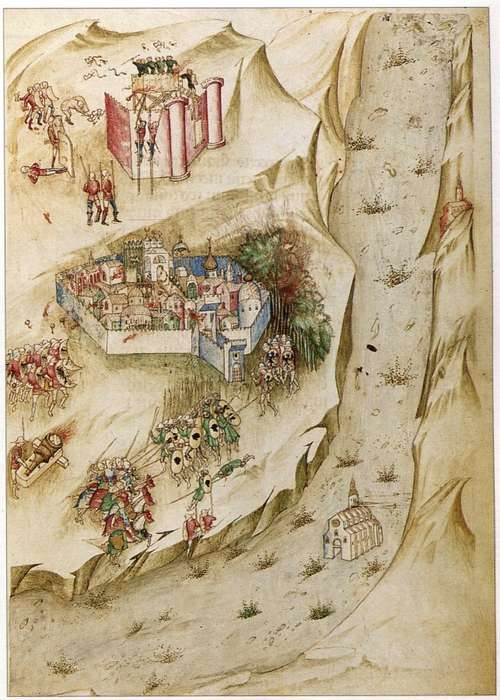
Battle scene of Crusaders attacking a Muslim city
Visconti Semideus
The St. Petersburg National Library is the current home of the Semideus. When de Hamel arrived, he went through a near-Soviet experience of rigid and inexplicable bureaucracy interspersed with casual Russian friendliness. At last he settled down to inspect the precious manuscript. He was so immersed in his work that it was well past lunch time when he looked up. The Russian invigilator keeping watch over the reading room realized he had missed the meal – so she brought him a handful of whiskey-flavored chocolates to eat while he continued to handle the manuscript.
Could I put together my mystery plot with less information than this? Logic says yes. I say no. These winding little back alleys of fact are putting flesh on the bones of my story and slowly filling the memories (and the unconscious) of several of my characters. At any rate, the mavens can’t prove that I don’t need to do this. Until they can, I plan to enjoy myself.
 Eleanor Ingbretson
 Karen Whalen
 llandrigan
 Heidi Wilson
 Mike M
 Thursday Night Writes