Blog Archives
Stockings filled with coal
When you get to be my age, it’s amazing what an almost fourteen hour trip to Virginia, in steady rain, in a rental car with tires in need of replacement, with GPS directions that you find out are not taking you the way you think you are going until it’s too late to change direction, can do to you the next day. And I was only the passenger. The driver started the trip at six a.m. getting thrown to the ground after being hit in the head by the garage door on its downward trajectory. I think you may get the picture why this post will be short and disjointed!
The good news is we made it to Virginia safe and sound, our suitcases already unpacked and clothes hung in the closets with care, the driver still lively and quick. The last leg of our journey to Arizona will be by sleigh, er, airplane, that is.
I survived, and won, NaNoWriMo, with time to spare but not a creative thought lurking anywhere. I’ve printed my 2014 and 2015 winning submissions and lugged them with my original printed book (“Anne”) with a plan to ignore the Arizona sunshine this winter and return home with a completed draft comprised of an amalgamation of all three novels. We shall see…
Over a year ago I wrote a short story that

Christmas at the Omni Mount Washington Resort
partially is set in my daughter’s house in Virginia. (You may recall the experiment with the weed whacker string.) Another unfinished work. As I walked into her garage last night, after the exhausting trip from New Hampshire, the story engulfed me, reminding me of characters and story lines left hanging, like stockings hung on the mantle filled with coal. They deserve better than that. I just may finish that story this trip.
And Santa just may bring me everything on my list.
Dancing About Architecture

Donald Swann in full voice
Singer and composer Donald Swann once said that writing about music is like dancing about architecture. You can walk around that simile for quite a while. The writing is pointless? Music is bigger, more impressive, more lasting and hence more important? The one can’t substitute for the other?
At the moment, I’m writing about architecture, and Swann’s dictum haunts me. I need to take my readers into a house that is as real to me as my own. I know that each reader will blend my descriptions with her own home, her family’s homes, her feelings about home in general and god knows what else. But I need her to see some parts of the house clearly, and I want her to experience much more than an architectural plan.
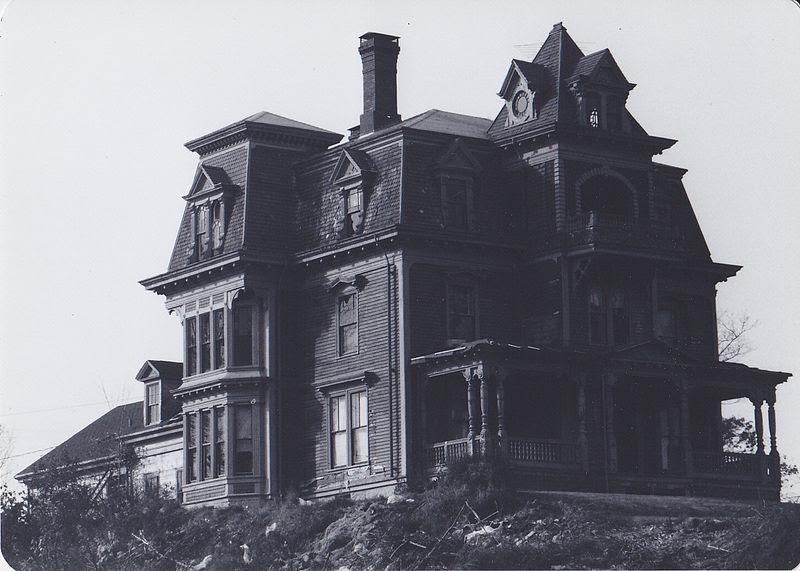
A possible model for Fallowfields
The fictional house in question, recently named Fallowfields by its snobbish owner, was built in the late 1800s in rural New Hampshire. It is an uneasy blend of Victorian-era ostentation and New England tradition. Both aspects are important to my plot and to the personalities of my characters. So both have to come through.
My plot requires that people sneak around the place, in and out, upstairs and down, undetected. So I designed Fallowfields on the model of ‘big house, little house, back house, barn.’ Farm housekeeping in the nineteenth century required more than one structure. The little house was usually built onto the back wall of the big house, which was where the humans lived. It might be a summer kitchen, a dairy, a woodshed or all three. A third structure, the back house, would share the back wall of the little house and shelter a different activity. One way or another, all the space that made up the house was formed around the chores and the home production of goods that supported the family.
The Fallowfields barn now has an apartment built into the old hay loft. My heroine has converted the tack room into a home laboratory for her botany experiments. Readers need to notice that proximity. The little house has, unusally, a second story and an internal flight of stairs. There’s another flight at the front of the big house. Before we can do exciting scenes of rushing up and down and dodging round the house, I must lay the routes out for the reader in the course of their ordinary use. Needless to say, my writing group read the early drafts and scratched their heads. “Wait! She was in the barn. How did she get to the bedroom?” Time to revise.
I want much more from Fallowfields than these mechanics. My heroine is facing forced retirement from work that took her around the globe. Unless I can convey her growing contentment with a life in northern New England, she and the book will come to an unhappy end, which is not my intention. Fallowfields and the rest of her home town must convey the possibility of that contentment.

A view of Peacham
Parts of Fallowfields are based on my grandfather’s house in Peacham, Vermont, purely for the pleasure I take in recalling it. To a five-year-old, its little house was Aladdin’s cave. It held pairs of rubber boots tall and thick enough for Jack-in-the-Beanstalk’s giant, or to survive a universal deluge. There were thin bamboo sticks as tall as my father and balls of bright green twine that would stake vines in the garden next summer. There were little, square wood boxes streaked inside with bright crimson, waiting for yet another year’s raspberry crop. There was a tub of something called paraffin, which I was forbidden to touch. It felt smooth and slick.
Grandpa’s back house was a chicken house. Every egg we ate in that house was less than 24 hours old. At Fallowfields, the old chicken house has been converted into a paradise for a pair of pet ferrets, but hovering sharp and dusty in the air, somewhere between a scent and a memory, is the smell of the feathers, droppings and dirt generated by a flock of healthy chickens. Even today, one breath of that scent takes a half-century off my age. Can I manage to show that? Because telling just won’t do.
Vicarious Eviltude
‘Eviltude’ is our family’s term for a certain kind of transgression: those delightful delicts that are entirely voluntary, pleasurable and unregretted. Taking the last piece of chocolate cake without apology or second thought is eviltude, as is buying that adorable, vulgar sequined vest that you will never have the guts to wear in public. Eviltude can be identified by a certain YAHOO! feeling, lamentably scarce in my day-to-day life.
There are days, though, when it just isn’t enough. Respectability weighs heavy, and the odds of becoming a pirate seem vanishingly small. That is one of the times when writing murder mysteries comes to the rescue. (Yes, I know we call it crime fiction now. Mine are murder mysteries.)
Kate Flora blogged the other day, on Maine Crime Writers, that “writing things out of our systems is why we crime writers usually are pretty cheerful.” And this is true. Giving an unpleasant character some of the traits of your venomous neighbor can really ease your mind. It probably counts as eviltude. But it seems to me that Kate left out a lot of the upside. When I am plotting crime, I’m not just relieved of care, I’m gleeful. There is nothing I couldn’t do! And nobody I don’t want to get caught, will get caught!
I just finished reading The Map Thief, a nonfiction account of Edward Forbes Smiley III, who stole hundreds of rare maps from libraries, sold them to collectors and lived the jet set life among the ultra-rich. I learned the details of library security systems, the twist of the wrist used to run a razor blade down a book binding, and the little alterations that can be made to disguise a stolen parchment. It just so happens that my mystery #2 concerns the theft of an ancient manuscript, complete with gorgeous illuminations, glittering and bizarre.

Monkey-lion centaur sawing books (much worse than eviltude)
(Courtesy British Library, Add. 49622, f.146)
As I read about Smiley, I kept thinking, “I could use that! I could use that, too!” It was almost as if I were stealing the books myself. Onward to piracy!
With only two plots (and no completed manuscript) to my credit, I’m amazed at the amount of mayhem I have already enjoyed. Young and old have fallen at my hand, by poison, violence and an intricate plot involving a clown at a children’s party.

Clostridium botulinum bacteria. (Science Photo Library)
As a bonus, every murder needs alternate explanations that the detective must investigate and discard. It’s as much fun as killing your venomous neighbor two or three times. In mystery #1, the first victim is found to be full of botulism toxin. Of course, it is found in the canned tomatoes. But the victim’s house is also full of Botox (as is the victim’s fiance.) How to choose? Shall I have a single murderer kill several people off, one per source of botulism? Or shall I invent more murderers? Now sounds the evil pirate laugh, BWAH-HAH-HA-HA!
I’ve begun to see opportunities for murder in every chance-met object. Here in rural New Hampshire, we have myriad neglected houses dating back a century or two, just crying out for renovation. What if, while the carpenters are rebuilding the sash windows, having found lovely antique sash weights for the purpose, a murderer finds his victim alone in the house?
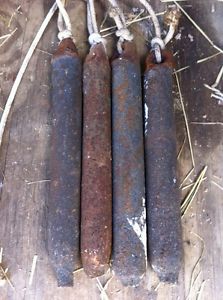
6-lb Antique Sash Weights
(Need a blunt instrument? Get these on Ebay!)
In my saner moments, I fear no good can come of this. Vicarious eviltude could take me to new and dangerous places. I might just wear that vest. To a bar. Where I would get into a fight. With a cop…. Or maybe I should just keep my eviltudes vicarious.
I am not Salman Rushdie
The September 2015 issue of the “Harvard Business Review” (creativity section) included an Interview with Salman Rushdie by Alison Beard. Thank you to Heidi, who admits to being obsessed with Rushdie, for sharing this inspiring article.
This is how I interpreted some of the interview in relation to how I write (I know, how arrogant to compare myself to a writing giant such as Rushdie):
Rushdie states that he evolved from a plotter to a pantser. He appears to write in a linear fashion, composing only 400 to 500 words a day—mostly complete scenes, requiring minimal, if any, revision. It’s perfect the first time.
I have never succeeded as a plotter. I attempted to outline my current novel, “Claire,” using a storyboard and post-its. Instead of sticking to my outline I ended up writing an island for our most recent writing group and then I determined where it would fit in the plot. (I was told that’s the definition of an island!) I was surprised to find that it closely matched an existing post-it. However, it was neither perfect nor the next unwritten scene.
Rushdie does not share his writing until it is finished. That is hard to pull off in a writing group as the expectation is that you will submit your work on a regular basis. And since I tend not to finish anything—you can see where this is headed!
Undisciplined: me. Disciplined: Salman Rushdie. He treats his writing as though it were a job with a regular schedule—no waiting for inspiration to strike.
I am nowhere near that point in my writing progression. I write when I have committed to submit to my writing group and when it is my turn to post on our blog. That’s not much. Heidi (who else) has suggested that we resurrect our group writing project centered on a bridal shop. Why not? At least I’d have a third reason for writing.
Would Rushdie ever delay publication of one of his works because he had to paint a bedroom to match a quilt? Or even just not write for the same excuse—I mean reason? Certainly not. For one thing, he most likely hires out his painting. Does he realize he’s missing out on the pleasure of a sore back, of putting on the same smelly painting tee shirt every time he paints, of putting Vaseline on his elbow where he scrubbed too hard with a pumice stone to remove stuck-on paint?
Yet I am a day late with this blog post so that I could assist my husband with just such a task. Further proof that I am not Salman Rushdie. As though any further proof were needed….
Blocked
I am, never have been, and probably never will be “…in search of a reason not to work on the book just now”. I don’t need a reason; my avoidance of pen, paper and computer seems to come naturally. When the muse does favor me, I love writing my thoughts and stories. But sometimes the muse is on strike, or out on the golf course or wherever it is that the muse goes when she’s not on my shoulder to whisper in my ear.
Life often provides the circumstances for writing avoidance. There are things that have to be done, such as lawn mowing, home repairs and family events. Notice I didn’t mention WORK. Retirement should have taken care of that time sucker. Strangely, though, retirement hasn’t provided more time to write, it has merely formed a vacuum that was filled with a large whoosh when I volunteered for my church, library and historical society.
Another interference with writing is the very thing that should push it right along: peer pressure. This blog is written by five of us who have been together in a writing group for years. We always offer support, even if we have to suppress our naturally kind tendencies and mercilessly criticize each other’s work. Now, I can take criticism, but I guess that maybe my muse can’t and that’s why she doesn’t always show up for appointments. The idea that others depend on me to fill space on a regular basis is like a magnifying glass that focuses the sun’s rays on my imagination; it dries up and bursts into flames.
By the way, Scott Adams had some great observations about writer’s block in his Dilbert comic strip this past Monday, Tuesday and Wednesday. See them at http://dilbert.com/. Also, don’t leave that site before you read Adams’ very interesting blog.
This is all I have for right now. In the end, the only thing I understand about why I don’t write more is that … I don’t write more.
An Aspen Phantasmagoria
What brought all this on was a man who passed me on the sidewalk of Main Street in Aspen, Colorado, one fine July morning. He’d be called a “big guy” by the polite; that is, he was well over six feet tall and appeared to be pregnant. His expression was mildly concussed, though most likely, that was just pot. Stretched across his beer belly was a drab gray, hip-length tee shirt sporting in firework colors the legend, BAZINGA!
Not an unusual sight in Aspen. But there are few unusual sights here. Anything and everything shows up, and nobody pays any attention. Incongruities rub shoulders without noticing one another. The motto seems to be “Never connect.”
This fact only started bothering me when I started to write. Writers invent connections, of course. That’s the job. But in most places, in most situations, there’s a pre-existing network of workaday relationships growing through time, a warp and woof. On that, we stitch a story. If you write about Aspen, you write without a net.
Chronology won’t help you. Aspen’s history is a series of jerks and starts. A mining boom created the town in 1879, but by the 1930s, population had dropped again to 700 or so. After WWII, the craze for skiing brought in small numbers of permanent residents and many more seasonal ones. In came the full-time ski bums and the part-time resort patrons. And money. And more money.
Finally, one Walter Paepcke, corporate executive, philanthropist, skier, music lover, founded the Aspen Institute, the Aspen Ski Corp. and the Aspen Music Festival and School on top of everything else. That was the Big Bang, and Aspen has been hurtling away from itself ever since. The ski bums, the potheads, the fat cats, the intellectuals all orbit their own kind and pass through the rest like neutrinos.
So here are a couple of weeks’ observations from the streets, restaurants and concert venues of Aspen. Make of them what you will.
The program announces Beethoven’s Violin Concerto in D Major. The soloist will be Augustin Handelin, unknown to me. The concertmaster appears, wearing black tie. The conductor appears, wearing black tie. Pause. The soloist appears. He is dressed in a Nehru jacket of grubby white with matching trousers whose hems drag behind his heels. He stops, bows, smiles. Can it be? He seems to be wearing lipstick on a mouth (and none of us can help how we’re made) that has side extensions like the Joker in the Batman movies. Surely that powdery white is not his natural complexion? The Concerto has an extended opening before the soloist begins. He stands and waits, grimacing with overwhelming emotion. Or with something. I can’t watch. And then, note by perfect note, he takes the entire audience to Heaven with him.
Aspen is full of terrifying crones with long, jet-black hair (perfectly coiffed), gold jewelry of ball-and-chain weight, blood-red lips and eyebrows disciplined into the perfect accent circonflexe. They do not look like people who listen. Some of them, however, do take mountain hikes. Their presence lingers on the trail in the scent of Diorissimo.
Not all female denizens are slaves of the salon. The New England Puritan is well represented. From my seat at a window table of The Bakery, I watch a woman of a certain age with streaky gray hair, sitting at the bus stop. Her ironed blouse, shorts and vest are as neutral as her hair, spotless and rigorously ordinary. One knows that she bought the turquoise running shoes only because they didn’t come in beige. Beneath the crags of Ajax Mountain she sits, the New York Times folded beside her, atop a copy of The Atlantic.
A new(er)comer to the Aspen Institute complex is the Aspen Center for Physics. Here, people whose brains are of another order than yours or mine come to think about the nature of the universe in peace and quiet. But the Institute does its best to reach out to all sorts and conditions of men. Hence you may, if you like, attend a lecture tonight on “Engineered Magnetism in an Atomic Bose-Einstein Condensate.”
Just down valley in Basalt, Colorado’s newly legal marijuana industry is powering up. The selectboard will wrestle tonight with its own problems of physics: the mountain wind currents and the greenhouse exhaust fans are choking retail and residential districts with the skunky smell of cannabis bloom.
Way, way back in the seventh row of violins (Aspen orchestras run heavy to strings), sits a very small Japanese girl, perhaps 16 years old. She has followed the orchestra dress code: her blouse is white, her skirt and shoes black; she wears no jewelry. But her hair has been cut and dressed to fall in asymmetric wedges and some of it is caught up in a plastic clip shaped like Hello Kitty. She is clearly human, but a human modeled on an anime character crossed with a furry marketing behemoth. One assumes this was voluntary.
Is this just me? Are all these disconnects making me see grotesques where there are none? A scarier question: am I one of them, at least when I’m here?
Be ready to duck
We’ve been back in New Hampshire for a little over a week now. Last night was my first writing group meeting since December. And I actually jumped right back into the fray and submitted a revision of my “Jamie” story.
I suppose I could be accused of creating the fray when, following all of the insightful comments from my fellow writers, I took my copy of my story and tossed it into the air. Some might say I flung it across the room but no one can claim that it hit them. So much for saving my ranting and raving for the drive home…..
My husband was appalled when I told him what I had done. He feels that now no one will be honest with their comments in the future, fearful that they will provoke a similar reaction. Not my writing group. Not after five years of sharing the good, the bad, and the ugly. (That’s my writing–everyone else’s is good to outstanding in my mind.)
I am hopeful that they are still happy to have me back after my winter away……I certainly am thankful to be back with my “muses”!
This morning I reviewed the written comments from two of the members of my group. It’s always eye-opening to see my writing through their eyes. Areas that are clear to me they find confusing. Why? It’s clear in my mind what I am trying to convey–but not so much on paper it appears. How would I ever identify those deficiencies without their assistance? Once I’ve written multiple drafts of a story, it becomes harder and harder to recognize problem areas on my own. Reading it out loud helps–but after correcting any issues that jump out at that point, my writing always sounds pretty darn good. To me.
So thank you, ladies and gentlemen, for your patience and support. And I suppose next time I submit you’ll be ready to duck.
Desire Isn’t Enough

Arizona hummingbird-my muse?
I’ve moved from the bed of the dim, cozy casita to the patio adorned with blue sky and sunshine. Little birds chatter in the palo verde trees. The water fountain bubbling in the background competes with the wind chimes in the tree. Helicopters and Canada geese fly overhead while the thrum of a hummingbird draws my attention to the feeder. A ruby glitter signals this is a male. My muse, perhaps?
I have decided to read outside rather than write inside—the comfort of the bed was about to lure me to sleep at eleven in the morning. Or was it the pressure to write that caused my eyes to glaze over, my lids to droop? Yet here I am, outside, surprised to find pen and paper, rather than my Kindle, in hand. How is it that the distractions of a glorious winter morning in Arizona are allowing me to focus on my writing when I was convinced that I needed quiet and seclusion, and especially darkness, to get words, action, characters, plot, onto paper?
Excuses. I have plenty of them. The environment isn’t conducive to writing (see above), I have too many other things to do (aren’t I retired?), I don’t have the energy (it’s the medicine), my Words with Friends and Trivia Crack opponents are waiting for my next move (life or death situation to some).….you get the drift.
I can’t write on demand–the forces of the universe must be perfectly aligned before I can put pen to paper, fingers to keyboard,

I’m a winner!
with words leading to paragraphs to chapters to a book. A completed book. Yet I have won NaNoWriMo two times—a “complete” novel, 50,000 words written in the month of November! How do I reconcile this?
NaNoWriMo frees me. No inner critic sits on my shoulder or on the page. No time for self-doubt, perfection, or the fear of failure that normally trigger my procrastination. No concern over what my writing group will think. And then there’s that deadline. All I need for the other eleven months of the year is to find a way to replicate NaNoWriMo, to accept that my first draft will be a shitty first draft, and my creative juices will flow. Miraculously, I will become a published author. Though I have heard that it also takes hard work, writing every day, perseverance. Oh, and I can’t forget a dash of talent. Desire isn’t enough. And desire is all that I seem to be able to muster.
A few nights ago I was up until one in the morning reading a novel, anxious, as usual, to find out how it would end. Although it was my own 2014 NaNoWriMo submission, I had already forgotten. Now I remember how as midnight on November 30 approached those last few sentences seemingly leapt from the keyboard onto the page, surprising even me. Funny how that happens.
Of the Making of Many Blogs There Is No End
WordPress has my number. No sooner had I obeyed its command to “Create Your Web Site,” than it was tempting me to explore everybody else’s blog instead of writing my own. It waved a dozen links to blogs on writing under my nose, even more to book lovers’ blogs, and one called (truth in advertising) Longreads that can mess you up for days.
Then there’s Freshly Pressed, WordPress’s links to individual posts that “you might like.” How does it know? Yeah, Google tells it. The trouble is, Google is so often right. I told myself I was looking for good writing, for ideas on using WordPress well, for designing the page, blah, blah. And I did find ideas I could use.
But if I read all this stuff, when do I write?
All the wonderful How to Write books pose this same problem. Ideas about writing exist in a different universe from writing itself. Books show you nice clear roads to success: if you are writing X kind of book, and arrange your chapter in Y way, the result for your book will be Z. Those are the basic books. The tone of the more advanced comes closer to celebrity cooking shows: “you’ll be amazed how just a touch of coriander (humor/specifics/pornography) will transform your recipe!”
The actual experience of writing is more like forcing yourself to jump off a cliff, having been told by, say, an angel that you will not in fact be smashed to jam, because you can fly – as long as you think you can. Some days, just the icon for your writing program is enough to send you to Longreads.
When you do make the jump, you can fly or you can’t. You start where you left off or somewhere else in the text where you need to be. Your characters need to limber up over a few (dozen) pages. Then they stop making the kind of remark you make at dinner parties to people you don’t know why you’re talking to. And then, from somewhere behind your left ear, an earlier prop or an embedded quarrel or a potential love affair hooks around and snatches your plot. Suddenly, the conversation is making sense, but only if we assume that… and the story is writing itself. If you can keep the scene pulled up around you, and refrain from insisting that it “work out right,” you’re golden. For the time being.
And some days, you’re smashed to jam.
There is no way to avoid either the jump or the jam. I read a bit, here and there, in my pile of how-to books, and like the blogs, they add to my little store of technique. I may even recall their tips to my great profit, if I ever get to the third draft. As soon as your nose emerges from the book, you are going to have to walk back to that cliff face. So get over it, close the book, close the writing blog and jump.
That’s all for today. I gotta go write my post.
 Eleanor Ingbretson
 Karen Whalen
 llandrigan
 Heidi Wilson
 Mike M
 Thursday Night Writes