Blocked
I am, never have been, and probably never will be “…in search of a reason not to work on the book just now”. I don’t need a reason; my avoidance of pen, paper and computer seems to come naturally. When the muse does favor me, I love writing my thoughts and stories. But sometimes the muse is on strike, or out on the golf course or wherever it is that the muse goes when she’s not on my shoulder to whisper in my ear.
Life often provides the circumstances for writing avoidance. There are things that have to be done, such as lawn mowing, home repairs and family events. Notice I didn’t mention WORK. Retirement should have taken care of that time sucker. Strangely, though, retirement hasn’t provided more time to write, it has merely formed a vacuum that was filled with a large whoosh when I volunteered for my church, library and historical society.
Another interference with writing is the very thing that should push it right along: peer pressure. This blog is written by five of us who have been together in a writing group for years. We always offer support, even if we have to suppress our naturally kind tendencies and mercilessly criticize each other’s work. Now, I can take criticism, but I guess that maybe my muse can’t and that’s why she doesn’t always show up for appointments. The idea that others depend on me to fill space on a regular basis is like a magnifying glass that focuses the sun’s rays on my imagination; it dries up and bursts into flames.
By the way, Scott Adams had some great observations about writer’s block in his Dilbert comic strip this past Monday, Tuesday and Wednesday. See them at http://dilbert.com/. Also, don’t leave that site before you read Adams’ very interesting blog.
This is all I have for right now. In the end, the only thing I understand about why I don’t write more is that … I don’t write more.
Middle of the night jottings
Fantasy–not my thing, I cover my ears in my writing group whenever this genre is discussed. Yet I believe in the fantastical notion that what I think about in the middle of the night when I get up to pee–or to put it more politely to “answer nature’s call”–I will remember word for word in the morning. You know how this fantasy ends.
Except for last night. At 4:30 a.m. (I suppose that makes it this morning and late enough that I could have gotten up for the day) I grabbed the little notebook and pencil on my nightstand and wrote out four pages of diverse thoughts. Some were for my book “Claire” and others for this blog.
Or at least that’s what I wrote. It would be incredibly rewarding if only I could decipher what all those scribbles are. Or, of the ones that I can actually read, what they mean.
For example, my first note is: “This was the time, Claire thought.” Underline.
Hmmm….time for what?? Time to get up and go to the bathroom? Time to get married? Time to iron? (You’ll have to read the book, I suppose, to find out. And I’ll have to finish writing it to figure it out. But I will use that line!)
At our last writing group, I was asked to focus on Claire’s emotional backstory. I’ve been thinking about that during my “free” moments on our recent overnight trip to Ogunquit, Maine, with two of our grandchildren and my eighty-seven year old mother. One germ of an idea managed to surface somewhere between the frigid ocean waves and the heated excitement of Chuck E. Cheese’s.
However, the best one came from one of my middle of the night jottings. It connects the bruises on the bride for whom Claire is making a wedding gown with long sleeves to Claire’s wedding gown with long sleeves that is stored in her attic.
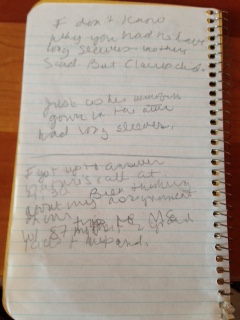
Middle of the night notes
These two ideas have reinforced the fact that I have been writing “Claire” on a superficial level, unwilling or unable to delve into what is happening in Claire’s mind to cause her to act as she does. I finally get it that her actions will not be acceptable to the reader without a better understanding of her motivations, especially her internal ones. As usual, I know what those are, I simply have failed to commit them to paper. Basic “Novel Writing 101” and something John, our facilitator, has encouraged me to focus on. I can’t wait to get to work on that!
Free Names

Listen Up!
For some time, I have been keeping a small notebook in my purse in which to capture fugitive ideas, oddities, vignettes, and joyful or horrid happenings for use in future writing. From this exercise has come, among much else, a long list of weird names encountered in the press and occasionally in life. I long to use them in fiction, but since they belong to real people, the best I can hope for is to mix and match. Today, I want to share some of this raw material with you, my fellow writers, who may well come up with better matches and better mixes than I. Feel free.
Some of the names are simply too appropriate to be believed. There are:
- Sir Jock Stirrup, once head of the British armed forces (and now Baron Stirrup.)
- John Stalker, an ex-Deputy Chief of Police.
- James Naughtie, the BBC Today interviewer of a heterosexual man who, after a stroke, “woke up gay.” Naughtie was described by Britain’s Daily Mail as “the formidable BBC pinko who turned the airwaves blue.”
- UK Member of Parliament, Mark Reckless, who bolted the Conservative Party to join the Independence Party.
(The English outnumber the Americans in my list. Does this Mean Something?)
Here at home, the items in my collection seem to come with brief stories attached. I itch to fill them out:
From my cookbook shelf, Crescent Dragonwagon beckons. According to my sister-in-law, who claims acquaintance with her (and that is not the kind of source one questions), Ms. Dragonwagon married an enlightened man who did not insist that she take his surname. Neither of them wanted a hyphenated name, however, so they made one up. The marriage ended, but Ms. Dragonwagon’s  vegetarian cookbooks were already well known, so, publicly at least, she will be Dragonwagon to the end of her days. The stuff of tragedy.
I found another name near the end of a news tidbit about the theft of a Stradivarius violin. We were several paragraphs down into an account of the Strad before the perpetrator appeared: “The violin, which police said appeared to be in good condition, was stolen late last month from a concert violinist who was shocked with a stun gun…. Police traced the stun gun to Universal Knowledge Allah, a 36-year-old barber….”
A cousin of Michelle Obama made the papers very recently. Rabbi Capers Funnye of Chicago was nominated to become what an international organization is calling the first “black chief rabbi” of the 21st century. A statement from the International Israelite Board of Rabbis declared that Funnye would serve as the “titular head of a worldwide community of Black Jews.” And why not?
Internationally, my best name source so far came from an account of Ted Cruz being booed off the stage at a gathering of Middle Eastern Christian ecclesiastics. It was also my best source of impressive titles. In the audience were:
- Patriarch Mar Bechara Boutros Cardinal Raï, Maronite Patriarch of Antioch and All the East;
- Gregorios III Laham, Melkite Greek Catholic Patriarch of Antioch and All the East, Alexandria, and Jerusalem [pictured at the top of this post];
- Ignatius Youssef III Younan, Syriac Catholic Patriarch of Antioch and All the East;
- Aram I Keshishian, Catholicos of the Great House of Cilicia of the Armenian Apostolic Church;
- Metropolitan Joseph Al-Zehlawi, Archbishop of New York and All North America for the Antiochian Orthodox Christian Archdiocese of North America;
- Bishop Angaelos, General Bishop of the Coptic Orthodox Church of Alexandria;
- Ibrahim Ibrahim, Bishop Emeritus of Chaldean Eparchy of Saint Thomas the Apostle.
I don’t know where to start the character list for my fantasy novel, with the Catholicos of the Great House of Cilicia or the Bishop of the Chaldean Eparchy of Saint Thomas the Apostle. George R. R. Martin, look out! (Alas, the first result of a Google search on the Eparchy was a parish listing — in Southfield, Michigan. The glamor is gone.)
Okay, writers, start your pens. Pick a name and give me a scenario.
WHEN IN THE COURSE. . .
When in the course of revising your story you come upon an insurmountable impediment to the furthering of your plot, or to your characters movements, it may become necessary not to cut the ties which bind you and your story, but to write an outline.
I’m a pantser and pantsers naturally abhor outlines. Luckily outlines come in many forms. What I did was follow a very loose format that J.K. Rowling did for one of her Harry Potter books. Hey,why settle for anything less than the best?
Rowling took a sheet of lined loose leaf paper and made a grid. She listed the months of Harry’s school year down the left hand side of the paper and characters/incidents along the top. In this way she could fill in the squares and make sure Harry and Co. were led to the right place at the right time to meet with Voldemort, or whoever, when the story required it of them.
If outlining is not beneath J.K. Rowling I reasoned, then why not try it myself?
I took a sheet of poster board and graphed it into squares the same size as the post-it notes I planned to strew the whole thing with. My story currently in revision takes place in the space of one week, so down the left hand side of the board I put the days of the week. Characters and situations ran along the top. I went through the scenes I had most recently revised and plotted them on my board. Back story went behind the post-its onto the board and current events went onto the post-its so they could be moved as needed.
So, did it help? It did. I was able to see the story, as far as I had revised it, at a glance. Amazed at how easily I could tell where something needed to happen, I made it happen. Now only halfway through this revision, and the outline only halfway through that, I saw that the thread of a sub-plot could be made stronger and that character enlarged to amplify the denouement.
Changes were made right away onto the hard copy I had on hand to plot information onto my graph. That is a revision in itself.
I’m looking forward to more plotting on the outline as I go along with the revision. The outline will probably progress faster than I can revise my scenes, so whereas the scenes had defined the outline I can tell that the changes that I’ve made will help the outline to define the scenes yet to be revised. Hope that made sense. Somehow it does to me.
Added bonus, this exercise should make the following revisions easier.
Will I become a bona fide plotter? Well, I don’t think I can write a story by outlining it first, but at this point I feel an outline such as this one helps to find and tie up those loose and flimsy threads that run through the story. And that’s good.
Voice
After almost six years of meeting, the voices of my fellow Thursday Night Writers have become pretty familiar to me and easy to spot. The vocabulary and cadence are like fingerprints that don’t seem to change. However, it wasn’t until recently that I seriously considered what my own voice was.
About a month ago, we did a couple of writing exercises one night. In one scenario, the instruction was to think of something we either liked or disliked, and then write a story as if we had the opposite feeling. For the second exercise, the point was to think of a dozen details that could be used as description and then write two or three paragraphs using those details. It was fun and I had no problem writing two short pieces. Then we each read our work aloud and it was pointed out to me, and I immediately saw, that I had used exactly the same voice in response to two totally different scenarios.
My voice in both pieces was cynical, which actually seems normal to me because I am not a Pollyanna and believe that there are a lot of negative and malignant things in our world. But, the more I think about it, the more I come to the conclusion that, if I’m cynical about the world then it is only fair that I should be cynical about myself, or at least about my writing. I’m undertaking this appraisal of my writing with the idea that maybe I can somehow rub salve on my dark worldview and alleviate some of the aches and pains it gives to both me and my readers.
I hope this self-examination bears fruit. When we did those exercises and then discussed them, it was an eye opener to realize that what had been so comfortable only minutes before suddenly felt foreign. There it was, right in front of my face, challenging me to consider whether I like what I see and feel when I write. Wish me luck.
Watching My Garden Grow—or Not
I think my patch of dill is three inches high today, my tomato plant and two bean vines about mid calf and mid thigh respectively.
Well, I was slow to get the seeds in the ground, so what could I expect?
I also forget to water, until my scrawny little plants are banging their leafy fists on the ground and saying accusingly, “What kind of gardener are you?”
This is a blog about writing, and I’m writing about not writing. My pen, when I can find it, could say the same thing to me: “You never call, you never write . . .”
I admire Heidi and Karen and Eleanor for undertaking the writing of a novel—and following it through, untangling the snarls in the plots, deepening their characters with each rewrite, filling in the holes with some excellent writing.
I look at the characters in my pre-written stories, and they just glare back at me, accusingly. “Well, we’re not going anywhere while you just sit there and doodle in the margins!” Maybe I should just take up cartooning.
My live-and-let-live approach to gardening and writing hasn’t worked well (except for the weeds). Participating in the blog has been helping me get over my block—I’m writing and stretching that mental muscle that I’ve let atrophy for too long.
Confession: I am a pantser
I’ve hit the wall, thrown in the towel, given up on my Camp NaNoWriMo project. Oh, I still plan on completing my novel “Claire”—just not in July. If I believed in writer’s block, I’d have to say this is what I am experiencing. But I know deep down I’m just being plain lazy. And that I set too ambitious a goal.
After all, it is summer and we did just buy a Jeep. A toy that we have gotten maximum pleasure out of in the few weeks that we have owned it, tooling around the scenic roads of Vermont and New Hampshire every available evening, anxious to stumble upon some wildlife, or, absent that, feel the freedom of the wind blow through our (my) hair, removed from the necessities of mowing the lawn and painting the trim on the house. And working on “Claire.”
John, our group’s facilitator, has requested (“suggested”—too passive) that I bring in an outline of the book to the next writing group meeting in two weeks. I readily agreed. Deadlines are my allies. And the outline is half-written anyway. Which may be my source of writer’s block. Assuming I believed in it.
I am a “pantser.” I start writing with a germ of an idea for my work of fiction and then I write. I usually don’t have an outline when I start—that would make me a “plotter.” I prefer for my plot to evolve organically. (I just learned that there are also “plantsers.”)
I’m not alone in this approach. But the plotters will tell you that this only makes more work for us pantsers in the long run, that I’ll need to write a few rough drafts to be where they are after their first rough draft.
Hang in there—I’m getting to my point….
Which is that for Camp NaNoWriMo I decided to write more like a plotter than a pantser, outlining before adding to the 10,000 plus words I had already written for “Claire.” Seemed like more than a good idea. More like a necessity. After all, this is the first book in a trilogy and a thriller. That worked. For a while.
Now that I have a half-finished outline, I’m unable to get back to the story and write. Or even finish the outline. So I’m stuck. Writer’s block. Lesson learned: I am definitely a pantser. What I really want to do is just write the damn book.
I’m relying on my writing group to jump-start my writing. Bring it on!!
Meanwhile, I’m waiting for July 31 so that I officially can announce that I did not win Camp NaNoWriMo 2015.
An Aspen Phantasmagoria
What brought all this on was a man who passed me on the sidewalk of Main Street in Aspen, Colorado, one fine July morning. He’d be called a “big guy” by the polite; that is, he was well over six feet tall and appeared to be pregnant. His expression was mildly concussed, though most likely, that was just pot. Stretched across his beer belly was a drab gray, hip-length tee shirt sporting in firework colors the legend, BAZINGA!
Not an unusual sight in Aspen. But there are few unusual sights here. Anything and everything shows up, and nobody pays any attention. Incongruities rub shoulders without noticing one another. The motto seems to be “Never connect.”
This fact only started bothering me when I started to write. Writers invent connections, of course. That’s the job. But in most places, in most situations, there’s a pre-existing network of workaday relationships growing through time, a warp and woof. On that, we stitch a story. If you write about Aspen, you write without a net.
Chronology won’t help you. Aspen’s history is a series of jerks and starts. A mining boom created the town in 1879, but by the 1930s, population had dropped again to 700 or so. After WWII, the craze for skiing brought in small numbers of permanent residents and many more seasonal ones. In came the full-time ski bums and the part-time resort patrons. And money. And more money.
Finally, one Walter Paepcke, corporate executive, philanthropist, skier, music lover, founded the Aspen Institute, the Aspen Ski Corp. and the Aspen Music Festival and School on top of everything else. That was the Big Bang, and Aspen has been hurtling away from itself ever since. The ski bums, the potheads, the fat cats, the intellectuals all orbit their own kind and pass through the rest like neutrinos.
So here are a couple of weeks’ observations from the streets, restaurants and concert venues of Aspen. Make of them what you will.
The program announces Beethoven’s Violin Concerto in D Major. The soloist will be Augustin Handelin, unknown to me. The concertmaster appears, wearing black tie. The conductor appears, wearing black tie. Pause. The soloist appears. He is dressed in a Nehru jacket of grubby white with matching trousers whose hems drag behind his heels. He stops, bows, smiles. Can it be? He seems to be wearing lipstick on a mouth (and none of us can help how we’re made) that has side extensions like the Joker in the Batman movies. Surely that powdery white is not his natural complexion? The Concerto has an extended opening before the soloist begins. He stands and waits, grimacing with overwhelming emotion. Or with something. I can’t watch. And then, note by perfect note, he takes the entire audience to Heaven with him.
Aspen is full of terrifying crones with long, jet-black hair (perfectly coiffed), gold jewelry of ball-and-chain weight, blood-red lips and eyebrows disciplined into the perfect accent circonflexe. They do not look like people who listen. Some of them, however, do take mountain hikes. Their presence lingers on the trail in the scent of Diorissimo.
Not all female denizens are slaves of the salon. The New England Puritan is well represented. From my seat at a window table of The Bakery, I watch a woman of a certain age with streaky gray hair, sitting at the bus stop. Her ironed blouse, shorts and vest are as neutral as her hair, spotless and rigorously ordinary. One knows that she bought the turquoise running shoes only because they didn’t come in beige. Beneath the crags of Ajax Mountain she sits, the New York Times folded beside her, atop a copy of The Atlantic.
A new(er)comer to the Aspen Institute complex is the Aspen Center for Physics. Here, people whose brains are of another order than yours or mine come to think about the nature of the universe in peace and quiet. But the Institute does its best to reach out to all sorts and conditions of men. Hence you may, if you like, attend a lecture tonight on “Engineered Magnetism in an Atomic Bose-Einstein Condensate.”
Just down valley in Basalt, Colorado’s newly legal marijuana industry is powering up. The selectboard will wrestle tonight with its own problems of physics: the mountain wind currents and the greenhouse exhaust fans are choking retail and residential districts with the skunky smell of cannabis bloom.
Way, way back in the seventh row of violins (Aspen orchestras run heavy to strings), sits a very small Japanese girl, perhaps 16 years old. She has followed the orchestra dress code: her blouse is white, her skirt and shoes black; she wears no jewelry. But her hair has been cut and dressed to fall in asymmetric wedges and some of it is caught up in a plastic clip shaped like Hello Kitty. She is clearly human, but a human modeled on an anime character crossed with a furry marketing behemoth. One assumes this was voluntary.
Is this just me? Are all these disconnects making me see grotesques where there are none? A scarier question: am I one of them, at least when I’m here?
Layers of Revision
Most of us are familiar with Abraham Maslow and his hierarchy of needs. Very basic needs form the foundation of his triangular hierarchy and only when they are achieved can one can move upward, one level at a time, through safety, security, belonging and self-esteem until finally personal creativity is realized. Then, voila, one achieves what Maslow called self-actualization.
The latest issue of Writer’s Digest (September, 2015), an article on revision equates Maslow’s hierarchy (loosely) to the problems we face when revising a story (okay, you knew we would get around to writing sooner or later. Well, we’ve arrived).
In The Great Revision Pyramid, by Gabriela Pereira, it is suggested that the shortest distance from first draft to a finished book is by systematically covering all the layers, in order, in a hierarchy of revision. One layer per revision.
Layer one, the narration. This corresponds to Maslow’s base level of food, water, shelter and warmth. In revision we must tackle voice and point of view first, and get them right, before going on to the next layer.
Layer two: the characters. This includes your protagonist, antagonist, and supporting cast. Know your protagonist almost as well as you know yourself. Know your antagonist as well.
Layer three: the story; plot and structure. I was glad to see that this layer was in third place. That’s where I am in my very long, very sporadic revision process. I’ve got layers one and two done (Maybe. Ask my writing group to verify that), only four and five to go!
Layer four: the scenes. Scenes include world-building, description, dialogue and theme. That sounds like a whole pyramid in itself.
Layer five: cosmetics. This layer includes spelling and word choice. They can be fun. It also includes grammar and punctuation; two banes of my existence. However, one writer’s bane is another writer’s raison d’etre, so I’ll not say anything further. If and when I get to layer five I have friends and family in reserve who can fix my shortcomings.
So, there you have it. In a nutshell. Revise, rewrite, one layer at a time, starting at the base layer, and you’ll soon be at the pinnacle. Soon is a relative term, as you know.
Ms. Periera’s article was a great source of inspiration. If you’re not a fiction writer there are also, in this issue, revision techniques for non-fiction and poetry.
Happy revising!
Home and Away and Writing
I’ve had the pleasure recently of visiting Ithaca, New York, and from my brief stay, I’m totally intrigued by the region. The Finger Lakes and the numerous and dramatic waterfalls themselves tell a story that goes back for centuries and centuries. The wineries and local food eateries that have sprung up more recently tell another, perhaps related, story of how people respond to the environment in which they live and work.
We talk a lot about sense of place when we talk about writing, and for good reason. If characters drive the story, then perhaps setting drives the characters. When I read a story that is set in no place in particular, I often feel that something essential about the people in the story is lacking. When the setting of a story or novel pulses with it’s own heartbeat, the characters within that story have more depth. And some stories couldn’t exist apart from their setting, as so many people are rediscovering this summer rereading To Kill a Mockingbird.
It makes me wonder how people can write about a place and the people who live in that place without having spent much time there themselves. I know that there are skilled writers who can do so . . . What are their tricks and tools for absorbing the essence of a place enough to capture not only in the descriptions of the setting, but also in their characters? This has long been a worry of mine, since I never felt that I came from anyplace. As a child I lived with my grandmother in Florida, who told me often enough “Kentucky is our home.” She’d lived more years in Florida than Kentucky, but she carried with her the traits of her birthplace in her speech, her cooking, her sense of propriety. I loved Kentucky, but it was never my home. My mother and I eventually landed in a college town after she got her masters—a town where no one was from. I don’t feel like I inherited a culture from the place; I always felt like an outsider. And in fact, I could not get out of that town fast enough when I graduated from high school. It’s only since I’ve been away from “home” for a good twenty-plus years, that I can begin to see how my own hometown shaped the essential me.
Extensive research about a place, rounded out with empathetic imagination—whether it is a storefront in a dusty, dying strip mall or a fierce and angry waterfall carving through shale and sandstone—are the essential things a writers must bring to the table when sitting down with pad and paper. A little local cheese and wine helps, too.
 Eleanor Ingbretson
 Karen Whalen
 llandrigan
 Heidi Wilson
 Mike M
 Thursday Night Writes