Waiting for inspiration
Inspiration…..waiting…..waiting…..when are you going to swoop down and write my blog post for me? That is what usually happens when it’s my turn but this time not so much. Oh, yesterday I wrote enough words to comprise a post. But they weren’t anything I would reread in a few months and wonder if I had actually written them or if my name were mistakenly attached to someone else’s writing.
Yet it’s been hammered into my head that I shouldn’t wait for inspiration. I need to be disciplined, sit down at the same time every day and write. Treat it as though it were a job–unpaid, but a job nevertheless. And some of the members of my writing group do that. They are the ones who produce, who eagerly volunteer to submit their writings for next week’s critiquing by the group.
Where would I be without my writing group? We celebrated our sixth anniversary at last week’s meeting. Six years!! Of the seven attendees, five are charter members and two are “newcomers” We toasted with port, indulged in a multitude of desserts and snacks, and reminisced. I left feeling reinvigorated, ready to tackle (and finish!!) “Claire.” Again.
The next day the four ladies of the group met for our usual Friday lunch. Heidi provided me with an idea for “Claire” that I absolutely will use. It’s a tweak to the story line that started the wheels in my mind turning and whirring.
Three full days later and I haven’t written a word. But I will.
In addition, the three ladies listened patiently as I outlined, off the cuff, my concept for the upcoming NaNoWriMo (National Novel Writing Month) in November. I know what you’re thinking: 1) it’s only September and she’s already started her plot for NaNoWriMo? and 2) she’s going to attempt NaNoWriMo again? She doesn’t need a new writing project, she needs to finish something she’s already started. What is she thinking??
The answer is, for me writing isn’t about thinking. It’s about feeling. That’s what makes me a better pantser than a plotter.
Also, I mentioned in a previous post that without agreeing to submit to my writing group and posting to this blog, I wouldn’t write. I neglected to include committing to NaNoWriMo. It’s potentially 50,000 words that I otherwise would not write.
My proposed story for NaNoWriMo has a personal foundation going back to my grandmother in Germany. Unfortunately, she’s not alive so I will have to rely on the memory of my eighty-seven year old mother to provide the background for my NaNoWriMo novel. In addition, it will involve research about World War II, something I can do in advance of November 1. “Can” doesn’t necessarily translate into “will” I have found.
Linda, Heidi, and Eleanor were supportive of my concept. And of my writing ability. What a wonderful feeling to enjoy a cup of clam chowder with people who have become good friends, talk about writing–and leave with my ego pumped up just a bit.
Vicarious Eviltude
‘Eviltude’ is our family’s term for a certain kind of transgression: those delightful delicts that are entirely voluntary, pleasurable and unregretted. Taking the last piece of chocolate cake without apology or second thought is eviltude, as is buying that adorable, vulgar sequined vest that you will never have the guts to wear in public. Eviltude can be identified by a certain YAHOO! feeling, lamentably scarce in my day-to-day life.
There are days, though, when it just isn’t enough. Respectability weighs heavy, and the odds of becoming a pirate seem vanishingly small. That is one of the times when writing murder mysteries comes to the rescue. (Yes, I know we call it crime fiction now. Mine are murder mysteries.)
Kate Flora blogged the other day, on Maine Crime Writers, that “writing things out of our systems is why we crime writers usually are pretty cheerful.” And this is true. Giving an unpleasant character some of the traits of your venomous neighbor can really ease your mind. It probably counts as eviltude. But it seems to me that Kate left out a lot of the upside. When I am plotting crime, I’m not just relieved of care, I’m gleeful. There is nothing I couldn’t do! And nobody I don’t want to get caught, will get caught!
I just finished reading The Map Thief, a nonfiction account of Edward Forbes Smiley III, who stole hundreds of rare maps from libraries, sold them to collectors and lived the jet set life among the ultra-rich. I learned the details of library security systems, the twist of the wrist used to run a razor blade down a book binding, and the little alterations that can be made to disguise a stolen parchment. It just so happens that my mystery #2 concerns the theft of an ancient manuscript, complete with gorgeous illuminations, glittering and bizarre.

Monkey-lion centaur sawing books (much worse than eviltude)
(Courtesy British Library, Add. 49622, f.146)
As I read about Smiley, I kept thinking, “I could use that! I could use that, too!” It was almost as if I were stealing the books myself. Onward to piracy!
With only two plots (and no completed manuscript) to my credit, I’m amazed at the amount of mayhem I have already enjoyed. Young and old have fallen at my hand, by poison, violence and an intricate plot involving a clown at a children’s party.

Clostridium botulinum bacteria. (Science Photo Library)
As a bonus, every murder needs alternate explanations that the detective must investigate and discard. It’s as much fun as killing your venomous neighbor two or three times. In mystery #1, the first victim is found to be full of botulism toxin. Of course, it is found in the canned tomatoes. But the victim’s house is also full of Botox (as is the victim’s fiance.) How to choose? Shall I have a single murderer kill several people off, one per source of botulism? Or shall I invent more murderers? Now sounds the evil pirate laugh, BWAH-HAH-HA-HA!
I’ve begun to see opportunities for murder in every chance-met object. Here in rural New Hampshire, we have myriad neglected houses dating back a century or two, just crying out for renovation. What if, while the carpenters are rebuilding the sash windows, having found lovely antique sash weights for the purpose, a murderer finds his victim alone in the house?

6-lb Antique Sash Weights
(Need a blunt instrument? Get these on Ebay!)
In my saner moments, I fear no good can come of this. Vicarious eviltude could take me to new and dangerous places. I might just wear that vest. To a bar. Where I would get into a fight. With a cop…. Or maybe I should just keep my eviltudes vicarious.
ANOTHER SLAM
ANOTHER SLAM
This past weekend saw another 48 Hour Film Slam in Bradford, Vermont. It was the 6th Annual Film Slam to be sponsored by the Cohase Chamber of Commerce. Cohase being the region here in upper New Hampshire and Vermont.
Friday evening the competing film teams drew their genres from a hat. They were then given a list of required ‘musts’ they must embed into the film.
This year’s physical requirements were a sap bucket, and a product placement (advertisement piece); a plastic cup with a sponsors name written on it. Woodsville Guarantee Savings Bank, in this case. Also a location; the Newbury Village Store, and a line of dialog; “I don’t know, Herman. Something about you just pisses me off”.
The teams retired to come up with what they hoped was a great story. They built props, checked out locations, prepared costumes. They had already composed their cast and crew, checked their equipment, and lined up a caterer. Then they acted, filmed, edited and wrote music.
Because my son heads a film team I’ve seen some of the nitty gritty aspects that go on behind the scenes. Cast and crew catching cat-naps wherever they can, whenever they can. Fake blood production in the kitchen, clean-up of fake blood where its been liberally used. People eating in shifts, sometimes in the middle of the night while they are still working. Trucking equipment here and there, trucking cast and crew hither and yon, and shooting till there’s no light left to see. I’ve seen hopes raised, dashed, and materialized when the seven minute films are judged.
This year only five teams competed. Few compared to other years and venues, but still serious business. Never let your guard down, never let yourself think that you have this film sewn up and tied with a bow, because you never know what the judges and audience will think. It has to be the best you can do in 48 hours, even if it means no sleep and working with perpetual jet-lag.
The team members love it. These competitions get their blood flowing – that’s real blood, in real veins.
In past years my home has been a set and I’ve been caterer. I’ve housed cast and/or crew, and have been a general dogs-body. This year I was invited to sit in on the two hour story marathon where everyone involved speed wrote and pitched their story.There was a vote and the most popular choices were then reviewed by the directors. I was totally surprised when my story was picked because I thought that other stories were more exciting. Exciting isn’t necessarily what is looked for. There’s audience appeal, feasibility, and comprehension. Even in a Monster movie.
We wrote a screenplay from my narrative and I went home and crawled into bed at 2 AM. Not to sleep, though. Too many thoughts ran through my head all night.
The next morning I checked my email for the screenplay only to find that all sorts of things had been changed overnight. Should I fuss about it? Naw, it’s out of my hands now. When I got the call later to say I was needed to play a character even more things had changed.
Shooting my scene happened at midnight, after which I went home and crawled into bed, again not to sleep. Too much adrenalin coursed through my veins.
Early the next morning shooting was wrapped up in the woods behind my house. Later we all prepared for the big event that evening. Our film was turned in one minute before the deadline. Harrowing!
We won. So happy. Celebratory festivities.
I crawled into bed that night, but sleep again eluded me. Just too much excitement for an old lady I guess.
The film making process is fun, but definitely exhausting. Am sleep deprived as I write this.
Will include a link to the film hopefully the next time I post. Now to sleep.
House Guest
I am lying in bed. Everything is turned off. The excited chatter of the evening’s dinner has finally stopped echoing in my head. And yet, true silence is elusive. The noises are now unfamiliar. Was that a rustle of the sheets, or a footfall on the stair? The wind knocking at the window, or someone’s fingers slipping off the screen?
At night, little creaks are piercing, the refrigerator hum deafening. My racing heart is at war with the sleeping pill I took, and the dripping sink sings me awake awake awake. Then as I start to drift off, a party somewhere down the street breaks apart messily.
I wait for the last hoot of laughter, the rumble of the last car pulling away. . . . And I start again to parse the grunts and groans of the old bones of this house, the patter of mice in the rafters, suddenly becoming aware of the fan, it’s blades slicing the air.
I am not Salman Rushdie
The September 2015 issue of the “Harvard Business Review” (creativity section) included an Interview with Salman Rushdie by Alison Beard. Thank you to Heidi, who admits to being obsessed with Rushdie, for sharing this inspiring article.
This is how I interpreted some of the interview in relation to how I write (I know, how arrogant to compare myself to a writing giant such as Rushdie):
Rushdie states that he evolved from a plotter to a pantser. He appears to write in a linear fashion, composing only 400 to 500 words a day—mostly complete scenes, requiring minimal, if any, revision. It’s perfect the first time.
I have never succeeded as a plotter. I attempted to outline my current novel, “Claire,” using a storyboard and post-its. Instead of sticking to my outline I ended up writing an island for our most recent writing group and then I determined where it would fit in the plot. (I was told that’s the definition of an island!) I was surprised to find that it closely matched an existing post-it. However, it was neither perfect nor the next unwritten scene.
Rushdie does not share his writing until it is finished. That is hard to pull off in a writing group as the expectation is that you will submit your work on a regular basis. And since I tend not to finish anything—you can see where this is headed!
Undisciplined: me. Disciplined: Salman Rushdie. He treats his writing as though it were a job with a regular schedule—no waiting for inspiration to strike.
I am nowhere near that point in my writing progression. I write when I have committed to submit to my writing group and when it is my turn to post on our blog. That’s not much. Heidi (who else) has suggested that we resurrect our group writing project centered on a bridal shop. Why not? At least I’d have a third reason for writing.
Would Rushdie ever delay publication of one of his works because he had to paint a bedroom to match a quilt? Or even just not write for the same excuse—I mean reason? Certainly not. For one thing, he most likely hires out his painting. Does he realize he’s missing out on the pleasure of a sore back, of putting on the same smelly painting tee shirt every time he paints, of putting Vaseline on his elbow where he scrubbed too hard with a pumice stone to remove stuck-on paint?
Yet I am a day late with this blog post so that I could assist my husband with just such a task. Further proof that I am not Salman Rushdie. As though any further proof were needed….
It’s Christmas!
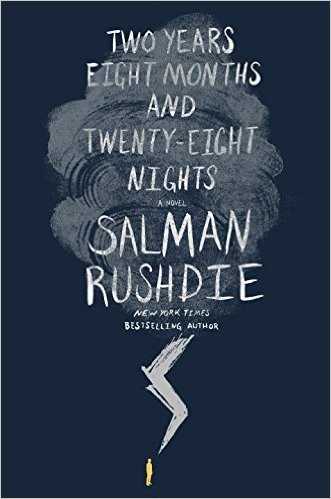
My pre-order has been in for weeks (at my local independent bookstore, of course.) Tomorrow I shall swoop down and scoop up my copy of Two Years Eight Months and Twenty-Eight Nights. It is Salman Rushdie’s first new novel in seven years. Everything else I’m currently reading will start gathering dust.
I encountered Rushdie in the same way many others did: I bought a copy of The Satanic Verses purely to show solidarity against censorship, after Iranian clerics ordered that Rushdie be murdered for the “blasphemy” it contained. It sat on my shelf unread for years. Once I finally read it, I began a reading marathon of everything he ever wrote.
How to explain his magic? Plot summaries wouldn’t do it, even if I could recall every twist and turn of the fantastic events that befall his characters…his myriad characters, his worldsful of characters, the armies of imagined people who march, parasang upon parasang, the length and breadth of the Rushdie universes.
The universes themselves are miracles. These are not alternate worlds like Middle Earth or Westeros. They contain, for example, the India we all know, the England, the United States. They also contain impossible events (two men survive a fall from a bombed plane miles in the air), strange powers (e.g., telepathy and witchcraft), eerie coincidences (an Indian songwriter anticipates all Elvis’s greatest hits.) Real-world politics, popular culture, “high” culture – usually taken down a peg – toss these very-not-ordinary people hither and yon. Some of them survive and even triumph, in a way. Others are ground to bits by the entirely ordinary evil and stupidity that permeate every human institution. But somehow, Rushdie’s Children defeat even defeat itself, simply by being more genuine – realer – than the real-world institutions that destroy them.
If I had to choose one characteristic that will keep me reading Rushdie till they bury me, it would be his perfect pitch for detail. Given his tortuous plots, many in the 500-600 page range, he must select just the right objects to bring the meaning of each scene into focus. Here is a passage that begins by evoking a real-world place in rather general terms, only to explode into the imaginary detail it calls forth from a character’s mind. From Fury:
“In Amsterdam in his middle twenties Malik Solanka – in the city to speak on religion and politics at a left-leaning institute funded by Fabergé money – visited the Rijksmuseum and was entranced by that great treasure-trove’s displays of meticulously period-furnished dollhouses, those unique descriptions of the interior life of Holland down the ages. They were open-fronted, as if bombs had knocked away their façades; or like little theatres, which he completed by being there….
“After a few visits, however, it became clear that mere houses would not be enough for him. His imaginary environments must be peopled. Without people there was no point. The Dutch dollhouses, for all their intricacy and beauty… finally made him think of the end of the world, some strange cataclysm in which property had remained undamaged…. After he had this idea, the place began to revolt him. He started imagining back rooms in the museum filled with giant heaps of the miniature dead: birds, animals, children, servants, actors, ladies, lords.”
And how about that “left-leaning institute funded by Fabergé money”?
So tomorrow I shall vanish from the world for some days, to read Rushdie and do nothing else. I hope my friends will speculate that something very odd may have happened to me. After all, I understand that in Two Years Eight Months and Twenty-Eight Nights, genies rise up from the sea bed in New York Harbor and eat the Staten Island ferry.
NUMBERS
9:07 AM,
09:07 Hours
9/5/2015
21st Century
Have you ever noticed how many numbers we use just to get through the day? I’m not a big fan of numbers, but when they’re used, as above, without requiring me to manipulate them in some way to prove a point, then I can deal. Those manipulation processes, which purport to figure out everything in the universe and then some, left me cold way back in elementary school.
Phone numbers, the remembrance of, especially when rattled off as though the person’s life depended on it, or, so the rattler can conclude that one is a person of little intellect when one can’t rattle them back, that’s another bete noir of mine.
Highway numbers. Oy vey. I’ve lived up here in the frozen north for over twenty years and still couldn’t tell you which state, New Hampshire or Vermont, has I-93, and which has I-91. I’ve driven them both many times, but I still have to say, ‘the one in New Hampshire’, or ‘the one in Vermont’, if I’m informing someone of my travel plans. In N.Y. we had the Grand Central Parkway and the Long Island Expressway. Names make so much more sense than numbers.
Yes, I concluded a long time ago that I had a real problem with numbers
So, last week I was asked to do a writing exercise. I had written a scene in 1st person. The exercise was to re-write it in 3rd person. I had to re-circuit that information to the language section of my brain and remember that 3rd person equaled he, she, it. Or maybe it doesn’t anymore, but that’s not my problem, my problem is with numbers, not genders. I find it hard to fathom that people can, with facility, transpose numbers and words at the drop of a hat. I had to immediately stop thinking 3rd person once I made the connection and only think of my character as a she, and not as an I. True, it wasn’t as hard as I’ve made it sound, I’ve learned to compensate for numerical deficiencies. I can ask to have the question repeated, I can cough, I can pretend I was thinking, in an attempt to gain the nano-second more time I need to process a spoken number and have the question re-routed.
Oliver Sacks, who passed away last week at the age of 82, was a neurologist, and a best-selling author. His research involved studying his patient’s disorders and learning how they coped with their conditions. Sacks wrote The Man Who Mistook His Wife for a Hat, an article which later appeared in a book of case histories with the same title. The man in question suffered from prosopagnosia, the inability to see facial features,a condition Sacks himself had.
Sacks’ condition didn’t stop him from writing, in fact it gave him the old grist for the mill. I see no reason to stop either, and any numbers I use in my stories will probably be the kind that appear at the bottoms of the pages.
1
A question for Siri
A few nights ago I attended a Willie Nelson and Family and Old Crow Medicine Show concert at Meadowbrook in Gilford, NH. (In case you were wondering why I was there, my friend’s husband backed out and I was asked to go in his place.)
Thousands of people applauded and cheered after each song. Some were inspired by their ingestion of alcohol and other substances but a genuine appreciation of the music permeated the air (along with a sweet odor). There is no disputing the fact that attending a concert is a social activity for many people, in addition to an opportunity to enjoy the music. The majority of the songs performed by Willie Nelson have been sung or played many times over the span of many years yet the attendees reacted as though he had dedicated the last five or more years of his life to creating and perfecting them and that he was performing them for the first time.
What if we authors got that same reception every time someone read a book we had written? Would we be motivated to spend even more time writing?
Different abilities and talents are required for singers and writers (unless the singers also write their own lyrics). Would I as an author be comfortable on stage under bright lights in front of thousands of people reading from my novels about Claire, Anne, or Olivia? Hell, no. I have a hard enough time sharing my writings with my writing group. Yet I couldn’t help being jealous of the accolades the performers received at the concert.
Reading is generally a solitary pastime. Any cheering and clapping is done in the privacy of your home. The author, therefore, receives limited direct feedback. So what drives a writer, especially one who has yet to be published, to keep producing? Maybe that is a question appropriate for Siri, along the lines of “what is the meaning of life?”
Speaking of Claire and her cohorts, I offer my sincerest apologies to them for being out of touch these past weeks. You have to believe me that they’ve been in my thoughts. I know what they’ve been doing and thinking and even planning to do. But I haven’t taken the time to record any of this. Everywhere I have been—the hotel in South Yarmouth, Massachusetts, the Cape Cod Inflatable Park, the swimming pool, the Mayflower Beach—I’m thinking of them, feeling their presence, the same as when I’m reading a book with a main character with whom I identify. I know she isn’t real yet it’s as though she is my companion.
Writing a book is like reading a book. The characters get under your skin, into your head.
Only it’s a million times harder.
Word Death
Eventually, the words get you.
You struggle with plots, with character development, with the godawful job of pulling it all together. And while you are wrestling with that angel, the words he is made of creep through your pores and invade your brain. They become the plaque that stops the neurons firing.
It happened to James Thurber. Much of his last two books, Lanterns and Lances and the posthumously published Credos and Curios,

My 1962 copy of Credos and Curios
were compendia of words that had dug their little claws into his mind and wouldn’t let go, long lists of words that had, perhaps, only sounds in common, or were all place names or first names beginning with O. He packed them up and disguised them as essays and stories, and his most devoted fans slogged their way through, but even they knew it was crazy.
Thurber had shown signs of the word disease much earlier. After “The Night the Bed Fell” and “The Night the Ghost Got In,” he wrote “More Alarms at Night.” In it, you hear the Siren song of verbal miscellany. One of the episodes recounted in “More Alarms” begins when the words won’t let Thurber sleep:
I had been trying all afternoon, in vain, to think of the name Perth Amboy. It seems now like a very simple name to recall and yet on the day in question I thought of every other town in the country, as well as such words and names and phrases as terra cotta, Walla-Walla, bill of lading, vice versa, hoity-toity, Pall Mall, Bodley Head, Schumann-Heink, etc., without even coming close to Perth Amboy…. I began to suspect that one might lose one’s mind over some such trivial mental tic as a futile search for terra firma Piggly Wiggly Gorgonzola Prester John Arc de Triomphe Holy Moses Lares and Penates….
When I read that for the first time, I nearly fell off the end of my mother’s bed, laughing. Mother, propped up at the head and reading herself to sleep, listened with a grin as I read it aloud, choking with laughter. But in Thurber’s later books, the humor had drained out, leaving only the words.
Thurber’s woes came back to me when I read Howard Elman’s Farewell, Ernest Hebert’s wonderful finale to the Darby Chronicles. In the first book of the Chronicles, The Dogs of March, Howard Elman is an illiterate adult, a man with a good eye and a wondering mind but few words with which to order his experience. His rural New Hampshire world is being invaded by the come-heres, wordy, untrustworthy flatlanders who end by taking not only Howard’s land but also his children into their insubstantial world of hot air and incomprehensible notions.
In the Farewell, Howard has learned to read, and death approaches. He is now up against the next generation of strangers, who are obsessed with ones and zeroes and with an ‘ecosystem’ apparently coterminous with, but different from, the New Hampshire forests he loves. They seem to have invaded, not from the flat lands, but from Mars. One of them is his son, who has changed his name.
In this milieu, words have begun to bother Howard. You accumulate them, they name new things that may or may not exist, and then when you put them up against each other, you can see that they don’t make sense. What do they mean, “the prime evil forest”? “Why does ‘purposes’ sound so much like ‘porpoises’?” Howard has begun talking to himself in a final attempt to ‘combobulate’ his world. “How to say it and make it make sense?”
Perhaps it’s a problem of scale. Thurber vanished into minutiae. From Howard Elman’s point of view, his son’s new friends operate in a world of vast, airy nothings. All their words are code words, but the code refers to nothing he can get a grip on. Behind the airy nothings he can see only more airy nothings.
For those of us less talented than James Thurber and Ernest Hebert, a focus on the words themselves just produces ‘darlings’ – abominable cutenesses and dreadfully, dreadfully clever repartée. Once these insinuate themselves into a first draft, the novice writer can find them impossible to dislodge, even knowing that the reader will find them impossible to stomach. When the words begin to preen themselves this way, when you feel the poison creeping into your writerly veins, what to do? Here is one suggestion: imagine this question from an innocent, eager child reader:
“But what happened next?”
Perennial Reading
PERENNIAL READING
Doesn’t everyone have a ‘to-be-read-again’ list of books that equal, or exceed, in length a list of books that still need to be read? Maybe it’s a written list, maybe it’s one held in your mind as a vague and various bunch of books that were exceptionally good reads. Maybe it’s a sub-liminal list from which books only spring to mind when triggered by a word, scent, sight, or even a song heard long ago while reading that book. Then you get that all-over, tingly, mystical frisson that sends a message to your brain saying, oh,yeah, I should read that again, soon. Maybe now. And somehow you manage to get hold of that book from off a dusty shelf, from your mother’s house, out of an unpacked box of books from your move twenty years ago. Or you just happen to see it in a yard sale for five cents. That’s kismet.
My to-be-read-again list is unwritten. I’m not sure what’s actually on that list, but I’m darn sure there is a list, and I think it’s the sub-liminal kind.
I looked up sub-liminal and discovered it’s equally acceptable spelled with or without the hyphen. That’s interesting. Another interesting thing is my discovery of WICTIONARY. I looked further and discovered that Wictionary is a Wiki-based Open Content dictionary. I kept looking and probing and maybe never would have gotten back on track with this post if I hadn’t glanced at the clock. I stopped in the middle of reading all about Beowulf Clusters. At this hour enough is enough. (Ten PM.)
Sub(-)liminal still means what I thought it meant, and then a little extra:“Below the threshold of conscious perceptions, especially if still able to produce a response.”!
Ok. I take those bold italics to mean that I might not get that frisson if the subliminal message to read a specific book:
a. is past it’s expiration date, meaning I’ve moved on past that book to bigger and better books, or;
b. I’ve actually just re-read that book and the message fell on a satiated sense, or;
c. the last time I re-read that book I hated it and the message fell on a repugnant sense.
I looked up repugnant in Wiktionary just to make sure that at ten:eighteen I was still conscious.
It’s from the Old French, (borrowed from the Latin, pugnare – to fight). Repugnant means, “to oppose, to fight against.” If I hated a book that much I suppose I would fight against it, no matter how many subliminal messages I received to the contrary.
I’d love to hear about lists that don’t wreak havoc on the sub_concious.
I’d love to hear what books are on those lists!
 Eleanor Ingbretson
 Karen Whalen
 llandrigan
 Heidi Wilson
 Mike M
 Thursday Night Writes