IS IT TOO EARLY FOR SPRING CLEANING?
IS IT TOO EARLY FOR SPRING CLEANING?
I cleaned out the bathroom closet yesterday, and after, kept opening the door to admire my handiwork. I told my husband and my son to check it out, both of them said it looked the same.
I cleared off my desk on the weekend. Now that was some task. No one could say it looked the same after I had hauled off a stuffed to the gills hefty trash bag of STUFF. But no one noticed. Sigh.
Usually I clear off my desk between stories. I think maybe I neglected to do that the last time or two, because this mess was the worst I’d ever seen. The boxes of Christmas cards only indicated that I was three months late. The chapters from my novel that I’d last worked on in October was another indication that I’d been remiss in tidying up. But, what about the open chessboard with sticky notes indicating strategic moves that I’d been using as reference. . .to a story I hadn’t touched in a year!
Things were in a bad way. My desk was my brain’s Portrait of Dorian Gray. I couldn’t think. Though seemingly calm and collected on the outside, my mind wasn’t able to move through the muck that surrounded me.
I got to work. I was brutal. Maybe I shouldn’t have tossed so liberally, maybe there was something vital in all those papers I burnt. Maybe. I’ll never know. They’re burnt, like bridges, behind me. But I second guess, and move on.
My desk is a ten foot counter top, on a balcony that overlooks my living room. I overlook the other way, at a short wall and the ceiling which slants up over my head. No window. Stuff tacked randomly in front of my face. It’s a place of work. It was, before the weekend, a piece of work, the ten feet narrowed down to two feet around my laptop. Now I can breath. I can move on from the short story that I will, today or tomorrow, send in to a contest, and go back to that novel of last October. Or something else. Who knows. I’m moving on. My brain, like my desk, is a now a tabula rasa. Some might agree with that in a literal way concerning my brain, but by chucking out all the crap from my desk, I’ve freed my mind up for the next great writing endeavor. Whatever that may happen to be.
It’s not too early for Spring cleaning.
More than one
Taunted by the books
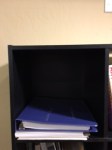
The royal blue three-ring binder taunts me from its secure spot on the bookshelf. Eighty-one completed pages of “Anne” with additional pages of notes, outlines, and prose tucked here and there. Hidden underneath are two manila folders. One holds “It Takes A Village Store,” 50,065 words of my 2014 NaNoWriMo submission. “Full Circle,” my 2015 submission, 50,212 words total, is ensconced in the other. The main characters of each novel are strong women from the same family, a mother, daughter, and niece/cousin. The setting is the same town for all three novels.
Originally I intended to have the novels comprise a trilogy but now I am reconsidering that. I feel that it makes more sense to combine them into one novel. How did I reach that conclusion? Good question. One issue is that none of the three are long enough in their current state to be a complete novel. Another problem is that they are extensions of each other, their plots and characters interwoven as only a family can be. I could solve the problems by expanding each of them, differentiating the plots so that they stand alone yet remain connected. Or I could stick with my decision to produce a single novel. Flip a coin?
 I have looked for novels with more than one main character, and diverse points of view (obviously), for inspiration. I am surprised that the last three random books I’ve read meet those criteria. (“The Valley of Amazement” by Amy Tan; “the speed of light” by Elizabeth Rosner; “Life After Life” by Jill McCorkle.) Each one has taken a different approach, probably none of which will work for me.
A long time ago I heard that first-time authors should stick to a straightforward, one main character, one point of view, story. I can see the wisdom in that advice. Yet I’m in a situation where that won’t work. Unless I write three separate novels. Can you hear my teeth gnashing?
No wonder the binder and the two folders that took up valuable space in my suitcase—at least two pairs of shorts worth–have sat untouched on the bookshelf for two months. (Of course, they also are on my laptop but a hard copy is easier to edit. You’ve got to pick it up to do that.)
My only writing goal for this winter in Arizona was to work on this project. Instead, I have devoted my writing time to my short story, “He’s All She Has” (originally titled “The Intruder”). The last revision of this story garnered the suggestion from John, our facilitator, that I put it aside and move onto something else. And I thought it was one revision away from being completed…I’ll try to put a positive spin on it–guess I’ll have time to work on my novel(s)!
Dubious Sanctities
The Celtic goddess Brigantia
Between bouts of work on my mystery novel, I tinker with a literary work. It’s so serious I can hardly shift it most of the time, but it does have lighter moments. Since it takes place in Ireland, those moments often involve saints.
Ireland favors saints who are hard to pin down, some of dubious origin. They tend to be knowledgeable about human wants and needs, and indulgent of them. I’m far from the final cut on which sanctities will be included. This makes a perfect excuse for “research” that takes me away from the grunt work. Today, I offer you a sampling of my favorites.
The Irish are all good Catholics, even the bad ones. This is possible because, after they had submitted to the church, they went higher up and cut their own deal. St. Patrick, having driven out all the snakes and converted or incinerated

St. Patrick defeats the pagan priests in argument before the High King at Tara
all the pagans, asked and received a boon from Christ: on Judgment Day, Christ will judge the living and the dead – except for the Irish. They will be judged by Patrick. In life, Patrick was not a forgiving sort, but for his own people….
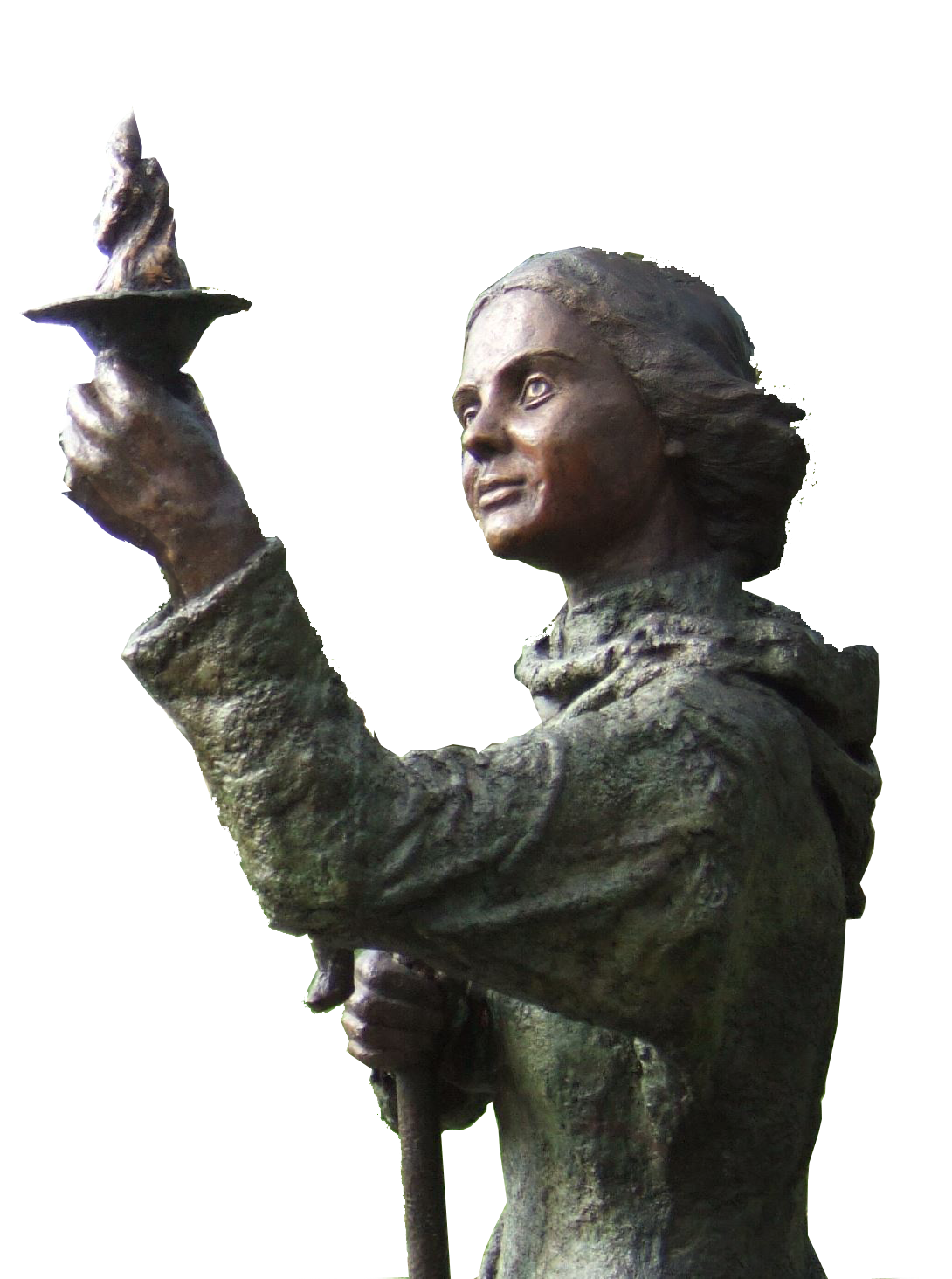
St. Brigid is sometimes called the “second most important Irish saint.” Patrick, being male and alleged founder of the faith in Ireland, is number one. Officially, the church doesn’t care for women in the top job. But Brigid is “the Mary of the Irish.” According to her legend, when she went to take the veil from Bishop Mel, the Holy Spirit caused him to read the form for ordaining a bishop over her.
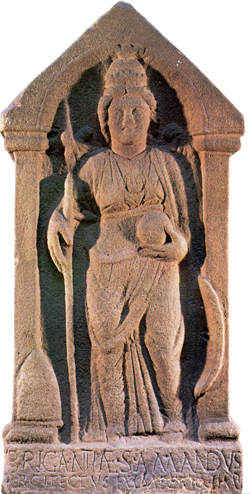
In fact, Brigid predates Patrick. She began her career of divinity as Brigantia, “the high one”, a Celtic goddess (seen in a Roman-era relief at the top of this post.) She is the saintly patron of blacksmiths, doctors and poets – metallurgy, medicine and poetry were the three magical arts of the pre-Christian Celts.
A modern, but orthodox, sculpture of St. Brigid
Her feast day, Feb. 1, is on the pagan festival of Imbolc. (Imbolc has since slipped by a day and been reduced to the yearly appearance of Punxatawny Phil the groundhog to foretell the spring.)
Brigid’s symbol, the cow, was the store of wealth and unit of account among the pagan tribes of Ireland, and her miracles include the sudden appearance of milk, butter and cheese in vast quantities, as well as beer, beer, beer. Irish priorities are clear: first the beer, and only then the loaves and fishes. On one occasion of drought, she converted her bathwater into beer, a very Irish conversion. She could also hang her cloak on a sunbeam.
St. Brendan the Navigator was an Irishman, and his tales are tall. He set sail in a curragh — a boat not much more than a cockleshell made of hides and waterproofed with fat. In it, he traveled west across the Atlantic for seven years to the “Promised Land of the Saints,” the “Land of Promise” or perhaps the Garden of Eden. Mind you, he only went because St. Barrid told him that he, Barrid, had already been there.

Brendan the Navigator with his towers of crystal
On the way, Brendan landed on a whale, saw floating crystals as high as the sky and was pelted by burning rocks from an island, so clearly he got as far as Iceland.
Brendan also encountered Judas, sitting drenched and miserable on a rock in the midst of the sea. Judas explained that this was his Sunday holiday; the rest of the week, he spent in Hell. The church insists that Brendan’s journeys were for the purpose of converting the heathen and founding abbeys. He is the patron of Clonfert Abbey, so that just shows.
I don’t plan to confine myself to Irish saints. The Irish venerate whatever saint can best deliver what is needed (for a certain value of ‘need,’ which includes beer.) My heroine will have recourse to St. Walter of Pontoise, a sad fellow from a place near Paris.

Sad St. Walter, after a chat with the Pope
Walter wanted only to be left alone in a monk’s cell to fast and pray, but the King of France appointed him abbot of the monastery. The poor man ran for it but was caught and brought back. This happened several times. Finally, the pope put his foot down and told Walter to stop complaining and do his job. Now, he is the patron saint of people whose jobs are getting to be too much for them.
Another favorite of mine: St. Ubald of Gubbio can be invoked against headaches, which I take to mean anything that makes a nuisance of itself without justifying immediate flight. If things get even worse, St. Ubald is said to have miraculously defeated an invading army and talked Frederick Barbarossa himself out of sacking the city of Gubbio. More: he is invoked contra omnes diabolicas nequitias – “against all diabolical depravity.” I presume I can involve my heroine in absolutely anything and get her out of trouble in the end.

St. Ubaldo’s incorruptible body in the basilica at Gubbio, beyond all woes
To speed you on your way, here is a prayer attributed to St. Brigid, as translated (perhaps loosely) and performed by the Irish singer Noirin Ni Riain on a recording with the Benedictine monks of Glenstal Abbey in County Limerick:
I’d like to give a lake of beer to God.
I’d love the Heavenly
Host to be tippling there
For all eternity.
I’d love the men of Heaven to live with me,
To dance and sing.
If they wanted, I’d put at their disposal
Vats of suffering.
White cups of love I’d give them,
With a heart and a half;
Sweet pitchers of mercy I’d offer
To every man.
I’d make Heaven a cheerful spot,
Because the happy heart is true.
I’d make the men contented for their own sake
I’d like Jesus to love me too.
I’d like the people of heaven to gather
From all the parishes around,
I’d give a special welcome to the women,
The three Marys of great renown.
I’d sit with the men, the women of God
There by the lake of beer
We’d be drinking good health forever
And every drop would be a prayer.
MAH JONGG, HEADACHES, AND TIME TRAVEL
MAH JONGG, HEADACHES AND TIME TRAVEL
Mah Jongg has nothing to do with writing, unless one writes a story about the game. It’s a lot of fun to play. Writing can be fun too, but I’ll get to why sometimes it isn’t in just a minute.
On Saturday I finished the fourth of four Mah Jongg classes at the Haverhill Library, the same library where that illustrious group, the Thursday Night Writes, meets each week to critique the heck out of one another. Criticism can be fun when you are on the dishing out end, but this past Thursday I was on the receiving end. It wasn’t too, too bad. If you can keep an open and disengaged mind the bad stuff can just float over your head while you write down the criticisms. It seems the major problem in my current story is getting the hang of time travel.
In the film Back to the Future, and in one of the Harry Potter stories, why can one person appear in a time and place both as the present existence of himself and as a future or past existence, yet I’m not allowed do it in my story? Is it such a big deal to stretch and break the bonds of believability? This is why writing sometimes is not fun, when one just can not grasp why one’s critique group cannot grasp the concept!
But, back to Mah Jongg. This was the first time I’ve taught the game to a group. And to a large group of ten, only one of whom had actually touched a Mah Jongg tile before, and yet no one threw anything at me. That, in itself, was both rewarding, and remarkable. It can be frustrating when you don’t know the game. Even when you do know the game. When you are just learning the rules sometimes you just can not grasp the concept of why the game is played that way. Grasping new concepts, slippery concepts like time travel and Mah Jongg, make your head hurt. Several times during the class on Saturday I heard someone say they had a headache.
Figuring out my time travel issue will probably give me a headache at some point this week. If anyone can give me a definitive explanation of time travel, in simple terms that a lay person can understand, I’d be most thankful.
THE END
THE END
For the past year I’ve been keeping a sort of journal. It’s not a journal about myself. Perish the thought someone would actually choose that to read out all the things I’ve written. Really. Perish.
This journal is about endings. How to wrap up a story in the best possible way, with the best possible choice of words, and the best finale to the great work one has just finished. In this journal I write down the title and author, and just a bit of the opening lines to jog my memory as to which book this is, because it’s been so long since I read it. Then I dart to the end, to the author’s nugget summation, the wrap-up, and I write down the closing paragraph, or maybe just a few sentences. Some authors take pages for their closing. Some, just a few words.
The March/April issue of Writer’s Digest has a great article all the way back on p.40, by Jacquelyn Mitchard. It’s entitled, “Goodbye to All That,” and it’s all about endings. Charles Dickens could take pages to finalize his novels. Charlotte Bronte took but four words at the end of Jane Eyre: “Reader, I married him.” Most everything else ever written lies somewhere betwixt the two.
One of Ms. Mitchard’s comments was about the late David Foster Wallace. DFW admitted that his masterwork, Infinite Jest, just simply “stopped” rather than truly ending. A post-millennial trend, he suggested.
Well, isn’t that just great. I want a book to end. I want to know when it ends, and I want a great ending.
I’ve mentioned Infinite Jest in a previous post. It has no plot, no real main character, no story arc, no cohesion even unto itself. And it’s 1,445 pages long! I knew what I was getting myself into when I began it, so it’s my own fault. I’m on page 400 something, and thank goodness the last 400-500 pages are footnotes, and I can pass on those. And, strange as it seems, I have enjoyed DFW’s style, if not subject matter. But now I find that there’s no way of even knowing when to stop reading! It’s a bit much, really.
Perhaps, if I’m lucky, DFW wrote those timeless words at the point where his story just stops:
THE END
Adios to the gun
Two Thursdays ago I submitted to my writing group for critique my short story “The Intruder” now renamed “He’s All She’s Got.” As usual, my submission generated a fair amount of “positive criticism.”
Our facilitator, John, pointed out that I had “not fully imagined from the inside” the main scene that involved the gun, the intruder, and the tying up to the newel post of my protagonist. I have since attempted to immerse myself deeper into this scene only to discover that I have imagined it to the fullest extent possible. I just can’t write any more realistically about guns and tying up people.
I’ve given my story a hard look–a VERY hard look–and decided to rewrite it with more of a focus on the relationship between the mother and her daughter. I think it best to say adios to the gun scene. What a relief. Eleanor, who has worked tirelessly on a gun scene for possibly years suggested an alternative to my opening scene that does not involve a gun and I’m going to give it a try. Naturally, this change will ripple throughout the story. It’s all for the good. I am better at writing about relationships than guns.
Once again I am thankful for the input from my writing group. Without their advice, I’d–well, I’d be a wannabe writer without any possibility of publication. With them, my odds are slightly better. When we concluded the discussion of my short story, I made a negative comment about it. Immediately, thousands of miles away, I heard “it’s a good story” and “I like your story.” That was enough encouragement for another go-round. Thanks, guys!
What I find of interest is that when I am working on one project, my short story in this instance, all sorts of ideas for my other current project, (my book, “Anne”) erupt unbidden. I do wonder if all other writers have this problem, or if it just belongs to us procrastinators, for whom it is a means of getting out of what we are supposed to be doing.
Last week I took a break from my writing group and writing as my mother, sister and  brother-in-law visited from New Hampshire. We relaxed by the pool at their resort, did a few tourist activities, and ate out, naturally. We were pleased we could reward them for their long flight with sunshine and some record-breaking temps in the 80’s. Too bad they had to return to temperatures that were nearly 100 degrees lower (with wind chill) than what they enjoyed here.
Now I will have time to write–the grandkids will be in school, Joy will be working, Steve will be golfing, and, oh, darn, the sun will be shining and temps will be even higher….
Bad Reads
“Leave me alone. I’m reading.” We’ve all said it, and we haven’t said it half as often as we wanted to. Give us a good book, and the world can stay on hold forever.
But how about, “Somebody get me out of this book! Where are the telemarketers when you need them?”
Why do we keep slogging through books we don’t want to read? We of all people, wordsmiths, people of literary judgment! (And in my case, old people. I don’t have decades to waste.)
Lately, I’ve been buzz-bombed by these loser books. The worst of them was called The Matter of the Gods, by Clifford Ando. It purports to be a history of religion in ancient Rome. In a former incarnation, I was a classicist, and mythology was my specialty. So I bought the d***** book. Imagine the ghastliest academese prose, wrenched and decorated to sound arch, while avoiding the dreadful faux pas of actually suggesting any conclusions. That’s MotG.
Why did I finish it? Because every couple of pages, he’d quote an ancient writer I’d never read or drop in a factoid on Roman ritual that was new to me. Drop a trail of M&Ms and I’ll follow you anywhere. It’s the kind of reinforcement that creates drug addicts.
Running in tandem with MotG was Antidote to Venom, by Freeman Wills Crofts. Crofts was one of the most popular mystery writers of the Golden Age, God knows why. I bought it because I’m working on a book that involves snake venom. Crofts’ golden rule seems to be that every thought, speech and action must be reported at least twice. Plans must be explained at length, and then carried out at equal length, in the same sequence. Plod. Plod. Plod. And to top it off, one of his villains has an alibi so unbreakable that Crofts has to give him a religious conversion at the end, to elicit a confession!
Why did I finish it? Sheer bloody-mindedness. Not to be able to finish a book in my own genre and of the period I most admire was too shaming. Also, it had just been reissued. So publishers thought it would sell, right? I should see why, right? I still don’t know.
Then there are the bestsellers everyone else has read. A few years ago, I read Haruki Murakami’s 1Q84. It was 944 pages of I-still-don’t-know-what. It had something to do with domestic violence; I figured that much out. It had an alternate universe in it, only it wasn’t all that alternate.
Why did I finish it? This one was almost justified. Murakami’s prose floated me along in a mental state just like that of his confused characters. This stuff was just happening. You couldn’t do anything about it, so you just did the next thing. Which was to read the next sentence. Still, 315 pages would have been enough.
Don’t even ask me about books written by friends.
So, what to do, assuming that you find you can’t just toss the book? Here are my strategies:
- Demote to bathroom. This worked, eventually, for The Matter of the Gods and Antidote to Venom. The time isn’t wasted, and page by page you get to the end. Please do not tear out completed pages and re-purpose them. That is cruel.
- Learn to skim. This used to be called speed reading. It doesn’t really work, but you can pretend it does, and if your eyes have traveled over every page, you are only half lying when you say you’ve read it.
- Arrange an unfortunate accident. This requires a degree of double-think, but what writer lacks that? Reading paperbacks in the bathtub is the easiest method. (Buy an oilier bubble bath.) Leave hardbacks on or near the recycle container. Forget them in waiting areas or on public transportation.
I’m about to start Chris Holm’s The Killing Kind. It’s about a hit man who only hits other hit men. I gobbled down three of his earlier books. I’ll have to find something else to read in the bathroom.
PRIMARY DAY
PRIMARY DAY
It was Primary Day for First In The Nation New Hampshire yesterday. The line-up of candidates on the ballots was extensive, to say the least. It reminded me of cereal aisles at grocery stores. So many brands to choose from, so many boxes, so many facadic advertising ploys reaching out into the aisles to grab at unsuspecting consumers. So much empty caloric sugar inside each box, and wheat that has been stripped of all it’s nutrients and replaced with refortified man-made ingredients. Tons of preservatives to make sure that the contents have a long shelf life, maybe as long as the shelf itself. And don’t forget that the cereal is boxed by weight, not by the contents which may have settled.
All sorts of shapes, flat, round, round with holes in them, chunky, colored pastelly or natural. A cereal for each and every member of the masses.
That’s what we had to choose from on Tuesday. A candidate for every palate. But very few that actually had any nutritional content.
I hate talking about politics, I get nowhere. I hate thinking about politics, but I did cast my vote.
Back in the seventies and eighties people discussed pre-,post-and a-millennialism. You got nowhere when you were sucked into one of those arguments. Now you get nowhere if you discuss global warming, aka climate change. Of course there’s climate change, there always has been, and always will be climate change.
As a matter of fact we have always had cereal, politics, and a knowledge that this world is not going to last forever though I’m not sure which actually came first. It’s probably a close tie. I think taxation fits in there nicely, too.
This following quiz might not be as much fun as Heidi’s quiz a few weeks ago, but what the heck. Go for it.
Arrange the items below in the order in which you think they happened/will happen in time. To keep this a writers blog I’ve thrown in some books.
Politics
The end of the world
The Bible
Cereal
Pride and prejudice (the sins)
Taxation
Jasper Fforde’s next Thursday Next in his series.
My cosy mystery
Pride and Prejudice (the book)
Climate change
The Love Song of J. Alfred Prufrock
Do let me know what you think.
Rediscoveries
I’ve always had an interest in rediscovering old mysteries. I love seeing how the stories are constructed and the characters fleshed out, and comparing the authors’ techniques to the contemporary writers I read. I love finding new (to me) words and phrasings—meaching, roistering. Most of all , though, I delight in finding the cultural and historical threads that connect my own time to the period of the old books—political jokes that haven’t changed, societal expectations that have.
My latest discovery is The Horizontal Man by Helen Eustis. Originally published in 1946, it has been republished in Sarah Weinman’s excellent two-volume collection of novels by women crime writers of the ’40s and ’50s. The Horizontal Man takes place at a fictional women’s college in the Berkshires, and in many ways echoes the cozy, village-set mysteries of Agatha Christie. Set in autumn, when the leaves have strayed from the trees, the small college town is exposed to Eustis’s crisp, satirical delineations. The murder of a handsome, sexually attractive English professor brings to the fore the neuroses, pretensions, snobbery, and jealousies that flourish in a quaint, academic environment. Helen Eustis, too, knew that environment well: She married her English professor when she was a student at Smith College.
Plus ça change . . . Eustis could be describing any English department functioning today. Her character studies, especially of the minds of the insecure professors grappling for position, are so spot on, you feel you’ve met these people before. She pokes a little fun at them, but they aren’t so overdrawn as to become caricatures. The Horizontal Man manages to be a smart mystery that expects its readers to be as smart as its characters.
What is out of date? Well, for one, the psycho-babble is risible now—but that was our understanding of the human mind at the time the novel was written. The unmarried professors live in boarding houses, the students’ dorms have house mothers. To me this is all part of the fun of discovering what the day-to-day life of a college community was like in the forties.
Helen Eustis was not a prolific writer. In fact, The Horizontal Man was her only novel, but it was critically acclaimed at the time and it won the Edgar Award for Best First Novel from the Mystery Writers of America. In addition to a collection of short stories, The Captain and the Kings Depart and Other Stories (1943), she wrote for the New Yorker and other periodicals and translated George Simenon into English.
Sarah Weinman in her anthology is saving Helen Eustis and the other women crime writers she included—Margaret Millar, Charlotte Armstrong, Elisabeth Sanxay Holding, to name a few—from drifting into obscurity. And their novels are worthy of our attention and study for their craft, their engaging suspense, and the way they weave in a woman’s perspective from an era on the cusp of revolutionary societal changes.
My (so-called) life as a writer
Technology is great (when it works, of course). For the past two Thursday nights I’ve been able to FaceTime with my writing group back in New Hampshire. I hope the second Thursday was an improvement for them–I used my iPad instead of my iPhone and they added speakers. The only problem on my end is that it’s harder to interrupt someone when you’re an image on a screen!
With the two hour time difference, I had no choice last Thursday but to eat my dinner while we had our discussion. I don’t imagine my slurping spaghetti noodles was a very appealing sight. That won’t be an option this week as I volunteered to submit. Tacky to eat and present at the same time.
Yikes. What was I thinking? I’ve been much too busy enjoying myself in sunny, warm Arizona (not so much today as we had a storm blow through last night–thank you, El Nino) to find time to write. And we’ve had visitors from New Hampshire. And the three grandkids passed a diluted version of their debilitating virus to me which kept me in bed part of this past weekend. And this coming weekend we have family from New Hampshire arriving.
And…that’s my life as a writer. Full of excuses as to why I haven’t written. But as I look through my two yellow pads of paper, I see pages of notes about both my story, “The Intruder,” and my book, “Anne.” But notes, in my book, don’t constitute writing. And as useful as they are to me, I can’t submit them to my writing group.
My notes on “Anne” pertain to combining my three related novels into one, not as easy a task as I originally anticipated. The process of writing my thoughts down on paper led me to the realization that I am starting the novel with Anne’s story and I need to conclude the novel with her story. My original plan was to end the novel with her daughter Olivia’s story. I suppose if I keep writing notes about the book I’ll come to a different conclusion.
I did have a motivational experience at, of all places, my grandson’s soccer tournament in Tucson. The opening ceremonies included the typical dais with a podium, microphone, and folding chairs. And a replica Olympic torch. Just the sight of the dais (sans the torch) transported me back to a scene in “Anne.”
Time to write (revise, finish) the damn book!
So heads up, writing group. If I get my act together, you’ll be reading a new (improved?) version of “The Intruder” this week. If I don’t, well…I’ll just have to blame it on technology.
 Eleanor Ingbretson
 Karen Whalen
 llandrigan
 Heidi Wilson
 Mike M
 Thursday Night Writes