A Pilgrim in the Family
I think I’m addicted to genealogy, specifically that of my family and now my husband’s family. I started researching my father’s family history in order to join the Daughters of the American Revolution (DAR). I already knew I had a Revolutionary War Minuteman for a fourth great-grandfather from a family history, which made completing the application for DAR membership less daunting than I anticipated. That done, I wanted to learn about his parents beyond their names and dates of death–were they born in Maine (which is where they lived when two of their sons ventured to Groton, VT)?; where are they buried?; where did their parents come from?;–the usual sort of questions you want answers to. But there isn’t much information on Ancestry.com, my main research site.
Not making much progress there, I moved on to the German side of my family. When I realized that I would need my German-speaking mother’s undivided attention for about six weeks to make any headway in that arena, I decided that my husband’s family might be easier to research. We already knew about the Civil War soldier who died at Andersonville Prison but we weren’t aware of the two Revolutionary War soldiers I unearthed.

“Mayflower Harbor” by William Halsall, 1882, Pilgrim Hall Museum, Plymouth, MA
Then–JACKPOT!! I am 99% certain that my husband is a lineal descendant of Governor William Bradford of Plymouth Colony who arrived in New England on the Mayflower. With a Pilgrim in the family, Thanksgiving will never be the same.
My own research brought me to this conclusion and when I ventured out to Wiki Tree, a free genealogy website, there it was, printed boldly on the bottom of my mother-in-law’s record: “Mayflower Descendant (Gov. William Bradford). I immediately sent a text to my three daughters: “SOMEBODY CALL ME! I am hyperventilating.” Soon I was talking to one daughter on my cell phone (left ear) with another daughter on the home phone (right ear). I’d say they were excited as well–but not as much as their mother was. And it’s not even my own family.

“King Henry VIII” by Hans Holbein the Younger, Walker Art Gallery, Liverpool, England
One of my granddaughters was not impressed by the Mayflower connection. Her comment: “I don’t care. I just want to know if I’m a princess.” Hmmm…I think we would know if that were the case but just for fun I went looking for a royal connection. I’m certain I violated all rules of genealogy research when I just clicked away on every link to every father of the next male in the line until I reached a dead end. It just happened to be on Sir Edward Rogers, born in 1498, who served as a courtier to Henry VIII. Yes, that Henry VIII. Sir Edward may not have been a prince but he did hang out with a king! What remains to be determined is if he is a relative.
Real genealogists take their research seriously. Which is what I should be doing with my writing. Is this new hobby of mine just another means of avoiding writing? (That’s a rhetorical and, by now, annoying question. So don’t answer it.) I’m stuck in the saggy middle of my murder mystery–the saggy middle of my outline of the novel, not the actual writing of it. My latest goal is to generate the same enthusiasm for writing this mystery that I have for researching dead ancestors. Wish me luck!
A Modest Enlightenment
“Stories about women’s enlightenment often feature damage to domestic equipment.”
I found this parenthetic remark by a modern Buddhist teacher in his commentary on the koan called A True Person of No Rank. The domestic equipment in question was a doughnut pan, whatever that is. Its newly enlightened owner rushed off to her Zen teacher to present her enlightenment, and later became a “famous teacher” herself.
I don’t know if writing is equivalent to enlightenment, but it seems to have the same effect on household efficiency. Most of the women writers I know, or whose blogs I read, complain about the pile-up of housework that occurs when they take large chunks of time to write. I notice that the more successful ones usually report ignoring the pile to do the writing. We amateurs use it as an excuse for why we didn’t write.
Both ways of dealing with dirty dishes exist, of course, but I think they miss the deeper relationship between scutwork of all kinds and writing. Scutwork is, by definition, menial and repetitive. Dish after dish into the dishwasher. Or in the office, memo after memo into the files. Sweep the floor again, just before they track more mud in.
In other words, it’s the maintenance of order. A lot of us are willing to admit doing trivial tasks to avoid facing the blank page in the typewriter. (Remember typewriters?) But why are those tasks preferable? Because doing them, we accomplish what, at the moment, we can’t accomplish with our writing. Mostly it isn’t the blank page that scares us off. It’s the roily-boily mess on the dozens or hundreds of already-filled pages that were supposed to be a book but look like a dog’s lunch. Rather than plunge into that abyss and be lost forever, we put a load of wash through.
So, the washing machine is churning. What now? Like the psychiatrist dealing with a phobia, we may inch just a little closer to the neurotic fear. The desk is in a state of chaos. Chapter outlines have fluttered to the floor, and sticky notes encroach on the keyboard. The character list has become a bookmark on which coffee-mug rings make the Olympic symbol. We straighten up the desk. In doing so, we will have to read at least some of each slip of paper, to find out which pile it belongs in. The names of characters and places fill our minds with detailed images and inch us toward our fictional world.
The next step may be the most dangerous. A lot of that paper should not have been put in the piles or the files; it should have gone into the wastebasket. The abortive outlines and mad, scribbled notes on every possible plot twist or additional detail that might conceivably, someday, end up in the final draft need to be out of your sight, if not burned to ashes. You are where you are. By all means, reread a little of the last chapter to get a good run-up to the current one. Just don’t start over. Planning and outlining were all very well in their time. Re-planning and re-re-planning are avoidance.
Your washing (or your doughnut pan) have done the trick, no smashing required. At this point, you scroll down to the blank space below your last word – and write. Feel free to make some doughnuts later.
Is Your Plot Line Screwed?
IS YOUR PLOT LINE SCREWED?
I just finished reading Richard Russo’s, Everybody’s Fool, which takes place in the present in a forty-eight hour time period. There are 447 pages in the book. That indicates a lot of detail crammed into those two days. My assignment was to unfold the the un-tangential secrets of his plot line.
I thought of a screw. Of course, why not.
Screws come in different sizes and types. Their job is to hold things together. A story is like a screw in that it has to hold itself together.
Screws are usually classified as Type A or Type B. A’s are coarse threaded screws; they have fewer threads per inch for holding together lighter materials. B’s are finer threaded screws with more threads per inch. They can hold together more and heavier materials.
Stand a screw on its head and imagine that the threads are the actual storytelling of a book which ascends in an orderly circular fashion along the core (or plot) of the screw (or story). You can tell at a glance if there will be a lot of description, or a little, if it’s coarse threaded or fine, if it is holding together a light weight book or a heavier tome.
Light writing, heavier writing; both are fine. They just need the right screws. They need to hold together and not have tangents that fly off the page.
Russo did a lot of plotting. Every character, even the dog, had his or her own plot line. The town and the physical terrain had plot lines. Maybe there was an instance or two of too much plot and the story line escaped and flew off the handle.You could feel it as you read. There the description, an added character, or a sub-plot line were impediments to the smooth turning of the screw. They were not firmly attached to the main core, they did not ascend in that even circular movement, with the rest of Russo’s neatly constructed plot lines, all the way to the denouement. They were irritating flanges on the threads that needed to be filed off. They were gluts of cream that escaped a centrifuge and slopped out of the book. A darling perhaps?
Everybody’s Fool is an example of a long screw with very fine threads; a tightly wound screw. I only used his, maybe only one, instance of unnecessary flange-ness, to point out that no book is perfect. For the most part Russo kept his character descriptions and plot and sub-plot lines in an orderly fashion, but not so orderly that it was boring, as they rounded and tightened the story. His writing drew the reader in, instead of flinging her out. The facets of the story were firmly attached to the core and to all the other characters even as they moved along and around each other and the story line.
I should be so meticulously careful in my writing!
I could add that all of Russo’s characters were screwed from the beginning, even the dog, as was the landscape, but for the main characters the ending was as redeeming as an ending should be.
Diagnosis: I’m suffering from TCTW Syndrome
I had forty-five minutes of free time Friday morning and thought that would make a nice block of time to focus on writing my blog post. There wasn’t anything else I could do. Except breathe. I even had ear plugs and headphones on. My eyes were shut and I had strict instructions to not move. What was left to do but think?
So think I did. But not about my writing. I thought about the three inches between my face and the “ceiling”. About holding my breath for what seemed like forever. About the noise coming out of the “casket” I was lying in. About the ball in my hand that I could squeeze and immediately would be rescued. From my MRI.
The diagnosis? I am suffering from Too Cranky To Write (TCTW) syndrome. The cure for this? I thought it was hot fudge sundaes and espresso coffee bean ice cream but alas that hasn’t worked.
On Saturday, just when I’d given up hope of ever writing again due to the TCTW delivering a fatal blow to my creative juices, we drove by the abandoned house where I’ve staged a murder in one of my abandoned novels. My mind rewound to this novel and almost instantly I conjured a new murderer and a new plot twist. (Now I want to abandon my current project and return to the old novel. I hate when that happens.)
I’ve driven by this house hundreds of times, taken photos of it for inspiration for the setting. Then how, after all these years of staring at the house, did I miss the red fire hydrant on the front lawn? Or even worse, the damn fire station right next door? I can’t have that. It would be hard to explain the house burning down with the fire department as a neighbor.
As best as I can figure, I’ve been so fixated on the house that I’ve not even noticed its surroundings. That happens in my writing as well. I become hyperfocused on one aspect of the plot and fail to see what else should be happening. Or what my characters who are waiting in the wings for their cues are doing.
What I find of interest is how this relates to Heidi’s most recent blog. The house is an actual character in the novel with a crucial role to play. Unfortunately, as occasionally happens to human characters, it has to be sacrificed for the benefit of another character.
And just like that, I’ve banished my TCTW syndrome. All it took was a moment with a mystery that’s been on the back burner (or in the wood stove pile) and I’m writing again. But I’m still a wee bit cranky….
Well, Whaddya Know.
2016 Short Story Award
The Bethlehem Writers Group, LLC (BWG), founded in 2006, is a community of mutually-supportive, fiction and nonfiction authors based in Bethlehem, Pennsylvania. The members are as different from each other as their stories, spanning a range of genres including: children’s, fantasy, humor, inspiration, literary, memoir, mystery, paranormal, romance, science fiction, women’s fiction, and young adult.
Congratulations to our
2016 Short Story Award Winner
First Place
ELEANOR INGBRETSON, PIKE, NEW HAMPSHIRE
“STICK TO THE BYPATHINGS”
This is true. I did win. I’m still in a bit of shock, but good shock.
My story is pure fiction; a fantasy about a little boy who may or may not have abilities far superior to the abilities of others around him. It all depends on your outlook.
Shakespeare, Job, and Voltaire, among others, were convinced that there is so much more, here, in this world, that transcends what we mere mortals can perceive, believe or imagine.
We have to look beyond what we can see, aim to have a wilder imagination and a broader faith. We need to access that so-much-ness, and sink into it with our writing teeth (should I mention that J. Ff. already has a lot of that on his plate?).
I do want to thank the members of my writing group, some of whom blog here with me: Mike, John, Linda, Mike, Karen and Heidi. They are, as Lewis Carroll might say, a much of a muchness. And who could ask for anything more from one’s critique partners? Without them I’m sure the sum total of my writing would still be my ubiquitous shopping lists. And if I never succeed again, they will still be a much of a muchness.
The Bethlehem Writers Group’s anthology, ONCE UPON A TIME: SWEET, FUNNY, AND STRANGE TALES FOR ALL AGES, will be coming out the end of October. Yes, I’m anxious to see it, but I’ll never mention this again, in this blog, lest my head begin to swell.
A Different Kind of Character

View through a ruined abbey
On the advice of Umberto Eco (in Reflections on The Name of the Rose), I’ve just decided to give more weight in my novel to its setting. Thinking it over, I realized that one way to do this is to include a new, non-human character: the plucky little newspaper that serves my fictional town of Oxbow, New Hampshire. I dredged from my files the clippings I’ve accumulated from our real local paper, the illustrious Valley News of Lebanon, NH, mainstay of the Upper Valley of the Connecticut River. The News is living proof that rural life provides all the opportunity you need to spread yourself out in life, to let anything happen. Up here, it eventually will.
Exhibit A, from the Valley News “Local Briefs” section:
NAKED PEDESTRIAN STROLLS THROUGH BURLINGTON [VERMONT]
A naked pedestrian strolling through Burlington this week has caused quite a stir.
The man was first spotted Tuesday walking through the city’s Church Street Marketplace completely nude, with exception of sneakers and a bandana on his head.
Bystanders say they were amazed to see him walk around the busy shopping and dining district.
Burlington Police Lt. Paul Glynn said that while the man’s nakedness is “inappropriate,” it’s not necessarily illegal as long as he left home naked and isn’t disrobing the public [sic] or harassing people.
The man turned down a request by WCAX-TV for an interview.

I love the first sentence. It could only have been written by an experienced small-town reporter. You can’t imagine it appearing in the New York Times. I like to picture the interviews of the bystanders: “How did you feel when you saw the man?” “Well, amazed, I guess. I was just amazed.” Reporter writes down, “Witness amazed.”
The typo is nice, too. And the sun protection of the bandana directs one’s thoughts to all the possibilities of sunburn.
Best of all are the scrupulous liberties of the People’s Republic of Vermont. (We Granite-staters don’t always see eye-to-eye with the Vermonters just across the river.) Vermont law says that you may not take your clothes off in public. But that’s all the law says. So…. What would constitute harassment in this case? Touching is out, obviously, but what about, “Look at this”? If you only said it once? Only once to each person? Panhandling in a non-harassing manner is allowed. If you didn’t even ask for cash, just for one moment of human attention before you moved on, who could object to that? He didn’t want to appear on TV, so it’s clear he isn’t an exhibitionist. Not in Vermont, anyway.
Local TV covered the story, too, if you’re feeling voyeur-ish.
Last February 5, “Local Briefs” reported a near-tragedy. Here are the essentials. (Unhappily, the Valley News website doesn’t include the paper’s archives, so I can’t send you to the original articles.)
Fire officials say a heat lamp used for chickens caused a fire that gutted a small barn. All of the chickens escaped unharmed.
These would not be generic chickens. Here in the Upper Valley, we like to buy our eggs from our neighbors, and we know the chickens almost as well as we do the neighbors’ dogs. Miss Bossy, for instance, is a Rhode Island Red who lives out in Orfordville. I heard about her from

Miss Bossy?
the lady at the feed store, who is her owner (though Miss B. might not agree about that.) Miss Bossy is the smallest of her tiny flock, which she rules with an iron claw. Her fellow Rhode Island Red is named Thelma. The two Buff Orpingtons don’t have names – I guess compared to Miss Bossy and Thelma, they’re such wimps they’re hardly there at all. You can see why, when fire threatens a barn up here, the Valley News knows what’s important. All the chickens got out.
The paper does a good job of selecting and condensing national and world news stories for its “World and Nation” page (two pages, max.) We get several serious items a day from the top news bureaus plus a small feature summing up lesser stories in a few sentences. Sometimes, on a slow news day, the editor favors us with oddities that just struck his fancy. E.g.:
Meerkat Expert Cleared of Assault in Zoo Love Triangle
London, AP. A former meerkat expert at London Zoo was cleared Tuesday of assaulting a monkey handler in a love spat over a llama-keeper….
Meerkat, marveling

Or, if your favorite sin is anger rather than lust:
West Palm Beach, FL. Joshua James, 24, is charged with aggravated assault with a deadly weapon …after throwing an alligator through a Wendy’s drive-thru window.
The point to notice about these stories is their datelines. London, West Palm Beach, what can you expect? If they weren’t already crazy, they’d live here. The news(wo)man’s inverse-square law states, “The farther from home, the weirder.” James got off with nothing worse than probation.
Local papers set the tone, but all our media report scrupulously on what matters to, or reliably annoys, people like us. War and pestilence were raging around the globe, as always, when the public radio station gave us this bulletin:
A tractor-trailer full of cheese caught fire on the interstate. The driver escaped, and was able to detach the truck from the trailer, but the trailer and its contents were destroyed.
Use all the senses, the writing mavens tell us. Think how grounded, how riveted, your reader would be if you could convey to her the sight and smell of 17 tons of smashed and smoking cheese! Consider the plight of the cars immediately following. The report didn’t say, but if it was Velveeta, it would qualify for HazMat treatment. And if, like me, you write mysteries, who set that fire?
Confession: I murdered someone
I have to confess–I did it. I murdered someone. It was a first time for me but probably not the last. I’ve been advised to say no more.
My sister-in-law (also an aspiring writer yet definitely not someone you associate with murder) here visiting from Florida by way of Pennsylvania was a most eager accomplice. While snapping green beans and sipping wine, we planned the murder. Over dinner, she would interrupt the flow of conversation with “what if…”. Certainly not appropriate conversation for a dinner party but totally acceptable among family members.
You’ve no doubt figured out that I am writing a murder mystery and the person I killed is a fictional character in the novel, whose identity I am not at liberty to reveal.
The outline for this murder mystery is supposed to be my submission for this week’s writing group. I’ve been working on it what feels like every free minute I have (which haven’t been many lately). The outline has been inching and crawling toward the murder; at times I have felt as though I am writing away from the murder instead of toward it.
Thus the decision to jump right to the outline of the murder and skip the remainder of the forty-nine unwritten pages leading up to it. (Murders should happen by page fifty, I am told.) I am certain John, our fearless leader, has instructed me or someone else in the group (we all start to blend together after nearly seven years) to do just that. I am beginning to see the logic in it. Now that I have the murder, or at least the first version of the murder, committed to paper, I can return to the beginning and force the actions of the characters to keep the reader guessing who the murderer is. Reminds me of solving quadratic equations. Creatively.
Genre smorgasbord
How do I even dare to refer to myself as a writer when I am still figuring out what genre is calling my name? Six years ago I started in my writing group assuming that I’d write contemporary fiction, or chick lit as the worst case scenario, and when I got really good I’d advance to literary fiction. I needed a writing project so I took the easiest route and continued where I had started over twenty years earlier with my novel, “Anne” (genre to be determined). I was able to produce about 140 pages of a draft so rough you could rip the skin off your fingers just turning the pages.
After reading and critiquing the murder mysteries/cozies created by fellow group members, I decided to write murder mysteries, of which I have accumulated a number of first drafts, partial drafts, and rough outlines. I’m beginning to wonder if I haven’t just fallen under the influence of those members who love to write murder mysteries/cozies and are pretty darn good at it. They get excited over how much of a drug it will take to kill a character and whether his weight and how much he just ate should be manipulated to make it work within the allotted time frame.
Am I that same writer? It’s not looking that way.
What my characters are thinking about is more to my liking. My approach in real life (there is such a thing and it’s always getting in the way of my writing time) is to analyze why people around me do what they do. Or don’t do. Psychological thrillers, maybe?
This week at the first writing group meeting I attended in weeks I floated the idea of writing historical fiction. It’s the genre I currently gravitate to for reading pleasure, particularly World War II and the Revolutionary War novels. (I did mention in an earlier post that I was Betsy Ross in a previous life, right?) I already have a setting for my first attempt at this genre!
Historical fiction requires research and getting the details correct while you’re making up some of the characters, dialogue, and events. Epiphany: that’s control. And I like being in control. Duh. That’s what writing fiction is all about: creating and manipulating characters and action any way your heart desires. And any fiction genre lets you do that. Except with historical fiction you take control of events that have actually taken place. That’s power.
Meanwhile, I’ve committed to submitting an outline of the murder mystery I’ve started recently, “Patsy’s Posse”. Why? To prove I can complete an outline. To give a murder mystery one more try before I move on. (To what?) Also, I’m attending the New England Crime Bake 2016 in November so I might as well hang in there with murder mysteries until then. I signed up for the Agent & Editor roundtable and I need to produce a decent first page of a manuscript. Let’s hope I can get that far in three months.
Nobody Reading Your Blog? What You Need Is a Monkey-centaur.
It’s hard enough to claw back time from the demands of life and fiction writing to write a blog post. Why, then, double the time with a search through Google images to illustrate my points? Because that’s where so much of the fun lies. Visual puns, quirky interpretations or just the weirdities that pop up on the web can add a zing that keeps the casual reader going. So today, in fraternal and sororal solidarity, I offer up one of my best sources of free images.
The British Library’s Medieval and Earlier Manuscripts blog reproduces illuminations from the manuscripts in their collection. When I contacted them, they said I might reproduce the images in my blog as long as I credited the Library and gave their citation to the manuscript. Hence this monkey-centaur, with which I illustrated the concept of an evil deed.

Monkey sawing books
(Courtesy British Library, Add. 49622, f.146)
What could be worse than sawing a book in half? Who but a monster would do it?
The blog itself is a welcome break from the slog through my inbox. Every few days one of the BL’s experts discourses on a gorgeously illustrated manuscript, on several manuscripts on a single theme, on a type of illustration (the marginalia are the

Detail of a marginal scene of a fox seizing a duck, with ‘sound effects’ added in a later hand, reading ‘queck’. (Courtesy British Library, Add MS 49622, f. 190v)
most fun) or on whatever else strikes their fancy. The Library is digitizing its collections as fast as ever it can, and newly digitized manuscripts are frequent subjects of the blog. An international cadre of enthusiasts seem to spend their time crawling through the collection online, and sometimes they find delights that the staff haven’t had time to appreciate. This hapless duck was tweeted out by one Erik Kwakkel of Leiden, who got credit in the BL’s caption. He must have been researching his genealogy.
Medieval monks laboring in the scriptorium frequently found their minds directed to the world, the flesh and the devil. Sometimes these showed up in decorous and improving forms. Sometimes not.
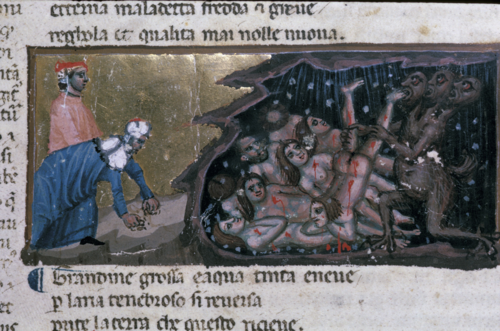
Cerberus (strangely human) feasts on the gluttons condemned to Hell (Courtesy British Library MS Egerton 943, f. 12r)
Here we have the punishment of gluttony from a manuscript of Dante’s Inferno. In classical mythology Cerberus was a three-headed dog who guarded the gates of Hades; here he is a three-headed devil who eats those who eat too much. Be warned.

Nun rebuking a lecherous grotesque. (Courtesy British Library Add. ms 49672 f098v)
Progress has made prudes of us. Here we have a nun wagging a monitory finger at a grotesque who is clearly attacking her. According to the BL manuscripts blog, later owners of such manuscripts often defaced scandalous images in the margins as disrespectful to the pious subject matter.
And here is the editorial comment of some envious monastic on the lovers in the main image:
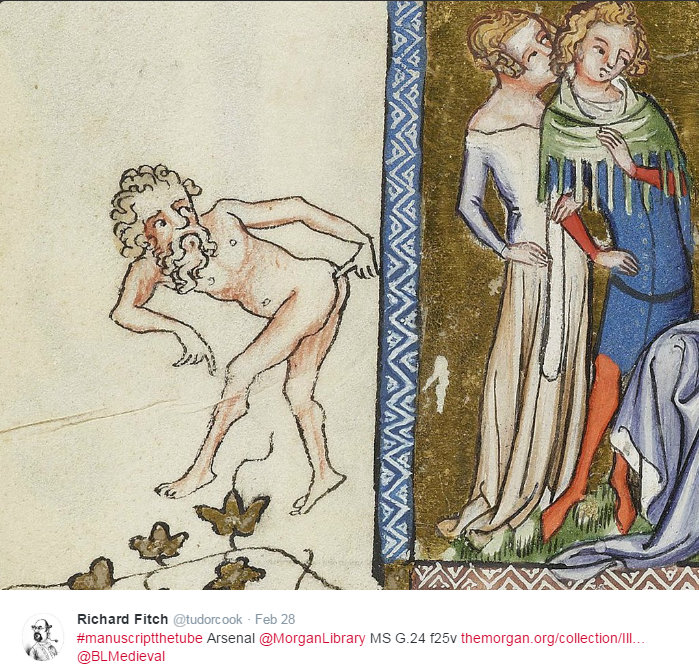
A monk’s envy expresses itself. The BL bloggers passed this on from the Morgan Library’s collection, MS G 24, f. 25v.
Readers of the blog get to play with the toys, too. Contests are held for the best caption for various images. The one just above was submitted in a contest to find images illustrating the names of London subway stops. That one was for “Arsenal.”
If you’d like some sympathy in your writing woes, check out The Burden of Writing: Scribes in Medieval Manuscripts.
Every April 1, a spoof post appears. In one, the digital whizzes at the British Library had introduced flying saucers into the illuminations. Another announced the discovery of an ancient cookbook with recipes for unicorn.
I know you get too much email already, but I really recommend following this blog. You’ll find images you can use, and you’ll enjoy yourself, too.
METAMORPHOSIS
In Memoriam: The Pike Library Association
Small town libraries are closing. Even after cutting hours because of lack of funds some still can’t find a way to stay open. A few people complain, but the fact is that so many more people couldn’t care less if one of the pillars of society fails.
But it’s not the fault of the libraries. They aren’t the failures. Society is failing. Demographics are changing and interests are devolving.
Not to get into it too deeply, but if you are aware that your small local library has closed, you’re probably not the problem. The problem is that, seemingly, the majority of the population doesn’t read anymore
My own little, tiny, library in Pike, New Hampshire (a little, tiny town), that I’d been proud to be on the board of for more than twenty years, has just closed its doors. It did get by on the donation the town made to it, and to the three other libraries in Haverhill, NH, but just barely. It kept up-to-date books that its dwindling number of patrons liked to read, it had the best collection of children’s classics in town, and it was friendly. But it was doomed.
One hundred years ago Pike was a bustling, small town. Its whetstone factory was the largest in the world, producing sharpening stones for all sorts of purposes. The sharpening stone that my father, an engraver, used way back when, was probably a Pike sharpening stone.
Newspaper articles from the turn of the (previous) century said that the whetstone company employed over 100 people in downtown Pike, and more outside of town. Another article described Pike as:
“a little village of more than 500 inhabitants. There is a fine department store, whetstone mill, sawmill, box factory, wheelwright and blacksmith shop, grist mill, hotel, livery stable, a good hall and schoolhouse. The village has long distance telephone, telegraph, and six (!!!) mails a day.”
Pike had everything a small town should have, and then, just to put the icing on the cake, it got a library.
Over the years, things happened to this former bustling village. Artificial abrasives were invented which changed the course of the whetstone factory. Less customers meant unemployment for its workers, which led to an exodus of the former employees and their families. Schools closed. The auxilary mills folded or moved away. Obviously there was no need for a livery stable or blacksmith any more, and those workers and their families moved on.
Yesterday, literally, all that was left of the town proper were the library, the post office, and the ruins of the whetstone factory. Today it’s just the post office, the ruins and an empty building.
The Pike library starved to death. Or maybe, like Gregor Samsa in Franz Kafka’s, The Metamorphosis, it died of a broken heart. Take your pick, both are equally miserable endings.
Kafka’s, The Metamorphosis, can be found at most libraries.
(my thanks to Robert Fillion and his publication ‘Early Pike and Whetstone Works,’ 1994, Woodsville, NH, for the excerpts of newspaper articles, circa 1900.)
 Eleanor Ingbretson
 Karen Whalen
 llandrigan
 Heidi Wilson
 Mike M
 Thursday Night Writes