Category Archives: writing
It Has to be Good, Not Perfect
The sun pours down on my life today. Actually, a thunderstorm is approaching, but to me, all is light and life. I gave a talk yesterday to a foreign affairs discussion group I belong to. Today, therefore, I no longer have to give a talk to the foreign affairs discussion group!
Speaking in public is not a problem for me. It’s the fear of making a mistake that wrecks my life. The search for correctness on every last tiny point ate up last week like the Tazmanian Devil pouncing on its prey. I had a good grasp on my material. But what if that date (2005) should actually be 2004? Google it. It was 2005. What if…? Google it. I spent more time in Google than in Word.
Because I spent the week obsessing, I printed my handouts at the last minute. My printer broke down. I switched to my husband’s printer, got one file completed, and the printer suddenly began taking its orders from Mars. Half a ream of paper was wasted before I finished the task. My office looked as if Dirty Harry had ransacked it.
No time for a shower before leaving. I plastered my hair down with a comb so severely that no one could doubt I intended it to look that way, for some unfathomable reason. Since I know where all the local speed traps are, I walked into the meeting room right on time, wearing an easy expression of ‘no sweat!’ Which made me think of the missed shower again.
And it all went fine. It almost always does. And so what if I had made a mistake or two? The world would not have ended. I would not have been damned for all eternity.
You wouldn’t think that writing fiction would be as susceptible to the search for perfect truth as reportage. You’re supposed to make fiction up. The writer is responsible for all the truth in the fiction. Unhappily, s/he gets none of the feedback offered by the real world when truths collide. In life, a brook simply will not run uphill. In your book, it can run one way in Chapter 3 and the other in Chapter 11. Until some kind or not-so-kind reader points that out.
The perfection trap doesn’t confine itself to fictional facts. When every flaw catches your eye equally, whether it’s a poor word choice or a gaping plot hole, progress can be agonizingly slow. I’ve managed to bring forth a first draft. I’ve rewritten, rewritten the rewrites and … you finish the sentence, assuming it ever ends. A draft that really needs only a clean-up is still miles over the horizon.
Perhaps it’s a trick of focal distance. The present plan is to focus on plot, plot, plot and never mind the rest. And we all know how to find out whether that’s a good idea. 1) Apply rear end to chair. 2) Write.
When you know you’ve made it as a writer
You know you’ve made it as a writer when your career is the subject of one of the questions on the Buzztime Trivia game at Buffalo Wild Wings. We were “dining out” with our oldest grandson at B-Wild at Chandler Fashion Center when I glanced up at the huge screen on the wall connected to the tablet at our table and read a question I could actually answer. In other words, it wasn’t sports related.
The question was, per my recollection, “who writes about the nightmarish side of society?” I’m unsure who the other choices were but I knew immediately that Joyce Carol Oates was the answer. She may not be everyone’s cup of tea but I happen to love her books, as depressing as they tend to be. Wonder what that says about my psychological makeup?
I was fortunate to hear Oates read from her novel “The Accursed” at the Canaan, NH, Meetinghouse Readings on July 11, 2013. (Was it really almost three years ago?)
Anyone living within an hour’s drive, or more, of Canaan, NH, please plan to attend the readings at least once. The Meetinghouse, built in 1793, is worth the trip alone. I don’t know how the moderator convinces such acclaimed authors to make the trek to Canaan but you are certain to find at least one each summer that has you sitting on the edge of your bench, pinching yourself to check that you haven’t ventured into an alternate universe.
If I had to choose between being a question on the Buzztime Trivia game and reading from one of my novels at The Meetinghouse, without a doubt I would choose the latter. On second thought, I’d prefer to follow in Oates’ footsteps and do both.
Why don’t I write?
Today’s post on the Maine Crime Writers blog by Bruce Robert Coffin about why he writes resonated with me, as do many of their posts. Beyond the writing connection, it may be because I spent my “formative” years (ages 4 to 14) living in Bangor.
Funny how my reasons for not writing when I should be writing mirror Coffin’s reasons for writing…
He writes to quiet those voices he hears in the middle of the night. When I can’t sleep, I think about my characters and what they are up to and–just as when I was hypnotized on a stage in front of hundreds of people–before I know it I’m sound asleep. No need to keep pen and paper on my nightstand. (I do but, as you may recall, I can’t read what I’ve written so I use it for grocery lists.)
Coffin apparently has some demanding, strong-willed characters in his stories who have no qualms about disagreeing with his plans for them. My characters, on the other hand, hang around as they lean against the walls, hands in their pockets, and wait for direction from me. Don’t they realize how much work they make for me with their lack of gumption and rebelliousness? Give me a protagonist who has a mind of her own and flaunts (my) authority and I’ll step back and let her take charge.
I don’t know where he gets some of his characters, either. Apparently his Sergeant Byron takes Coffin for rides in his car on his way to catch the bad guy. Instead of the other way around. As none of my characters have drivers’ licenses they expect me to drive them wherever they need to go. I just don’t have time for that. Maybe carpooling is the answer?
One thing we do have in common is that he doesn’t appear to prepare in-depth outlines. (And why should he? His characters run the show.) I’m a proud pantser and I surmise that Coffin is as well, based upon his comment that the enjoyment he derives from writing is not knowing what is going to happen in his stories.
Unfortunately for me, a newbie cozy/murder mystery writer, demands are being made of me that I may not be able to meet. After submitting my rough plot summary and character description for a new cozy to my writing group last night I’ve been asked to write the murder scene. Before I write anything else. The audacity! That I should know “who done it” before, well, before I know anything else. Apparently the writer, unlike the reader, should know this prior to investing time and energy into writing the actual book. Sigh. Big sigh. How do I reconcile this with my badge of honor as a pantser? I suppose it could be to ensure that the reader will want to invest time and energy into reading my book…
W? Or Not?

Would-be writers can always be lured into taking just one more how-to-write course, buying just one more book, attending just one more conference. Flailing and weeping in the chaos of our own material, we’re sure that someone out there has a system. No, has The System that, with one hard shake, will order our characters, themes and events into a page-turning plot.
I lost a lot of time trying to cram my plot into the shape recommended by 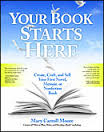 Mary Carroll Moore’s Your Book Starts Here. Her system is to shape your plot like the letter W. Your protagonist encounters loss or danger, plunges to the depths, pulls herself together and addresses her problem with some success – we’re now at the peak of the first upstroke of the W – then gets really whacked by some failure or complication, descends to the uttermost depths, and finally wrestles her way back to whatever fate you have in store for her.
The W method is good for making a start, and also for combatting saggy-middle syndrome. In the end, though, you have to compound your own prescription. So today, I offer a few alternative plot shapes, as discussed by Kurt Vonnegut on the Washington Post’s “Wonkblog.” In a hilarious (truly!) video Vonnegut explains how simple it all is, really.
Plot 1 is “Man in Hole.” The hero starts in a reasonably comfortable condition, encounters a problem, solves it and ends up better off. Vonnegut graphs this  from beginning to end as a nice even sine wave on a happy-unhappy vertical axis. Events head down into negative territory, reverse course at the bottom, and end up even higher on the happy scale than they started. Wonkblog’s example: Arsenic and Old Lace. Note that Mary Carroll Moore’s W could be titled “Man in Two Holes.”
Plot 2 is “Boy Meets Girl,” in which the initial events head upward on the graph, i.e., boy falls in love. From there on, Plot 2 replicates Plot 1, as the lovers are separated, then reunited. Traditionally, “Boy Meets Girl” ends higher on the vertical scale than “Man in Hole,”since (as we all know) they lived happily ever after.
Now we get into the kind of plot I like best: Cinderella. No, not for the happy ending. By me, that prince is a Ken doll. According to Vonnegut (and strangely
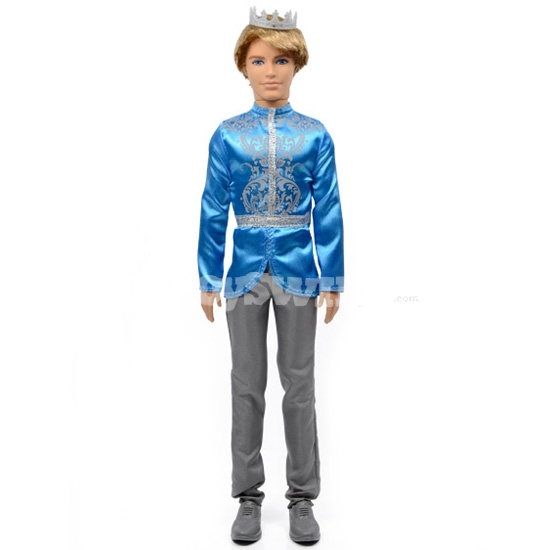
The Ken Prince from, I kid you not, “toyswill.com”
mis-graphed in the Post article), “Cinderella” is distinguished by its beginning – among the cinders, way, way below the middle of the happy-unhappy axis. Then (and this is what I love), progress toward the Prince’s ball takes place not in a smooth curve, but in a series of stair-steps. The gown. The glass slippers. The pumpkin coach. The mouse-horses. These lovely items are provided by Cinderella’s fairy godmother, but in more interesting stories, each has its own provenance, sometimes but not always obtained by the heroine’s own efforts.

Broccoli’s fractal form, an instance of the Fibonacci sequence
It’s the detail that grabs me. The plot takes on the shape of a Fibonacci sequence. Every step can replicate into a handful of details or issues, which in turn can replicate. This is why I like Proust. (Trouble is, I haven’t yet been able to work out what the heck his stair-steps are leading to.)
The stair-steps also occur in the folkloric creation story, in which a deity or deities generate successive gifts which, combined, produce the world. My favorite literary example is Elizabeth von Arnim’s Elizabeth and Her German Garden, but of course Genesis I is better known. According to Vonnegut, the Old Testament is simply the creation story with an unhappy ending tacked on: God makes the world, we live in it, we die. With the addition of the New Testament, we are back to Cinderella.
Vonnegut does not ignore modern literature. There’s “From Bad to Worse,” in which some poor schlemiel simply gets hammered, and that’s it. Wonkblog’s example: The Metamorphosis. And then there’s “Which Way is Up?”, exemplified by that most modern of stories, “Hamlet.”
You can noodle around with these curves forever, and come up with a story to match anything you can draw . At present, I have no idea what shape my own story (fictional, that is) will take. I got troubles, I got worries, I got stair steps, nobody gets a girl … who could ask for anything more?
More than one

Taunted by the books
The royal blue three-ring binder taunts me from its secure spot on the bookshelf. Eighty-one completed pages of “Anne” with additional pages of notes, outlines, and prose tucked here and there. Hidden underneath are two manila folders. One holds “It Takes A Village Store,” 50,065 words of my 2014 NaNoWriMo submission. “Full Circle,” my 2015 submission, 50,212 words total, is ensconced in the other. The main characters of each novel are strong women from the same family, a mother, daughter, and niece/cousin. The setting is the same town for all three novels.
Originally I intended to have the novels comprise a trilogy but now I am reconsidering that. I feel that it makes more sense to combine them into one novel. How did I reach that conclusion? Good question. One issue is that none of the three are long enough in their current state to be a complete novel. Another problem is that they are extensions of each other, their plots and characters interwoven as only a family can be. I could solve the problems by expanding each of them, differentiating the plots so that they stand alone yet remain connected. Or I could stick with my decision to produce a single novel. Flip a coin?
 I have looked for novels with more than one main character, and diverse points of view (obviously), for inspiration. I am surprised that the last three random books I’ve read meet those criteria. (“The Valley of Amazement” by Amy Tan; “the speed of light” by Elizabeth Rosner; “Life After Life” by Jill McCorkle.) Each one has taken a different approach, probably none of which will work for me.
A long time ago I heard that first-time authors should stick to a straightforward, one main character, one point of view, story. I can see the wisdom in that advice. Yet I’m in a situation where that won’t work. Unless I write three separate novels. Can you hear my teeth gnashing?
No wonder the binder and the two folders that took up valuable space in my suitcase—at least two pairs of shorts worth–have sat untouched on the bookshelf for two months. (Of course, they also are on my laptop but a hard copy is easier to edit. You’ve got to pick it up to do that.)
My only writing goal for this winter in Arizona was to work on this project. Instead, I have devoted my writing time to my short story, “He’s All She Has” (originally titled “The Intruder”). The last revision of this story garnered the suggestion from John, our facilitator, that I put it aside and move onto something else. And I thought it was one revision away from being completed…I’ll try to put a positive spin on it–guess I’ll have time to work on my novel(s)!
Dubious Sanctities
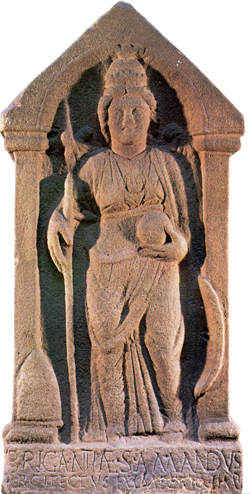
The Celtic goddess Brigantia
Between bouts of work on my mystery novel, I tinker with a literary work. It’s so serious I can hardly shift it most of the time, but it does have lighter moments. Since it takes place in Ireland, those moments often involve saints.
Ireland favors saints who are hard to pin down, some of dubious origin. They tend to be knowledgeable about human wants and needs, and indulgent of them. I’m far from the final cut on which sanctities will be included. This makes a perfect excuse for “research” that takes me away from the grunt work. Today, I offer you a sampling of my favorites.
The Irish are all good Catholics, even the bad ones. This is possible because, after they had submitted to the church, they went higher up and cut their own deal. St. Patrick, having driven out all the snakes and converted or incinerated

St. Patrick defeats the pagan priests in argument before the High King at Tara
all the pagans, asked and received a boon from Christ: on Judgment Day, Christ will judge the living and the dead – except for the Irish. They will be judged by Patrick. In life, Patrick was not a forgiving sort, but for his own people….
St. Brigid is sometimes called the “second most important Irish saint.” Patrick, being male and alleged founder of the faith in Ireland, is number one. Officially, the church doesn’t care for women in the top job. But Brigid is “the Mary of the Irish.” According to her legend, when she went to take the veil from Bishop Mel, the Holy Spirit caused him to read the form for ordaining a bishop over her.
In fact, Brigid predates Patrick. She began her career of divinity as Brigantia, “the high one”, a Celtic goddess (seen in a Roman-era relief at the top of this post.) She is the saintly patron of blacksmiths, doctors and poets – metallurgy, medicine and poetry were the three magical arts of the pre-Christian Celts.
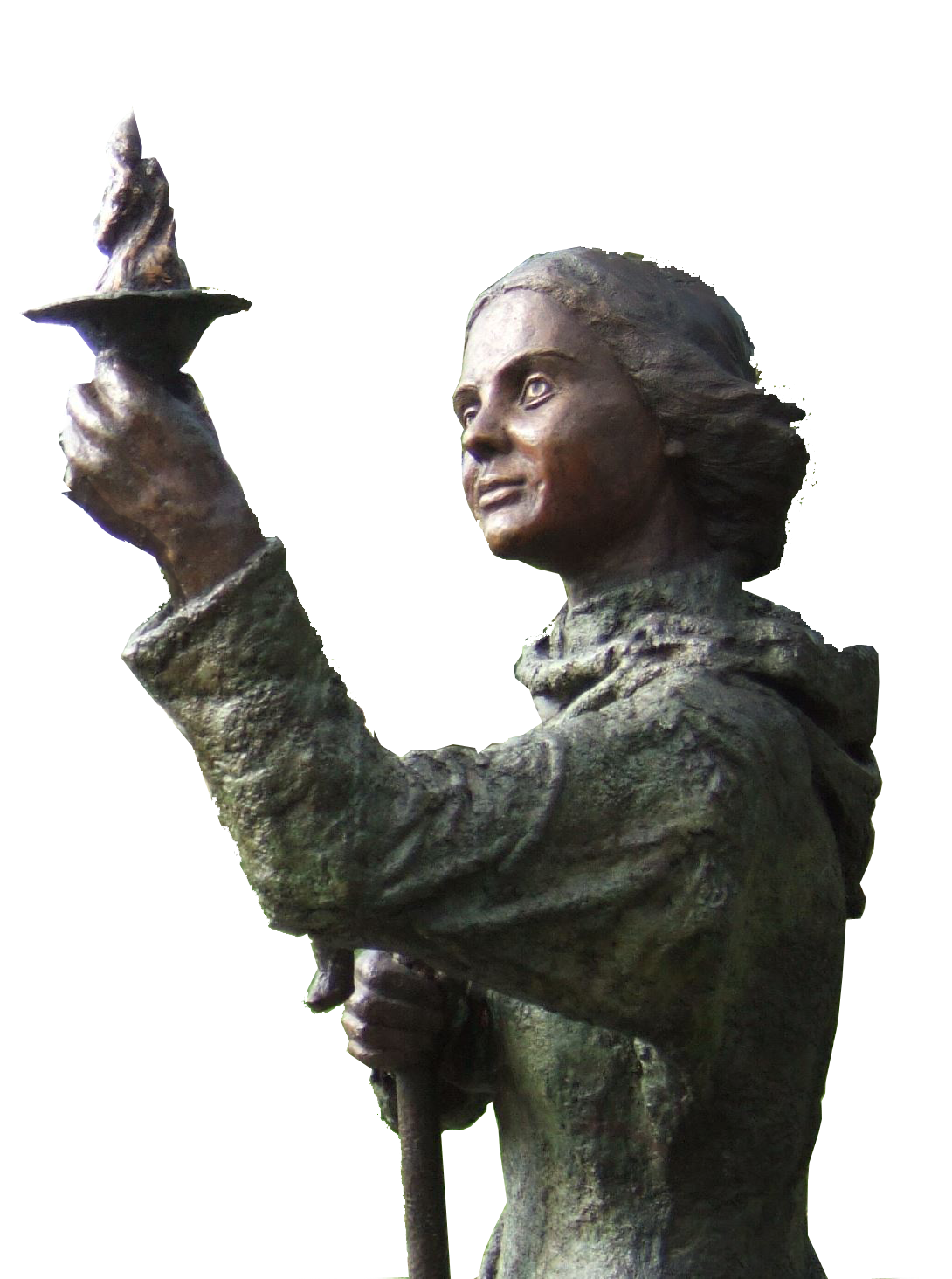
A modern, but orthodox, sculpture of St. Brigid
Her feast day, Feb. 1, is on the pagan festival of Imbolc. (Imbolc has since slipped by a day and been reduced to the yearly appearance of Punxatawny Phil the groundhog to foretell the spring.)
Brigid’s symbol, the cow, was the store of wealth and unit of account among the pagan tribes of Ireland, and her miracles include the sudden appearance of milk, butter and cheese in vast quantities, as well as beer, beer, beer. Irish priorities are clear: first the beer, and only then the loaves and fishes. On one occasion of drought, she converted her bathwater into beer, a very Irish conversion. She could also hang her cloak on a sunbeam.
St. Brendan the Navigator was an Irishman, and his tales are tall. He set sail in a curragh — a boat not much more than a cockleshell made of hides and waterproofed with fat. In it, he traveled west across the Atlantic for seven years to the “Promised Land of the Saints,” the “Land of Promise” or perhaps the Garden of Eden. Mind you, he only went because St. Barrid told him that he, Barrid, had already been there.

Brendan the Navigator with his towers of crystal
On the way, Brendan landed on a whale, saw floating crystals as high as the sky and was pelted by burning rocks from an island, so clearly he got as far as Iceland.
Brendan also encountered Judas, sitting drenched and miserable on a rock in the midst of the sea. Judas explained that this was his Sunday holiday; the rest of the week, he spent in Hell. The church insists that Brendan’s journeys were for the purpose of converting the heathen and founding abbeys. He is the patron of Clonfert Abbey, so that just shows.
I don’t plan to confine myself to Irish saints. The Irish venerate whatever saint can best deliver what is needed (for a certain value of ‘need,’ which includes beer.) My heroine will have recourse to St. Walter of Pontoise, a sad fellow from a place near Paris.

Sad St. Walter, after a chat with the Pope
Walter wanted only to be left alone in a monk’s cell to fast and pray, but the King of France appointed him abbot of the monastery. The poor man ran for it but was caught and brought back. This happened several times. Finally, the pope put his foot down and told Walter to stop complaining and do his job. Now, he is the patron saint of people whose jobs are getting to be too much for them.
Another favorite of mine: St. Ubald of Gubbio can be invoked against headaches, which I take to mean anything that makes a nuisance of itself without justifying immediate flight. If things get even worse, St. Ubald is said to have miraculously defeated an invading army and talked Frederick Barbarossa himself out of sacking the city of Gubbio. More: he is invoked contra omnes diabolicas nequitias – “against all diabolical depravity.” I presume I can involve my heroine in absolutely anything and get her out of trouble in the end.
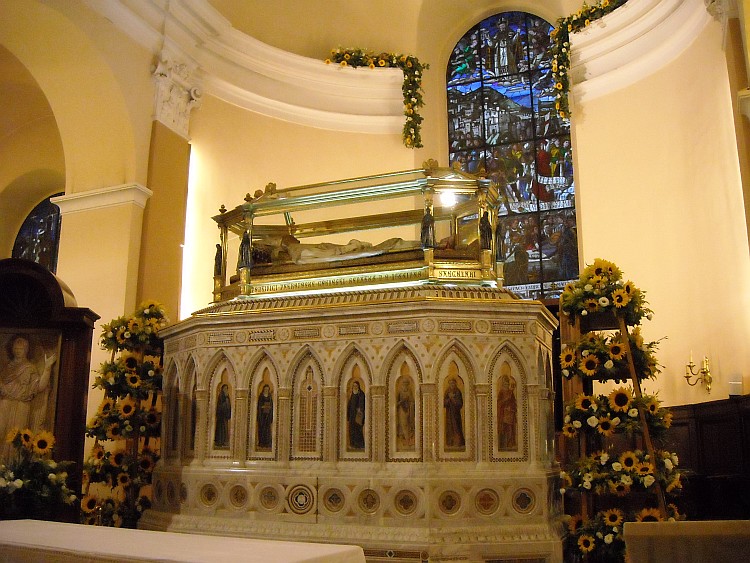
St. Ubaldo’s incorruptible body in the basilica at Gubbio, beyond all woes
To speed you on your way, here is a prayer attributed to St. Brigid, as translated (perhaps loosely) and performed by the Irish singer Noirin Ni Riain on a recording with the Benedictine monks of Glenstal Abbey in County Limerick:
I’d like to give a lake of beer to God.
I’d love the Heavenly
Host to be tippling there
For all eternity.
I’d love the men of Heaven to live with me,
To dance and sing.
If they wanted, I’d put at their disposal
Vats of suffering.
White cups of love I’d give them,
With a heart and a half;
Sweet pitchers of mercy I’d offer
To every man.
I’d make Heaven a cheerful spot,
Because the happy heart is true.
I’d make the men contented for their own sake
I’d like Jesus to love me too.
I’d like the people of heaven to gather
From all the parishes around,
I’d give a special welcome to the women,
The three Marys of great renown.
I’d sit with the men, the women of God
There by the lake of beer
We’d be drinking good health forever
And every drop would be a prayer.
Adios to the gun
Two Thursdays ago I submitted to my writing group for critique my short story “The Intruder” now renamed “He’s All She’s Got.” As usual, my submission generated a fair amount of “positive criticism.”
Our facilitator, John, pointed out that I had “not fully imagined from the inside” the main scene that involved the gun, the intruder, and the tying up to the newel post of my protagonist. I have since attempted to immerse myself deeper into this scene only to discover that I have imagined it to the fullest extent possible. I just can’t write any more realistically about guns and tying up people.
I’ve given my story a hard look–a VERY hard look–and decided to rewrite it with more of a focus on the relationship between the mother and her daughter. I think it best to say adios to the gun scene. What a relief. Eleanor, who has worked tirelessly on a gun scene for possibly years suggested an alternative to my opening scene that does not involve a gun and I’m going to give it a try. Naturally, this change will ripple throughout the story. It’s all for the good. I am better at writing about relationships than guns.
Once again I am thankful for the input from my writing group. Without their advice, I’d–well, I’d be a wannabe writer without any possibility of publication. With them, my odds are slightly better. When we concluded the discussion of my short story, I made a negative comment about it. Immediately, thousands of miles away, I heard “it’s a good story” and “I like your story.” That was enough encouragement for another go-round. Thanks, guys!
What I find of interest is that when I am working on one project, my short story in this instance, all sorts of ideas for my other current project, (my book, “Anne”) erupt unbidden. I do wonder if all other writers have this problem, or if it just belongs to us procrastinators, for whom it is a means of getting out of what we are supposed to be doing.
Last week I took a break from my writing group and writing as my mother, sister and  brother-in-law visited from New Hampshire. We relaxed by the pool at their resort, did a few tourist activities, and ate out, naturally. We were pleased we could reward them for their long flight with sunshine and some record-breaking temps in the 80’s. Too bad they had to return to temperatures that were nearly 100 degrees lower (with wind chill) than what they enjoyed here.
Now I will have time to write–the grandkids will be in school, Joy will be working, Steve will be golfing, and, oh, darn, the sun will be shining and temps will be even higher….
Rediscoveries
I’ve always had an interest in rediscovering old mysteries. I love seeing how the stories are constructed and the characters fleshed out, and comparing the authors’ techniques to the contemporary writers I read. I love finding new (to me) words and phrasings—meaching, roistering. Most of all , though, I delight in finding the cultural and historical threads that connect my own time to the period of the old books—political jokes that haven’t changed, societal expectations that have.
My latest discovery is The Horizontal Man by Helen Eustis. Originally published in 1946, it has been republished in Sarah Weinman’s excellent two-volume collection of novels by women crime writers of the ’40s and ’50s. The Horizontal Man takes place at a fictional women’s college in the Berkshires, and in many ways echoes the cozy, village-set mysteries of Agatha Christie. Set in autumn, when the leaves have strayed from the trees, the small college town is exposed to Eustis’s crisp, satirical delineations. The murder of a handsome, sexually attractive English professor brings to the fore the neuroses, pretensions, snobbery, and jealousies that flourish in a quaint, academic environment. Helen Eustis, too, knew that environment well: She married her English professor when she was a student at Smith College.
Plus ça change . . . Eustis could be describing any English department functioning today. Her character studies, especially of the minds of the insecure professors grappling for position, are so spot on, you feel you’ve met these people before. She pokes a little fun at them, but they aren’t so overdrawn as to become caricatures. The Horizontal Man manages to be a smart mystery that expects its readers to be as smart as its characters.
What is out of date? Well, for one, the psycho-babble is risible now—but that was our understanding of the human mind at the time the novel was written. The unmarried professors live in boarding houses, the students’ dorms have house mothers. To me this is all part of the fun of discovering what the day-to-day life of a college community was like in the forties.
Helen Eustis was not a prolific writer. In fact, The Horizontal Man was her only novel, but it was critically acclaimed at the time and it won the Edgar Award for Best First Novel from the Mystery Writers of America. In addition to a collection of short stories, The Captain and the Kings Depart and Other Stories (1943), she wrote for the New Yorker and other periodicals and translated George Simenon into English.
Sarah Weinman in her anthology is saving Helen Eustis and the other women crime writers she included—Margaret Millar, Charlotte Armstrong, Elisabeth Sanxay Holding, to name a few—from drifting into obscurity. And their novels are worthy of our attention and study for their craft, their engaging suspense, and the way they weave in a woman’s perspective from an era on the cusp of revolutionary societal changes.
My (so-called) life as a writer
Technology is great (when it works, of course). For the past two Thursday nights I’ve been able to FaceTime with my writing group back in New Hampshire. I hope the second Thursday was an improvement for them–I used my iPad instead of my iPhone and they added speakers. The only problem on my end is that it’s harder to interrupt someone when you’re an image on a screen!
With the two hour time difference, I had no choice last Thursday but to eat my dinner while we had our discussion. I don’t imagine my slurping spaghetti noodles was a very appealing sight. That won’t be an option this week as I volunteered to submit. Tacky to eat and present at the same time.
Yikes. What was I thinking? I’ve been much too busy enjoying myself in sunny, warm Arizona (not so much today as we had a storm blow through last night–thank you, El Nino) to find time to write. And we’ve had visitors from New Hampshire. And the three grandkids passed a diluted version of their debilitating virus to me which kept me in bed part of this past weekend. And this coming weekend we have family from New Hampshire arriving.
And…that’s my life as a writer. Full of excuses as to why I haven’t written. But as I look through my two yellow pads of paper, I see pages of notes about both my story, “The Intruder,” and my book, “Anne.” But notes, in my book, don’t constitute writing. And as useful as they are to me, I can’t submit them to my writing group.
My notes on “Anne” pertain to combining my three related novels into one, not as easy a task as I originally anticipated. The process of writing my thoughts down on paper led me to the realization that I am starting the novel with Anne’s story and I need to conclude the novel with her story. My original plan was to end the novel with her daughter Olivia’s story. I suppose if I keep writing notes about the book I’ll come to a different conclusion.
I did have a motivational experience at, of all places, my grandson’s soccer tournament in Tucson. The opening ceremonies included the typical dais with a podium, microphone, and folding chairs. And a replica Olympic torch. Just the sight of the dais (sans the torch) transported me back to a scene in “Anne.”
Time to write (revise, finish) the damn book!
So heads up, writing group. If I get my act together, you’ll be reading a new (improved?) version of “The Intruder” this week. If I don’t, well…I’ll just have to blame it on technology.
Wait, wait! It’s a mystery!
I should be writing Gothic fantasy, not mysteries. When I consult my pocket notebook (which I often do, because, as Oscar Wilde said, one should always have something sensational to read on the train), I seldom find jottings about sinister strangers or mysterious events. I seem to be attracted by weirdities. I overhear remarks that suggest the speaker is not living a boring life. My passersby live in an alternate universe.
So today I present a quiz, modeled on the radio news quiz, “Wait, wait! Don’t tell me!” The deal is, in each section, I give you three scenarios. One is from my notebook; I witnessed it. The other two are my efforts to create a similar, but more plausible, fiction. Your job is to guess which is the true event.
No prize; the answers are at the bottom of this post.
[Spoiler alert: I have no idea how to make the answers at the end show up upside-down. So don’t scroll past the fourth question till you’ve committed yourself to an answer.]
A London perfumerie in the exclusive Burlington Arcade has premiered its latest original scents. These are:
A. Breath of Bristol and Liverpool Breeze. “The tang of salt, seaweed and steamers to the Orient. The scent of Empire.”
B. Blasted Bloom and Blasted Heath. “Experience the Wild Scents of the British Coast.”
C. Rosalind and Lady MacBeth. “Are you a charmer or a femme fatale?”
Cutting edge European fashion in hair style currently includes:
A. The Angela Merkel short page boy
B. Thin, wispy curls arranged with scalp showing, a la Princess Charlotte
C. The Lisbon pony tail: a shaved head except for a long pony tail growing from the crown.
In his keynote address at Magna cum Murder XXI, author Simon Brett discussed:
A. The new Jane Austen app. It tracks all Jane Austen meetings, conventions and re-enactments worldwide, and lets users chat about their costume plans.
B. Sense and Sensuality, JA’s only attempt at a pornographic novel.
C. An academic article on a murder near Austen’s home at Chawton.
A British gentleman in business attire is walking down Piccadilly with a similarly dressed lady. She gives him a perky smile and says,
A. “So, they exhumed his body?”
B. “She stabbed him. But only with a fish knife.”
C. “My, what a tightly rolled umbrella!”
AND THE ANSWERS ARE:
B, C, B, A
So, what do you find in your pocket notebook?
 Eleanor Ingbretson
 Karen Whalen
 llandrigan
 Heidi Wilson
 Mike M
 Thursday Night Writes