Author Archives: Heidi Wilson
Nobody Reading Your Blog? What You Need Is a Monkey-centaur.
It’s hard enough to claw back time from the demands of life and fiction writing to write a blog post. Why, then, double the time with a search through Google images to illustrate my points? Because that’s where so much of the fun lies. Visual puns, quirky interpretations or just the weirdities that pop up on the web can add a zing that keeps the casual reader going. So today, in fraternal and sororal solidarity, I offer up one of my best sources of free images.
The British Library’s Medieval and Earlier Manuscripts blog reproduces illuminations from the manuscripts in their collection. When I contacted them, they said I might reproduce the images in my blog as long as I credited the Library and gave their citation to the manuscript. Hence this monkey-centaur, with which I illustrated the concept of an evil deed.

Monkey sawing books
(Courtesy British Library, Add. 49622, f.146)
What could be worse than sawing a book in half? Who but a monster would do it?
The blog itself is a welcome break from the slog through my inbox. Every few days one of the BL’s experts discourses on a gorgeously illustrated manuscript, on several manuscripts on a single theme, on a type of illustration (the marginalia are the

Detail of a marginal scene of a fox seizing a duck, with ‘sound effects’ added in a later hand, reading ‘queck’. (Courtesy British Library, Add MS 49622, f. 190v)
most fun) or on whatever else strikes their fancy. The Library is digitizing its collections as fast as ever it can, and newly digitized manuscripts are frequent subjects of the blog. An international cadre of enthusiasts seem to spend their time crawling through the collection online, and sometimes they find delights that the staff haven’t had time to appreciate. This hapless duck was tweeted out by one Erik Kwakkel of Leiden, who got credit in the BL’s caption. He must have been researching his genealogy.
Medieval monks laboring in the scriptorium frequently found their minds directed to the world, the flesh and the devil. Sometimes these showed up in decorous and improving forms. Sometimes not.
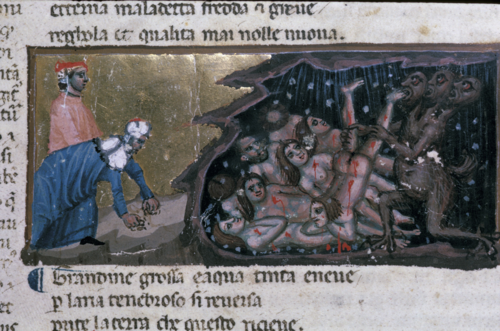
Cerberus (strangely human) feasts on the gluttons condemned to Hell (Courtesy British Library MS Egerton 943, f. 12r)
Here we have the punishment of gluttony from a manuscript of Dante’s Inferno. In classical mythology Cerberus was a three-headed dog who guarded the gates of Hades; here he is a three-headed devil who eats those who eat too much. Be warned.

Nun rebuking a lecherous grotesque. (Courtesy British Library Add. ms 49672 f098v)
Progress has made prudes of us. Here we have a nun wagging a monitory finger at a grotesque who is clearly attacking her. According to the BL manuscripts blog, later owners of such manuscripts often defaced scandalous images in the margins as disrespectful to the pious subject matter.
And here is the editorial comment of some envious monastic on the lovers in the main image:
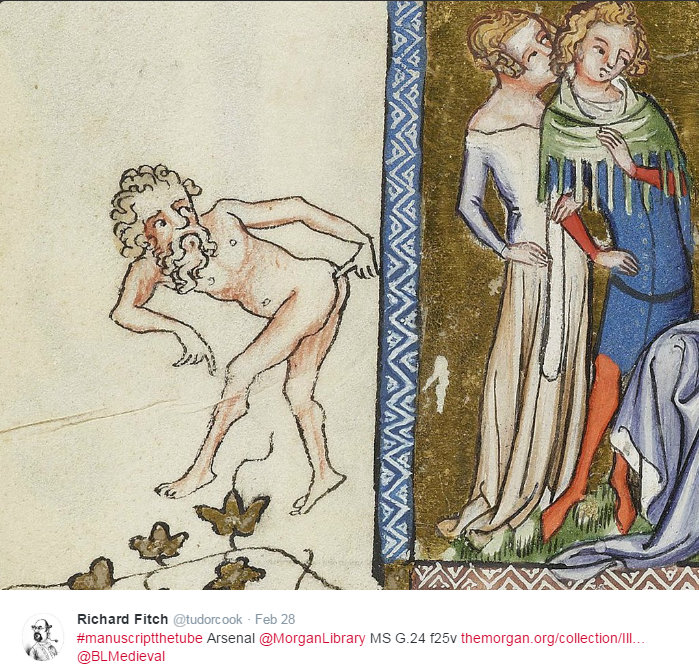
A monk’s envy expresses itself. The BL bloggers passed this on from the Morgan Library’s collection, MS G 24, f. 25v.
Readers of the blog get to play with the toys, too. Contests are held for the best caption for various images. The one just above was submitted in a contest to find images illustrating the names of London subway stops. That one was for “Arsenal.”
If you’d like some sympathy in your writing woes, check out The Burden of Writing: Scribes in Medieval Manuscripts.
Every April 1, a spoof post appears. In one, the digital whizzes at the British Library had introduced flying saucers into the illuminations. Another announced the discovery of an ancient cookbook with recipes for unicorn.
I know you get too much email already, but I really recommend following this blog. You’ll find images you can use, and you’ll enjoy yourself, too.
Catch Me If You Can, Google!
My fellow oldsters talk a lot these days about how scary Google is. Sometimes the scary thing is called “The Cloud” or just “They”. What’s worrying my buddies is the idea that somebody out there, Mr. Google for choice, is amassing information on them from their computers, secret stuff, that will be used to sell them things, and soon after that, to mess directly with their minds. These conversations usually end with firm resolutions, if not oaths, that they never have and never will purchase anything except on the most rational principles of usefulness.
I got a little antsy about Mr. Google myself, before my grandson put an ad blocker on my computer. I’d been looking online for a dress to wear to a family graduation. Didn’t find one. But for weeks afterward, every dress I’d clicked on kept popping up on every site I went to.

Featured! Sale! Today Only! It wasn’t that I minded having Them know that I’d considered that dress. I minded having Them think I’d buy anything if they waved it under my nose enough times.
The ad blocker solved that problem. Lately, though, I’ve been taking note of what my digital friends try to make me buy on their own sites. I thought Mr. Amazon liked me, because I buy so many books from him. So many, in fact, that I never even glanced at his recommendations – I didn’t have space on my shelves for what I was buying anyway. Then one day I just happened to look down….

Reading Level: Ages 5-102
Do I sound to you like a person for whom the ideal book would be Horton Hears A Who?
That was Mr. Amazon’s #1 pick for me. Besides, I’ve already read it. Many times. Out loud. To myself.
All right, all right, that doesn’t make my case, does it? Then consider the #2 choice: the Bible. Could be a compliment, could be an insult. I opted for the second interpretation when I noticed that the #5 recommendation was also the Bible.
I do buy cozy mysteries. I like Miss Marple a lot, anything by Ngaio Marsh even better and Dorothy L. Sayers best. Amazon entered my purchases into its complex algorithms, turned the crank and out popped John Grisham’s A Time to Kill.
My favorite Tana French
That was the only mystery suggested, except for The Likeness by Tana French, which I had already bought from Amazon.
After that came The Scarlet Letter. So I was right about why they put in the Bible.
YouTube must be using the same algorithms. Long ago, I worked for investment management firms as an economist, and I still keep up on the subject. Mr. Google knows that I have a bookmark to a site that gives stock market quotations. He must have told Mr. YouTube. I’ve been known to buy books on the subject online, too. Mr. Amazon is in the loop. So what is my first recommended video on YouTube?
BREXIT 2016: ILLLUMINATI-FREEMASON Struggles
At this point, I began to form algorithms of my own. Take two or three books on the economy, add two or three or four dozen on fantasy worlds, elves and so forth, divide by The Companion to The Name of the Rose, and you get irrefutable proof that the Illuminati were behind one side of the Brexit vote and the Freemasons behind the other. I didn’t watch the video just because I wouldn’t give them the satisfaction. But it does worry me. Not that YouTube has my number, but that there’s somebody out there who made that video.
In fact, I have occasionally searched for clips on YouTube, so Mr. YouTube was able to take his own notes. For instance, I’m working on a book that has pet ferrets in it. I clicked on videos of ferret owners showing off their weasly little companions. I admit that I even clicked on one that had “cute” in the title. Naturally, YouTube now always recommends ferret videos. In the last lot, they saw fit to include:
See How Easily a Rat Can Wriggle Up Your Toilet

You don’t have to believe this.
You can see the connection to ferrets, can’t you?
“Cute” earned me a flood of links to animals claiming that distinction. It also got me:
EXCLUSIVE: Male Polar Bear Chases and Eats Cub
I didn’t watch that one, either.
So you tell me: have the Illuminati of the Internet got my number yet? I figure I’ll be long dead before the Exalted Grand Masters can sell me so much as a peanut.
Readers: what are the computer geniuses flogging to you these days?
Permission to Age
Botox has been good to me. Not that I’ve ever used it. But it has provided me with a couple of nice red herrings to cover up poisonings.* Fictional poisonings, I mean, of course.
Botox has a bad rep. Nobody ever praises a woman for getting her jowls propped up. You don’t hear, “She deserves that lovely face. Think of the needles she’s endured.” And when a man indulges…! Nothing articulate need be said. Sniggers suffice.
Yet the American public is equally censorious about having saggy jowls when two conditions obtain: 1) you are a public figure, and 2) you are a woman. Yes, there are women who power through the pressure, and men do account for a low but rising percentage of Botox patients. However, my unscientific matched-pair study indicates severe injustice on the saggy issue.
Consider my first pair, an odd couple who may loom large in your nightmares at the moment.


Hillary Clinton – this is just my opinion, now – does not appear as nature made her. Scalpel or needle, this is not the face of a 68-year-old grandmother who’d be fine with staying at home with the darling baby. But why can’t the potential President of the United States look like a 68-year-old grandmother? The alternative President offered us by the Democrats looks like a grandpa, all right, and one with an uncertain temper at that. And somehow that’s fine.
Don’t ask me about Donald Trump. I can’t get past the hair.
Possibly Europeans are less uptight about their political figures. At least until recently, the most successful and respected of them all was “Mutti.”  That’s what Germans call their Chancellor, Angela Merkel. (Her actual title is Kanzlerin – “Lady Chancellor.”) And Mutti means “Mummy” in German, not “mutt.”
Moving on to the journalism business and triplets instead of a pair, whom do we trust and revere more than our news anchors? (Well, yes, there was that thing with Brian Williams, but still….) Judy Woodruff of the PBS Nightly News Hour is – again, my opinion – a worthy successor to Jim Lehrer. In particular, she handles the Friday political news round-up with Mark Shields and David Brooks as well as Jim ever did. Now, here’s Judy, age 69:

And here are Mark (78) and David (54).


How is that fair?
I started brooding about all this when I visited the websites of published female authors. A lot of them are “of a certain age.” Not as old as I am, maybe, but they’ve traveled some distance. And so many of them are bloody gorgeous! For whatever reason. Make-up, maybe.
If I ever make it to published status, I’m going to have problems. I’m afraid of needles, and even more of knives. (Hence my fondness for poisonings.) So unless my friends stage a serious intervention, here’s what my readers will see on the back cover of every book I write:

*Before any dermatologists write in, let me point out that, properly administered, Botox does not pose a risk of poisoning. You just aren’t supposed to get it into your bloodstream. So if you do go for the Barbie look, see a doctor and have it done right, okay?
Building the Plot Machine

When last heard from, I was moaning and complaining about my inability to focus in on the important things, in particular, my mystery novel’s plot problems. Since then, I have followed my own advice: “Apply rear end to chair. Write.” Danged if it isn’t working.
What is going down on paper – into electrons, I should say – is not fluent prose but brief sentences in an Excel worksheet. It’s my fourth attempt to organize this monster in Excel. Fourth time’s the charm.
My earlier worksheets were chimaeras. Along the horizontal axis were the four murders I had concocted. Each column was meant to state, in chronological order, “what happened.” The difficulty was that everybody’s “what happened” was different from everybody else’s.
I don’t mean just the characters, though each of them had his or her own body of knowledge about who was where, when and why, and above all, who hated whom. I also had to keep track of what happened as far as the reader knew. And of things that had happened all right, but that were supposed to make no sense until the big reveal at the end. And of the little event-clouds that shroud those baffling happenings in ordinariness for the time being.
Since my mystery is a cozy, my detective is an amateur. Her personal life impinges deeply on her need to solve the mystery. Her biggest personal problem (illness) needs to be consistent with the action. Even more, it needs to cast light on her actions, and outside events have to feed back into her situation. I added another column.
Her biggest challenge in outward life (a lawsuit) demanded a similar treatment. Add another column.
Then there were the police. They had to be hunting in all the wrong places. Their errors needed to ratchet up the dangers for the detective. Another column.
On top of that, mere order of events wasn’t enough. I needed specific dates for every event. Can’t have people building snowmen in May (actually, you can do that sometimes here in New Hampshire) or going on a shopping binge on Christmas Day.
You can imagine what a ragbag my worksheet became. Columns could be plot threads, themes, or characters. I found myself copying and pasting the contents of one box into three more, where they were just as relevant. Excel can be an excellent disordering technique.
Now I think I’ve got it. In the new worksheet, each column represents a single character and its contents are single-minded: what does this person want right now, and how does s/he go about getting it? No date column yet, but I think I’ll be able to stagger each character’s moves with the others – and possibly get them into a tighter, tenser order. That’s to say nothing of the way the author’s errors light up. I wasn’t half-way through entering my data before I found the murderer acting directly against his own interests. Duh.
I’ve been whining about all this in my writing group for so long that our moderator came up with an exercise for all of us to work on. He went to http://writingexercises.co.uk and used their “random plot generator.” Out popped the following:
Main Character: An optimistic 23-year-old woman
Secondary Character: A rebellious 60-year-old woman
Setting: The story begins on a cliff
Situation: A robbery goes badly wrong
Theme: It’s a story about risk-taking
Character action: Your character sets out on a rescue mission
Our assignment is not to write the story, but to come up with the outline of a coherent plot using these elements. I hope to make this a dry run in miniature of my big Excel project.
(By the way, writingexercises.co.uk also provides other sorts of prompts and helps you work on other tasks, e.g., “generate a fictitious ‘English-sounding’ town name.” Check it out.)
So what about it, campers? How do you keep your plot threads untangled? All tips welcome. Or try your hand at the exercise, and let us know how you did.
It Has to be Good, Not Perfect
The sun pours down on my life today. Actually, a thunderstorm is approaching, but to me, all is light and life. I gave a talk yesterday to a foreign affairs discussion group I belong to. Today, therefore, I no longer have to give a talk to the foreign affairs discussion group!
Speaking in public is not a problem for me. It’s the fear of making a mistake that wrecks my life. The search for correctness on every last tiny point ate up last week like the Tazmanian Devil pouncing on its prey. I had a good grasp on my material. But what if that date (2005) should actually be 2004? Google it. It was 2005. What if…? Google it. I spent more time in Google than in Word.
Because I spent the week obsessing, I printed my handouts at the last minute. My printer broke down. I switched to my husband’s printer, got one file completed, and the printer suddenly began taking its orders from Mars. Half a ream of paper was wasted before I finished the task. My office looked as if Dirty Harry had ransacked it.
No time for a shower before leaving. I plastered my hair down with a comb so severely that no one could doubt I intended it to look that way, for some unfathomable reason. Since I know where all the local speed traps are, I walked into the meeting room right on time, wearing an easy expression of ‘no sweat!’ Which made me think of the missed shower again.
And it all went fine. It almost always does. And so what if I had made a mistake or two? The world would not have ended. I would not have been damned for all eternity.
You wouldn’t think that writing fiction would be as susceptible to the search for perfect truth as reportage. You’re supposed to make fiction up. The writer is responsible for all the truth in the fiction. Unhappily, s/he gets none of the feedback offered by the real world when truths collide. In life, a brook simply will not run uphill. In your book, it can run one way in Chapter 3 and the other in Chapter 11. Until some kind or not-so-kind reader points that out.
The perfection trap doesn’t confine itself to fictional facts. When every flaw catches your eye equally, whether it’s a poor word choice or a gaping plot hole, progress can be agonizingly slow. I’ve managed to bring forth a first draft. I’ve rewritten, rewritten the rewrites and … you finish the sentence, assuming it ever ends. A draft that really needs only a clean-up is still miles over the horizon.
Perhaps it’s a trick of focal distance. The present plan is to focus on plot, plot, plot and never mind the rest. And we all know how to find out whether that’s a good idea. 1) Apply rear end to chair. 2) Write.
Giveaway Books. Or Not.

Awaiting you at the Five Colleges Book Sale
The annual Five Colleges Book Sale is a big deal here in the Upper Valley. Organized to fund scholarships for New Hampshire and Vermont students at Mt. Holyoke, Simmons, Smith, Vassar, and Wellesley colleges, it is the largest second-hand book sale in northern New England. For this book addict, it is a blessed way to reduce my library, at least for the two weeks between when I drop off my contributions and when I attend the sale.
Today, I went down to the basement to pack up the pile of books that I have winnowed over the last year. Here are a few of the items you’ll be able to buy at a really good price, while benefitting worthy young scholars:
The German Cookbook, by Mimi Sheraton. I bought this book hoping to please my Germanophile husband with the dishes of his ancestors.

After rolling the strudel dough
http://www.wikihow.com/Make-Apple-Strudel
I should have checked the apple strudel recipe before I forked over the cash. It involves rolling out dough, which you have already slapped down on the pastry board 115 times, over a whole kitchen table until it is as thin as tissue paper. Guess I’ll have to think of some other way to please my husband.
Two biographies of Samuel Johnson. I tried hard to like Johnson. I read Boswell’s Life of Johnson and was sure he had to be right about his idol. So I read these books. Doubtless they are great works of scholarship. But what kind of idiot tries to write a life of Johnson after Boswell?
Six paperback murder mysteries, published between 1993 and 2014. I read them all within the last two or three years. I cannot remember the plot of a single one. This confirms me in my dreary notion that my own mystery manuscript will have to be re-re-re-revised till Judgment Day.
 Angels and Demons, by Dan Brown. Brown’s The Da Vinci Code was a page turner, I admit. No matter that it read like its own outline. Like everyone else, I couldn’t put it down. So I went and paid the hardback price for his earlier book. It was like The Da Vinci Code if The Da Vinci Code had never been outlined at all. It had angels and demons. I guess. Further, deponent remembereth not.
The Strange Ride of Rudyard Kipling. His Life and Works, by Angus Wilson. I haven’t read this one. It belonged to my late husband. I’d like to read it…but there just isn’t TIME. I flipped through it… it looks fascinating…with photos, yet…a Spy cartoon…but something’s got to go. I can’t keep retrieving things from the pile.
Which brings me to the more interesting part of this list. Below are several books from the pile that the Five-Colleges sale will not be seeing. How long have they languished in this limbo? And more important, what was I thinking when I put them there?
Something of Myself, by Rudyard Kipling. I compromised. I’ll give up the biography and keep the autobiography. I flipped through this, too. I cannot discard a book that includes the sentence, “For the great J.M. [Cook] himself – the man with the iron mouth and domed brow – had been one of my father’s guests at Lahore when he was trying to induce the Indian Government to let him take over the annual pilgrimage to Mecca as a business proposition.”
The Letters of Madame, Vol. II. Princess Elisabeth Charlotte of the Palatinate, known as “Madame,” married Louis XIV’s brother in 1671. She was a woman

Madame, in her later years
who did not pussyfoot. She slapped her son’s face before the whole court when she learned that he had agreed to marry one of his royal uncle’s bastards. She never had the slightest desire to participate in court intrigue, love affairs, government or fashion. She liked hunting all day, she liked her meals large and regular, and she loved to write letters. The accounts she sent to her German family and friends about the court at Versailles were so frank that the government used them to blackmail her in later life. Their demand? That she shut up about her opinion of Mme. de Maintenon, the king’s mistress. I found this second volume, without its first, in a second-hand bookstore, and I have been looking for Volume I ever since.
Howe & Hummel: Their True and Scandalous History, by Richard H. Rovere. William F. Howe and Abraham H. Hummel were New York lawyers in the second half of the nineteenth century. They got murderers off scot free. They got Lilian Russell divorced – frequently. They bought off witnesses. Hummel eventually went to jail himself. If you liked the movie Chicago, you’d love Howe & Hummel.
A Moveable Feast, by Ernest Hemingway. Good grief! This is a first edition, bought by my mother when it came out in 1964. Just last year, I bought the new edition that includes the parts that Hemingway’s publishers cut, and I hunted for this book to compare it with. And there it was, down in the giveaway pile. I must have been mad.
These notes are based on the contents of the first two grocery bags of books that made up the pile. There are two more. I don’t dare look into them.
W? Or Not?

Would-be writers can always be lured into taking just one more how-to-write course, buying just one more book, attending just one more conference. Flailing and weeping in the chaos of our own material, we’re sure that someone out there has a system. No, has The System that, with one hard shake, will order our characters, themes and events into a page-turning plot.
I lost a lot of time trying to cram my plot into the shape recommended by  Mary Carroll Moore’s Your Book Starts Here. Her system is to shape your plot like the letter W. Your protagonist encounters loss or danger, plunges to the depths, pulls herself together and addresses her problem with some success – we’re now at the peak of the first upstroke of the W – then gets really whacked by some failure or complication, descends to the uttermost depths, and finally wrestles her way back to whatever fate you have in store for her.
The W method is good for making a start, and also for combatting saggy-middle syndrome. In the end, though, you have to compound your own prescription. So today, I offer a few alternative plot shapes, as discussed by Kurt Vonnegut on the Washington Post’s “Wonkblog.” In a hilarious (truly!) video Vonnegut explains how simple it all is, really.
Plot 1 is “Man in Hole.” The hero starts in a reasonably comfortable condition, encounters a problem, solves it and ends up better off. Vonnegut graphs this  from beginning to end as a nice even sine wave on a happy-unhappy vertical axis. Events head down into negative territory, reverse course at the bottom, and end up even higher on the happy scale than they started. Wonkblog’s example: Arsenic and Old Lace. Note that Mary Carroll Moore’s W could be titled “Man in Two Holes.”
Plot 2 is “Boy Meets Girl,” in which the initial events head upward on the graph, i.e., boy falls in love. From there on, Plot 2 replicates Plot 1, as the lovers are separated, then reunited. Traditionally, “Boy Meets Girl” ends higher on the vertical scale than “Man in Hole,”since (as we all know) they lived happily ever after.
Now we get into the kind of plot I like best: Cinderella. No, not for the happy ending. By me, that prince is a Ken doll. According to Vonnegut (and strangely
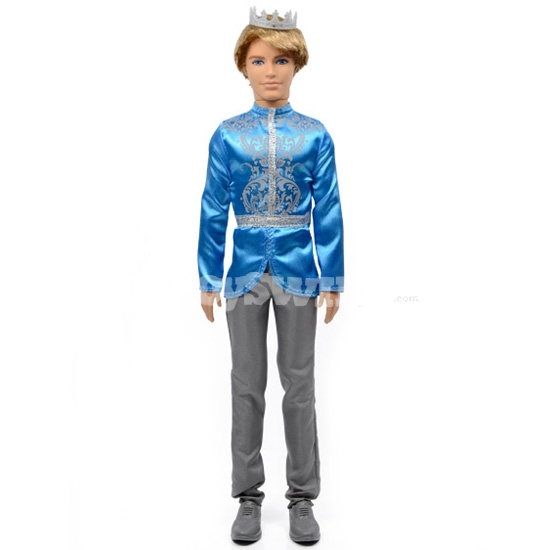
The Ken Prince from, I kid you not, “toyswill.com”
mis-graphed in the Post article), “Cinderella” is distinguished by its beginning – among the cinders, way, way below the middle of the happy-unhappy axis. Then (and this is what I love), progress toward the Prince’s ball takes place not in a smooth curve, but in a series of stair-steps. The gown. The glass slippers. The pumpkin coach. The mouse-horses. These lovely items are provided by Cinderella’s fairy godmother, but in more interesting stories, each has its own provenance, sometimes but not always obtained by the heroine’s own efforts.

Broccoli’s fractal form, an instance of the Fibonacci sequence
It’s the detail that grabs me. The plot takes on the shape of a Fibonacci sequence. Every step can replicate into a handful of details or issues, which in turn can replicate. This is why I like Proust. (Trouble is, I haven’t yet been able to work out what the heck his stair-steps are leading to.)
The stair-steps also occur in the folkloric creation story, in which a deity or deities generate successive gifts which, combined, produce the world. My favorite literary example is Elizabeth von Arnim’s Elizabeth and Her German Garden, but of course Genesis I is better known. According to Vonnegut, the Old Testament is simply the creation story with an unhappy ending tacked on: God makes the world, we live in it, we die. With the addition of the New Testament, we are back to Cinderella.
Vonnegut does not ignore modern literature. There’s “From Bad to Worse,” in which some poor schlemiel simply gets hammered, and that’s it. Wonkblog’s example: The Metamorphosis. And then there’s “Which Way is Up?”, exemplified by that most modern of stories, “Hamlet.”
You can noodle around with these curves forever, and come up with a story to match anything you can draw . At present, I have no idea what shape my own story (fictional, that is) will take. I got troubles, I got worries, I got stair steps, nobody gets a girl … who could ask for anything more?
Dubious Sanctities
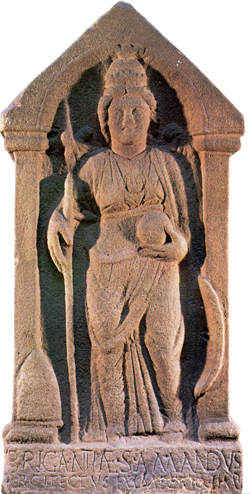
The Celtic goddess Brigantia
Between bouts of work on my mystery novel, I tinker with a literary work. It’s so serious I can hardly shift it most of the time, but it does have lighter moments. Since it takes place in Ireland, those moments often involve saints.
Ireland favors saints who are hard to pin down, some of dubious origin. They tend to be knowledgeable about human wants and needs, and indulgent of them. I’m far from the final cut on which sanctities will be included. This makes a perfect excuse for “research” that takes me away from the grunt work. Today, I offer you a sampling of my favorites.
The Irish are all good Catholics, even the bad ones. This is possible because, after they had submitted to the church, they went higher up and cut their own deal. St. Patrick, having driven out all the snakes and converted or incinerated

St. Patrick defeats the pagan priests in argument before the High King at Tara
all the pagans, asked and received a boon from Christ: on Judgment Day, Christ will judge the living and the dead – except for the Irish. They will be judged by Patrick. In life, Patrick was not a forgiving sort, but for his own people….
St. Brigid is sometimes called the “second most important Irish saint.” Patrick, being male and alleged founder of the faith in Ireland, is number one. Officially, the church doesn’t care for women in the top job. But Brigid is “the Mary of the Irish.” According to her legend, when she went to take the veil from Bishop Mel, the Holy Spirit caused him to read the form for ordaining a bishop over her.
In fact, Brigid predates Patrick. She began her career of divinity as Brigantia, “the high one”, a Celtic goddess (seen in a Roman-era relief at the top of this post.) She is the saintly patron of blacksmiths, doctors and poets – metallurgy, medicine and poetry were the three magical arts of the pre-Christian Celts.
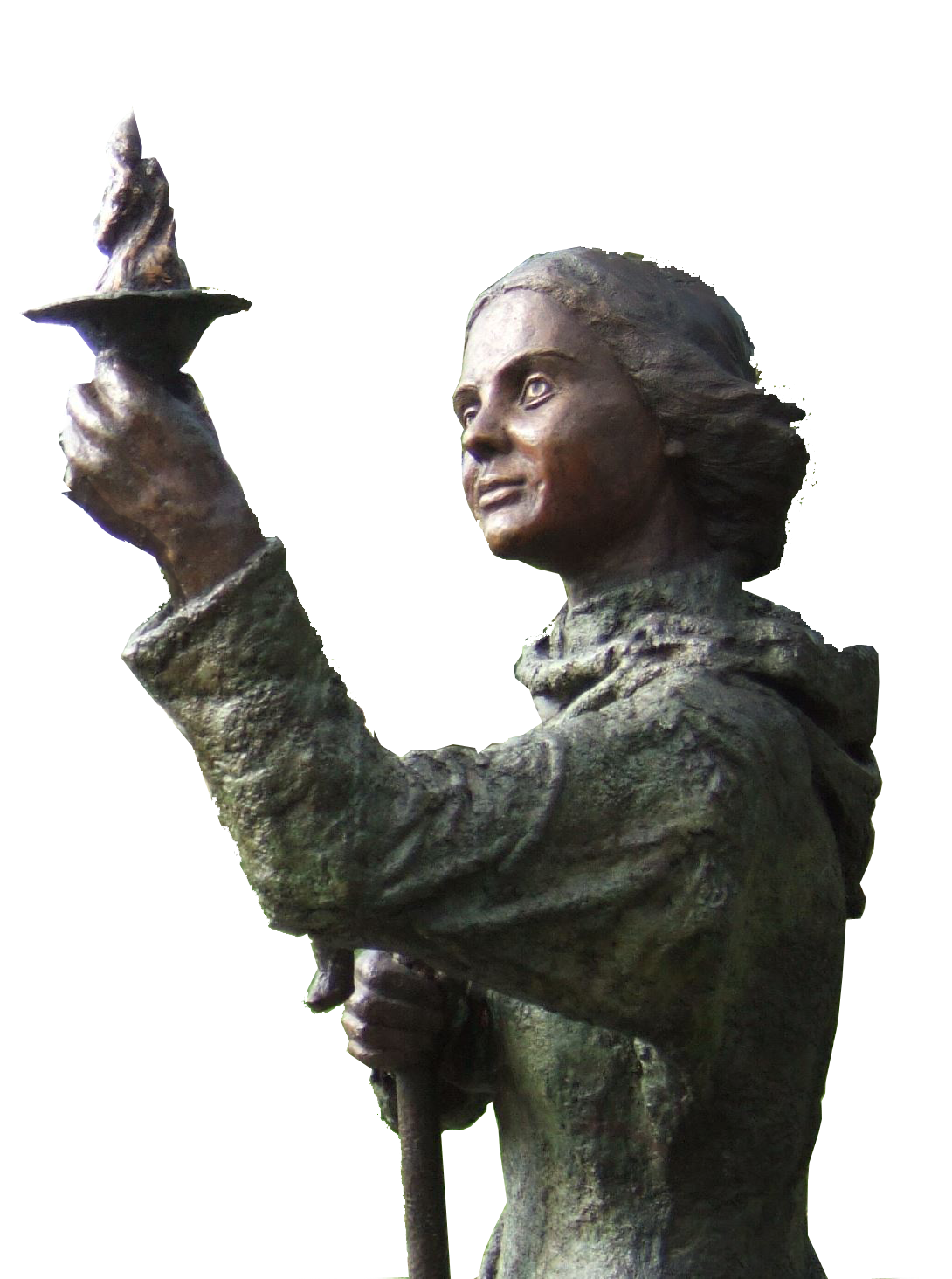
A modern, but orthodox, sculpture of St. Brigid
Her feast day, Feb. 1, is on the pagan festival of Imbolc. (Imbolc has since slipped by a day and been reduced to the yearly appearance of Punxatawny Phil the groundhog to foretell the spring.)
Brigid’s symbol, the cow, was the store of wealth and unit of account among the pagan tribes of Ireland, and her miracles include the sudden appearance of milk, butter and cheese in vast quantities, as well as beer, beer, beer. Irish priorities are clear: first the beer, and only then the loaves and fishes. On one occasion of drought, she converted her bathwater into beer, a very Irish conversion. She could also hang her cloak on a sunbeam.
St. Brendan the Navigator was an Irishman, and his tales are tall. He set sail in a curragh — a boat not much more than a cockleshell made of hides and waterproofed with fat. In it, he traveled west across the Atlantic for seven years to the “Promised Land of the Saints,” the “Land of Promise” or perhaps the Garden of Eden. Mind you, he only went because St. Barrid told him that he, Barrid, had already been there.

Brendan the Navigator with his towers of crystal
On the way, Brendan landed on a whale, saw floating crystals as high as the sky and was pelted by burning rocks from an island, so clearly he got as far as Iceland.
Brendan also encountered Judas, sitting drenched and miserable on a rock in the midst of the sea. Judas explained that this was his Sunday holiday; the rest of the week, he spent in Hell. The church insists that Brendan’s journeys were for the purpose of converting the heathen and founding abbeys. He is the patron of Clonfert Abbey, so that just shows.
I don’t plan to confine myself to Irish saints. The Irish venerate whatever saint can best deliver what is needed (for a certain value of ‘need,’ which includes beer.) My heroine will have recourse to St. Walter of Pontoise, a sad fellow from a place near Paris.

Sad St. Walter, after a chat with the Pope
Walter wanted only to be left alone in a monk’s cell to fast and pray, but the King of France appointed him abbot of the monastery. The poor man ran for it but was caught and brought back. This happened several times. Finally, the pope put his foot down and told Walter to stop complaining and do his job. Now, he is the patron saint of people whose jobs are getting to be too much for them.
Another favorite of mine: St. Ubald of Gubbio can be invoked against headaches, which I take to mean anything that makes a nuisance of itself without justifying immediate flight. If things get even worse, St. Ubald is said to have miraculously defeated an invading army and talked Frederick Barbarossa himself out of sacking the city of Gubbio. More: he is invoked contra omnes diabolicas nequitias – “against all diabolical depravity.” I presume I can involve my heroine in absolutely anything and get her out of trouble in the end.

St. Ubaldo’s incorruptible body in the basilica at Gubbio, beyond all woes
To speed you on your way, here is a prayer attributed to St. Brigid, as translated (perhaps loosely) and performed by the Irish singer Noirin Ni Riain on a recording with the Benedictine monks of Glenstal Abbey in County Limerick:
I’d like to give a lake of beer to God.
I’d love the Heavenly
Host to be tippling there
For all eternity.
I’d love the men of Heaven to live with me,
To dance and sing.
If they wanted, I’d put at their disposal
Vats of suffering.
White cups of love I’d give them,
With a heart and a half;
Sweet pitchers of mercy I’d offer
To every man.
I’d make Heaven a cheerful spot,
Because the happy heart is true.
I’d make the men contented for their own sake
I’d like Jesus to love me too.
I’d like the people of heaven to gather
From all the parishes around,
I’d give a special welcome to the women,
The three Marys of great renown.
I’d sit with the men, the women of God
There by the lake of beer
We’d be drinking good health forever
And every drop would be a prayer.
Bad Reads
“Leave me alone. I’m reading.” We’ve all said it, and we haven’t said it half as often as we wanted to. Give us a good book, and the world can stay on hold forever.
But how about, “Somebody get me out of this book! Where are the telemarketers when you need them?”
Why do we keep slogging through books we don’t want to read? We of all people, wordsmiths, people of literary judgment! (And in my case, old people. I don’t have decades to waste.)
Lately, I’ve been buzz-bombed by these loser books. The worst of them was called The Matter of the Gods, by Clifford Ando. It purports to be a history of religion in ancient Rome. In a former incarnation, I was a classicist, and mythology was my specialty. So I bought the d***** book. Imagine the ghastliest academese prose, wrenched and decorated to sound arch, while avoiding the dreadful faux pas of actually suggesting any conclusions. That’s MotG.
Why did I finish it? Because every couple of pages, he’d quote an ancient writer I’d never read or drop in a factoid on Roman ritual that was new to me. Drop a trail of M&Ms and I’ll follow you anywhere. It’s the kind of reinforcement that creates drug addicts.
Running in tandem with MotG was Antidote to Venom, by Freeman Wills Crofts. Crofts was one of the most popular mystery writers of the Golden Age, God knows why. I bought it because I’m working on a book that involves snake venom. Crofts’ golden rule seems to be that every thought, speech and action must be reported at least twice. Plans must be explained at length, and then carried out at equal length, in the same sequence. Plod. Plod. Plod. And to top it off, one of his villains has an alibi so unbreakable that Crofts has to give him a religious conversion at the end, to elicit a confession!
Why did I finish it? Sheer bloody-mindedness. Not to be able to finish a book in my own genre and of the period I most admire was too shaming. Also, it had just been reissued. So publishers thought it would sell, right? I should see why, right? I still don’t know.
Then there are the bestsellers everyone else has read. A few years ago, I read Haruki Murakami’s 1Q84. It was 944 pages of I-still-don’t-know-what. It had something to do with domestic violence; I figured that much out. It had an alternate universe in it, only it wasn’t all that alternate.
Why did I finish it? This one was almost justified. Murakami’s prose floated me along in a mental state just like that of his confused characters. This stuff was just happening. You couldn’t do anything about it, so you just did the next thing. Which was to read the next sentence. Still, 315 pages would have been enough.
Don’t even ask me about books written by friends.
So, what to do, assuming that you find you can’t just toss the book? Here are my strategies:
- Demote to bathroom. This worked, eventually, for The Matter of the Gods and Antidote to Venom. The time isn’t wasted, and page by page you get to the end. Please do not tear out completed pages and re-purpose them. That is cruel.
- Learn to skim. This used to be called speed reading. It doesn’t really work, but you can pretend it does, and if your eyes have traveled over every page, you are only half lying when you say you’ve read it.
- Arrange an unfortunate accident. This requires a degree of double-think, but what writer lacks that? Reading paperbacks in the bathtub is the easiest method. (Buy an oilier bubble bath.) Leave hardbacks on or near the recycle container. Forget them in waiting areas or on public transportation.
I’m about to start Chris Holm’s The Killing Kind. It’s about a hit man who only hits other hit men. I gobbled down three of his earlier books. I’ll have to find something else to read in the bathroom.
 Eleanor Ingbretson
 Karen Whalen
 llandrigan
 Heidi Wilson
 Mike M
 Thursday Night Writes