Monthly Archives: August 2015
A question for Siri
A few nights ago I attended a Willie Nelson and Family and Old Crow Medicine Show concert at Meadowbrook in Gilford, NH. (In case you were wondering why I was there, my friend’s husband backed out and I was asked to go in his place.)
Thousands of people applauded and cheered after each song. Some were inspired by their ingestion of alcohol and other substances but a genuine appreciation of the music permeated the air (along with a sweet odor). There is no disputing the fact that attending a concert is a social activity for many people, in addition to an opportunity to enjoy the music. The majority of the songs performed by Willie Nelson have been sung or played many times over the span of many years yet the attendees reacted as though he had dedicated the last five or more years of his life to creating and perfecting them and that he was performing them for the first time.
What if we authors got that same reception every time someone read a book we had written? Would we be motivated to spend even more time writing?
Different abilities and talents are required for singers and writers (unless the singers also write their own lyrics). Would I as an author be comfortable on stage under bright lights in front of thousands of people reading from my novels about Claire, Anne, or Olivia? Hell, no. I have a hard enough time sharing my writings with my writing group. Yet I couldn’t help being jealous of the accolades the performers received at the concert.
Reading is generally a solitary pastime. Any cheering and clapping is done in the privacy of your home. The author, therefore, receives limited direct feedback. So what drives a writer, especially one who has yet to be published, to keep producing? Maybe that is a question appropriate for Siri, along the lines of “what is the meaning of life?”
Speaking of Claire and her cohorts, I offer my sincerest apologies to them for being out of touch these past weeks. You have to believe me that they’ve been in my thoughts. I know what they’ve been doing and thinking and even planning to do. But I haven’t taken the time to record any of this. Everywhere I have been—the hotel in South Yarmouth, Massachusetts, the Cape Cod Inflatable Park, the swimming pool, the Mayflower Beach—I’m thinking of them, feeling their presence, the same as when I’m reading a book with a main character with whom I identify. I know she isn’t real yet it’s as though she is my companion.
Writing a book is like reading a book. The characters get under your skin, into your head.
Only it’s a million times harder.
Word Death
Eventually, the words get you.
You struggle with plots, with character development, with the godawful job of pulling it all together. And while you are wrestling with that angel, the words he is made of creep through your pores and invade your brain. They become the plaque that stops the neurons firing.
It happened to James Thurber. Much of his last two books, Lanterns and Lances and the posthumously published Credos and Curios,

My 1962 copy of Credos and Curios
were compendia of words that had dug their little claws into his mind and wouldn’t let go, long lists of words that had, perhaps, only sounds in common, or were all place names or first names beginning with O. He packed them up and disguised them as essays and stories, and his most devoted fans slogged their way through, but even they knew it was crazy.
Thurber had shown signs of the word disease much earlier. After “The Night the Bed Fell” and “The Night the Ghost Got In,” he wrote “More Alarms at Night.” In it, you hear the Siren song of verbal miscellany. One of the episodes recounted in “More Alarms” begins when the words won’t let Thurber sleep:
I had been trying all afternoon, in vain, to think of the name Perth Amboy. It seems now like a very simple name to recall and yet on the day in question I thought of every other town in the country, as well as such words and names and phrases as terra cotta, Walla-Walla, bill of lading, vice versa, hoity-toity, Pall Mall, Bodley Head, Schumann-Heink, etc., without even coming close to Perth Amboy…. I began to suspect that one might lose one’s mind over some such trivial mental tic as a futile search for terra firma Piggly Wiggly Gorgonzola Prester John Arc de Triomphe Holy Moses Lares and Penates….
When I read that for the first time, I nearly fell off the end of my mother’s bed, laughing. Mother, propped up at the head and reading herself to sleep, listened with a grin as I read it aloud, choking with laughter. But in Thurber’s later books, the humor had drained out, leaving only the words.
Thurber’s woes came back to me when I read Howard Elman’s Farewell, Ernest Hebert’s wonderful finale to the Darby Chronicles. In the first book of the Chronicles, The Dogs of March, Howard Elman is an illiterate adult, a man with a good eye and a wondering mind but few words with which to order his experience. His rural New Hampshire world is being invaded by the come-heres, wordy, untrustworthy flatlanders who end by taking not only Howard’s land but also his children into their insubstantial world of hot air and incomprehensible notions.
In the Farewell, Howard has learned to read, and death approaches. He is now up against the next generation of strangers, who are obsessed with ones and zeroes and with an ‘ecosystem’ apparently coterminous with, but different from, the New Hampshire forests he loves. They seem to have invaded, not from the flat lands, but from Mars. One of them is his son, who has changed his name.
In this milieu, words have begun to bother Howard. You accumulate them, they name new things that may or may not exist, and then when you put them up against each other, you can see that they don’t make sense. What do they mean, “the prime evil forest”? “Why does ‘purposes’ sound so much like ‘porpoises’?” Howard has begun talking to himself in a final attempt to ‘combobulate’ his world. “How to say it and make it make sense?”
Perhaps it’s a problem of scale. Thurber vanished into minutiae. From Howard Elman’s point of view, his son’s new friends operate in a world of vast, airy nothings. All their words are code words, but the code refers to nothing he can get a grip on. Behind the airy nothings he can see only more airy nothings.
For those of us less talented than James Thurber and Ernest Hebert, a focus on the words themselves just produces ‘darlings’ – abominable cutenesses and dreadfully, dreadfully clever repartée. Once these insinuate themselves into a first draft, the novice writer can find them impossible to dislodge, even knowing that the reader will find them impossible to stomach. When the words begin to preen themselves this way, when you feel the poison creeping into your writerly veins, what to do? Here is one suggestion: imagine this question from an innocent, eager child reader:
“But what happened next?”
Perennial Reading
PERENNIAL READING
Doesn’t everyone have a ‘to-be-read-again’ list of books that equal, or exceed, in length a list of books that still need to be read? Maybe it’s a written list, maybe it’s one held in your mind as a vague and various bunch of books that were exceptionally good reads. Maybe it’s a sub-liminal list from which books only spring to mind when triggered by a word, scent, sight, or even a song heard long ago while reading that book. Then you get that all-over, tingly, mystical frisson that sends a message to your brain saying, oh,yeah, I should read that again, soon. Maybe now. And somehow you manage to get hold of that book from off a dusty shelf, from your mother’s house, out of an unpacked box of books from your move twenty years ago. Or you just happen to see it in a yard sale for five cents. That’s kismet.
My to-be-read-again list is unwritten. I’m not sure what’s actually on that list, but I’m darn sure there is a list, and I think it’s the sub-liminal kind.
I looked up sub-liminal and discovered it’s equally acceptable spelled with or without the hyphen. That’s interesting. Another interesting thing is my discovery of WICTIONARY. I looked further and discovered that Wictionary is a Wiki-based Open Content dictionary. I kept looking and probing and maybe never would have gotten back on track with this post if I hadn’t glanced at the clock. I stopped in the middle of reading all about Beowulf Clusters. At this hour enough is enough. (Ten PM.)
Sub(-)liminal still means what I thought it meant, and then a little extra:“Below the threshold of conscious perceptions, especially if still able to produce a response.”!
Ok. I take those bold italics to mean that I might not get that frisson if the subliminal message to read a specific book:
a. is past it’s expiration date, meaning I’ve moved on past that book to bigger and better books, or;
b. I’ve actually just re-read that book and the message fell on a satiated sense, or;
c. the last time I re-read that book I hated it and the message fell on a repugnant sense.
I looked up repugnant in Wiktionary just to make sure that at ten:eighteen I was still conscious.
It’s from the Old French, (borrowed from the Latin, pugnare – to fight). Repugnant means, “to oppose, to fight against.” If I hated a book that much I suppose I would fight against it, no matter how many subliminal messages I received to the contrary.
I’d love to hear about lists that don’t wreak havoc on the sub_concious.
I’d love to hear what books are on those lists!
Blocked
I am, never have been, and probably never will be “…in search of a reason not to work on the book just now”. I don’t need a reason; my avoidance of pen, paper and computer seems to come naturally. When the muse does favor me, I love writing my thoughts and stories. But sometimes the muse is on strike, or out on the golf course or wherever it is that the muse goes when she’s not on my shoulder to whisper in my ear.
Life often provides the circumstances for writing avoidance. There are things that have to be done, such as lawn mowing, home repairs and family events. Notice I didn’t mention WORK. Retirement should have taken care of that time sucker. Strangely, though, retirement hasn’t provided more time to write, it has merely formed a vacuum that was filled with a large whoosh when I volunteered for my church, library and historical society.
Another interference with writing is the very thing that should push it right along: peer pressure. This blog is written by five of us who have been together in a writing group for years. We always offer support, even if we have to suppress our naturally kind tendencies and mercilessly criticize each other’s work. Now, I can take criticism, but I guess that maybe my muse can’t and that’s why she doesn’t always show up for appointments. The idea that others depend on me to fill space on a regular basis is like a magnifying glass that focuses the sun’s rays on my imagination; it dries up and bursts into flames.
By the way, Scott Adams had some great observations about writer’s block in his Dilbert comic strip this past Monday, Tuesday and Wednesday. See them at http://dilbert.com/. Also, don’t leave that site before you read Adams’ very interesting blog.
This is all I have for right now. In the end, the only thing I understand about why I don’t write more is that … I don’t write more.
Middle of the night jottings
Fantasy–not my thing, I cover my ears in my writing group whenever this genre is discussed. Yet I believe in the fantastical notion that what I think about in the middle of the night when I get up to pee–or to put it more politely to “answer nature’s call”–I will remember word for word in the morning. You know how this fantasy ends.
Except for last night. At 4:30 a.m. (I suppose that makes it this morning and late enough that I could have gotten up for the day) I grabbed the little notebook and pencil on my nightstand and wrote out four pages of diverse thoughts. Some were for my book “Claire” and others for this blog.
Or at least that’s what I wrote. It would be incredibly rewarding if only I could decipher what all those scribbles are. Or, of the ones that I can actually read, what they mean.
For example, my first note is: “This was the time, Claire thought.” Underline.
Hmmm….time for what?? Time to get up and go to the bathroom? Time to get married? Time to iron? (You’ll have to read the book, I suppose, to find out. And I’ll have to finish writing it to figure it out. But I will use that line!)
At our last writing group, I was asked to focus on Claire’s emotional backstory. I’ve been thinking about that during my “free” moments on our recent overnight trip to Ogunquit, Maine, with two of our grandchildren and my eighty-seven year old mother. One germ of an idea managed to surface somewhere between the frigid ocean waves and the heated excitement of Chuck E. Cheese’s.
However, the best one came from one of my middle of the night jottings. It connects the bruises on the bride for whom Claire is making a wedding gown with long sleeves to Claire’s wedding gown with long sleeves that is stored in her attic.
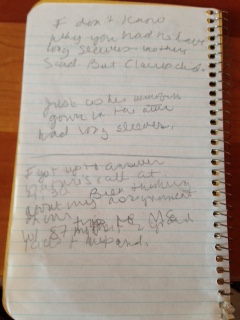
Middle of the night notes
These two ideas have reinforced the fact that I have been writing “Claire” on a superficial level, unwilling or unable to delve into what is happening in Claire’s mind to cause her to act as she does. I finally get it that her actions will not be acceptable to the reader without a better understanding of her motivations, especially her internal ones. As usual, I know what those are, I simply have failed to commit them to paper. Basic “Novel Writing 101” and something John, our facilitator, has encouraged me to focus on. I can’t wait to get to work on that!
Free Names

Listen Up!
For some time, I have been keeping a small notebook in my purse in which to capture fugitive ideas, oddities, vignettes, and joyful or horrid happenings for use in future writing. From this exercise has come, among much else, a long list of weird names encountered in the press and occasionally in life. I long to use them in fiction, but since they belong to real people, the best I can hope for is to mix and match. Today, I want to share some of this raw material with you, my fellow writers, who may well come up with better matches and better mixes than I. Feel free.
Some of the names are simply too appropriate to be believed. There are:
- Sir Jock Stirrup, once head of the British armed forces (and now Baron Stirrup.)
- John Stalker, an ex-Deputy Chief of Police.
- James Naughtie, the BBC Today interviewer of a heterosexual man who, after a stroke, “woke up gay.” Naughtie was described by Britain’s Daily Mail as “the formidable BBC pinko who turned the airwaves blue.”
- UK Member of Parliament, Mark Reckless, who bolted the Conservative Party to join the Independence Party.
(The English outnumber the Americans in my list. Does this Mean Something?)
Here at home, the items in my collection seem to come with brief stories attached. I itch to fill them out:
From my cookbook shelf, Crescent Dragonwagon beckons. According to my sister-in-law, who claims acquaintance with her (and that is not the kind of source one questions), Ms. Dragonwagon married an enlightened man who did not insist that she take his surname. Neither of them wanted a hyphenated name, however, so they made one up. The marriage ended, but Ms. Dragonwagon’s  vegetarian cookbooks were already well known, so, publicly at least, she will be Dragonwagon to the end of her days. The stuff of tragedy.
I found another name near the end of a news tidbit about the theft of a Stradivarius violin. We were several paragraphs down into an account of the Strad before the perpetrator appeared: “The violin, which police said appeared to be in good condition, was stolen late last month from a concert violinist who was shocked with a stun gun…. Police traced the stun gun to Universal Knowledge Allah, a 36-year-old barber….”
A cousin of Michelle Obama made the papers very recently. Rabbi Capers Funnye of Chicago was nominated to become what an international organization is calling the first “black chief rabbi” of the 21st century. A statement from the International Israelite Board of Rabbis declared that Funnye would serve as the “titular head of a worldwide community of Black Jews.” And why not?
Internationally, my best name source so far came from an account of Ted Cruz being booed off the stage at a gathering of Middle Eastern Christian ecclesiastics. It was also my best source of impressive titles. In the audience were:
- Patriarch Mar Bechara Boutros Cardinal Raï, Maronite Patriarch of Antioch and All the East;
- Gregorios III Laham, Melkite Greek Catholic Patriarch of Antioch and All the East, Alexandria, and Jerusalem [pictured at the top of this post];
- Ignatius Youssef III Younan, Syriac Catholic Patriarch of Antioch and All the East;
- Aram I Keshishian, Catholicos of the Great House of Cilicia of the Armenian Apostolic Church;
- Metropolitan Joseph Al-Zehlawi, Archbishop of New York and All North America for the Antiochian Orthodox Christian Archdiocese of North America;
- Bishop Angaelos, General Bishop of the Coptic Orthodox Church of Alexandria;
- Ibrahim Ibrahim, Bishop Emeritus of Chaldean Eparchy of Saint Thomas the Apostle.
I don’t know where to start the character list for my fantasy novel, with the Catholicos of the Great House of Cilicia or the Bishop of the Chaldean Eparchy of Saint Thomas the Apostle. George R. R. Martin, look out! (Alas, the first result of a Google search on the Eparchy was a parish listing — in Southfield, Michigan. The glamor is gone.)
Okay, writers, start your pens. Pick a name and give me a scenario.
 Eleanor Ingbretson
 Karen Whalen
 llandrigan
 Heidi Wilson
 Mike M
 Thursday Night Writes