Monthly Archives: September 2018
Consider yourself caught up
Time to bring you up-to-date on everything that’s kept me away from here since April 23.
Turns out that leaving Arizona a few weeks early this spring was a good idea. Within two weeks of our return, my ninety-year old mother was in the hospital with a compression fracture and three weeks later she died. With lots of help from family, we cleaned out her apartment in two days then sold the things we couldn’t keep (along with lots of my things–another good idea) at several yard sales. Her graveside service followed a few weeks later; the extra time allowed us to plan a very special service to honor her memory.
My husband and I have always said that once my mother passed, we would sell our house and move. Somewhere. That moment suddenly was upon us. We worked like crazy getting our house ready to put on the market, had lots of showings, and less than two weeks later we were under contract. That was pretty much the extent of our summer.

Grand Teton National Park
Except for the fantastic trip to Utah, Jackson Hole, WY, the Grand Teton and Yellowstone National Parks that we took with our Arizona crew in the middle of July, that is! We were fortunate to take our nine-year old grandson from NH with us, for a total of twelve. He loved his cousin time and the bears, bison, elk, Old Faithful, white water rafting, horseback riding, and pool time.
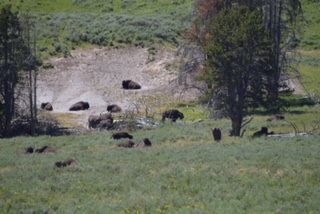
Yellowstone National Park
Amidst all of that, we worked feverishly on plans for a small apartment over the garage of my daughter and family in a town about twenty miles north of us. When the contractor calmly suggested cutting the roof off the garage to put in a shed dormer, we knew it was time to regroup. My daughter suggested we look down instead of up. Her finished, wide-open, walk-out basement makes much more sense–it’s larger than the first house we built back in 1975 and will cost twice as much to make it into an apartment.
We are now at a point that I never thought I would be at again: picking out kitchen cabinets, flooring, appliances, bathroom fixtures, paint colors, new furniture. I’ve managed to push as many of the decisions as possible onto my daughter. It is her house.
Our closing date for the end of October fast approaches. We have categorized our remaining furnishings as keep, sell, or give away. My husband says get rid of everything and start fresh. He may get his wish. After this weekend’s yard sale (the fourth of the summer!), we may be left with just the essentials: our bed, couch, television, coffee table, and coffee maker.
Starting fresh is my new approach on Gabby, one of my Woodbury trilogies. Though I’m not scrapping everything I’ve written, I have made some major changes. I’ve moved the beginning of the book back a few scenes, setting the murder a few chapters into the book. Gabby has a new background and family. If I can pull it off, the third act will include different points of view. Borrowing a memorable line from one of my favorite movies, we think you got a lot of potential, Gabriella.
Losing Fallowfields
The trouble with plotting a novel in which your protagonist encounters challenge and change is that you have to experience her losses with her. Eliza Harris, protagonist of my long-labored mystery novel, is going to end up moving into a “senior community” of highly eccentric academics. When I thought this up, it seemed full of promise. That was before I invented Fallowfields, the house she is going to leave.

“The Ridge,” known as the “finest group of Federal-style houses in the United States”
Near my own real home (I am, unfortunately, a real person) is a short stretch of country road where, around 1800, six New Hampshire tycoons built their mansions, one right next to the other. Remember the old ads for Dewar’s Scotch that had a rich guy trotting across the yard to his neighbor’s palatial home from his own, to borrow a cup of Dewar’s? It’s like that. Without realizing I was doing it, I created Fallowfields from bits and pieces of the three houses I’ve visited.

Fallowfields? (Actually a house in Glencoe, Illinois)
Externally, Fallowfields is unlike the Ridge houses. It’s a Victorian brick monstrosity, rather like the house of the Addams family. Inside, though, it’s a dream. In fact, imagined houses are like dreams. Bits and pieces of places we’ve known are plugged in or detached as needed, logic not included. As in Terry Pratchett’s Empirical Crescent (built, you will recall, by Bloody Stupid Johnson), the door of Number 3 can open into the back bedroom of Number 14, entirely without consequence.
Once you import these mysteriously significant spaces into a story, though, the pieces need to fit. The staircase and the fireplace in Fallowfields’ living room have changed places three times. In the end, the fireplace settled on an outside wall – less likely than a central position in a house of its vintage, but I needed a staircase open to the living room, so one character can overhear a remark not meant for her ears. Of course, she could simply have been walking in from another room on the same floor. But by that time, I had the stage set in my mind, and her descent from above pleased the director in me.
The layout of Fallowfields has reached the point of proprioception for me. I can feel the living room on my right as I stand in the dining room looking down the corridor to the front door. This south side of the house has been grafted onto the layout of the local mansions – it is an apartment that my mother lived in for only one year while I was mostly away at college. So although Fallowfields is a very large house, with big rooms, when my mind is absorbed in the action of the story, the walls shrink in around me. When space is needed for, say, a large party or for a character to be far enough away from another for a whisper not to be heard, the walls ease out again. These contortions warn me to be careful; they’ll be fertile breeding ground for howlers in the logistics of the story.

Eliza’s desk
The furnishings are much to my taste. Eliza’s desk is huge and heavy, made of the same mahogany as the pieces brought into our household by my English great-grandmother. It sits beside a tall window with six-over-six panes of glass. Outside is an ancient maple, huge and close enough for Eliza to watch lines of snow fall from individual twigs on a sunny February day. There is a liquor cabinet well-stocked with Scotch, bourbon and, at the back, an old bottle of rye that comes in handy for a rough-and-tumble visitor. The kitchen has a soapstone sink, hewn from the (perfectly real) soapstone quarry near my home on the side of Cottonstone Mountain.
Fallowfields has outbuildings linked together in the big-house-little-house-back-house-barn configuration of early New England farms. These, unmagicked, are cobbled together from the back house and barn of the original farmhouse on our property plus my grandmother’s chicken house in Peacham, Vermont.

Big House, Little House, Back House, Barn
My mystery plot requires that the back house have a loft, the barn’s tack room be turned into a laboratory and its hay loft into an apartment. They lost none of their reality in these renovations. The horse stalls in the far end of Eliza’s barn still bear the faded names of Shetland ponies who lived, long ago, in ours: Jennifer, Princess, Duchess.
So it will be very hard for me to force Eliza out of Fallowfields. I console myself with the thought that it will remain enshrined in the story, holding in place a lifetime of memories.
What about you, readers and fellow writers? As a story streams through your brain, what parts of your world does it clothe itself in?
Plot Blindness 2

Two months ago, I started work on a short story. Being, as I thought, hopeless at making up plots, I decided to call in a specialist. I hauled down my old copy of Vladimir Propp’s Morphology of the Folk Tale, wound my way through his detailed analysis of 600 Russian fairy tales, and plucked out the elements of a plot. Then I set to work to fill in the outline with a story of my own, about a carnival beset with supernatural difficulties.
The process may be working.
My original two pages of single-spaced blather was what you would get if shooting a writer in the head caused her ideas rather than her brain to splatter over the computer screen. (You can tell I come to this from the mystery genre.) As I said in a blog post at the time, the minute I set pen to paper, marvelous images and ideas proliferated out of all proportion to their usefulness. Booths selling deep-fried Twinkies jostled elderly elephants and juggling dwarfs for the spotlight. My characters wrangled over money, power, the uses of magic and dietary insufficiency.
By the grace of some Muse, I had the idea of searching the jumble for objects and events that would make striking scenes, regardless of logic. The jumble began to separate. In brief summaries, every scene made sense within itself. Some of them actually had an arc to them.
Once I had seven or eight scenes, stretching from start to resolution, I was sorely tempted to start writing. I held off, though. I tinkered. The carnival got realer and realer, but the plot got more tangled. As the scenes grew elaborate, contradictions between them multiplied.
Somehow, having each contradictory element trapped in its own scene made the process manageable. One by one, scrolling up and down, I made the changes needed to untangle them. By the time I had a complete set of scenes, I also had a workable plot.
Better still, as I worked, characters changed their motivations, their functions, their importance. The villain and a minor character swapped places. They all started talking to each other, and I eavesdropped on some quite good dialogue.
At last I started writing, and learned that writing as a plotter feels different from writing as a pantser. Same feeling of flow – complete absorption in the task – but it feels like working with a smaller brush. With a clear picture of what needs to be written right here and now, I find I’m working simultaneously on narrative, images and wording. I can reword a sentence three times in the course of writing one paragraph, without losing focus on the story. It feels tighter, but just as satisfying.
There are still glitches. Seeing each scene in great detail lets details creep in for their own sake. I need to give more thought to the order in which the reader learns things vs. the chronological order of events. Revisions will be needed, but as a plotter, I’m less afraid that they will simply blow the whole thing up.
Onward!
 Eleanor Ingbretson
 Karen Whalen
 llandrigan
 Heidi Wilson
 Mike M
 Thursday Night Writes