Monthly Archives: June 2018
Rx for Plot-Blindness
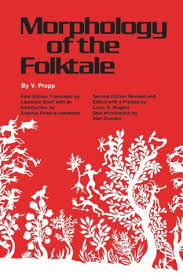 Having recently attempted to mend a badly boggled plot, and as a result scattered a whole book to the winds, I decided it was time to work stupid. Plagiaristically, even. I pulled off my bookshelf a favorite old textbook. Not from a creative writing class – I never took one of those (and that was a bad mistake.) My chosen instructor was Vladimir Propp, Russian scholar of folk tales and author of Morphology of the Folk Tale.
Morphology analyzes the structure of the stories in a huge corpus of Russian folk tales assembled by Alexander Nikolayevich Afanasyev, who was the Russian brothers Grimm rolled into one.

Alexander Nikolayevich Afanasyev
Afanasyev’s collection, published between 1855 and 1867, filled eight volumes and included some 600 tales. Propp found that he could condense everything that happened in every single one of the tales into a list of no more than 31 narrative events. He called these “functions.”
Better yet, for those of us with plot blindness, Propp claimed that whatever subset of the functions was included in a tale, they always appeared in the same order. That is, a tale might include only functions 2, 3, 8, 14, 16, 18, 30 and 31, but in the chronology of the tale, those functions will always appear in that order. Marvelous! Pick your functions, fill in a few details and there’s your story! Right?
The subset of functions above is not random: they’re the ones I picked out for my ready-made plot. Here are their definitions:
INTERDICTION: A forbidding edict or command is given.
VIOLATION OF INTERDICTION: The prior rule is violated.
VILLAIN CAUSES HARM, not necessarily to the hero.
HERO ACQUIRES A MAGICAL AGENT.
COMBAT OF HERO AND VILLAIN
VILLAIN IS DEFEATED.
VILLAIN IS PUNISHED.
HERO IS MARRIED AND ASCENDS THE THRONE.
Now, about those details….
Brainstorming is where I always get into trouble. It’s not that I can’t do it. I just find myself unreasonably delighted with the characters, settings and odd little objects that pop into my head. Once I’ve thought them up, I can’t sacrifice them just to make some stupid plot work.

Eat Me!
The hot dogs are a case in point. I’m currently re-re-re-reading The Circus of Dr. Lao, Charles G. Finney’s 1935 masterpiece about a very strange little carnival. So my brainstorm around the Propp plot naturally begins by setting my story in a carnival. A magical carnival, of course. That decided, I need a combat at a carnival. Bingo! A hot dog eating contest now infests my story, and I can’t get rid of it. And wait! Carnivals always have lots of stalls selling food. Like state fairs… Have you heard about the deep-fried Oreos at the New Jersey State Fair? The deep-fried butter in Wisconsin? How about those Twix-stuffed Twinkies wrapped in bacon at the North Carolina State Fair? I’ve got to get stuff like that in.
Then, instead of casting about for an interdiction, my mind leaps ahead to the magical agent. It’s my favorite function, and my favorite form of it has always been the magical animal. Propp lists multiple ways in which these may fulfill the function; I end up combining three of them. The third, a bag of dragon’s teeth, wandered in from my long-ago dissertation on the Argonautika.
So now I’m knee-deep in hot dogs, fried butter and dragon’s teeth. When I finally start the search for a good interdiction, food is still on my mind. I get a good long way with “no magic in the food for customers,” but then that gets tangled up with a princess (actually the carny owner’s daughter) who isn’t allowed to eat because it messes up her magic…. Did I mention that Propp also condensed the character list into only seven people?
I showed my brainstorm to date to my writing group. They said, “???”
I’m determined, though. I’ve already caught myself in three intolerable contradictions and wrestled my way out of them. I will get a story out of this exercise, or eat a Twix-stuffed Twinkie wrapped in bacon.
Win-win.
GARBAGE
GARBAGE
Or, as they say, not, in France, Gharrbahggge. They don’t call it that, but they do put it into a poubelle, which sounds so much more beautiful than a garbage can, or trash can, or even circular file.
While I was working my way through Sleep School, aka, Cognitive Behavioral Therapy for my insomnia, I whiled away many evenings reading mysteries, watching movies, TV mystery series, doing Sudoku puzzles, playing scrabble, indulging in long phone calls with people on the west coast, all in a seemingly never-ending struggle to stay awake until my appointed bedtime. Bedtime was at midnight but has moved slowly and incrementally up to a more reasonable 11PM. Now I’m aiming at 10:45. Not bad. I’ll still have time to read.
In the mysteries I entertained myself with, past and present, written or filmed, it dawned on me that the detective (professional, or the more entertaining amateur) might have to search through dumpsters, landfills, dumps, and sweet sounding poubelles to find clues. On the way to finding clues, there was a lot of yuck. Sometimes the yuck was a clue. Yuck.
Amateurs braved the garbage themselves unless they were independently wealthy and had an assistant to do it for them. They probably won’t have that assistant for long. Professionals had a string of underlings who aspired to reach the top rung in the ladder of detection and therefore dared not give up. They were given Hazmat suits. Lucky them.
I considered my own personal poubelle at the side of my desk this morning and wondered what clues it would yield to the inquiring mind. At the moment I’d wondered I had just tossed in a chocolate wrapper. It was exceedingly good chocolate, and I would recommend it to anyone who asks. In the same receptacle is a potato chip bag. Also a good quality chip.
What would those items tell a snoop?
However, the bulk of the trash is folded, smashed, wrinkled and torn up paper; my attempts at writing. They are the critiqued pages of my stories, handed back to me in good faith by my faithful companions. The notations had been gone over, the comments were read and may be applied.
There is nothing physically yucky in there, no need to suit up. I try to keep it all burnable.
But what would it tell someone who thought I had committed some heinous crime?
The crime indeed would not lie in my choice of snack. My taste in chocolate is impeccable. Quality over quantity every time.
But what about the paper? Quantity over quality?
Ah, there might lie the crime.
Breaking the Mystery Rules

I was whining away on a Facebook page the other day (Golden Age Detection) about how the current “rules” for mystery novels are turning them boring. So today, a positive note: a review of one of my favorite Golden Age mysteries that breaks many of those rules, Dead Water by Ngaio Marsh.
The book begins, as Marsh’s always do, with a list of the “dramatis personae.” Marsh worked in the theatre, and some of her best mysteries take place during theatre productions. (Her very best book, in my view, is Light Thickens, in which she violates the most sacred commandment of the Detection Club by…
SPOILER ALERT: if you haven’t read Light Thickens yet, scroll past the single line in italics immediately below this one.
…ending the story with the entirely satisfactory discovery of a homicidal maniac.
I love to make my way through the dramatis personae list, imagining likely interactions, spotting promising eccentrics and provokers of conflict. In Dead Water, the obvious candidate is “Miss Emily Pride, Suzerain of [Portcarrow] Island.”
Dead Water comprises only nine chapters, and the first of them is that major no-no, a prologue. Its title is actually “Prelude.” It recounts the alleged appearance of a fairy in a modern-day (that’s 1963) UK fishing village, and village’s resulting transformation into a folklore-y spa. Conflict is confined to minimal levels of discomfort as the whole cast of characters is introduced. Far from leaving anyone hanging from a cliff, the final sentence of the Prelude informs the reader that the story is about to leap over the following two years. This prologue takes up its full 1/9 of the text.
(“Prelude” also sets up one rule-blessed plot thread of which Marsh was fond: a romantic young couple, who will – the reader always knows – live happily ever after once the inevitable murder is cleared up.)
The first quarter of Chapter Two is very heavy to backstory, another no-no. The vivid characterization makes it perfectly smooth and perfectly fascinating. One of Marsh’s best creations, Miss Emily Pride, born ca. 1880, was formerly French coach to rising members of His Majesty’s diplomatic service. The rest of the chapter sets the scene for future confrontations, but the participants in the main conflict of the story remain hundreds of miles apart.
In Chapter 3 the enemies meet and conflict escalates, but nothing worse than threats and minor assaults occur. Not until the end of the chapter does the detective/protagonist appear on this scene of not-quite-crimes. In this reader’s opinion, the threatened victim beats out our hero for character and interest. (I’ve never been hugely enamored of Marsh’s detective Roderick Alleyn. He and the mysteries he unravels serve, it seems to me, largely as an axis for the galaxy of her dramatis personae.)
We are now 1/3 of the way through the book. The first quarter of Chapter 4 is a comic and entirely believable account of a disastrous village festival, ending in nothing worse than a thunderstorm. Not until the end of the chapter, at the 40% mark, does the first and only corpse in the story appear, and it is not a cliffhanger but an elegant switcheroo.
From that point, detection takes over, with no diminution of character interest or involvement with the setting. Marsh’s brilliant plotting picks up from the early chapters clues and red herrings –– including the fairy and the thunderstorm – so subtle as to have been invisible even to experienced mystery readers as they passed by. When the usual climactic scene of derring-do is complete (another rule that Marsh generally followed), Chapter 9 continues with an extended explanation by the detective, a happy ending for the lovers and charitable provision made for innocent sufferers. This denouement covers two days.
Marsh’s editors seem to have had no problem with passages inserted for sheer fun. Here’s one of my favorites. A now-deceased character, whose sole function is to have made a plot-generating bequest to Miss Emily, is described:
My sister, Fanny Winterbottom,” Miss Emily announced, “was not free from this fault. I recall an informal entertainment at our Embassy in which she was invited to take part. It was a burlesque. Fanny was grotesquely attired and carried a vegetable bouquet. She was not without talent of a farouche sort and made something of a hit. Verb. Sap.: as you shall hear. Inflamed by success she improvised a short equivocal speech at the end which she flung her bouquet at H.E. It struck him in the diaphragm and might well have led to an incident.
So there’s an instance of brilliant, rule-breaking mystery writing. A small prize (a blog shout-out) is offered to all who can name a recently published equal.
 Eleanor Ingbretson
 Karen Whalen
 llandrigan
 Heidi Wilson
 Mike M
 Thursday Night Writes