Monthly Archives: May 2017
I love my ladies
Spoiler alert…I’m indulging in some writer whining. Again.
Tonight, a remake of a movie that holds a special place in my heart, “Dirty Dancing,” airs on ABC. Among many other negative reviews, TV Guide had this to say: “In an era where actual dirty dancing…has gone so mainstream that Katie Couric knows how to do it, this adaptation does not tango with the present…”
And yet, knowing that it will be a huge disappointment, I will watch it.
I’ve registered for the 2017 New England Crime Bake. Without allowing myself to consider what it would entail, I paid the extra $49 for the Agent and Editor Program, which includes critiques of a pitch and a query as well as the opportunity to pitch to an agent.
Initially I thought that I should pitch my current project, Gabby, at the conference. She’s nowhere near ready but if I focus on her I might be able to whip her into shape by November. What does pitching Gabby do to my plans for a trilogy that takes place in Woodbury, NH?
If I am committed to creating a trilogy, I am pretty certain it doesn’t make sense to pitch the novel that is chronologically the last one (Gabby). I am also pretty certain that it would be incredible if at the Crime Bake I could pitch a cohesive trilogy.
The truth is that in addition to Gabby, my other rough drafts are not ready to be pitched. Anne, Olivia, and Claire. Yes, that is four novels not three but Anne is begging to be joined with her daughter Olivia, and if I acquiesce, I will have a trilogy. But Anne has no murder. Or murderer. My list of characters reveals that I can change a death to a murder and provides a potential murderer. That was easier than I expected. Now for some suspects…
However, that is not the biggest issue with Anne and Olivia. It’s somewhat like Katie Couric and dirty dancing. The premise works for 1993, when it is set, but not so much in 2017. Will it be relevant to readers?
Claire is next. She has some flexibility as to when she takes place but as a senior citizen she is aging the longer she waits. Luckily, she is endowed with a murder, murderer and some suspects. And a man in the attic is timeless.
So now I’ve created a three-headed monster: Anne/Olivia, Claire, Gabby. Do I put Gabby aside and return to Anne/Olivia because she started all of this? Is what I’ve invested hours of time and brain cells into worth resuscitating? Or am I trying to breathe life into a bunch of Word files that I would be better off jettisoning into the Trash folder?
Funny how I can hear a little voice in my head, let’s call him John, giving me some advice—most likely because I have posed this same question to my writing group numerous times. Don’t worry about a trilogy, just focus on getting one novel in good shape so you can pitch it in November. Burn those early writings. They were just practice. And that’s just some of what I assume his advice would be.
But I love my ladies.
Show Your Shelf!

Miniature of Cornificia (Corinse) in her study, from a Flemish translation of Christine de Pizan’s Cité des dames (‘De Lof der Vrouwen’), Bruges, 1475. British Library Add MS 20698, f.70r
Nowadays, even the Pope takes selfies. If you’re a committed writer and/or reader, though, you can get a better likeness than that. Share your shelfies, picture of your books. Give yourself a little leeway, and you can include your desk, your writing space and your reading corner. Why post a picture of your ugly mug? Show us your frontal cortex!
Here’s the most public of my shelfies, the bookcase beside my fireplace.  It displays the books most worth looking at as objects. Almost all of those on the top two shelves were my mother’s or my grandmother’s. They’re bound in leather, tooled in gold. (The books, not my progenitors, though they were pretty hidebound, too.) The stretch of identical bindings is a set of officially worthy books, some of which are indispensable, like Pride and Prejudice and Wuthering Heights, though I’d already read those in paperback before it occurred to me to look through the family holdings. On the other hand, Lord Charnwood’s biography of Abraham Lincoln will probably be up there, unmoved and undusted, when I die.
The tall books on the bottom shelves are mostly art and coffee table books. I have no memory at all of their provenance. I think people break in at night and drop them off to free up their own shelf space.
Below, in extreme contrast, is The Holy of Holies. Books have to be canonized to get here, and for this purpose, I am the Pope.  Most are fiction; a few belong on the history or science shelves. Atwood and Byatt are there, as are Pogo, the best of Diana Wynne Jones, and Perfection Salad, a study on the sociology of home cooking around 1900 that transports me to my grandmother’s kitchen. The woman in the picture is my best friend. A librarian, naturally.
Next, my Purgatory. These, combined, constitute the To Be Read pile. I’ll spare you images of the Lowest Circle (books that have been sitting around so long I can’t remember what they’re about, let alone why I bought them) and the Middle Circle (books I still firmly intend to get to, only not just now, because the purchasing impulse did not convert quickly enough into the buckling down impulse. There’s a lot of nonfiction here.)
Finally, the TBR Upper Circle. These are probably going to make it into my brain within a year or so. I hardly had to rearrange the piles at all to display all my major interests (widdershins from top left): writing, the Israel/Palestine conflict, mysteries and Buddhism.  The mix stays the same all the way down. There are also a few specialized books picked up for research, for instance, a detailed description of a classic Yankee-clipper-era mansion and an endless account of everything known about the Abenaki people of New England. But I guess those come in under “writing.”
How about you, readers? What do your bookshelves look like? Are your shelfies a better likeness of the real you than what you see in the mirror?
Later addendum: Actually, it’s not your frontal cortex (which should have been “frontal lobe” anyway.) You read with your posterior parietal lobe. But somehow, “show us your posterior!” even with “parietal lobe” added, seems to change the tone.
AN APPROPRIATE TIME
AN APPROPRIATE TIME
1 To everything there is a season, and a time for every purpose under the heaven.
2 A time to be born, and a time to die; a time to plant, and a time to pluck up that which is planted;
3 A time to kill, and a time to heal; a time to break down, and a time to build up;
4 A time to weep, and a time to laugh; a time to mourn, and a time to dance;
5 A time to cast away stones, and a time to gather stones together; a time to embrace, and a time to refrain from embracing;
6 A time to get, and a time to lose; a time to keep, and a time to cast away;
7 A time to rend, and a time to sew; a time to keep silence, and a time to speak;
8 A time to love, and a time to hate; a time of war, and a time of peace.
In Ecclesiastes we read that there is a time for this and a time for that. In the twentieth century Pete Seeger, The Byrds, and Simon and Garfunkel revisited these verses through their music. Writers constantly revisit the question: where and when (how, why, who, and by whom) should a murder be committed.
An agent I spoke with during a pitch session was adamant about when murders occur. She said, “One in the beginning (first page) one in the middle and one at the end. There had to be at least three”. I didn’t comment, after all, I was pitching, she was catching. But I disagreed. I have always disagreed with that formula.
Heidi, a fellow writer at Thursday Night Writes, agrees with me. This is what she wrote to me this morning:
“I just reached the first murder in my current reread of Ngaio Marsh: on page 111 of a 247-page book. So let’s have none of their nonsense about a murder on the first page.”
Exactly. With a first page murder where is the time for loving and hating, a build up to WHY.
Where is the time for being born, so we know WHO?
Where is the time to gather stones together so we can figure out BY WHOM?
And what about a time to plant in order to know WHERE or HOW.
Moby Dick didn’t kill Ahab till the very end of a very long book. And maybe Moby Dick isn’t the best example since it’s so long and drawn out, but in the course of the story the intentions of the two protagonists (Yes, two. I have always sided with the whale) are revealed to the reader. At the end of the book it was definitely time for Ahab to be plucked up. Definitely.
In a cozy we want to dwell on our characters and their emotions. By having a murder on the first page we lose a lot of opportunities for them, and especially for our protagonist, to weep and laugh and mourn and dance; to build them up and flesh them out. Flash forwards are the answer you say. Flashbacks. Sure, they can work, but I say there nothing like a straightforward build up of actions leading to straightforward consequences.
There’s a time for everything and everything in its time.
I’m (still) a Genealogy Junkie
My road down the path to becoming a genealogy junkie started innocently enough, as I imagine it does for many addicts. (See my blog post of September 13, 2016, A Pilgrim in the Family.) My husband’s family is my drug of choice.
When my research revealed that Bailey Clough, my husband’s fourth great-grandfather, of Lyman, NH, fathered Helen Luella Clough at the age of sixty-nine, I knew I had some digging to do. I located Historical Sketches of Lyman New Hampshire, written by E. B. Hoskins and published by Charles P. Hibbard in Lisbon, NH, in 1903.

Historical Sketches of Lyman New Hampshire
If these sketches are brief and contain little of deep interest, it is because Lyman is a small farming town, and its history has been quiet and peaceful, with no events of a remarkable character.
I smiled when I read this. It is how I envision Woodbury, NH, home to Gabby, Anne, Olivia, Em, Lexi Rae, Claire, Louise. Nothing has happened here of a remarkable nature. Until now.
Finally, on page sixty, I found the Clough family: William Clough served in the French and Indian war three years, was captured by the foe and carried to France, where he was kept a year or more. He entered the Revolution without enlistment, and was at the battle of Bunker Hill. His children were, namely: Zacheus, Enoch, Bailey, Cyrus, Abner, Jeremiah, Elizabeth, and Dorcas.
Turn the page and there’s virile Bailey: Bailey Clough, son of William, married Susannah Smith, sister of Reuben Smith, Nov. 28, 1799. Their children were, namely: James, born in 1801; David, born in 1803; Darius, born in 1809; Benoni, born in 1812; Chester Hutchins, born in 1822; Susan; and Bailey.
Aha. Bailey had a son with the same name. And Helen isn’t listed among the offspring of Bailey Senior. The son must be the father. If the children are listed in order of birth date, which the author generally did, then Bailey would have been born after 1822. As Helen was born in 1838 or 1839 or even 1841 (I think she lied about her age so that she wouldn’t appear to be ten years older than her second husband), it’s hard to believe that her father was the younger Bailey.
I scanned all of the biographies in the history hoping to find something to link Bailey Clough, senior or junior, and the daughter, Helen, and the wife, Lydia. Nothing there, nothing in Ancestry.com, nothing in Find A Grave, nothing in Wikitree. I can’t believe I’ve reached a dead end in the nineteenth century.
I’m mentally exhausted. And ready for a trip to another cemetery!!
PS After writing this post I was itching to resolve the Bailey Senior/Junior mystery. I returned to Ancestry.com and looked at some other family histories (the least reliable source of information) that I had ignored earlier. Some more research and I am closer to saying that Junior was married to Lydia Stevens and was the father of not just Helen Luella but also Martha Ella. (And I get complaints about the names of my characters!) Bailey Junior was born in 1817, making him old enough to be Helen’s father. He died around the time that Martha was born so it is conceivable that Helen went to live with relatives, as the 1850 census shows her living with an eighty-year old Bailey Clough and possibly her aunt and uncle.
Mystery almost solved…now to get to work on my own mystery.
Other Kinds of Craftsmanship
I went down to D.C. two days early for this year’s Malice Domestic conference, because my husband had an event to attend beforehand. I was at loose ends while he expounded energy policy, so I wandered into the annual Smithsonian Craft Show. It’s a juried show that draws applicants from all over the country. More than 1,000 artists competed for 120 spots. Thirty-four states were represented.
You know how you can get really depressed when you read a good mystery, because you can’t imagine how you’ll ever write one that good? Well, here’s news: other crafts than writing can have the same effect. The sheer perfection of these objects left me wincing at my own feeble efforts to make a work of art out of words.
But I’m a brave little soldier. I walked around, took pictures, talked to artists and tried to learn. I’d planned to write you a profound meditation on creativity and craftsmanship. But what do I know? Below are eight of my favorite exhibits, followed by what the makers themselves have to say about the process of bringing them into being. Change a few terms here and there, and they’d apply just as well to the writing trade.
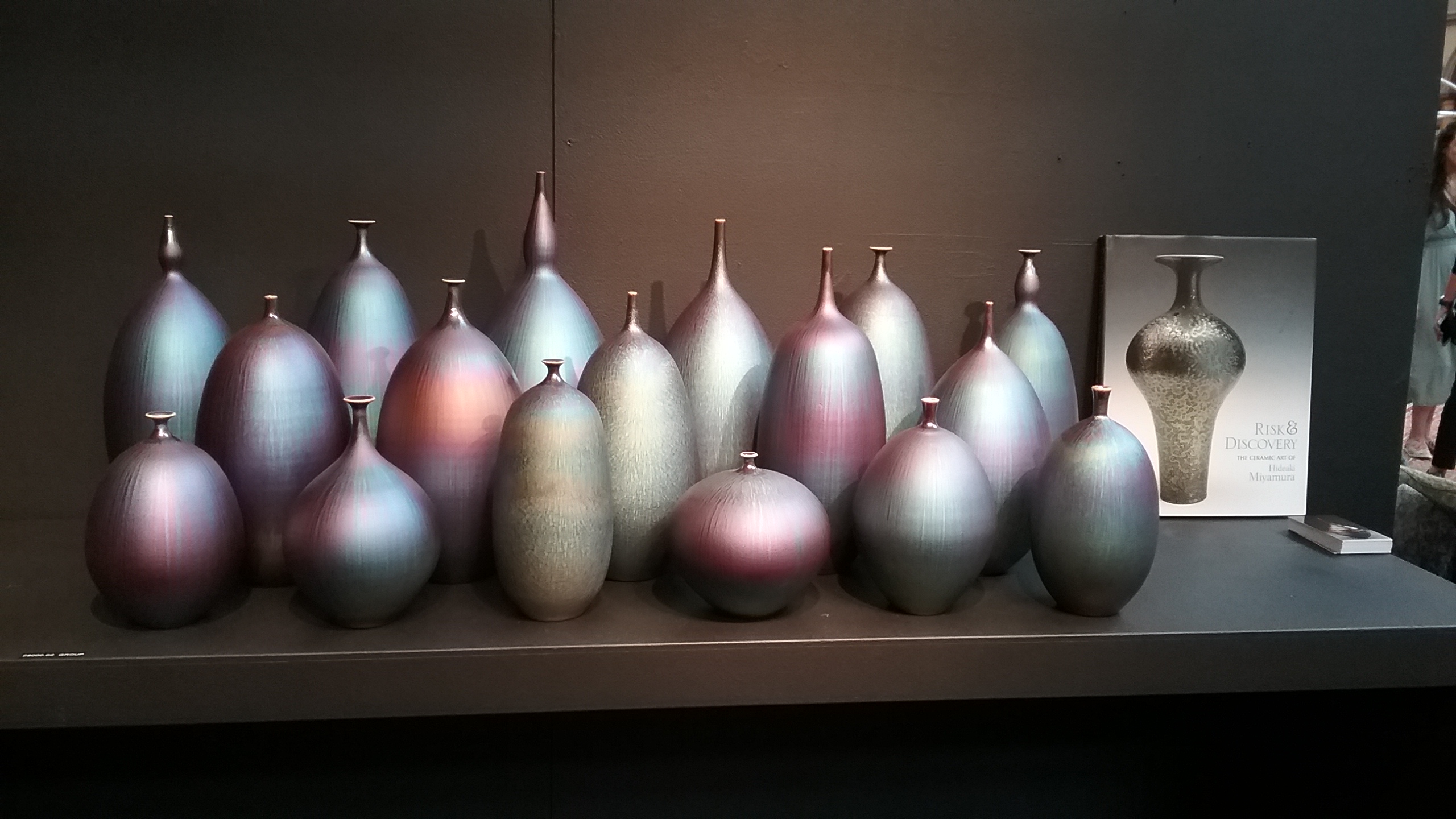
Ceramic vases by Hideaki Miyamura
miyamurastudio.com
My work began as a quest for iridescence…. I studied and apprenticed with a master potter for six years. At first, my studies focused on form. I made thousands of sake cups, then thousands of tea cups, then, eventually, vases and other forms, until my hands and body could create without the intervention of my conscious mind. I performed thousands of experiments….

Poppies on Silk by Deborah Falls
deborahfalls.com
I was drawn to working with silk and dyes because of the vibrant colors of the dyes and the wonderful texture of the silk. Since I am self-taught in this medium, I had no idea of traditional silk painting and developed my own way of applying and managing the unmanageable dyes. I did, however, have a sense of the imagery that I wanted, and was able, after many trials and much patience, to adapt a process that achieves my goals.
It was not until I started planting my own gardens about ten years ago that my imagery changed from abstract to realistic in the form of botanicals. I was so excited every time something emerged or bloomed that I felt compelled to capture this beautiful and amazing natural structure.
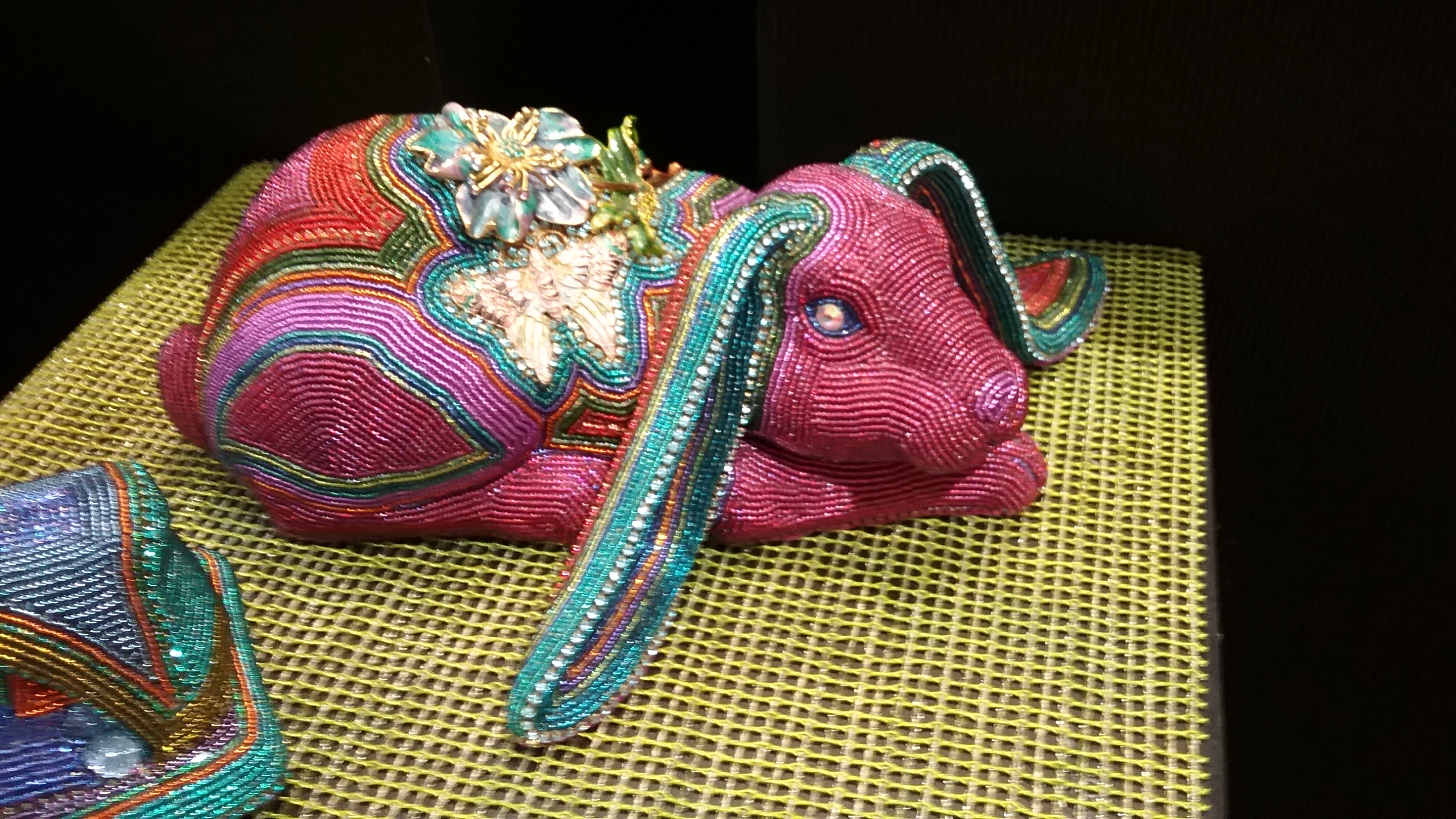
Beaded lop-eared rabbit by Tom and Kathy Wegman
tomandkathywegman.com
Tom and Kathy Wegman’s beaded art lives when they began collecting Native American beaded objects. After a while, they began making their own art, inspired by the beads themselves — bright, shiny things with the power to transform a mundane object into a thing of wonder.
Using over 450 different colors of seed beads to transform everyday objects into works of art. They glue individual strings of beads to other people’s discarded objects — roller skates from the Salvation Army, a lunchbox from the local secondhand store. Their general policy is “the brighter, the better.”
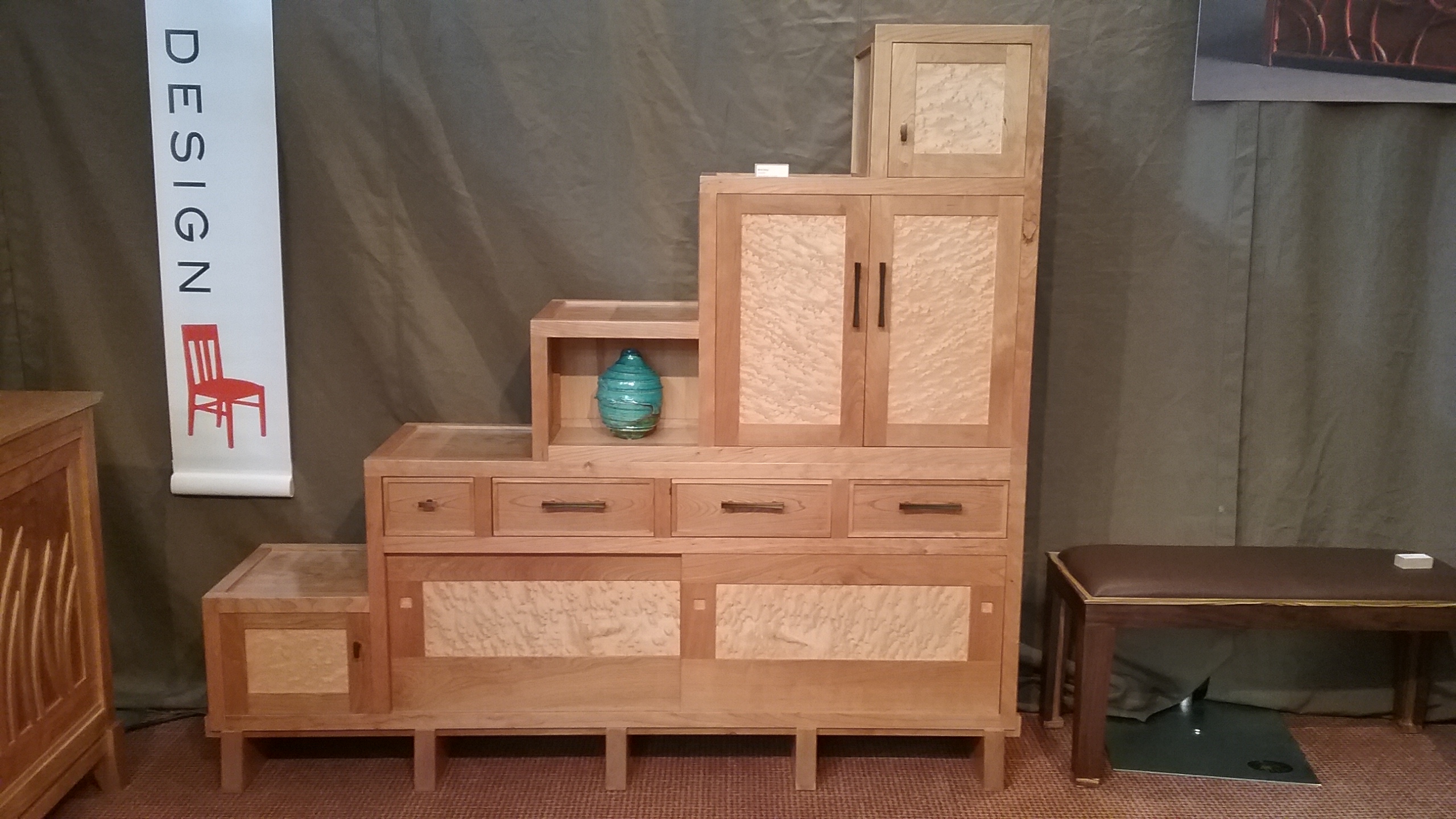
Bird’s-eye maple cabinet by Nojo Design
nojodesign.com
I take my cues from everyday objects, nature, the world around me, something as basic as a leaf – simplicity and elegance on the surface, but with an amazing underlying complexity.
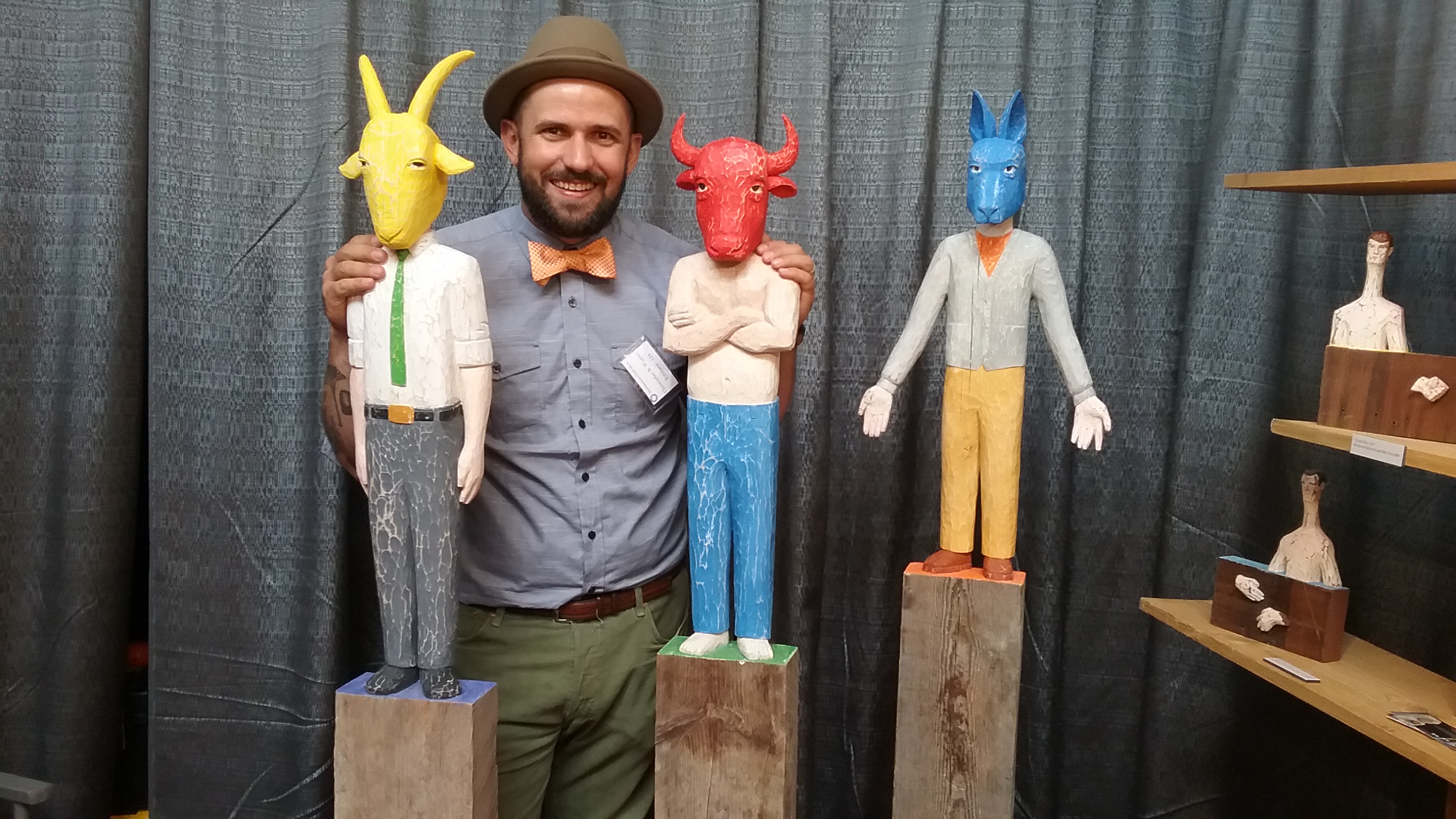
Wood sculptures by Christopher Wagner (and Christopher Wagner)
christopherbwagner.com
The reclaimed lumber he predominantly sculpts in provides a sense of history much greater than anything he could hope to achieve through artificial means. Elements of the wood’s own history, such as, nail holes, checking, and insect burrowing go into forming what he creates.
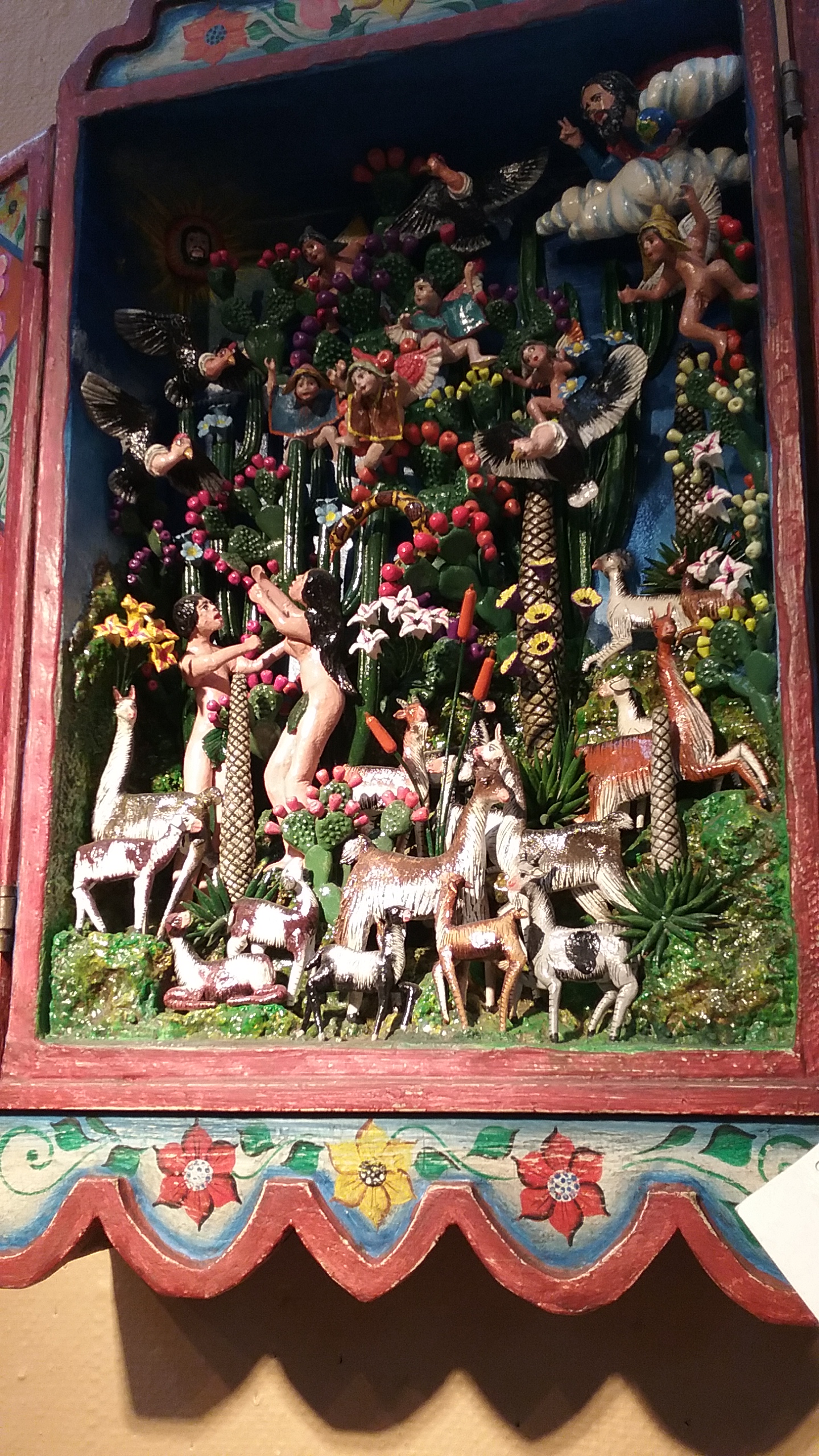
Retablo of the Garden of Eden by Nicario Jiminez
retablosnicario.com
Retablos are sophisticated folk art in the form of portable boxes filled with brightly colored figurines arranged into intricate narrative scenes. From the 16th to the 19th centuries, Retablos were carried through the mountains by Spanish priests as portable religious shrines for Catholic saints. Later, they were adapted by indigenous people to include their own deities and mythologies.

Glass vases by Fred Kaemmer
fredsglass.com
These pieces arose from a desire to create something interesting with clear glass. I enjoy working in this style because of the balance between control and serendipity each represents. Maintaining the shape of each vessel while allowing the glass canes to create a chaotic and beautiful fused nest within the piece is an exciting balance to execute. As a result, no two are alike.
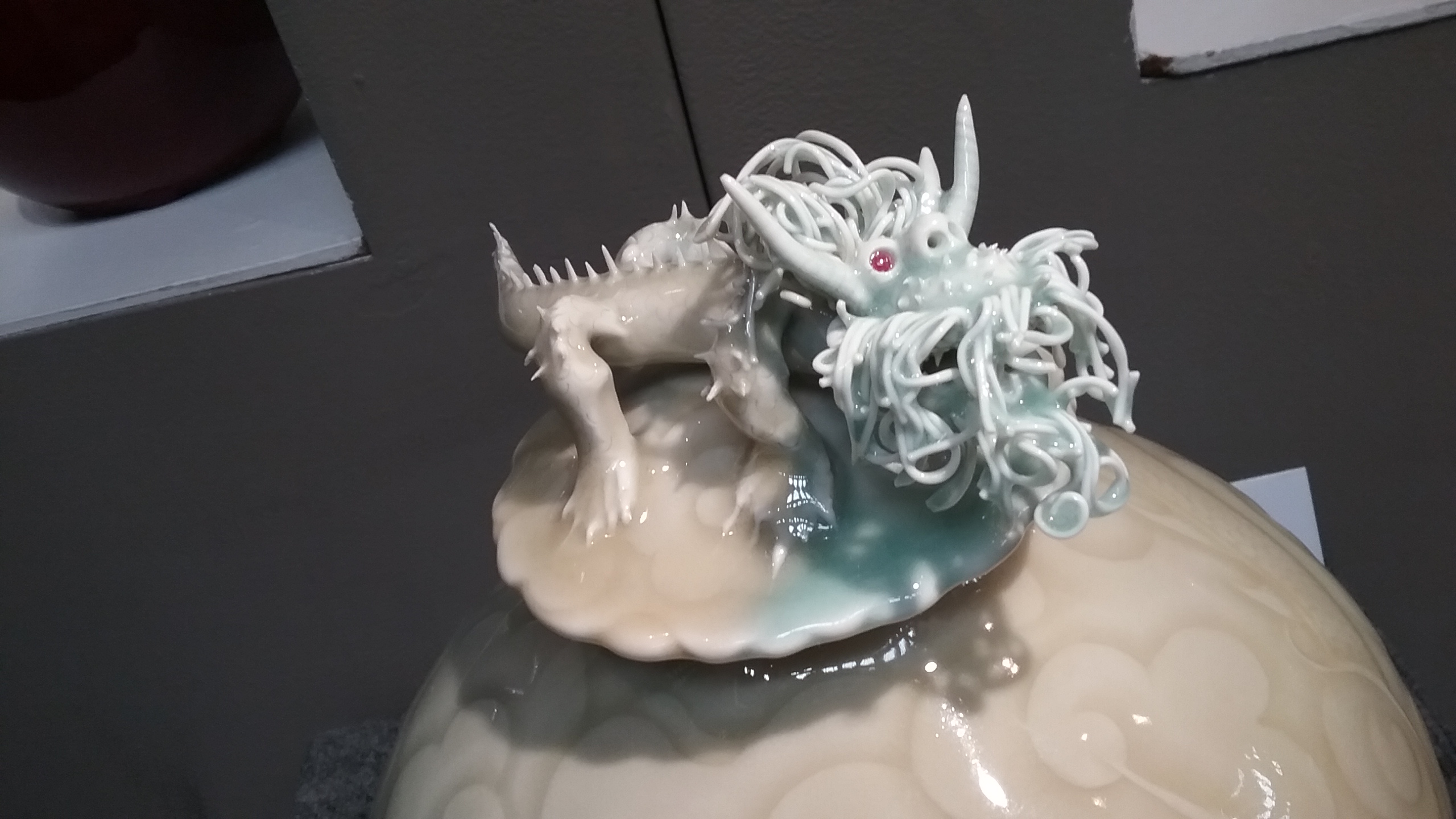
Lid of ceramic vase by ?
I lost my note of the artist’s name and contact information for this one. I’m still searching. For now, I’ll leave the nature of its inspiration to the reader as an exercise. Anybody care to ghost-write the artistic statement of this dragon’s maker?
 Eleanor Ingbretson
 Karen Whalen
 llandrigan
 Heidi Wilson
 Mike M
 Thursday Night Writes