Monthly Archives: March 2017
BLOOMING CROCUSES
BLOOMING CROCUSES
I just returned from Iceland, the land of ice and fire, back to snow covered New Hampshire. I’d gone north to get warm.
Actually, though they are warmer than we are throughout winter, the week I was there the temperature in Reykjavik was about the same as Pike, New Hampshire; in the thirties. But, wait for it, their crocuses were in bloom. And that’s saying something. We have another month to go before we see any spring flowers.
There’s no denying that I love Iceland. Just as I love Jasper Fforde and cats and chocolate. Maybe not in that order, but you catch my drift.
An idea for a story came to me while I was standing in the snowfields north of Reykjavik watching the Northern Lights play across the sky. Just before the Lights did their thing we’d watched starlings do their thing as they murmurated above the horizon. That was pretty glorious too. But back to the story.
Supposing a murder had occurred as the whole group from the tour van had their eyes fixed on the sky. Out there, in the dark, an isolated group of aurora borealis afficionadoes oohed and aahed away like five year olds at a fireworks display. Attention fixed on the display above, not one person glanced around at their neighbors. It was almost a locked room scenario. Then, just suppose that the perpetrator was confined to a wheelchair. One of our group was. Suppose he/she was not quite the invalid we all thought.
It’s the supposing that gets a story budding. I’m reading C.S. Lewis’ essays on stories right now. He apparently got his Narnia stories from pictures he saw in his mind. One picture he admitted carrying around for twenty-five years or more before he put it to good use.
I can see a picture right now, but don’t know how it will all turn out. C.S Lewis said the same thing. He played with his pictures, moved them around till they meant something to him. Then he connected the dots, and the story bloomed.
My picture, because it seems so locked room, has sent me back to re-reading Agatha Christie. I finished the ‘Crooked House’ and have started ‘The Murder of Roger Ackroyd’. Christie is technically not ‘locked room’ but she dealt with isolated scenarios, limited suspects, and clueless people. I researched her top ten stories and am picking and choosing from them while I begin to get my act together on paper. That’s the hard part. Definitely.
On a different note, a member of our writing group, Mike H., definitely has gotten his act together with his newly published short story. We are extremely proud of him, he makes us look good. You can find his story, ‘Next to the Fridge‘, online at Cold Creek Review.
Way to go, Mike.
Icebergs in Arizona
If a writer of prose knows enough about what he is writing about he may omit things that he knows and the reader, if the writer is writing truly enough, will have a feeling of those things as strongly as though the writer had stated them. The dignity of movement of an ice-berg is due to only one-eighth of it being above water. A writer who omits things because he does not know them only makes hollow places in his writing.
—Ernest Hemingway in Death in the Afternoon
Gabby has me diving into the freezing cold water of the North Atlantic, searching for the seven-eighths of my book that is underwater. Although just a meager portion of the seven-eighths, this is what I’ve uncovered:
- Subplot. I’ve fleshed out a murder subplot that wasn’t in the original NaNoWriMo novel. I wasn’t certain I even could use it when it appeared but I’ve grown to like it. I’ve been massaging it, expanding it, and I can see its potential as both a red herring and a means of inserting more of the backstory of some characters.
- Murderer. I’ve changed the murderer. This is big!! And it’s involved reworking not just the murder itself but also relationships among the characters. This change helped me flesh out the relationship between a mother and daughter, going back eighteen years to the daughter’s conception.
- Conflicts. You can never have too many of those, can you? Possibly in your real life but not in a book. My NaNoWriMo conflicts were superficial but now I’ve created some meaningful ones that will help Gabby develop into a well-rounded, mature woman.
- Family history. I’ve delved further into the history of the paternal side of the protagonist’s family, starting with the life of her great-grandfather. One of the perks of being an author is that you are in control of what happened generations ago that affects your living characters. It’s more fun, and easier, than using Ancestry.com.
- Whodunit? Most recently I have visited with each of my characters in order to discover who he or she thinks is the murderer. Through these conversations, I have learned more about my characters’ flaws, as well as gained some insight into where I need to place clues.
At this point, working with the separate parts of the structure of the novels means that I will have to fit all of this information together to form the novel. It is going to be like taking the pieces from numerous jigsaw puzzles and jamming the pieces together to create one much larger puzzle, all the while looking under the sofa and the coffee table for the missing pieces that make up the dreaded hollow places.
During all of this, I haven’t written one word that increases the word count of the novel. And that’s okay. For now.
The Fifth Season

It’s still winter in Orford, New Hampshire — if you don’t look down
I started out with the idea of a novel set in rural New Hampshire. There’s no such thing as a novel set in New Hampshire that excludes the weather. I decided to spread the plot out over a year – up here, you can’t leave out a single month and still cover the territory.
Fate gave me a freebie: the full-year idea fit well with a problem my protagonist faces. She’s stuck at home, probably for good, after years of regular escapes to Kenya.
Today’s weather reminds me of why I changed my plan.
Last fall was lovely. Dampish now and then, but the beeches, oaks and maples all came through with October fireworks in yellow, red and russet. Winter sidled in with a little snow but then appeared to give up. Open ground could be seen in January and February. We had a storm or two, sure, storms that people in D.C. would call blizzards. But nothing you’d mention. Nothing we would, anyway.
Snow gone at the end of February. Temperatures scaling toward 60 every now and then. And then… BWAH-HA-HA-HA-HA!

And from the back door….
Arrives the blizzard that breaks the records. With nine days to go till spring, parts of New Hampshire got more snow in a single day than at any time since Cain discovered writing. (He wrote crime fiction.)
Now we’re back up to March’s ordinary 40-degree highs, on one day out of two anyway. And today is the kind of day I’ll end my novel on. I could stretch it all the way around the calendar, ending on a June day of glorious sun, leaving out the black flies. Or I could end on a July day of glorious sun, leaving out the deer flies and the humidity. But no. My heroine will triumph on the first day of Mud Season.

My fairy footprints
The frost goes deep here. Even calling it “frost” is misleading. It’s a rock-hard layer of frozen earth that can go down five feet. We like it. Foresters can work in the woods all winter with heavy, heavy equipment.
But when the warmth creeps back, the ground unfreezes from the top first. The layers farther down don’t feel a thing. They don’t absorb moisture, either. So for weeks, meltwater mixes with topsoil and sloshes around — and slides and squishes and slops — on that impervious surface. This is Mud Season.
I took the dog out this morning. Winter is still mounded to either side of our forest road. You can’t walk over the plow piles because you’ll go straight down in and never get out again. The road, though, is all spring, from the surface to about two inches down. This new-born world is gluey, gritty, rich and brown. Runnels of melt water dig channels on the slightest slope. A blazing sun picks out sparkly grains of marble in the 3-inch gravel that is trying to hold the our forest roads in place against strong odds.
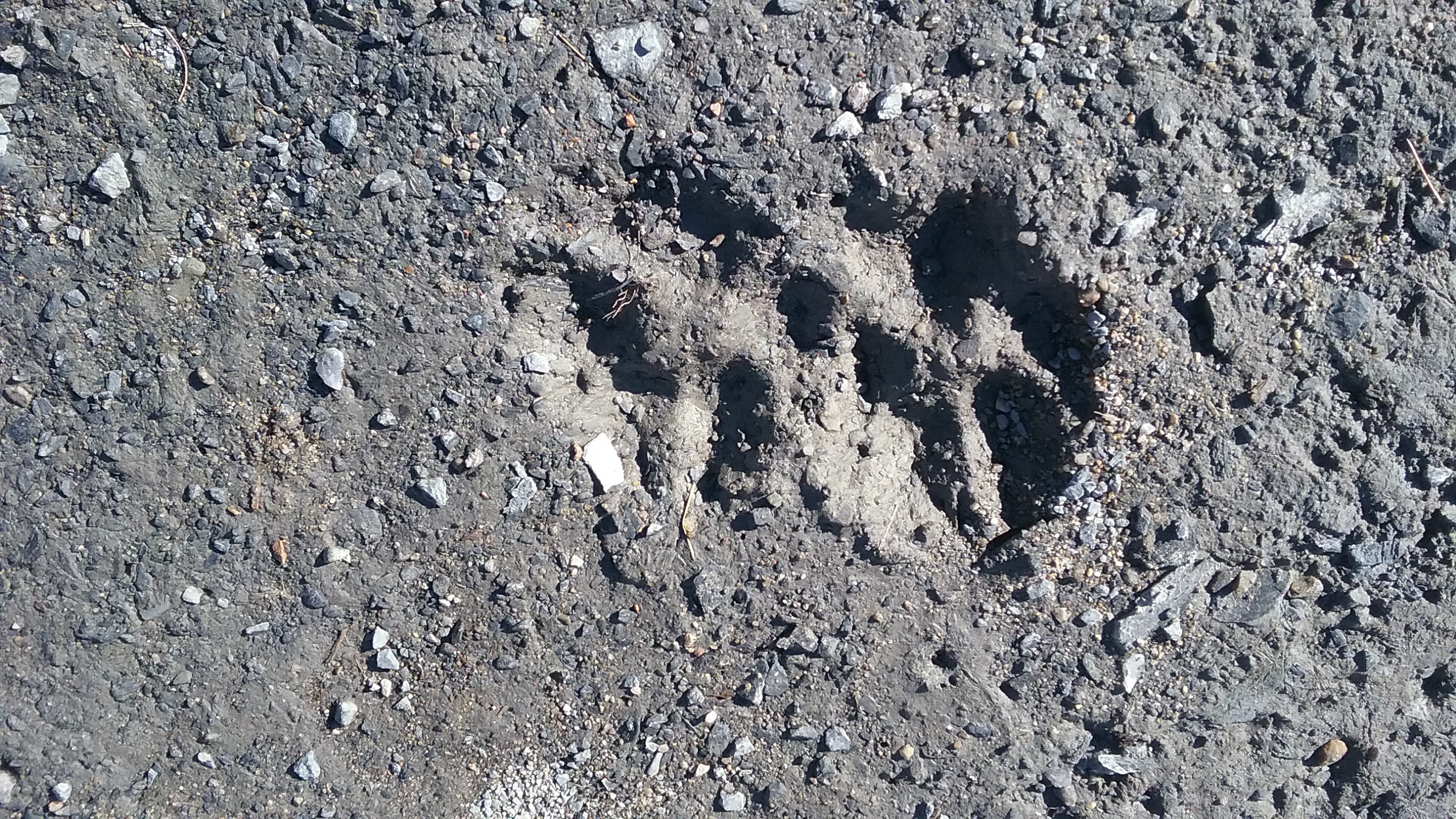
Dog prints, coming soon to a clean floor near me.
Pfeffernuss the dog is a 90-pound black Lab with feet almost as webbed as a duck’s. They sprea-a-ad out under her weight and then snap back into place like little backhoes, storing up hours-worth of pawprints for my floor tiles.
My knee-high muck boots go so deep you’d think “muck” is what they’re made of, not what they cope with. The sound they make on the upstroke is indelicate, nay, carnal.
This is what resurrection looks like in New Hampshire. The delicate blossoms and tender grasses come later, as an afterthought. When Mud Season arrives, you know you have come through the dark night of the New Hampshire soul and back out into the light.
Celebrating Toilets on International Women’s Day
In a show of solidarity with women in the United States and around the world who are observing International Women’s Day, I considered a boycott of my blog post for today.
However, as my writing is a hobby and nothing more–I don’t have to do it if I don’t want to– and not wanting to demean this cause, I am proceeding with my post. A radically different post than originally planned. (Hemingway’s Iceberg Theory can wait. Is there anyone who thinks Hemingway should be written about on International Women’s Day?)
Originally, I assumed– a gross mistake on my part–that this is a cause focused in the United States, where “A Day Without A Woman” is the rallying cry, urging women to strike by not working, whether paid or unpaid, or not shopping (except in small businesses or female-owned businesses). If you have to, or want to, work or shop, you can wear red to show your support.
A quick search on my phone left me in shock. And awe. And with the realization of how uninformed I am about women’s issues around the world even though I consider myself a feminist from way back. While we in the United States focus on the enormous contribution of women to the economy, women in other parts of the world are concentrating on more basic concerns.
Like toilets.
Today’s “New York Times” mobile article International Women’s Day: Calls to Action, Words of Praise and Rallies describes how Iceland, Russia, Egypt, Georgia, South Korea, Indonesia, Sri Lanka, Philippines, Manila, Kenya, Ireland, Poland, Italy, Hong Kong, Turkey, among other countries, observed the day.
And then there is India. Where a hole in the ground constitutes a family’s toilet. Where three hundred million women defecate in the open. Where these very women are susceptible to sexual assault.
That’s when I started crying.
My economic contribution to this cause will be to donate money to an organization that helps women in India dig toilets for their families.
And my husband and I are wearing red today.
The Ick Factor
The Thursday Night Writers had another set-to this week over my exploding canary. Only four of us were present this time, but the controversy has raged through the whole group since I submitted the first draft of chapter 36 – longer ago than I care to admit.
Here’s the passage:
For my part, I kept the Stark file spread out all over my desk, like one of those impossible variations on solitaire. I inspected every line of every document, straining for some way in which it might imply a deadly secret. I marked Jeremiah’s house purchase with a Post-it memo to trace the sellers. Somehow, the sale wasn’t legitimate? Or Jeremiah’s check bounced? Or maybe way earlier, somebody with the same name had just pretended to be a descendant of Enoch Stark when they bought the house? Pretty thin, Eliza. But it got another yellow sticky note. In the end, the solitaire game looked like an explosion in a canary.
Disregard the plot conundrum. It can’t be quickly explained, and the only problem, as far as the TNWs were concerned, was the canary.
One member is admittedly squeamish. She loves cozies because of their basic rule: no explicit sex or gratuitous violence. Simile or not, she does not want a piecemeal canary obtruded into her consciousness. In a later chapter, a mere reference to “my canary” in the context of the annotated documents was enough to set her off. (Granted, she had been recently lacerated by an episode involving a frog in William Kent Krueger’s Ordinary Grace. It wasn’t a good week to reprise the canary.)
The others, it seemed to me, were going deeper into the image than … I was going to say “a normal person,” but perhaps I should just say “the reader” is likely to. There was speculation as to the appearance of a real exploded canary. A consensus emerged that the resulting color would not be yellow. I believe someone brought up the probable radius of the debris. And there was me, just visualizing little Tweety-colored feathers floating down.
The title of this post comes from a critique I received from Mary Carroll Moore, with whom I’ve taken two live workshops and one online class. She used it when she advised me to abandon the opening sentence of my novel and, indeed, to remove all technical or at least all vivid medical details from the scene, which takes place in a doctor’s office. Here’s the paragraph:
I don’t deny that I was riddled with parasites. I always was when I got back from a field trip. But I saw no reason for Brad to take that tone with a woman twice his age. His father never had a problem with my parasites.
I submitted that paragraph, as part of my first two pages, to a panel at the New Hampshire Writers Day last year. The panel consisted of well-known NH writers – all genres, not just mysteries. Each submission was read aloud by the moderator. The panelists were instructed to raise their hands at the first word, phrase or other issue that “stopped” them.
When my first sentence was read, three out of four of them jumped, but no hand went up. Which means…? You tell me. Please.
(We got well down the second page before I got a hand. Several at once, in fact. But that’s another story.)
So maybe it’s just me. Maybe I’m made of grosser clay than the average cozy fan. Or maybe I just make my friends and seek advice from lovely people who are more-than-average refined. The one thing I’m sure of is that neither the canary idea nor the existence of parasites would boggle the mind of my protagonist. So maybe I’ll keep them both.
***
The Ick Factor may be on my mind at the moment because of the winning response to the challenge I posed in my last blog: to use in mystery plot the following two words:
Ylem: (in big bang theory) the primordial matter of the universe
Feague: To put a live eel up a horse’s bottom. An eighteenth-century horse dealer’s trick to make an old horse seem lively.
And the winner is….
Judy W.! She commented:
Your current words call to mind a Dick Francis-like mystery set in a racing stable. “The feaguing of the poor horse set loose an explosive diarrhea in the stall that splattered the walls like ylem after the Big Bang. Underneath the residue lay the missing gambler.” Ugh. Sorry, but you did issue a challenge.
Congratulations, Judy! After that, an exploding canary is nothing. It wouldn’t even cover up a dead gambler.
 Eleanor Ingbretson
 Karen Whalen
 llandrigan
 Heidi Wilson
 Mike M
 Thursday Night Writes