Monthly Archives: April 2015

Choosing Your Color

410px-Royal_Arms_of_England_(1198-1340).svg

England’s Royal Arms

I’ve been spending a lot of time lately with the second son of an English duke. You’ve guessed, of course: I’m devoted to Lord Peter Wimsey, Dorothy L. Sayers’ renowned aristocratic sleuth. There was something of a vogue for detection among the fictional peerage of the mid-twentieth century.  The fashion waned and probably received its death blow from the dreary antics of late-twentieth-century royalty.

Sayers (imho) made better use of aristocracy, or at least of wealth, than any of her contemporaries. In all too many a mystery, a mink stole or an ancient and expensive brandy drops into the scene for no better reason than to remind the reader that s/he is expected to be enjoying the idea of being rich. Sayers said that she surrounded Lord Peter with just those luxuries she would have loved herself: rare books, one’s own library, top-notch food and drink and presumably Wimsey’s high-powered Daimler, “Mrs. Merdle.” Her genuine delight in Wimsey’s primrose-and-black library, grand piano and excellent wine cellar call forth an equal delight in the reader.

With Sayers, this kind of detail is never just color, in the dreadful sense of the word as used by sportscasters. Our longest visit to Wimsey’s library contrasts its beauty and peace with his agony as he struggles to work out a case against a murderer who has framed the woman Wimsey loves. Dining on snails at an elegant restaurant, Wimsey notices that his guest views that dish askance, and calls for oysters instead. Attentive friend blends with money-no-object host.

CRW_1714

The New York Stock Exchange (Amazing Travel Photos)

The issue of color is on my mind because my fellow Thursday Night Writer Linda Landrigan persuaded me to try the mysteries of Emma Lathen, a queen of Golden Age detective fiction. Lathen was the nom de plume of two women, Mary Jane Latsis, an economist, and Martha Henissart, a lawyer. Their detective is John Putnam Thatcher, senior vice president of the Sloan Guaranty Trust Company. From his Wall Street office, he solves murders that occur in the world of business, especially high finance.

And for me it doesn’t work. I spent twenty years as an economist for investment firms. What is color to most of Lathen’s readers is just another Monday morning to me. My colleagues were not such buffoons as those Thatcher encounters (though I could have given Lathen a useful vignette or three.) But office life as described by an economist and a lawyer reaches me in pure monochrome. For Lathen’s many fans, it apparently works like a charm.

In the end, the characters and plot of Accounting for Murder pulled me in, but I doubt that I’ll read the whole series. And we all know that if you want to sell a mystery these days, and you aren’t an established author, you’d better be able to offer a series that will pull your first readers along with you.

So what about the color in my own mystery? In the literal sense, it starts out red, yellow and orange, the colors of fall in the New Hampshire mountains. It goes white and gray with winter, then a damp tan with mud season, and finally, joyously, green with spring. Figuratively, it’s the atmosphere of an Ivy League college, of a retirement home for some of its eccentric faculty, and of the rural village in transition that surrounds it.

Enough color? Not enough? Been done already? How about if the protagonist is an anthropologist specializing in African witchcraft? Too much yet? No? How about if I add a couple of ferrets? Okay, enough, right? But then I put the octopus in.

Maybe I need to rethink this….

04-21_OctopusNetsuke

Writing From Experience

Like first time parents, new writers worry about things they never realized existed before.  For me, this became a reality when we started our writing group and the others chimed in about how I should write stories based on my twenty-eight years as a State Trooper, ten of which were as a homicide detective.  For the five years since retirement, my persistent objection to my Thursday Night cohorts has been that it would be improper or unseemly for me to write about some of my experiences.  It is a high honor and huge responsibility to be entrusted to investigate a murder and I felt somehow that to write about what I had witnessed would take unfair advantage of my position.  I have discussed this with my old detective partner and he pointed out that if people did not write about these things, then how would anyone find out about them?  Maybe I’ll soften and reevaluate my stand as I progress as a writer.  No guarantees, but I’ll work on it.

Joseph Wambaugh wrote “…what a sorrowful thing it is to be murdered” in his novel The Glitter Dome.  I read that long before I became a cop, but it stayed in my subconscious and reemerged when I saw my first dead body.  It is sorrowful.  It’s not dramatic and certainly not glamorous.  It’s not at all like Hollywood’s CSI with mood music and fuzzy, psychic flash-back visions of the crime.  It is coldly sobering to stand or kneel over the most personal physical legacy of a human, their body, a human being who only hours earlier would never in their wildest dreams imagine that before the day was over, they would be cold, gray objects of observation to be described in notebooks, photographed and measured for diagrams.  I doubt that many people stop to consider when they lace up their shoes or button their shirts in the morning that they won’t be the ones to undo them at the end of the day.

Sometimes bodies lay in some degree of repose like on TV, but often they are in the grotesque sprawl of their last attempt to retain life or in the ineffective comfort of a fetal position.  Injury levels range from a few bruises or a little hole that is hard to find to extensive, mangled trauma with copious spilled blood.  There is a stillness to death greater than sleep or unconsciousness.  Oh, there actually is real, every-day music sometimes; if a body is discovered with a radio playing in the room, that’s documented as part of the scene and left on until everything is processed and turned off with the lights only when the search warrant return is left on the premises and the doors closed and locked.  You can only guess at the weird and lousy associations I have with some popular songs from years past.  The whole thing was and is sorrowful.

Any writing inspired by actual cases will have to be done with a high regard for ethics and respect for those involved.  No person’s death should be grist for the mill of popular culture where everything is presented merely for entertainment and titillation.  Before writing about such things, I’m going to grapple with the concept of “socially redeeming value”.  I’m no Pollyanna, in fact I’m quite cynical, but I do believe in karma.

I need my writing group

I miss my writing group.I miss the motivation, the camaraderie, it provides. But more importantly for my writing I need my writing group.  I feel accountable to the group to contribute. Away from my Thursday Night Writers for four months now (and another month before I arrive home), my writing has dwindled to a trickle.

I did some quickie research on what writing groups “should” do. It appears we are in noncompliance in a few areas. Yet how to explain our over five years of success as a writing group that meets weekly?

1) Have a mission statement or a written goal. We don’t. Jeez, what’s up with that?

2) Get in on the ground floor. In our group, some have come and gone but four of us have been here since day one.

3) Help each other get published. A few in our group have. We mainly just help each other keep writing. Or provide constructive feedback so that the author won’t be embarrassed when he or she submits something to a contest, literary journal, or agent, or self-publishes.

4) Pick a group that focuses solely on your genre. Living in a rural area we can’t do that (and not everyone writes in just one genre) so occasionally we have issues with other members understanding how something is written. For example, some write cozies and yet others don’t read cozies.

What do I think we do exceptionally well that not all groups do?

  • Our works are submitted in advance, allowing members time to read and absorb the material. Sometimes “in advance” may be a mere hour or two!
  • Meetings are well controlled by John, our group leader/facilitator. He is the sun around which we revolve!
  • We are happy to see each other, we have fun, and we write. We have birthday parties, Christmas parties, celebrations for getting published or winning awards, and anniversary parties for the founding of the group. Some of us meet for lunch on Fridays. Yet we work hard.
  • We willingly share our knowledge with our fellow writers. Having a former police detective in our group comes in mighty handy, especially when we’re writing about guns and crimes.

Six days before my husband and I are due to leave Arizona, I discovered a web page listing twenty-eight writers’ groups and “meetups” in the East Valley. They range from “The Erotic Voice” (13 Eroticians) to “East Valley Writers—Spec Fic (paranormal, sci fi, fantasy)” (12 Evil Dwarves) to “Chandler Romance Writing Meetup” (27 authors).  Some of the meetups have one thousand members.

I am quite certain that I deliberately did not do this research upon our arrival in January. I don’t want a new writing group—I need mine from NH! The one I’m comfortable with. The one whose members I can relate to, understand their comments, and get slightly defensive with.

Though I do try to save my ranting and raving for the drive home.

Maine Crime Wave 2


I finally got up the courage to expose myself. Right: I entered “Two Minutes in the Slammer,” a flash fiction contest that inaugurated the 2nd annual Maine Crime Wave last weekend. The conference MCW posteris held at the University of Southern Maine and sponsored by Maine Writers and Publishers Alliance. It lasted only a day, but not a minute was wasted.

The fun began Friday night. The flash fiction slam was hosted at the Portland Public Library by my favorite mystery blog, mainecrimewriters.com. The winning entries were “slams” indeed, uproariously funny and full of action, all in two minutes. The next time I slam, I’m going for uproar.

I didn’t win that prize, but I got another one: Chris Holm, author of the Collector series of mysteries and most recently of The Killing Kind, told me he liked my story, suggested that I submit it to Thuglit, and then poured forth suggestions for other e-venues that could be appropriate for me! The story went in to Thuglit as soon as I got home, and the next one is being spiffed up for submission.

That’s the best aspect of mystery conferences: there are so many friendly and helpful people. Much-published and admired authors are generous with advice and encouragement. Sort of makes you wonder why literary authors have such a reputation for behaving like twits.

The conference attendees are an equal attraction. At our post-slam dinner, I met Peter Murray, a retired police detective, now a chef. He’s doing research for a book based on the first unsolved murder in Westbrook, Maine, the bludgeoning of Abigail Stack on January 5, 1888. Over dinner, Pete told me about his work on the second unsolved murder – in 1987. Those Westbrook cops are good.  Check out Pete’s blog, especially the post about the pigeons and the lady who tried to poison them with a mixture of whiskey and Alka-Seltzer.

Roaming through the crowd, I met a marine ecologist and the former president of the Farnsworth Museum in Rockland, Maine, both writing their first mysteries. I’m an ex-economist and ex-teacher of Latin and Greek. Is the criminal mind really so widespread throughout the professions? (Anne Jenkins, the museum president, also gave me an update on the meteoric rise of Rockland as a tourist destination. I’ll be checking that out with a mini-vacation soon.)

Barbara Ross, author of the Maine Clambake Mystery Series, gave a blockbuster workshop on how to revise your manuscript. Her handout is now one of my prized possessions. She advocates multiple read-throughs with revisions for one single issue each time. You take the issues in the order that will produce the least wasted effort on things that may disappear in revision anyway. I would have thought of that myself, in time. Sure.

Chris Holm and me

Chris Holm and me

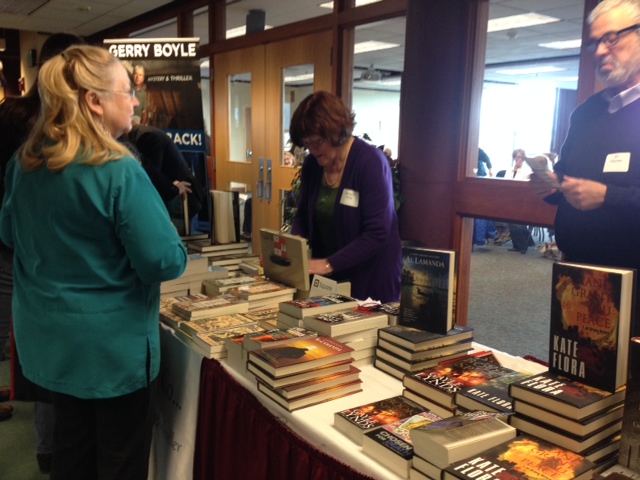
There was a certain amount of genre-blending at the conference. Sarah Graves, who writes the Home Repair is Homicide mysteries, mentioned that #11 in the series, The Book of Old Houses, was inspired in part by H.P. Lovecraft. And then there’s Chris Holm’s Collector mysteries, whose first volume I had just finished. See, there’s this dead guy, who’s been damned for murder and now has to collect the souls of other evildoers when their time comes. But being dead doesn’t mean being dumb. When he gets an assignment that just doesn’t smell right…. I picked up another Collector volume at the Kelly’s Books to Go table in the lobby, where speakers and audience alike were busting their book budgets.

Kelly's Books to Go

Kelly’s Books to Go


Barbara Kelly, the aforementioned bookseller, was on the final panel, the one on the business of getting your book sold to readers once you get it published. It was heartening to hear what enthusiastic fans booksellers can be, if you just take the trouble to make friends at your local bookstores. Barbara will sometimes take books she loves to a conference on a totally unrelated topic, and push them hard to attendees. The panel as a whole agreed on a new (to me) and upbeat concept: the “good rejection.” If your story comes back with comments, you’re onto something. The piece is just “not there yet.” So it’s worthwhile wandering in your personal wilderness yet awhile.


A venerable denizen of the USM campus


Quandaries in Teapots

As you know, we are five writers in search of a reason not to work on the book right now. Reasons, good reasons, are hard to come by which is why you find me actually working on my novel in progress. It’s a cozy mystery, or maybe it’s a cozy thriller. I won’t know until it’s finished. Lately a lot of genres have been morphing into other genres, and that usually makes for just as good a read, but hard to classify. One of my favorite authors, Jasper Fforde, calls these morphings, cross-genre. If you haven’t read Jasper Fforde yet, he’s amazing. He does a great comedy/fantasy/mystery series that follows the adventures of Thursday Next. I won’t tell you anything more, but please send in a comment if you have read or plan to read anything by J. Ff.

Yes, I ran out of reasons NOT to work on my cozy/thriller/mystery set in New Hampshire in the not-so fictional town of Poke. If my heroine, Gracie Smithwick, has her way the spelling of the town’s name will revert back to Poughke at the next town meeting day. She’s up against great odds not only in re-establishing the correct spelling, but in thwarting THE BAD GUY as he attempts to do BAD things. I’m on my third revision and there’s really no good reason not to continue. I plan to drop some dandy carrots in my postings to entice you to entice me to finish.

If you’re reading this blog you are either fellow writers, or fellow readers. If you are cozy writers or readers, maybe you can help me with a small problem. Problems become reasons not to work on the book right now, and I want no more of that. At least not right now.

If, when you are reading cozies, do you find that the heroine falls for the local law enforcement persona way to often? Like in ad nauseum? Like in cliched tropism?  I’m taking a poll and looking for interesting occupations for my heroine’s potential fellow. If I fall head over heels in love with a suggestion not only will I use it, but I’ll give you credit for the idea. How’s that for a bargain. You scratch my back and I’ll wash your hand. Well, that analogy sounds bizarre, but you know what I mean, a nice symbiotic relationship to ward off any reason for me not to work on my book right now.

A Nasty Piece of Work

Today, gentle readers, we are going to talk about those nasty pieces of work who are not what you would call exemplary figures. Nasty but necessary, because if they didn’t abound, dance around, roam the story seeking whom they may devour, from off whom would you bounce your protagonist? You need that nasty as a foil to show the excellent qualities of your hero(ine).

Protagonists today are not cut from the same cloth as the Nancy Drew and Hardy Boy types of yesteryear. They aren’t perfect goody two-shoes. And though they are are still cut from better quality cloth than our antagonists, they can and will lie. Every last character, the good, the bad and the ugly, from the matriarch or patriarch down to the toddler who shakes his head when asked if his diaper is dirty, lies. And it’s not limited to characters on the written page. Fiction is taken from fact and lying is universal. Did you know that on any given day one lies, or is lied to, from ten to over one hundred times?

But we can use that. We can make our good guys lie only about little things, this makes them more believable, and even likeable. We can make our bad guys lie about big things, or, if they are pathological liars, about everything. This makes them more believable, more despicable, more heinous. Whatever you need them to be.

Sometimes the lie is prefaced with one of these old gems: ‘believe me’, ‘honestly’, or, ‘to tell the truth I. . .’, etc.

Sometimes the lie comes with too much baggage in the belief that more exaggeration will belie the lie. Methinks he doth protest too much, someone once said.

Sometimes the lie is delivered with a smile or a warm hearted chuckle. Watch for description of the eyes. Does the sincerity of the spoken word extend to the window of the mind?

Oftentimes the liar, in preparation to putting the big one over on his/her interrogator, will repeat the question, hoping to buy time, ridicule the questioner, or express unbelief.

It’s up to the reader to be as discerning as possible. Look for clues and examine the characters. Go into your next book with open eyes. You can’t expect the author to come right out and say so-and-so is such-and-such. What fun would that be?

All these tricks of the writer’s trade are used to inform the reader who can be trusted and who can’t. Be wary the moment a character darkens the page of the mystery you’ve picked up. This becomes even more enjoyable when the author has penned an unreliable narrator.

Good recent reads about lying: Liane Moriarty’s “Big Little Lies”, and Tana French’s “The Secret Place.”

It’s About Time . . .

Except when it’s about something else.

I’m late with my blog post. I had thought that at the last minute Devine Inspiration would give me a good shove in the back and I would start moving forward on saying something. Apparently, D.I. has moved on herself—perhaps she’s read her share of self-help books on deadbeat relationships.

I’m particularly embarrassed about being late with my post because my day job is all about deadlines: getting edited copy to the typesetter, moving proofs through various editing stages so that we get the magazine to the printer on time, and eventually it gets mailed out to subscribers—on time.

Creative writers, too, have obligations and deadlines. The writer scribbling in blissful isolation—picture a cabin on the lake—is not the reality for most of us. If I were dumped in such a place, I might spend more time climbing the walls then actually writing. Writing is a social event; the activities of our lives, the complexities of our relationships swirl and meld in a febrile, creative mind. And as writers, we don’t just draw from our relationships and interactions with others, we are also responsible to our audiences. We need to contribute pieces to our writers groups and blogging partners, and some even have contractual deadlines to deliver a manuscript to an editor at a publishing house. It’s these social aspects of being a writer that provide that much need shove in the back.

Thanks, Heidi, Eleanor, Karen, Mike, Michael, and John. (D.I., I’m doing just fine, not that you asked . . . Do you even still think of me?)

The Non-Existent Page, the Blank Page and the #$%^&*@! Page

Countless good stories are lost forever because of the non-existent page; they never get written.  If not reduced to words right away, budding tales often blow away like swirled flights of dried leaves in a November wind, never to form the same pattern again.  Without immediate attention, fleeting visions and vague concepts can recede beyond the reach of memory.  Once released from consciousness, they float back up to the heavens like a reverse rainfall and dissipate into the ether, where they may or may not coalesce and fall back into someone else’s imagination.  My “gravatar” is a blank notebook page because a recurring theme in my writing life is to lose great ideas if I don’t write them down while they are fresh in my mind.  That little notebook could have saved those stories and given them a firm toehold from which to advance.

Whether ideas are fresh or captured in a notebook, a writer celebrates a story by facing the blank page with the intention of turning it into the written page.  If a writer is the little engine that could, the result is a successful flow of words as stories grow into a rich creation.  There are no guarantees, though.  Even with notes, ideas that seemed so clever when jotted down can morph into nonsense during a second reading.  What originally appeared to be inspiration turns out to be a chimera which evaporates from the heat applied to transform it into an understandable whole.  Still, the writer sits down to face the blank page.

Sometimes words stall and headaches develop.  A blank page that is not blooming becomes an enervation to the writer who confronts the #$%^&*@! page.  Whether or not the writer merely feels stuck or is actually thinking blasphemy and crudeness, the reality is that the creative process has stopped.  Thursday Night Write’s llandrigan characterized this phenomenon as “…fear or inertia or mental disorganization…” and Karen Whalen commented that the writer “…would rather have a root canal than write…”  That’s where I am now, so I’m going to put this away for awhile.  When I get back, hopefully I’ll bring the muses with me.

Write About What You Are Afraid Of

Advice for writers: write about what you are afraid of. I’ve never been very good at that. In fact, when things have happened to me that nightmares are made of (hitting a pedestrian with my company car, getting adrenal cancer, to name a few) I can’t write. I won’t write. I avoid recording my thoughts and emotions, even just the facts. Maybe that’s why I took two memoir writing classes, to find a way to break through that wall. Yet I still have no desire to write about what I fear. Possibly that will develop as I grow as a writer.

This week I read Laura Moriarty’s book, “The Rest of Her Life,” about a teenage girl who hits and kills a pedestrian in a crosswalk. I was interested in how another author would approach this topic, especially from the driver’s perspective. Moriarty focused more on the relationships among the family members and how they all dealt differently with the accident. I didn’t get what I wanted from the novel. But that’s what happens when you read a book, especially fiction. You get what the author wants to give you.

Cancer. If I wanted to write about my experience with adrenal cancer I’d be competing with a multitude of other cancer books. I doubt if I have anything new to contribute. Even if I did, I still have no desire to write about it.

I want to write about people who don’t exist. Whose lives I have made up and control. Whose lives do not resemble mine. In other words, books and stories I would want to read, characters I could engage with, who entertain me but don’t mimic me. I can’t engage with myself. Do other writers?

Woman in Gold

Woman in Gold

Yet there is one story that I play a minor role in that both piques my interest and frightens me, the story of my German heritage through my mother. We have both Nazis and Jews for relatives; anyone who knew about the Jews is long gone. My mother, though Christian, lost two brothers during World War II. They got on a train and my mother’s family never saw them again. Watching the movie “Woman in Gold” this morning not only brought me to tears, it also resurrected my need to know more about the German history of my family. I must hurry—my mother is 87. This is a story I want to write although it has been written before. But this one would be for me.